Cell specialization links selective gene expression, stem cell potency, cell size, exchange surfaces, and specialized tissues to biological function in multicellular organisms.
Syllabus
First assessment 2025
Topic
B2.3
Level
HL
Differentiation changes gene activity, not the genome
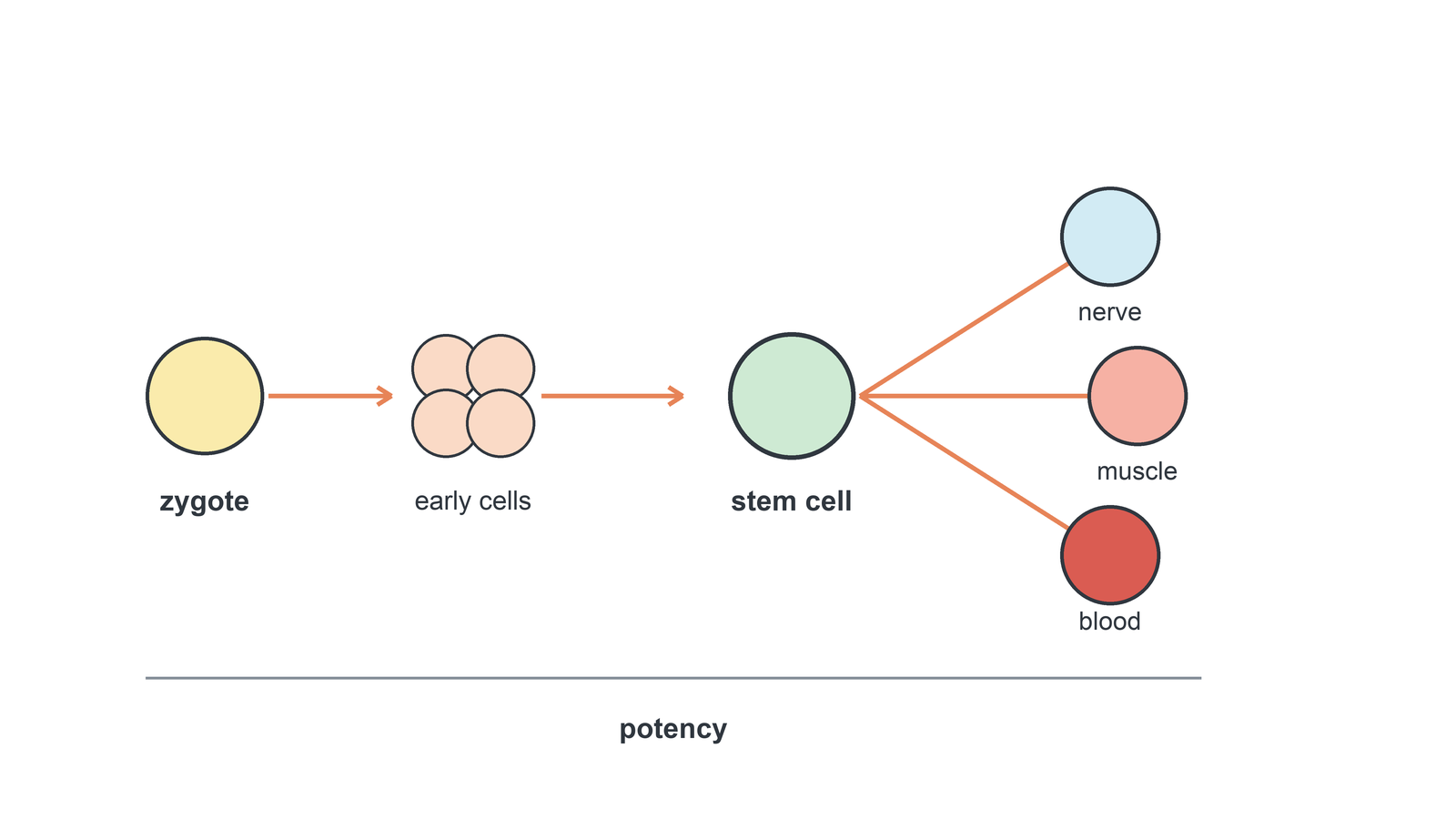
A zygote divides by mitosis to produce unspecialized cells with nearly the same genome. Differentiation occurs when different cells express different subsets of those genes.
1
A developmental signal activates or represses regulatory genes.
2
The pattern of transcription changes, so different messenger RNAs are produced.
3
Translation produces a cell-specific set of proteins.
4
Those proteins change cell structure, metabolism and behaviour.
A neuron and a muscle cell differ mainly because they use the shared genome differently—not because each cell type was given a different set of genes.
A morphogen gradient turns position into cell fate
A morphogen is an extracellular signalling molecule distributed as a concentration gradient across developing tissue. Cells at different positions are exposed to different concentrations.
Local exposure
Gene-regulatory response
Developmental consequence
above a high threshold
one set of genes switches on or off
one cell fate is stabilized
between thresholds
a different regulatory cascade begins
an intermediate fate develops
below a lower threshold
neither higher-threshold response occurs
another fate develops
The morphogen does not build a body part directly. Its concentration supplies positional information; altered gene expression then changes proteins, growth and differentiation.
Stem cells preserve themselves and preserve options
Defining property
What it means
Why it matters
self-renewal
repeated division produces cells that remain undifferentiated
the stem-cell pool is maintained
potency
a cell can differentiate into one or more mature cell types
new specialized cells can be supplied
A stem-cell population must balance these outcomes. If every daughter differentiated, the reserve would be depleted; if none differentiated, the tissue would not gain the mature cells it needs.
Embryonic stem cells generally retain broader potency. Most adult stem cells have a narrower range but remain essential for tissue maintenance and repair.
Potency narrows as developmental commitment increases
Potency
Typical developmental source
Possible descendants
totipotent
zygote and first few divisions
all body cells and extraembryonic tissues such as placenta
pluripotent
inner cell mass of the blastocyst
all body cell types, but not placenta or a totipotent cell
multipotent
adult tissue stem-cell niches
a restricted family of cells in one tissue or organ
Development usually moves from broad potential toward commitment: totipotent → pluripotent → multipotent → specialized. A narrower potency does not mean the cell is less useful; it means fewer fates remain available.
A niche decides whether an adult stem cell waits, renews or commits
A stem-cell niche is a local microenvironment whose neighbouring cells, extracellular matrix and signalling molecules maintain stem cells or change their behaviour.
Adult niche
Stem cells and local control
Tissue outcome
bone marrow
osteoblastic and vascular signals regulate haematopoietic stem-cell dormancy, renewal and mobilization
red blood cells, white blood cells and platelets are continually replaced
hair-follicle bulge
signals activate multipotent cells during a growth phase and allow dormancy during rest
the follicle and hair regenerate cyclically
The niche is not simply a storage site. It is a decision environment that can keep a cell undifferentiated, expand the stem-cell pool or trigger commitment to a mature lineage.
Useful cell size depends on the job
Specialized cell
Useful dimension
Function served
erythrocyte
small and flexible
passes through narrow capillaries
secondary oocyte
large cytoplasmic volume
stores organelles, nutrients and regulatory molecules for early development
neuron
very long axon
carries an impulse over a long distance without a chain of intervening cells
skeletal muscle fibre
long multinucleate cell
coordinates force along an extended contractile unit
Do not call a cell ‘adapted’ merely because it is large or small. Name the dimension that changes, then show how that dimension improves a specific task.
Volume outgrows the surface that must supply it
Surface area sets the capacity for exchange across the plasma membrane. Volume represents metabolically active cytoplasm that consumes nutrients and oxygen and produces wastes and heat.
SAVSA=6l2=l6V=l3
Cube side, l
Surface area
Volume
SA:V
1
6
1
6:1
2
24
8
3:1
4
96
64
1.5:1
As a similarly shaped cell grows, total surface area still increases—but volume increases faster, so SA:V falls and internal diffusion paths lengthen. Exchange can no longer keep pace with demand, limiting cell size unless shape, division or internal transport changes.
SL summary: connect fate, form and exchange
Differentiation: signal or morphogen position → selective gene expression → cell-specific proteins → specialized structure and function
Stem-cell control: self-renewal preserves the reserve; potency describes possible fates; a niche regulates waiting, renewal or commitment
Cell dimensions are useful only in relation to a job such as storage, long-distance signalling or coordinated contraction.
Exchange capacity scales with surface area, while metabolic demand scales with volume.
For similar shapes, growth lowers SA:V because volume increases faster than surface area.
A complete explanation names the signal or structural feature, states what it changes inside or around the cell, and links that change to the biological result.
An erythrocyte is shaped for rapid oxygen exchange in narrow vessels
HL only
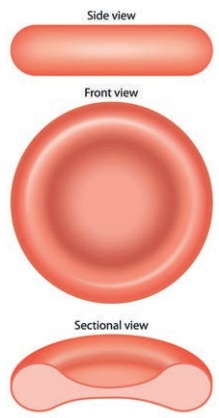
flattened, biconcave disc: large membrane area relative to volume and a short path from surface to haemoglobin
no nucleus at maturity: more internal space for haemoglobin and freedom to adopt the biconcave form
flexible membrane and small diameter: deformation through capillaries narrower than the resting cell
Together these features speed oxygen loading and unloading while allowing the cell to bring haemoglobin close to tissues throughout the capillary network.
A PCT cell builds two exchange surfaces for reabsorption
HL only
A proximal convoluted tubule epithelial cell reabsorbs useful solutes from nephron filtrate and transfers them toward nearby blood. Its apical and basal faces therefore have different structural jobs.
Cell region
Adaptation
Functional effect
apical surface facing filtrate
dense microvilli form a brush border
more membrane for transport proteins that take up glucose, amino acids and ions
basolateral surface facing tissue fluid and capillaries
deep membrane invaginations
more membrane for pumps and carriers moving solutes out of the cell
cytoplasm between the two surfaces
many mitochondria
ATP supply for active transport that maintains directional reabsorption
The folds increase area only because the added membrane carries transport machinery. Filtrate → apical uptake → cytoplasmic transfer → basolateral export → blood.
Two pneumocyte types keep an alveolus thin, dry and open
HL only
Cell type
Structure
Main contribution
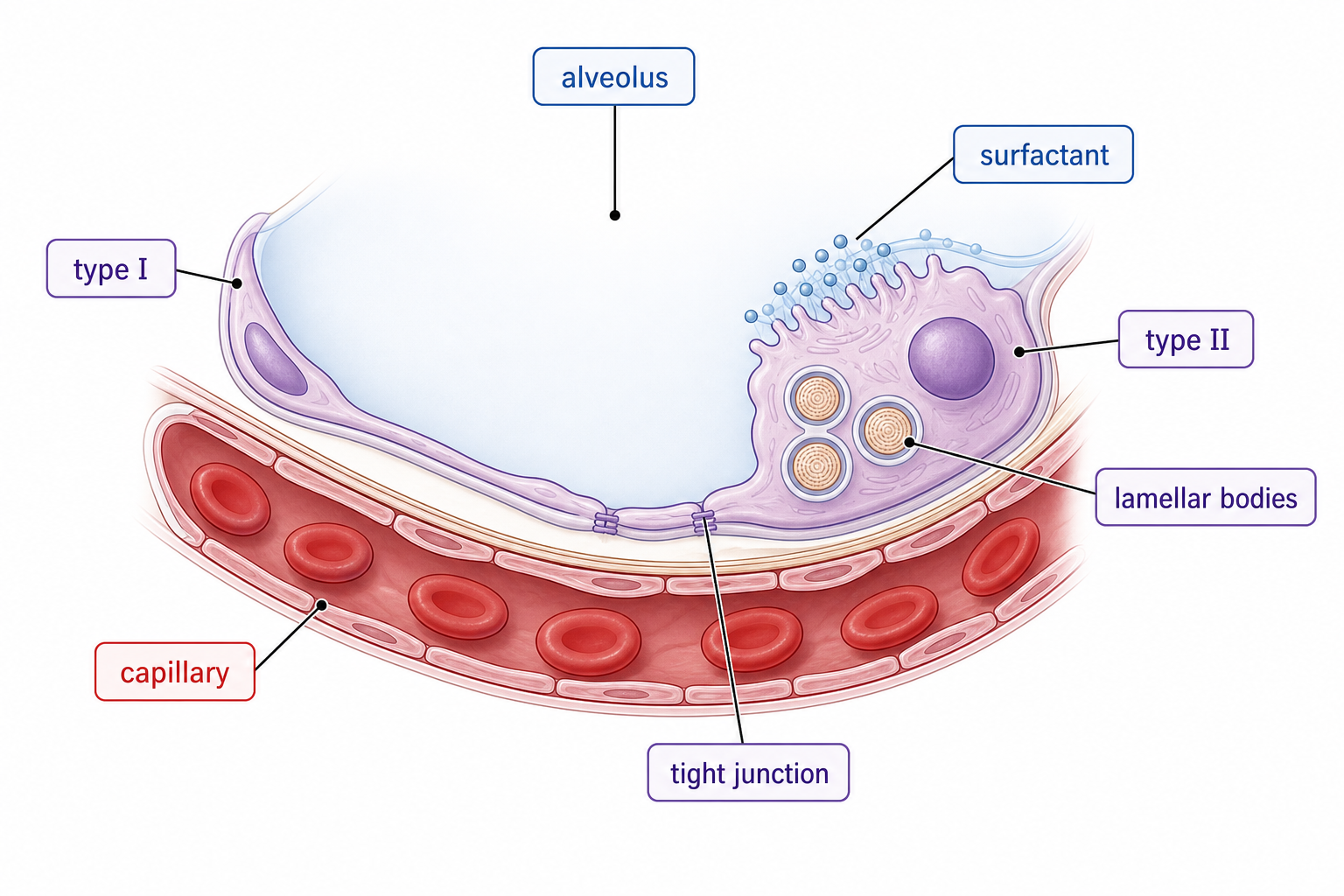
type I pneumocyte
flattened and extremely thin; covers most exchange surface
minimizes the air-to-blood diffusion distance
type II pneumocyte
cuboidal; lamellar bodies and secretory machinery
releases surfactant, lowering surface tension so alveoli resist collapse
Tight junctions between epithelial cells limit tissue-fluid leakage into the alveolar air space. A dense capillary supply keeps blood close to the thin type I surface.
One cell type cannot be maximally thin and strongly secretory at the same time. Division of labour lets the alveolus preserve a short diffusion path, a dry surface and low surface tension.
Cardiac cells couple into a synchronized contractile network
HL only
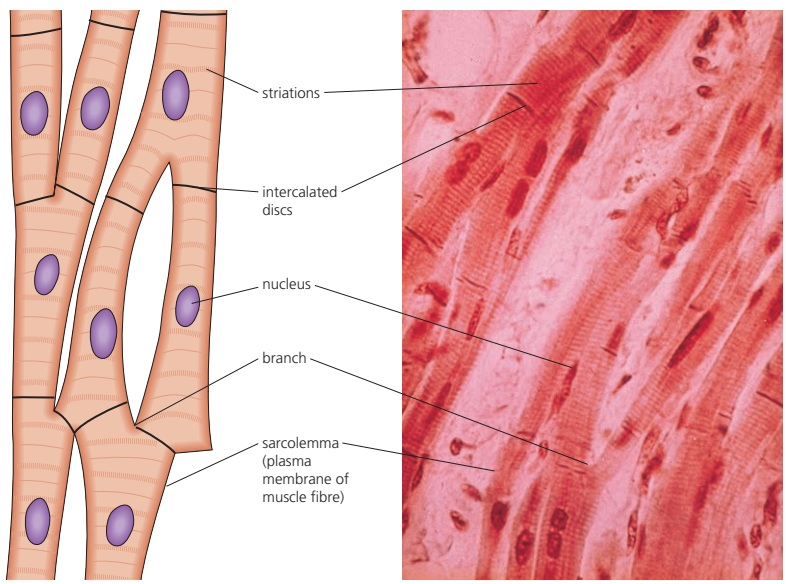
repeating sarcomeres in myofibrils produce the striated appearance and contractile force
branching connects each cell with several neighbours in a three-dimensional network
cardiac muscle is myogenic, so contraction impulses originate within heart tissue
numerous mitochondria support continual ATP demand
At an intercalated disc, strong junctions hold adjacent cells together during forceful contraction, while gap junctions provide low-resistance routes for depolarization to pass from cell to cell.
Electrical coupling spreads excitation rapidly and mechanical coupling prevents separation, so many cardiac cells contract as a coordinated wall.
A skeletal muscle fibre is one long multinucleate force unit
HL only
A skeletal muscle fibre forms by fusion of precursor cells, producing a very long multinucleate syncytium enclosed by one sarcolemma. It is a cell despite its unusual size and many nuclei.
Internal feature
Contribution to contraction
parallel myofibrils packed with repeating sarcomeres
force sums along the length of the fibre and creates striations
many nuclei
support gene expression across a large cytoplasmic volume
mitochondria between myofibrils
provide ATP close to contractile machinery
T-tubules and sarcoplasmic reticulum around myofibrils
carry excitation inward and release Ca²⁺ throughout the fibre
Both cardiac and skeletal muscle are striated and ATP-demanding. Cardiac tissue coordinates many short branched cells through intercalated discs; skeletal muscle coordinates one long fibre internally and is activated at neuromuscular junctions.
A sperm is a compact delivery system for one haploid nucleus
HL only
A sperm cell is specialized to reach a secondary oocyte, cross its outer layers and deliver a haploid paternal nucleus.
streamlined head: reduces resistance during movement and contains the haploid nucleus
acrosome: releases hydrolytic enzymes that digest a route through the zona pellucida
mitochondria-rich middle piece: supplies ATP for flagellar beating
flagellum with a 9 + 2 microtubule arrangement: generates propulsion
Each region serves the same sequence: movement toward the oocyte → penetration of the zona pellucida → fusion → nuclear delivery. Naming a part without this causal link does not explain its adaptation.
A secondary oocyte protects fertilization and provisions the zygote
HL only
A secondary oocyte is much larger than a sperm because it contributes nutrient-rich cytoplasm, organelles and regulatory molecules needed immediately after fertilization. It contains a haploid nucleus and completes meiosis only when fertilization occurs.
follicle cells: nourish and protect the developing oocyte
zona pellucida: glycoprotein layer for sperm binding; after fertilization it is altered to help prevent polyspermy
plasma-membrane microvilli: increase contact and nutrient uptake from surrounding follicle cells
cortical granules: release contents after sperm fusion, changing the zona pellucida so additional sperm are blocked
The gametes are complementary: the sperm is small and motile for delivery; the oocyte is large and resource-rich for controlled fertilization and early development.
HL summary: defend an adaptation with a mechanism
HL only
Cell
Structural change
Physical or cellular consequence
Biological result
erythrocyte
biconcave, flexible, no nucleus
large area, short O₂ path, capillary deformation
rapid oxygen transport
PCT cell
microvilli, basal folds, many mitochondria
more transporter membrane and ATP
directional reabsorption
alveolar epithelium
thin type I + secretory type II cells
short gas path + lower surface tension
efficient exchange without collapse
cardiac muscle
branches + intercalated discs
electrical and mechanical coupling
synchronized contraction
skeletal fibre
long syncytium with parallel myofibrils
force aligned through one fibre
directed voluntary movement
gametes
motile sperm + resource-rich oocyte
delivery paired with protection and provisioning
fertilization and early development
Use the complete chain: structure → changed area, distance, energy supply, coupling or control → cellular process → organism-level result. The word ‘helps’ is not a mechanism.
Specialization creates trade-offs. A type I pneumocyte is thin rather than strongly secretory; a mature erythrocyte gains haemoglobin space but loses its nucleus; a sperm is mobile but contributes little cytoplasm. Tissues and organisms combine different specialists to complete the whole task.
Differentiation after fertilization
[ 1 ]
The micrograph of a section through a plant stem shows at least ten different types of cells.
What explains the differences between these cells?
Properties of stem cells
[ 5 ]
Describe the characteristics of stem cells that make them potentially useful in medicine.
Types of stem cells
[ 1 ]
Which is a description of stem cells?
Cell size as specialization
[ 1 ]
Which specialized cell has the largest volume?
Surface area-to-volume ratios
[ 7 ]
Explain the importance of surface area to volume ratio as a factor limiting cell size.
Adaptations to increase SA:V
HL only
[ 1 ]
Where are microvilli located in the nephron?
Pneumocytes in alveoli
HL only
[ 2 ]
Outline the function of pneumocytes in the lungs.
Cardiac and striated muscle
HL only
[ 3 ]
Explain how the structure of cardiac muscle cells is adapted to their function.
Gamete adaptations
HL only
[ 1 ]
In which part of a mature spermatozoan are mitochondria most numerous?