Q BankQuestion BankDocsDocuments

B1.1.11—Triglycerides functions

Triglycerides store concentrated long-term energy because they are insoluble, stable, compact, and rich in energy-yielding carbon-hydrogen bonds within adipose tissue.

Syllabus
First assessment 2025
Objective
B1.1.11
Level
HL

Exam analysis

Chance of appearing3%of analysed past papers
Latest appearanceMay 2024
Most common paperPaper1
Typical marks1

Common command terms

  • Explain
  • Outline
  • State

Scoring notes

Common mistake
Saying lipids are more efficient because they are easier to transport than carbohydrates.

Recent exam appearances

May 2024Paper2 ["HL"] · TZ23(a)[ 1 ]B1.1.11—Triglycerides functions
May 2023Paper1 ["HL"] · TZ17[ 1 ]B1.1.11—Triglycerides functions
May 2014Paper1 ["HL"] · TZ17[ 1 ]B1.1.11—Triglycerides functions
Practice this objective

Coverage 2014–2024 · Updated 15 Jul 2026

Triglycerides Store Energy Efficiently

Triglycerides are effective long-term energy stores because their reduced hydrocarbon bonds release much energy and they can be stored with little associated water.

Their non-polar nature means they do not attract a large hydration shell, so storage is compact. When hydrolysed, fatty acids can be oxidised to transfer chemical energy to ATP-producing pathways.

The storage advantage comes from:

  • energy-rich reduced carbon
  • hydrophobic, compact storage
  • separation from the aqueous cytoplasm

A fat droplet can store substantial chemical energy in a small volume without dissolving throughout the cytoplasm, unlike a large pool of free glucose.

Triglycerides are storage molecules, not membrane bilayers. Their three tails and lack of a strongly polar head explain why they form droplets rather than a surface sheet.

Triglycerides functions

Assessment in practice

1–2 marks
How it is assessed

This objective is assessed through structured response, commonly using Explain / Outline / State.

Command terms

Explain / Outline / State

What earns marks

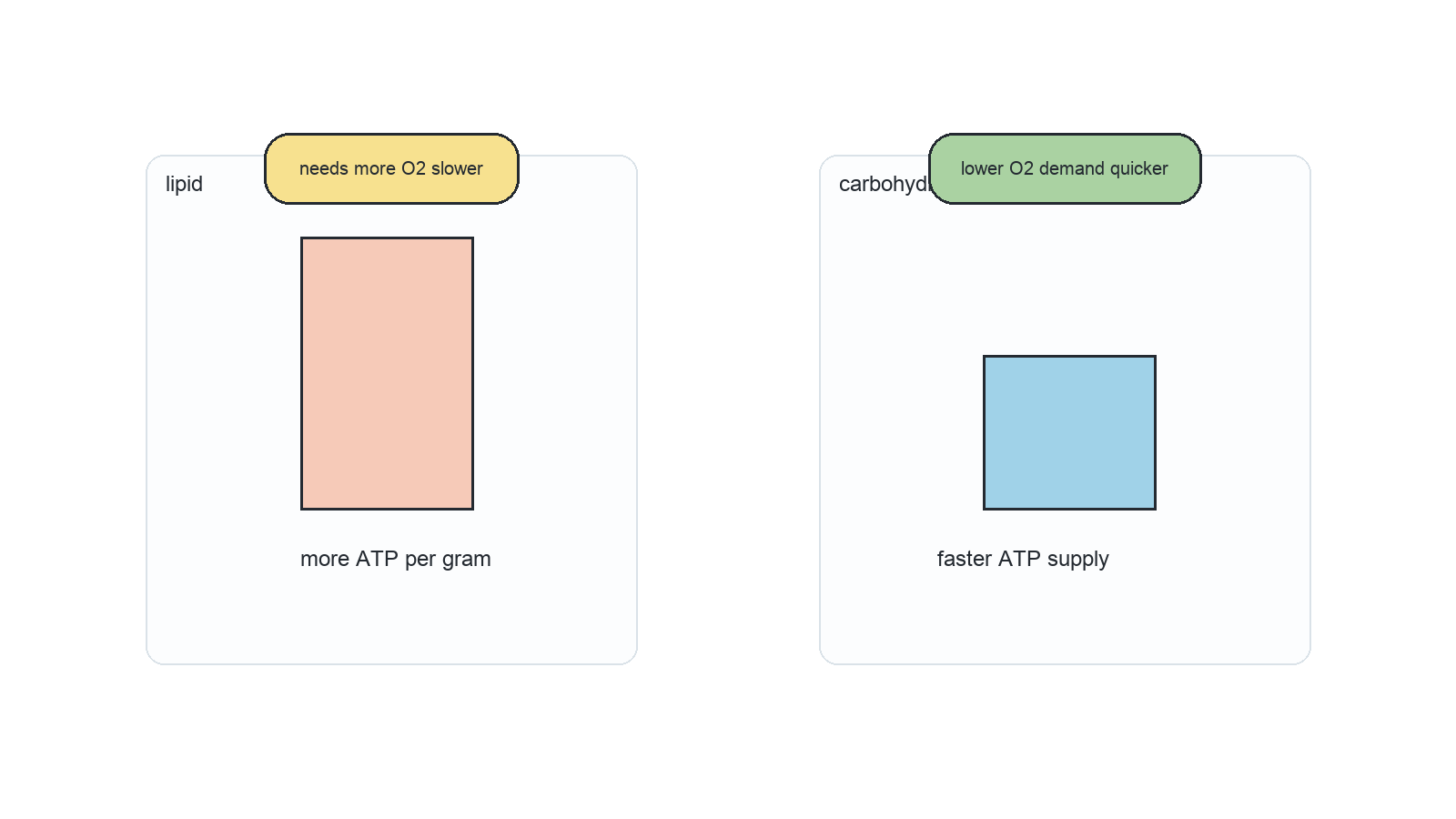
Build the answer around this relationship: Triglycerides store more energy per gram than carbohydrates.

Watch for

Saying lipids are more efficient because they are easier to transport than carbohydrates.

Representative question

Question 1

[Maximum number: 4]

Outline the use of lipids to store energy in humans.

Structure To Function

B1.1 becomes easy when every answer follows structure -> property -> function. Carbon skeletons and functional groups create molecular diversity. Condensation builds larger molecules and hydrolysis breaks them. Alpha-glucose stores energy as starch and glycogen; beta-glucose forms strong cellulose. Surface carbohydrates enable recognition. Lipids are hydrophobic, triglycerides store energy, phospholipids self-assemble into bilayers, and steroids cross membranes because they are mostly non-polar.

  • Carbon bonding and functional groups explain molecular diversity.
  • Condensation releases water; hydrolysis uses water.
  • Carbohydrates can store energy, build cell walls, and mark cell surfaces.
  • Lipids are hydrophobic and not true polymers.
  • Triglycerides store energy; phospholipids form membranes; steroids signal across membranes.

Concept essentials

  • Triglycerides store more energy per gram than carbohydrates.
  • Adipose tissue is a major long-term lipid store in humans.
  • Insolubility prevents triglyceride stores from causing strong osmotic effects.
  • Stored lipids can also provide thermal insulation and cushioning.
ConceptIB Biology HL