Unit Circle Explained | IB Maths AA
Learn the unit circle for IB Maths AA with exact trigonometric values, radians, quadrants, signs and exam methods.
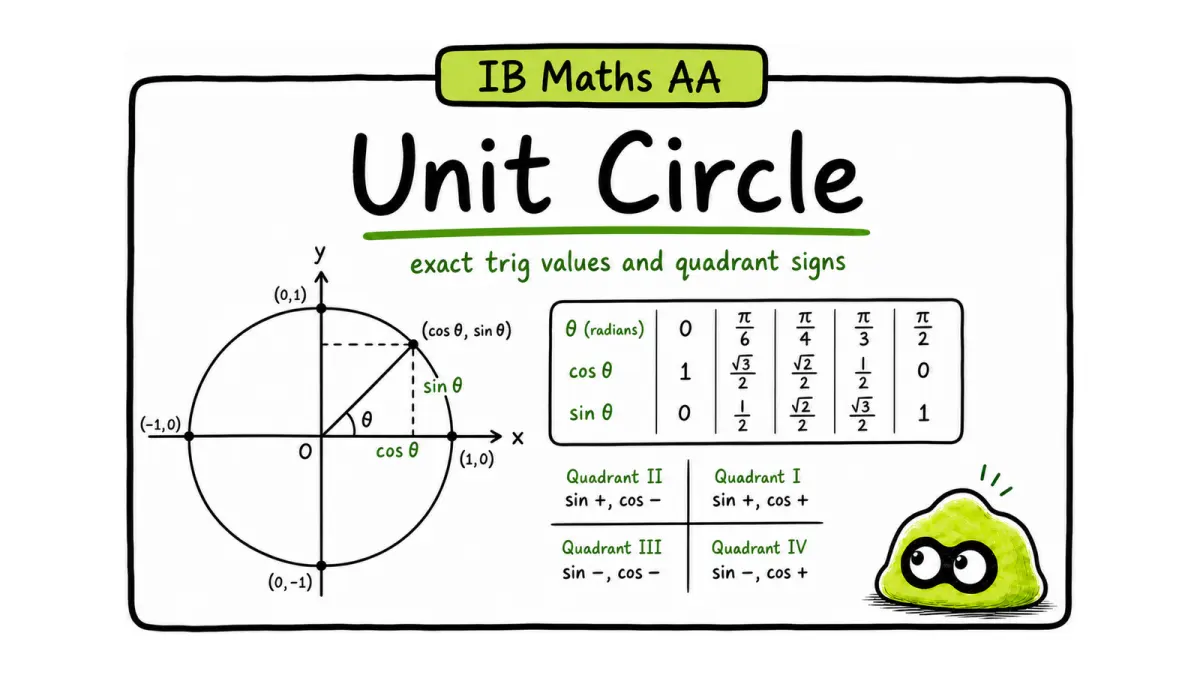
The unit circle becomes useful when a trigonometry question asks for an exact value, a sign in a particular quadrant or an angle in radians. Instead of memorising disconnected triangles, you can use one circle to organise the coordinates, reference angles and symmetry that IB Maths AA questions repeatedly test.
Quick Answer
- The unit circle has centre (0, 0) and radius 1.
- A point at angle theta has coordinates (cos theta, sin theta).
- Therefore tan theta = sin theta / cos theta when cos theta is not zero.
- Cosine is the x-coordinate; sine is the y-coordinate.
- Use quadrant signs and a reference angle to find exact values.
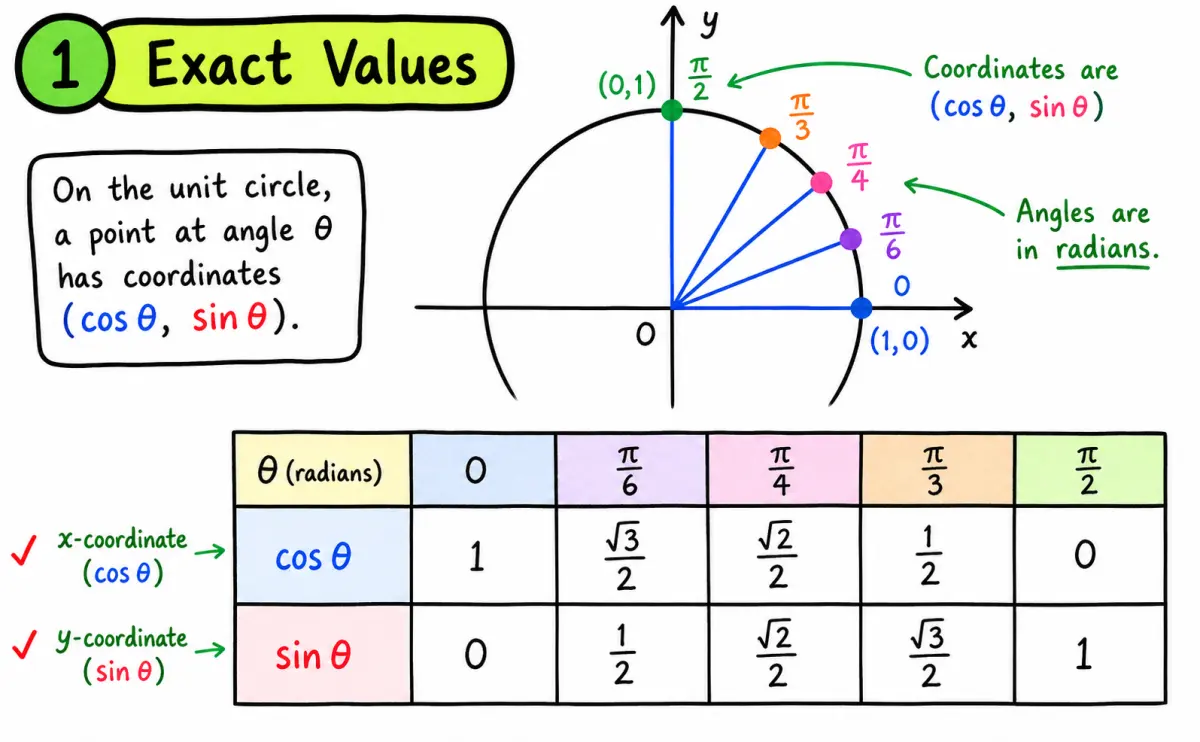
- Standard angles such as 0, pi/6, pi/4, pi/3 and pi/2 produce the familiar exact values.
What the Unit Circle Represents
Draw a circle of radius 1 centred at the origin. Start from the positive x-axis and rotate anticlockwise through an angle theta. The point where the terminal arm meets the circle has coordinates:
(x, y) = (cos theta, sin theta)
Because the radius is 1, the coordinate definitions are especially simple. The horizontal coordinate gives cosine and the vertical coordinate gives sine. This is why the unit circle links geometry, graphs and exact trigonometric values.
Exact Values to Know
| Angle | Radians | sin theta | cos theta | tan theta |
|---|---|---|---|---|
| 0 degrees | 0 | 0 | 1 | 0 |
| 30 degrees | pi/6 | 1/2 | sqrt(3)/2 | 1/sqrt(3) |
| 45 degrees | pi/4 | sqrt(2)/2 | sqrt(2)/2 | 1 |
| 60 degrees | pi/3 | sqrt(3)/2 | 1/2 | sqrt(3) |
| 90 degrees | pi/2 | 1 | 0 | undefined |
For angles in other quadrants, the reference angle keeps the same absolute values while the signs change. The safest method is to identify the quadrant first, then apply the correct sign to sine, cosine and tangent.
Quadrant Signs
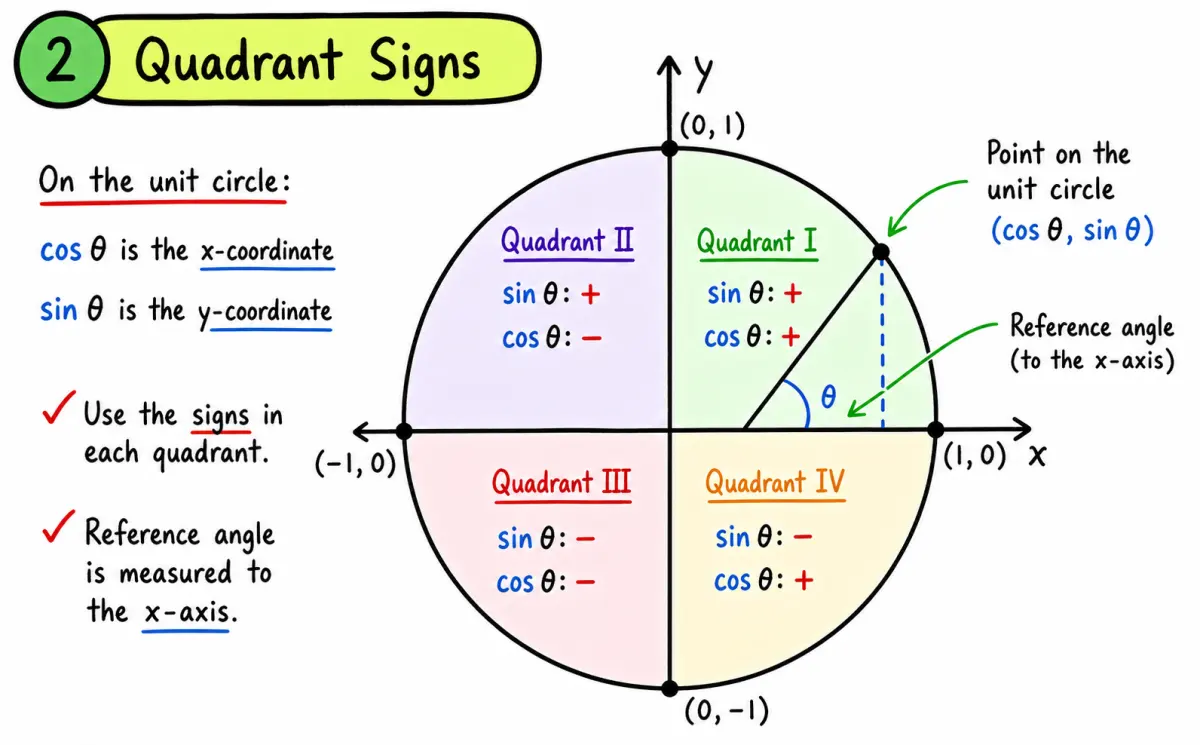
The signs come directly from the coordinates:
- Quadrant I: x positive and y positive, so sine, cosine and tangent are positive.
- Quadrant II: x negative and y positive, so sine is positive while cosine and tangent are negative.
- Quadrant III: x negative and y negative, so sine and cosine are negative while tangent is positive.
- Quadrant IV: x positive and y negative, so sine is negative while cosine and tangent are negative.
Do not rely on a memorised acronym if it makes you forget why the signs work. Read the x- and y-coordinates from the quadrant instead.
Reference Angles and Symmetry
The reference angle is the acute angle between the terminal arm and the nearest x-axis. For example, an angle of 5pi/6 is in Quadrant II and has reference angle pi/6. The unit-circle coordinates give:
- sin(5pi/6) = 1/2
- cos(5pi/6) = -sqrt(3)/2
- tan(5pi/6) = -1/sqrt(3)
The values are based on pi/6, but the signs come from Quadrant II. This two-step process is more reliable than trying to memorise every angle separately.
A Reliable Exam Method
When an exact-value question gives an angle:
- Convert the angle to a familiar position on the circle if needed.
- Identify the quadrant.
- Find the reference angle.
- Read the absolute value from the standard-angle triangle or unit circle.
- Apply the quadrant sign.
- Simplify the exact form and check whether the requested ratio is defined.
For example, 7pi/4 lies in Quadrant IV and has reference angle pi/4. Therefore sin(7pi/4) = -sqrt(2)/2 and cos(7pi/4) = sqrt(2)/2, so tan(7pi/4) = -1.
Common Mistakes
- Mixing degrees and radians in the same calculation.
- Assigning cosine to the y-coordinate instead of the x-coordinate.
- Forgetting that tangent is undefined when cosine is zero.
- Using the reference-angle value but forgetting the quadrant sign.
- Giving a decimal when the question asks for an exact value.
Practice This Topic
Try this exam-style question: Find the exact values of sin(5pi/6), cos(5pi/6) and tan(5pi/6).
Answer guide:
- 5pi/6 is in Quadrant II.
- The reference angle is pi/6.
- Sine is positive and cosine is negative in Quadrant II.
- sin(5pi/6) = 1/2, cos(5pi/6) = -sqrt(3)/2 and tan(5pi/6) = -1/sqrt(3).
Practice this topic
IB Maths AA SL Geometry and Trigonometry Question Bank
FAQ
What are the coordinates on the unit circle?
At an angle theta, the coordinates are (cos theta, sin theta). The x-coordinate gives cosine and the y-coordinate gives sine because the circle has radius 1.
How do I find an exact trig value?
Identify the quadrant, find the reference angle, read the standard exact value, and apply the correct sign. Keep the answer in surd or fractional form when an exact value is requested.
Is the unit circle needed for IB Maths AA?
Yes. The IB Maths AA syllabus uses the unit circle to define sine and cosine, obtain exact trigonometric values and apply quadrant relationships. Check the current course level and teacher guidance for the exact assessment emphasis.
Why is tan(pi/2) undefined?
Tangent equals sine divided by cosine. At pi/2, sine is 1 and cosine is 0, so the division would require dividing by zero. The tangent value is therefore undefined.
Related Study Links
Choose a course and continue studying.
Pick your curriculum and subject, then continue into the right question bank or notes.
Related articles
More course notes, updates and study resources from the EduNinja blog.
Piecewise Functions Explained | IB Maths AA
Revise IB Maths AA piecewise functions with interval rules, endpoint notation, graphs, evaluation steps, common mistakes and practice.
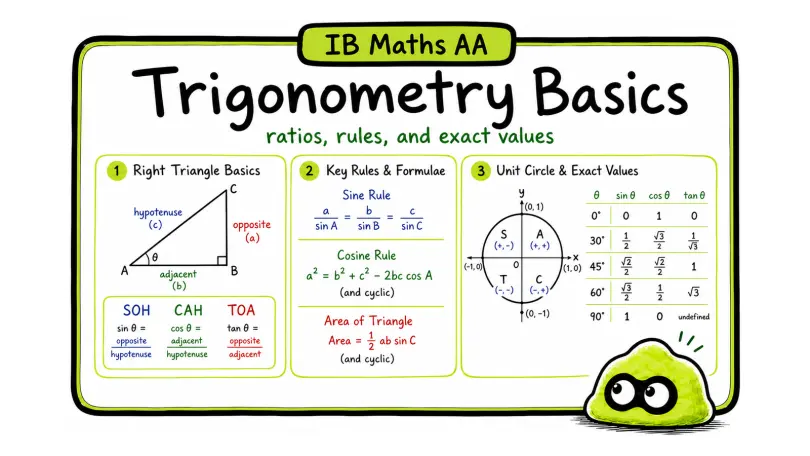
Trigonometry Basics for Exams | IB Maths AA
Learn IB Maths AA trigonometry basics with SOH CAH TOA, sine and cosine rules, area, unit-circle signs, exact values and exam practice.
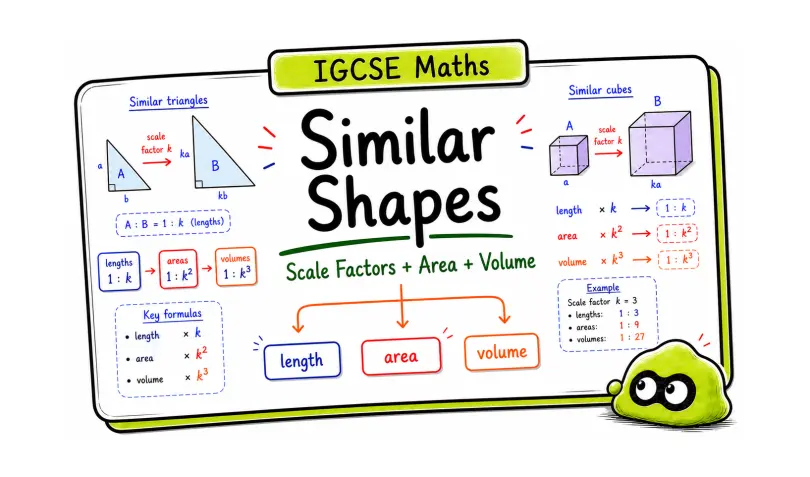
IGCSE Maths Similar Shapes: Scale Factors, Area, and Volume
A source-backed CAIE Mathematics guide for IGCSE Maths similar shapes, using EduNinja PDF notes, worked examples, and markscheme-style answers.