IB Maths AA Integration: Area, Antiderivatives, and Common Mistakes
Revise IB Maths AA integration with antiderivatives, definite integrals, area under curves, + C, limits, and common exam mistakes. Includes examples and targeted FAQ.
Integration in IB Maths AA is used for three main jobs: reversing differentiation, finding a definite accumulation, and calculating area. Before doing any algebra, decide which job the question is asking for. An indefinite integral needs a general antiderivative and usually + C. A definite integral needs limits and the calculation F(b)-F(a). An area question needs a sign check, especially if the curve crosses or lies below the x-axis.
Useful starting points:
Quick Answer
- Indefinite integration gives a general antiderivative and usually needs
+ C. - Definite integration gives a signed value using limits.
- Area questions need a sign check because geometric area is positive.
- For area between curves, use top curve minus bottom curve.
- If curves cross, split the interval at the intersection point.
- Most mistakes happen in setup before the integration step.
Which Integral Should You Set Up?
Most integration mistakes start before the integration. First classify the question.
| Question cue | Set up | Check |
|---|---|---|
Find ∫ f(x) dx |
indefinite integral | include + C |
| limits are given | definite integral | use F(b)-F(a) |
| area under a curve | definite integral | check sign |
| area between curves | top curve minus bottom curve | find intersections |
| rate of change over time | accumulation integral | use the initial value if given |
This first decision tells you whether the answer is a function, a signed value, an area, or a quantity in context.
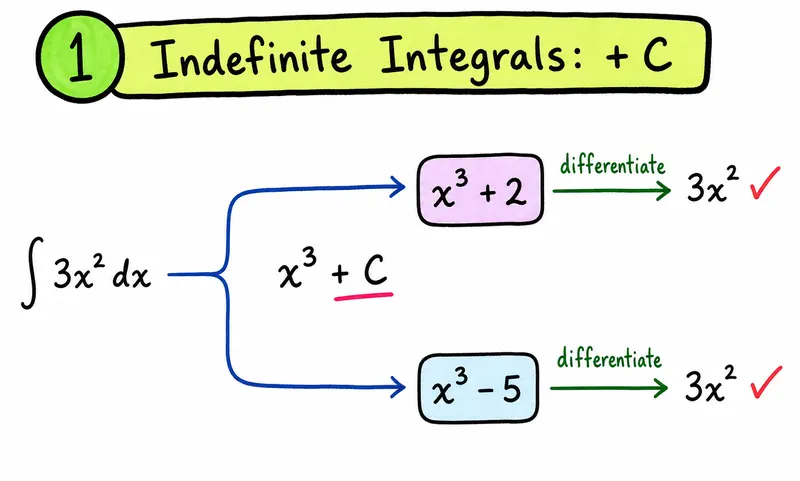
Indefinite Integrals: Where + C Belongs
Use + C when the integral has no limits:
Formula: integral 3x^2 dx = x^3 + C
The + C matters because many functions can have the same derivative. For example, x^3 + 2 and x^3 - 5 both differentiate to 3x^2.
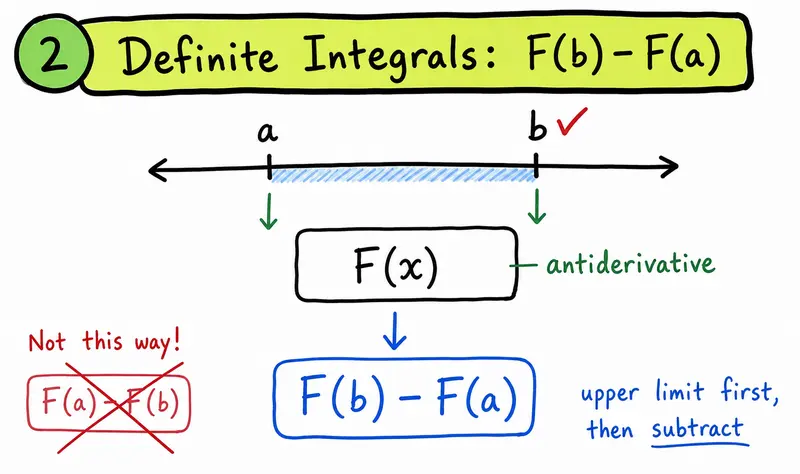
Definite Integrals: Why F(b) - F(a) Matters
For a definite integral:
Formula: integral_a^b f(x) dx = F(b) - F(a)
The order matters. Substituting the lower limit first is a common source of sign errors.
If the question asks for the value of the integral, give the signed value. If it asks for area, check whether the region is below the x-axis.
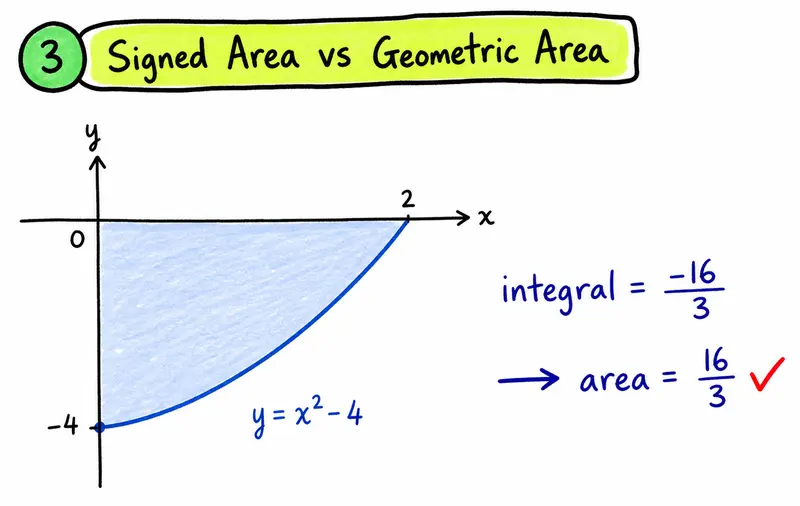
Area Questions: When The Sign Can Trick You
A definite integral gives signed area. Geometric area is always positive.
Use:
Formula: Area = integral_a^b | f(x) | dx
For area between two curves:
Formula: Area = integral_a^b (top curve - bottom curve) dx
If the top curve changes, split the interval at the intersection point.
Worked Example: Area Between a Curve and the x-Axis
Question: Find the area between y = x^2 - 4 and the x-axis from x = 0 to x = 2.
Setup: On this interval, x^2 - 4 is below the x-axis, so the definite integral is negative:
Formula: integral_0^2 (x^2 - 4) dx
Markscheme-style answer:
- integral_0^2 (x^2 - 4) dx
- = [(x^3) / (3) - 4x]_0^2
- = (8) / (3) - 8
- = -(16) / (3)
The geometric area is:
Formula: (16) / (3)
Why this works: It separates signed integral value from area. The final area is positive because area is a size.
Trap: Do not leave -16/3 as the area unless the question asks for the signed integral.
Mistake: Treating Signed Area as Geometric Area
Weak answer:
- The area is the value of the definite integral.
Better answer:
- The definite integral gives signed area. If the region is below the x-axis, the integral is negative, but the geometric area is positive.
What Method Marks Usually Reward
Method marks often come from the setup:
Formula: integral_a^b f(x) dx
or:
Formula: integral_a^b (top curve - bottom curve) dx
Accuracy marks usually come later, after correct integration and substitution.
Use Flashcards for integration rules, then practise area and limits questions in the Question Bank. For every missed question, write down whether the mistake was setup, integration, substitution, or sign.
Integration Practice Loop
Use this order:
- Classify the question before calculating.
- Write the integral clearly.
- Integrate and substitute limits.
- Check sign and context.
- Compare your setup with the markscheme, not only the final answer.
Related Calculus Links
- IB Maths AA Notes
- IB Maths AA Question Bank
- IB Maths Study Library
- IB Maths AI statistics guide
Practice This Topic
Try this exam-style question: Find the area under a curve represented by a definite integral, stating the antiderivative and limits clearly.
Answer guide:
- Find an antiderivative and include
+ Cwhen giving the general antiderivative. - Apply the upper limit and subtract the value at the lower limit.
- State the resulting area with appropriate units and check that it is non-negative.
Practise IB Maths AA SL calculus questions.
FAQ
When do I need + C in IB Maths AA integration?
Use + C for indefinite integration because there are no limits. Do not add it to the final value of a definite integral.
Why can a definite integral be negative?
A definite integral is signed area. The value is negative when the graph is below the x-axis over more of the interval.
How do I avoid area mistakes?
Sketch the region, check whether the curve is above or below the x-axis, and make the final geometric area positive.
Extra Area Example: Signed Integral vs Geometric Area
Question: Find the area between y = x^2 - 4 and the x-axis from x = 0 to x = 2.
The curve is below the x-axis on this interval, so the definite integral is negative. The geometric area must be positive.
- integral from 0 to 2 of (x^2 - 4) dx = -16/3
- area = 16/3
Why this scores: It recognises the difference between signed integral value and geometric area. That distinction is a common IB Maths AA markscheme point.
Integration Setup Checklist
Before calculating, ask:
- Is the question asking for an antiderivative, a definite integral, or an area?
- Do I need + C?
- Are the limits in the correct order?
- Is the curve below the x-axis anywhere?
- For area between curves, did I use top curve minus bottom curve?
- Did I substitute both limits before simplifying?
How EduNinja Helps with Integration
Use EduNinja Notes to revise the rule, then practise one narrow set in the Question Bank: antiderivatives, definite integrals, or area questions. Keep an error log with four labels: setup, integration rule, substitution, and sign. That makes each correction specific enough to fix.
<!-- backend-minimal-top-up-applied -->
One More Exam Check: Area Between Two Curves
For area between two curves, set up the integral as top curve minus bottom curve. If the curves cross, split the region at the intersection point. Do not assume one curve stays above the other across the whole interval without checking.
Related Study Links
Put integration back into your full IB Maths AA SL study plan.
Return to the complete course overview, or move directly into the most relevant study tool.
Related articles
More course notes, updates and study resources from the EduNinja blog.
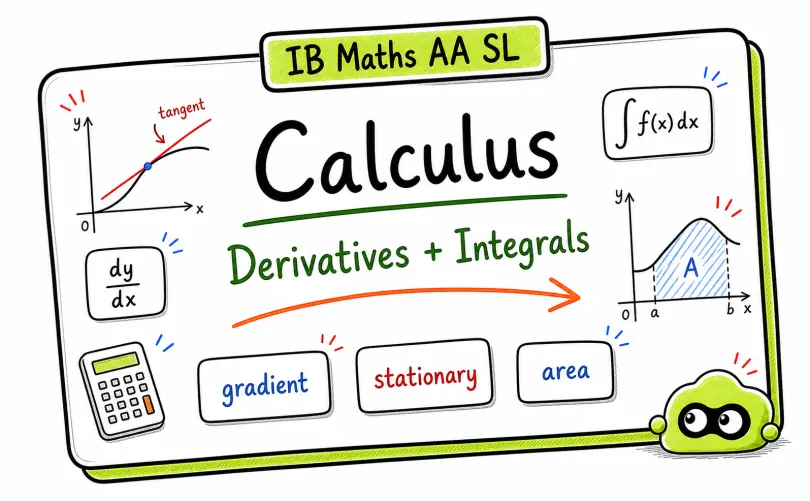
IB Maths AA SL Calculus: Differentiation and Integration Guide
Revise IB Maths AA SL calculus with derivative meaning, tangents, optimisation, integration, area, and calculator-safe exam routines.
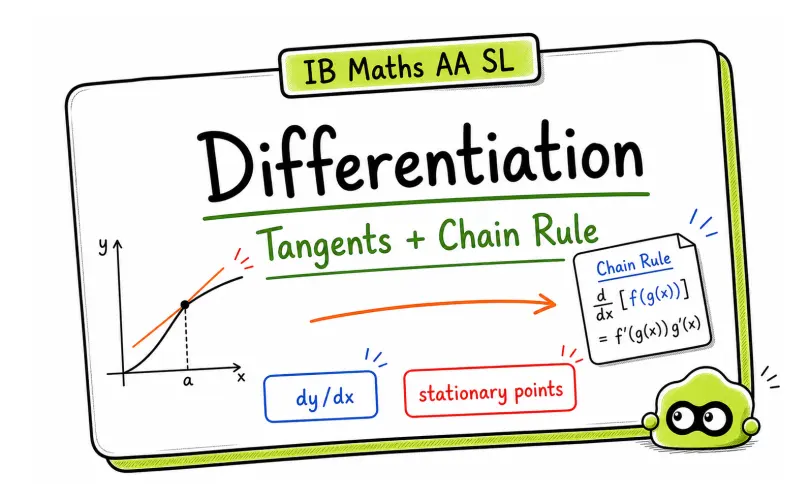
IB Maths AA Differentiation: Common Mistakes and Revision Guide
Revise IB Maths AA differentiation with gradients, tangents, normals, stationary points, increasing intervals, and common derivative mistakes.
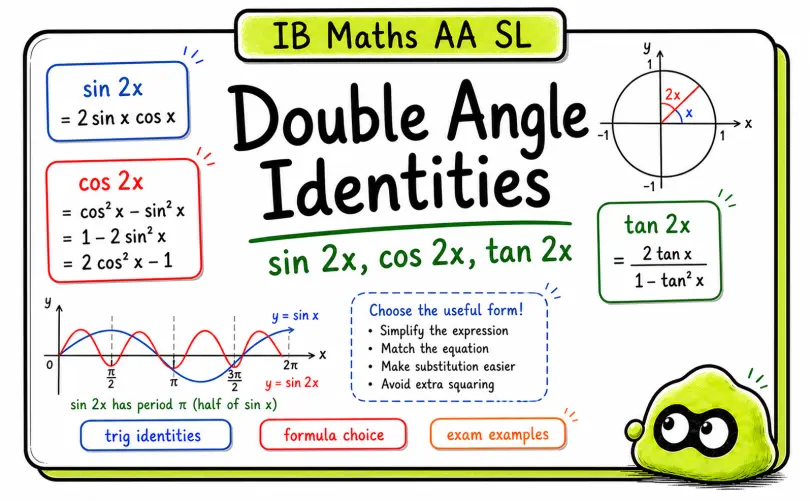
Double Angle Identities Explained with Examples
Learn double angle identities for IB Maths AA with sin 2x, cos 2x, tan 2x formulas, worked examples, common mistakes and practice.