IB Maths AA SL Calculus: Differentiation and Integration Guide
Revise IB Maths AA SL calculus with derivative meaning, tangents, optimisation, integration, area, and calculator-safe exam routines.
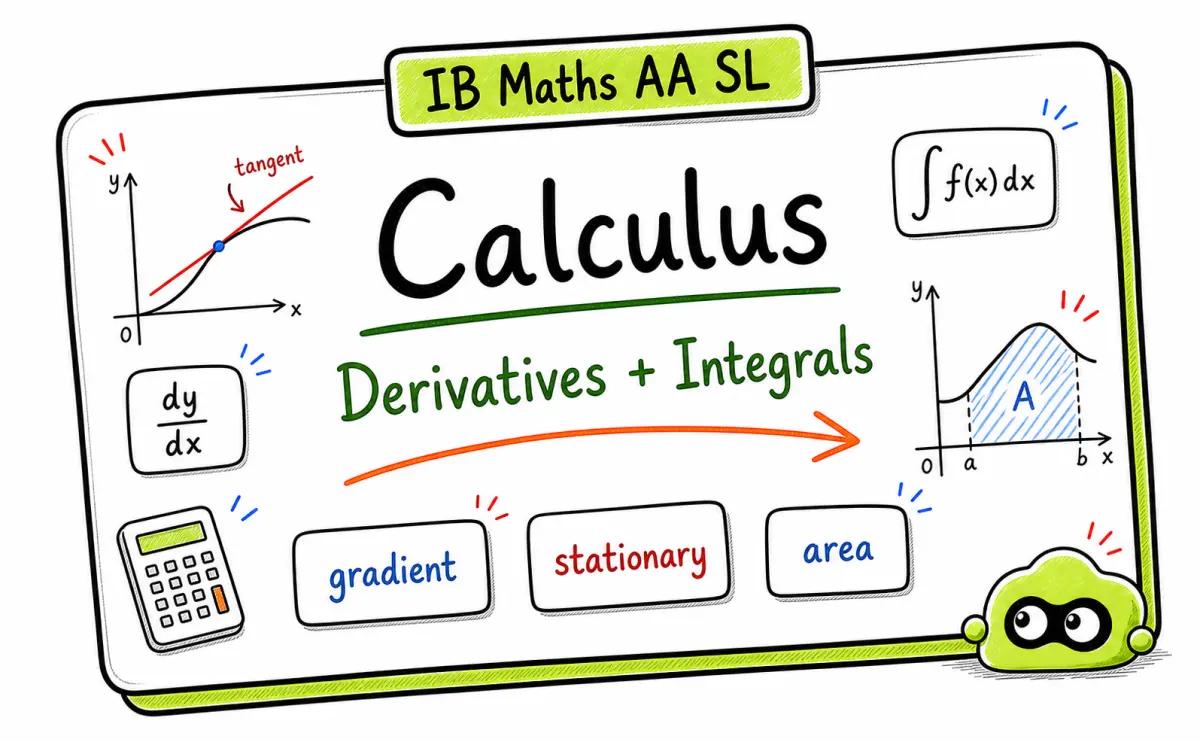
IB Maths AA SL calculus is not one skill. It is a chain: understand the derivative, use differentiation rules, read tangent and normal lines, classify stationary points, reverse the process with integration, and then interpret area or motion.
If you only remember one thing: differentiation tells you gradient or rate of change at a point; integration reverses differentiation and can measure signed area. Most exam mistakes happen when a student knows the formula but does not say what the answer means.
Useful starting points:
Use this page as a route through Topic 5. It follows the PDF order closely: derivative meaning, derivative rules, chain rule, tangent and normal lines, monotony and stationary points, integration, definite integrals, area, and basic kinematics.
This SL guide focuses on the core AA SL calculus skills. It does not go into HL-only techniques such as L'Hopital's rule, implicit differentiation, integration by parts, volumes of revolution, or Maclaurin series.
Quick answer
- A derivative is a new function that gives the gradient or rate of change of at a value of .
- For a power function, . This also works for negative and rational powers when the expression is defined.
- The chain rule is needed when is replaced by another function .
- A tangent line uses gradient . A normal line is perpendicular to the tangent, so when .
- Stationary points occur where . They are possible maximum or minimum points, but you must test them.
- An indefinite integral gives a family of antiderivatives, so the constant matters.
- A definite integral gives , where .
- Total area is not always the same as a signed integral. If the graph goes below the -axis, split the interval or use absolute value.
Derivative meaning: gradient and rate of change
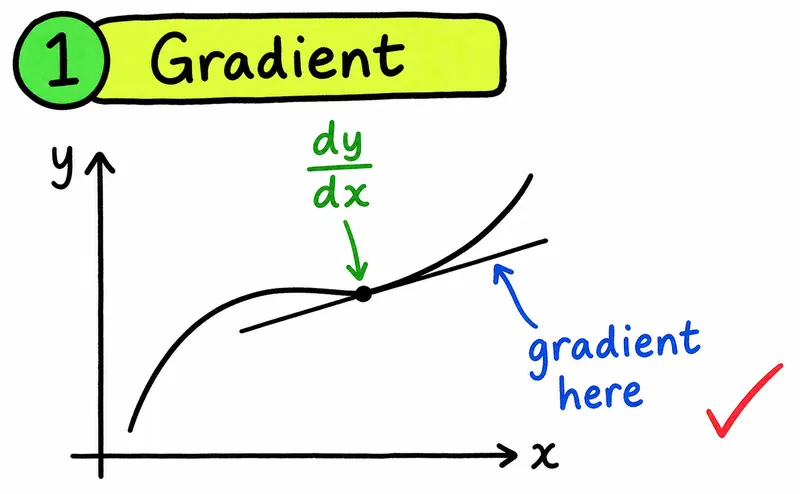
The PDF introduces the derivative after a short discussion of limits. For revision, the practical idea is more important than the technical notation: gives the gradient of the graph of at a particular -value.
That is why the same object can be described in several ways:
| Notation or phrase | What it means |
|---|---|
| Derivative function | |
| Rate of change of with respect to | |
| Gradient at | Slope of the tangent to the curve at that point |
| The derivative value when |
For example, if , then:
So the gradient at is:
Do not stop at "differentiate it". In an exam answer, say what the derivative value represents: a gradient, a rate of change, or the tangent slope at the point.
Basic derivatives you should know
The PDF starts with the power rule and then lists common derivatives. For SL calculus, these are the ones students should be able to use quickly.
| Function | Derivative |
|---|---|
| constant |
The power rule also works with negative powers and rational powers. Rewrite first if needed:
For square roots:
This is why rewriting is often the easiest first move in a calculus question.
Rules of differentiation
The PDF then builds the standard rules. Students often know the rules but apply them too quickly, especially when a function contains a product or quotient.
| Rule | Use it when |
|---|---|
| Sum or difference | Terms are added or subtracted |
| Constant multiple | A constant multiplies the function |
| Product rule | Two functions are multiplied |
| Quotient rule | One function is divided by another |
| Chain rule | A function is inside another function |
For sums and constant multiples:
For a product, do not multiply the separate derivatives. If , then:
That error is common because students try to do this:
The product rule keeps each original factor once.
Chain rule: the anti-panic rule
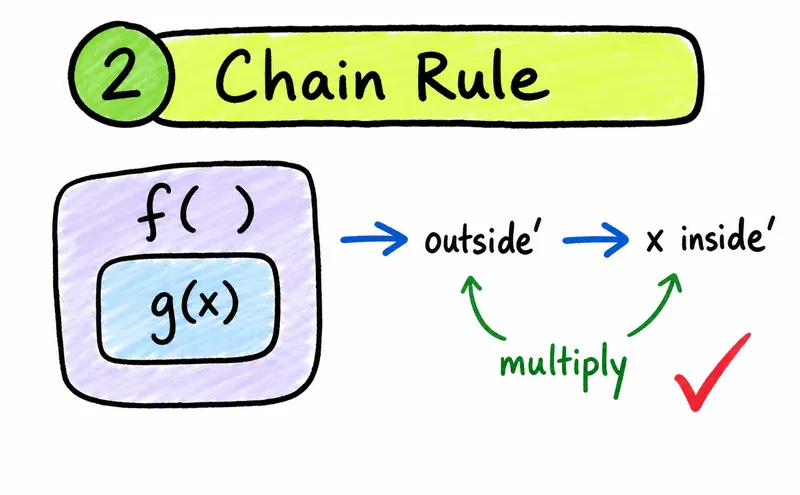
The PDF describes the chain rule in a simple way: if is replaced by another function , differentiate the outer function and multiply by .
If:
then , so:
For an exponential example:
For a logarithm:
The check is always the same: ask "what is inside?" and then multiply by the derivative of the inside.
Tangent and normal lines
The PDF gives a clear method for tangent and normal line questions.
Given and a point , first find the point of contact:
The tangent gradient is:
The normal line is perpendicular to the tangent:
Then use the straight-line equation:
For example, if and , then:
So the tangent line is:
and the normal line is:
A strong exam answer shows the point, the gradient, and the final line. Missing one of those steps makes the method harder to follow.
Increasing, decreasing, maximum and minimum
The PDF calls increasing and decreasing behaviour "monotony". The sign of the derivative controls the behaviour of the function:
| Derivative sign | Graph behaviour |
|---|---|
| is increasing | |
| is decreasing | |
| Possible stationary point |
A turning point has a horizontal tangent, so for an interior maximum or minimum:
But the reverse is not always enough. A point where might be a maximum, a minimum, or neither. That is why the PDF uses tests.
First and second derivative tests
The first derivative test checks the sign of around a stationary point.
| Change in | Conclusion |
|---|---|
| positive to negative | local maximum |
| negative to positive | local minimum |
| no change of sign | not a turning point |
The second derivative test is faster when it works:
| Value | Conclusion |
|---|---|
| local minimum | |
| local maximum | |
| inconclusive |
For example, suppose:
Then the stationary points are:
If:
then:
so gives a local maximum.
so gives a local minimum.
The important exam habit is to write the conclusion in words, not only the calculation.
Concavity and points of inflexion
The PDF also uses the second derivative to describe concavity.
| Second derivative | Shape |
|---|---|
| concave up | |
| concave down |
A point of inflexion occurs where the concavity changes. In a graph-sketching question, that matters because the derivative can tell you more than just maximum and minimum points. It also helps you describe the shape of the curve.
Optimisation questions
Optimisation is the exam version of maximum and minimum work. The method is usually:
- Define the quantity that needs to be maximised or minimised.
- Write it as a function of one variable.
- Differentiate.
- Solve .
- Use a test or the context to decide whether it is a maximum or minimum.
- Answer in the context of the question.
Do not leave the answer as only or . If the question is about area, volume, cost, speed, or distance, finish with that quantity and its units if units are given.
Indefinite integration: reverse differentiation
The PDF introduces integration as the reverse problem. If:
then:
For example:
The matters because many functions have the same derivative:
So the full family of antiderivatives is:
The power rule for integration is:
For , use:
Many students forget the constant in indefinite integration. That is a simple mark to protect.
Basic integrals from the PDF
| Function | Integral |
|---|---|
| , | |
Always check by differentiating your answer. If differentiating the result returns the original integrand, the integral is consistent.
Integration by substitution
The PDF first shows a simple linear case. If the expression has inside, the result often needs division by .
For example:
because differentiating gives:
Similarly:
The PDF later connects substitution to the chain rule. If you can see next to a function of , you can often integrate by recognising the pattern.
For example:
is almost a logarithm pattern because the derivative of is . Adjust the constant:
This is why substitution is sometimes called the reverse of the chain rule.
Definite integrals
A definite integral has limits:
If:
then:
For example:
The constant is omitted in a definite integral because it cancels when subtracting .
Signed area and total area
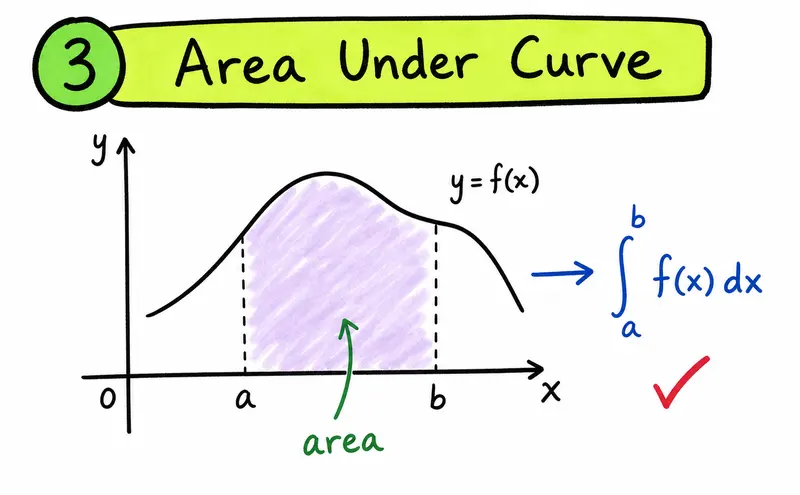
The PDF is careful about one point students often miss: a definite integral gives signed area, not always total area.
If the graph is above the -axis, the integral gives a positive area. If the graph is below the -axis, the integral gives a negative value. If the graph crosses the axis, positive and negative regions can cancel.
That means:
does not always give the total area between the curve and the -axis.
For total area:
In practice, split the interval at the roots where the graph crosses the -axis, then add the positive area values.
Area between curves
For area between two curves, subtract lower from upper:
The common mistake is to integrate the two functions in the wrong order or to ignore where the curves cross. Before integrating, sketch or use the calculator to identify which graph is above on the interval.
Exam routine:
- Find the intersection points if the limits are not given.
- Decide which curve is above.
- Set up one integral or split if the upper curve changes.
- Evaluate using .
- State that the result is an area.
Kinematics: displacement, velocity and acceleration
The PDF includes kinematics as an application of calculus. The link is:
So velocity is the derivative of displacement, and acceleration is the derivative of velocity.
In reverse:
For definite integrals:
gives displacement over the time interval, not always total distance travelled. If velocity changes sign, total distance needs the interval split where .
Common mistakes in IB Maths AA SL calculus
| Mistake | Better habit |
|---|---|
| Treating as automatically a maximum or minimum | Use first derivative or second derivative test |
| Forgetting in indefinite integration | Write before moving on |
| Using signed integral as total area | Split at -axis crossings or use |
| Applying the product rule as product of derivatives | Keep each original factor once |
| Missing the inside derivative in chain rule | Identify , then multiply by |
| Finding a tangent gradient but not the point | Compute before writing the line |
| Leaving an optimisation answer without context | State the maximum or minimum quantity asked for |
A short exam routine
For a differentiation question:
- Rewrite powers or roots if that makes the function easier.
- Choose the rule: power, product, quotient, or chain.
- Differentiate carefully.
- Substitute only after differentiating unless the question asks for a value first.
- Interpret the derivative as gradient, rate of change, tangent slope, or motion.
For an integration question:
- Decide whether it is indefinite or definite.
- For indefinite integrals, include .
- For definite integrals, use .
- If area is requested, check whether the graph goes below the -axis.
- If motion is involved, separate displacement from total distance.
Related Study Links
FAQ
What is the difference between differentiation and integration?
Differentiation finds a derivative, which gives gradient or rate of change. Integration reverses differentiation and can also calculate signed area under a curve.
Why do I need in integration?
Because many functions can have the same derivative. For example, , , and all differentiate to . The represents that family of antiderivatives.
When should I use the chain rule?
Use the chain rule when one function is inside another function, such as , , or . Differentiate the outside, then multiply by the derivative of the inside.
How do I know whether a stationary point is a maximum or minimum?
First solve . Then use a first derivative sign table or the second derivative test. If , it is a local minimum. If , it is a local maximum. If , use another test.
Is always the area?
It gives signed area. If the graph is below the -axis, the contribution is negative. For total area, split the interval at roots or use when appropriate.
What does calculus mean in kinematics questions?
Velocity is the derivative of displacement, and acceleration is the derivative of velocity. Integration reverses those links. A definite integral of velocity gives displacement, while total distance may require splitting where velocity changes sign.
Related study links
- IB Mathematics Notes
- IB Mathematics Question Bank
- IB Mathematics Study Library
Put exam skill back into your full IB Maths AA SL study plan.
Return to the complete course overview, or move directly into the most relevant study tool.
Related articles
More course notes, updates and study resources from the EduNinja blog.
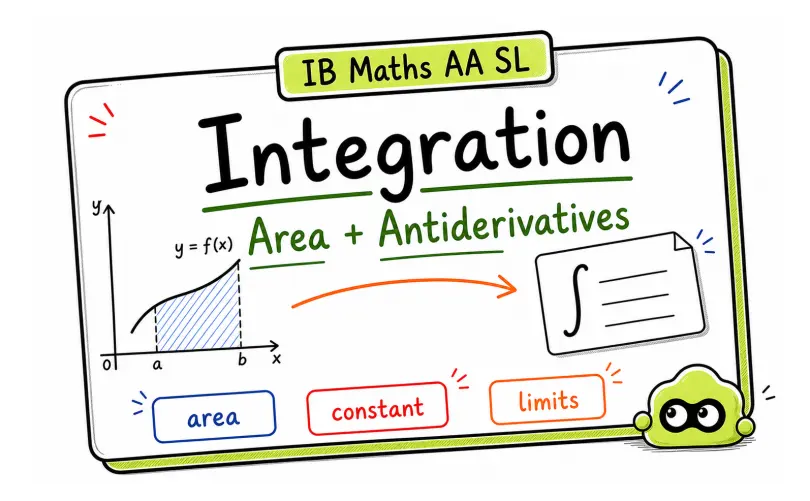
IB Maths AA Integration: Area, Antiderivatives, and Common Mistakes
Revise IB Maths AA integration with antiderivatives, definite integrals, area under curves, + C, limits, and common exam mistakes. Includes examples and targeted FAQ.
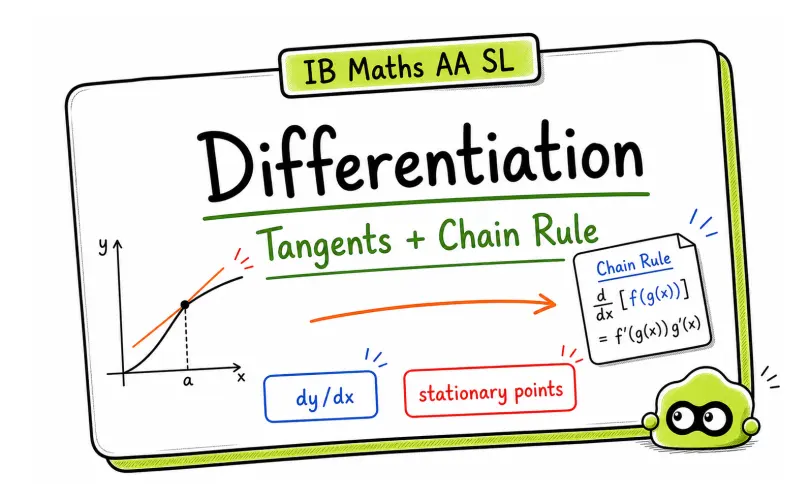
IB Maths AA Differentiation: Common Mistakes and Revision Guide
Revise IB Maths AA differentiation with gradients, tangents, normals, stationary points, increasing intervals, and common derivative mistakes.
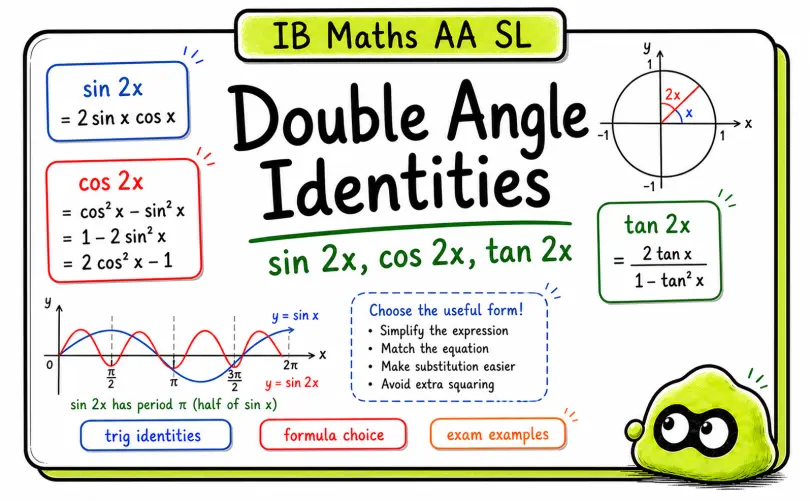
Double Angle Identities Explained with Examples
Learn double angle identities for IB Maths AA with sin 2x, cos 2x, tan 2x formulas, worked examples, common mistakes and practice.