Trigonometry Basics for Exams | IB Maths AA
Learn IB Maths AA trigonometry basics with SOH CAH TOA, sine and cosine rules, area, unit-circle signs, exact values and exam practice.
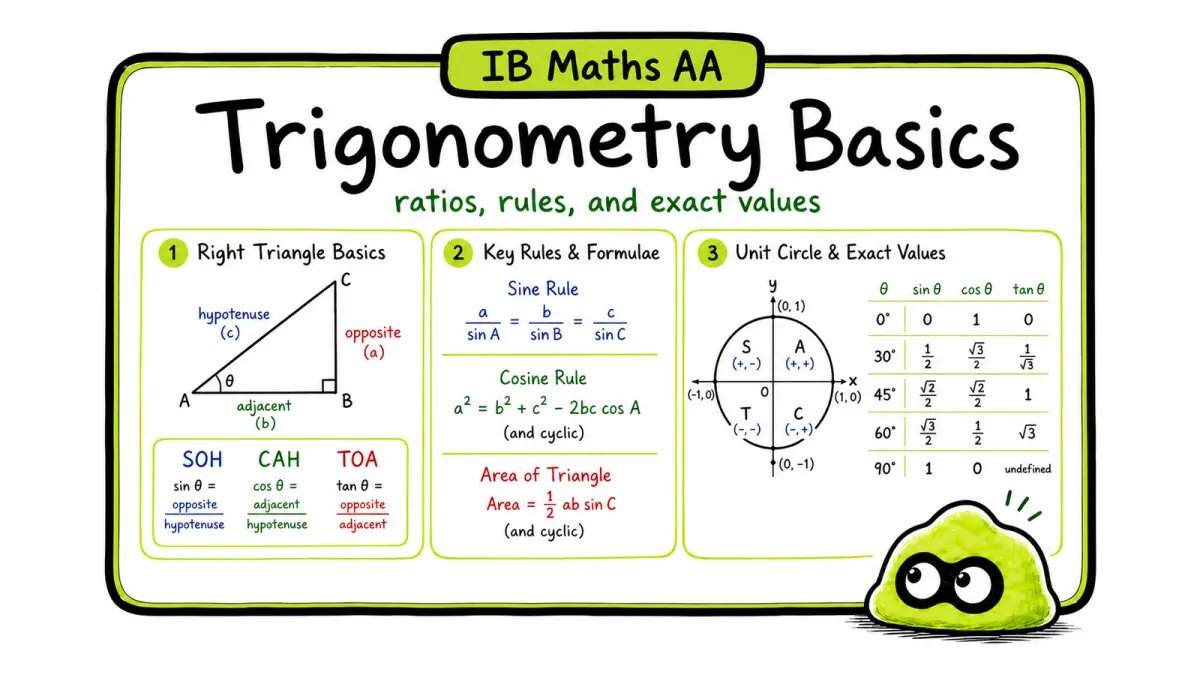
Trigonometry questions become much easier when you identify the shape, the known information, and the exact relationship before reaching for a calculator. In IB Maths AA, the same few decisions appear repeatedly: use a right-triangle ratio, choose the sine or cosine rule, calculate an area, or use the unit circle for an exact value.
Quick Answer
- In a right triangle, use SOH CAH TOA: sine = opposite/hypotenuse, cosine = adjacent/hypotenuse, tangent = opposite/adjacent.
- Use the sine rule when you have a side-angle opposite pair and another side or angle.
- Use the cosine rule when you know two sides and the included angle, or all three sides.
- Use the area formula Area = 1/2 ab sin C when two sides and their included angle are known.
- On the unit circle, the coordinates are (cos theta, sin theta), so the quadrant gives the signs.
IB Maths AA SL includes unit-circle definitions, quadrant relationships, standard exact values, and geometry and trigonometry methods. The reliable exam habit is to name the relationship first, then substitute.
Right-Triangle Trigonometry
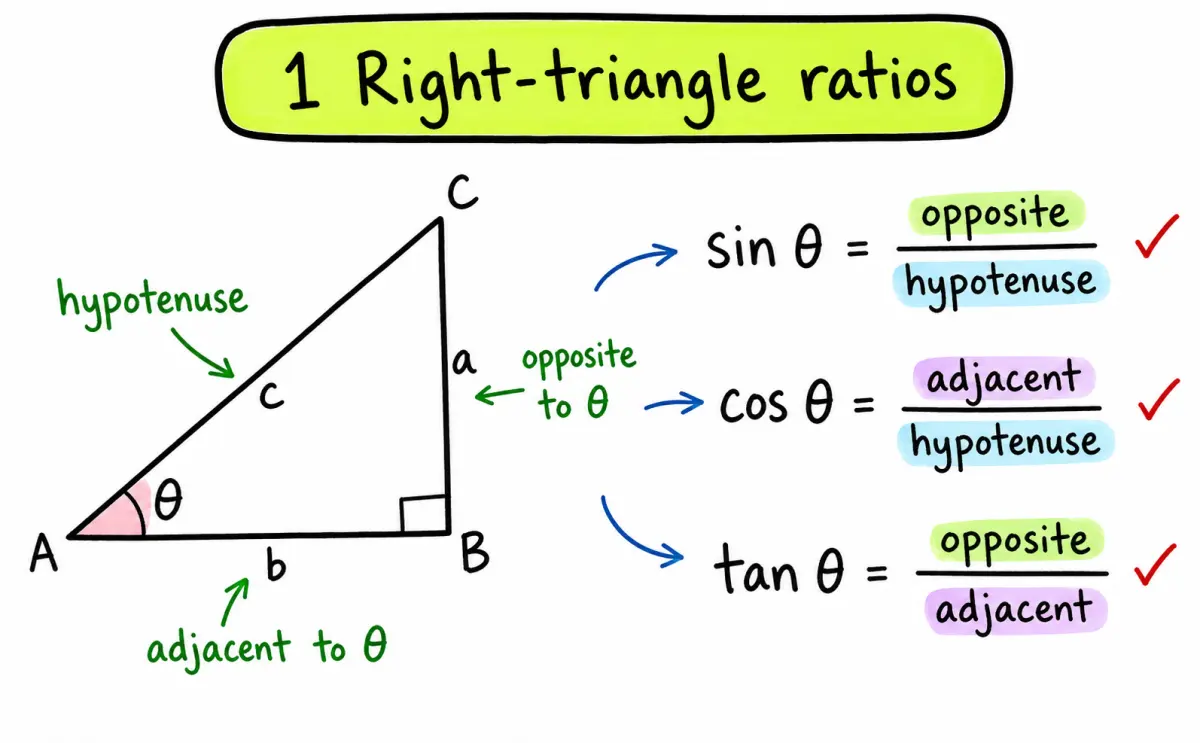
For a right triangle, label the sides from the angle you are using. The hypotenuse is opposite the right angle. The opposite side is across from theta, and the adjacent side touches theta but is not the hypotenuse.
The three basic ratios are:
sin theta = opposite / hypotenuse
cos theta = adjacent / hypotenuse
tan theta = opposite / adjacent
The memory aid SOH CAH TOA is useful, but the labels matter more than the phrase. If the question asks for an angle, rearrange the ratio and use the inverse trigonometric function. Check that your calculator is in degree or radian mode as required by the question.
Choosing a Trigonometric Rule
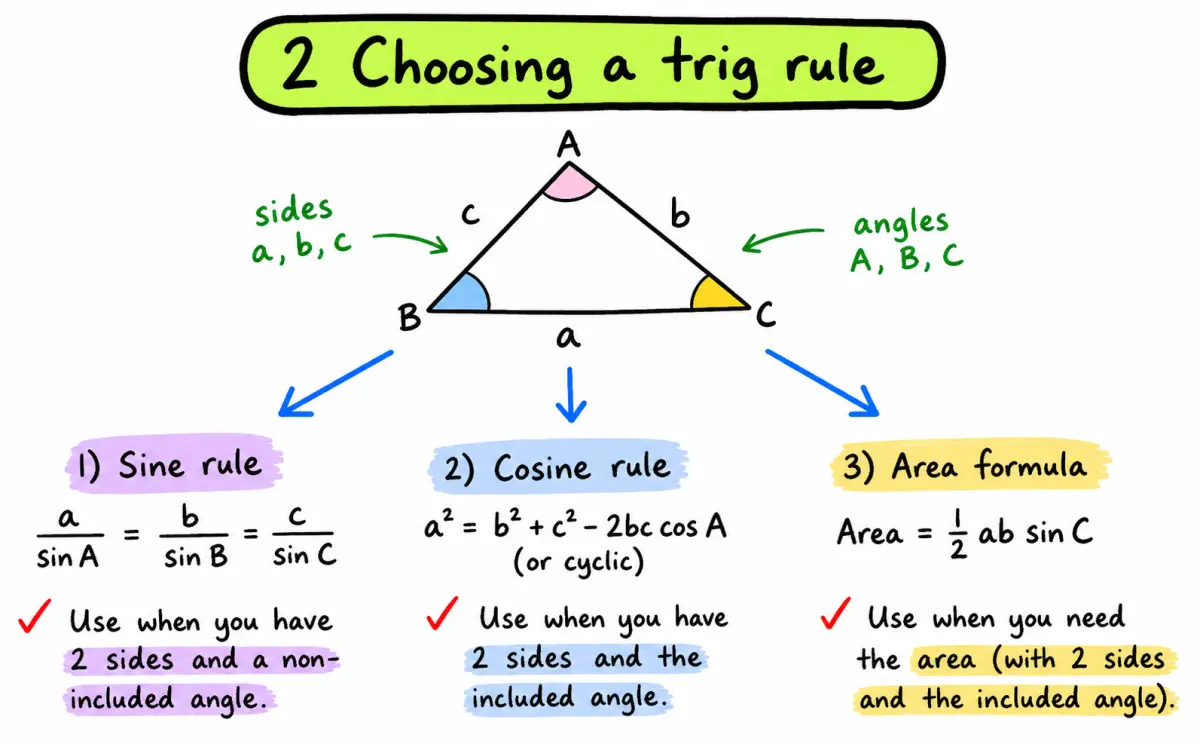
For a non-right triangle, do not force SOH CAH TOA onto the diagram. First list the sides and angles that are known.
Sine rule
Use the sine rule when you know an opposite side-angle pair:
a / sin A = b / sin B = c / sin C
It is especially useful when the information includes two angles and a side, or two sides and a non-included opposite angle. In the second situation, check whether the ambiguous case can produce two possible triangles.
Cosine rule
Use the cosine rule when two sides and the included angle are known, or when all three sides are known and you need an angle:
a^2 = b^2 + c^2 - 2bc cos A
Match the angle with the side opposite it. A common error is to use the correct formula with the wrong angle-side pairing.
Area formula
If two sides and their included angle are known, the area is:
Area = 1/2 ab sin C
The angle must be between the two sides used in the formula. Do not use an angle at the opposite vertex by accident.
Unit Circle and Exact Values
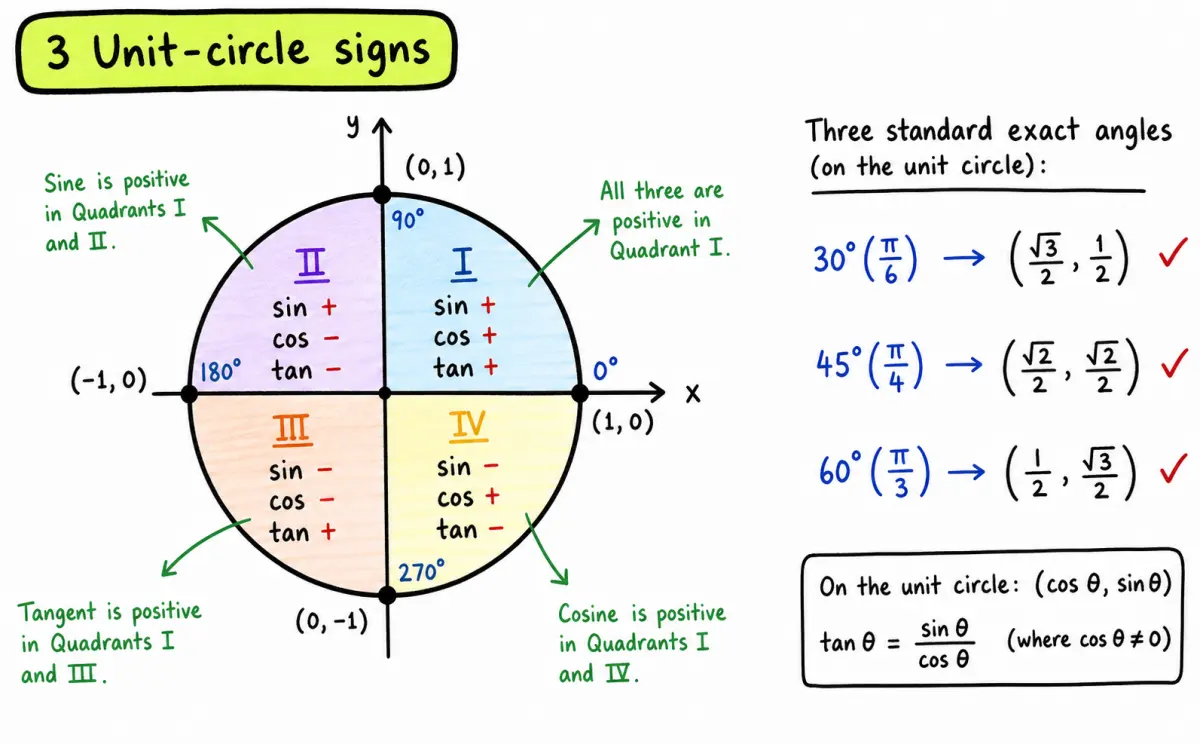
The unit circle has radius 1 and centre at the origin. At angle theta, the point on the circle has coordinates:
(cos theta, sin theta)
This gives the signs directly. In Quadrant I, sine and cosine are positive. In Quadrant II, sine is positive and cosine is negative. In Quadrant III, both are negative. In Quadrant IV, sine is negative and cosine is positive. Since tan theta = sin theta / cos theta, tangent is positive in Quadrants I and III.
For an exact-value question, use this sequence:
- Identify the quadrant.
- Find the reference angle.
- Recall the standard value for the reference angle.
- Apply the quadrant sign.
- Leave the answer in exact form rather than a decimal.
For example, 5pi/6 has reference angle pi/6 and lies in Quadrant II. Therefore sin(5pi/6) = 1/2, cos(5pi/6) = -sqrt(3)/2, and tan(5pi/6) = -1/sqrt(3).
Exam Method
Before calculating, write a one-line plan such as “use the cosine rule because two sides and the included angle are known.” This makes the method visible and reduces formula switching halfway through a question.
Keep full calculator precision until the final line, unless the question says otherwise. Include units for lengths, areas, and angles where appropriate. For an exact-value question, do not convert a surd to a decimal just because the calculator displays one.
Common Mistakes
- Calling the side next to theta the adjacent side when it is actually the hypotenuse.
- Using the sine rule without matching an angle to its opposite side.
- Using the cosine rule with a non-included angle.
- Forgetting that the area formula needs the included angle.
- Applying the reference-angle value but missing the quadrant sign.
- Leaving the calculator in the wrong angle mode.
Practice This Topic
Try this exam-style question: Find the exact values of sin(5pi/6), cos(5pi/6), and tan(5pi/6).
Answer guide:
- 5pi/6 is in Quadrant II.
- The reference angle is pi/6.
- Sine is positive and cosine is negative in Quadrant II.
- sin(5pi/6) = 1/2, cos(5pi/6) = -sqrt(3)/2, and tan(5pi/6) = -1/sqrt(3).
Practice the IB Maths AA SL Geometry and Trigonometry Question Bank.
Related Study Links
- Open the full revision Study Hub
- Unit Circle Explained | IB Maths AA
- IB Maths AA Differentiation: Common Mistakes and Revision Guide
- IB Maths AA Integration: Area, Antiderivatives, and Common Mistakes
FAQ
What does SOH CAH TOA mean?
SOH CAH TOA links the three right-triangle ratios to their side labels: sine is opposite over hypotenuse, cosine is adjacent over hypotenuse, and tangent is opposite over adjacent. Always label the triangle from the chosen angle before selecting a ratio.
When should I use the cosine rule?
Use the cosine rule when two sides and their included angle are known, or when all three sides are known and you need an angle. Match the angle to the opposite side in the formula so the substitution is consistent.
How do I find an exact trigonometric value?
Identify the quadrant, find the reference angle, recall the standard exact value, and apply the correct sign. Keep the result as a fraction or surd when the question asks for an exact answer.
Why do I get two possible answers with the sine rule?
The sine rule can create an ambiguous case when two sides and a non-included angle are given. The same sine value can correspond to an acute angle or its supplementary angle, so check whether both triangles satisfy the given information.
Choose a course and continue studying.
Pick your curriculum and subject, then continue into the right question bank or notes.
Related articles
More course notes, updates and study resources from the EduNinja blog.
Piecewise Functions Explained | IB Maths AA
Revise IB Maths AA piecewise functions with interval rules, endpoint notation, graphs, evaluation steps, common mistakes and practice.
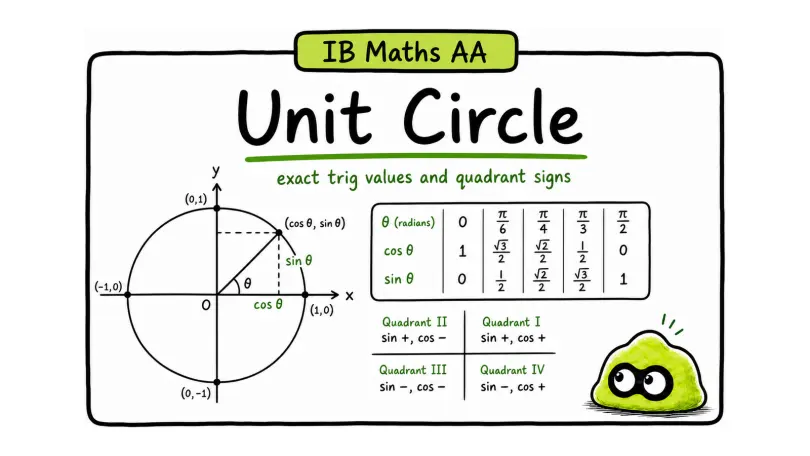
Unit Circle Explained | IB Maths AA
Learn the unit circle for IB Maths AA with exact trigonometric values, radians, quadrants, signs and exam methods.
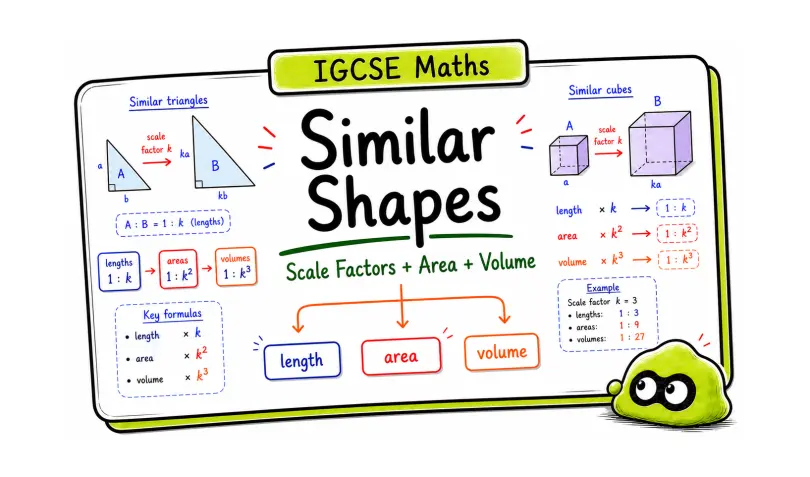
IGCSE Maths Similar Shapes: Scale Factors, Area, and Volume
A source-backed CAIE Mathematics guide for IGCSE Maths similar shapes, using EduNinja PDF notes, worked examples, and markscheme-style answers.