IB Maths AA Differentiation: Common Mistakes and Revision Guide
Revise IB Maths AA differentiation with gradients, tangents, normals, stationary points, increasing intervals, and common derivative mistakes.
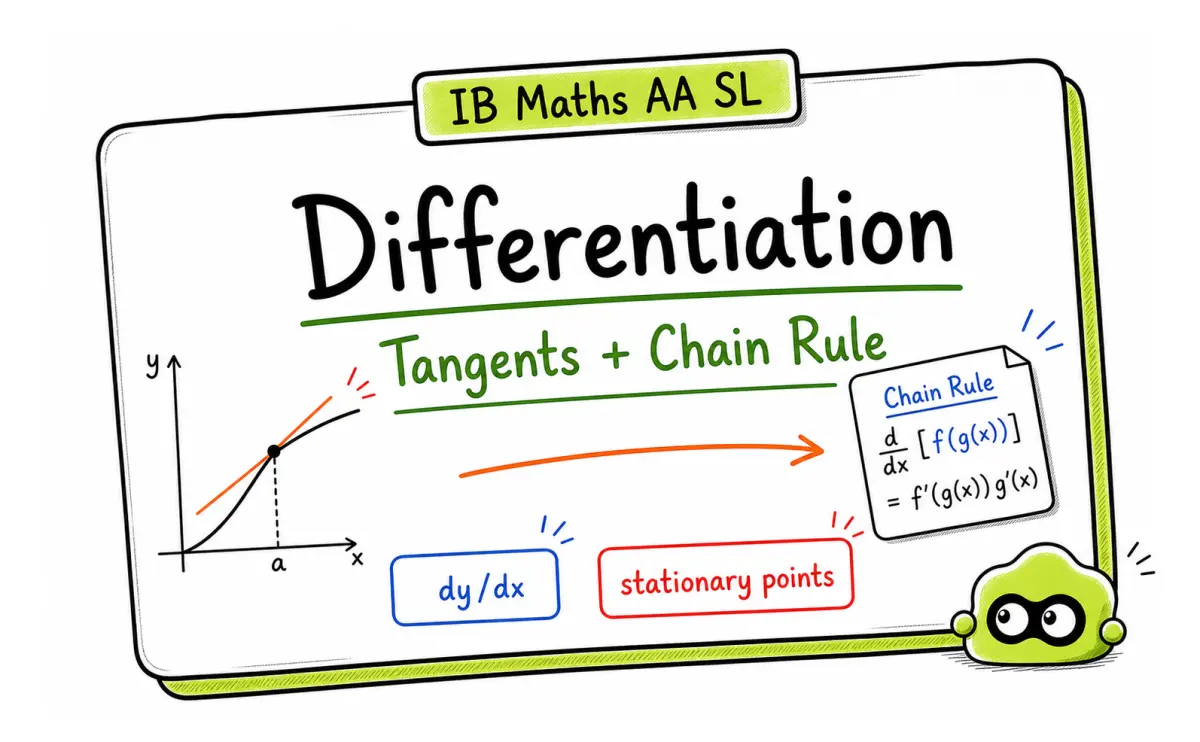
IB Maths AA differentiation is not just about finding a derivative. Exam questions often ask you to interpret the derivative: gradient, tangent, normal, stationary point, increasing interval, decreasing interval, or optimisation condition.
This guide gives you a practical way to revise differentiation so you can connect algebra to meaning.
Use the relevant EduNinja course pages as your base:
Do not open every link at once. Start with the notes or topic page, then move into question practice and use any PDF resource only when it helps clarify the exact idea you are revising.
Quick Answer
For IB Maths AA differentiation, remember the role of the derivative.
- dy/dx gives the gradient of the curve.
- A tangent uses the derivative at a point.
- A normal is perpendicular to the tangent.
- Stationary points occur where the derivative is zero.
- Increasing functions have positive derivative.
- Decreasing functions have negative derivative.
- Practise with the IB Maths AA Question Bank.
Core Concept That Gets Marks
Differentiation questions test meaning as much as technique. A derivative can represent gradient, rate of change, a tangent, a stationary point, or a step inside an optimisation problem.
What Differentiation Tests
Differentiation questions test technique and interpretation. You may need to differentiate a function, find the gradient at a point, write a tangent equation, classify a stationary point, or discuss where a function increases or decreases.
Use IB Maths AA Notes to rebuild the method, then practise Calculus SL content.
Derivative as Gradient
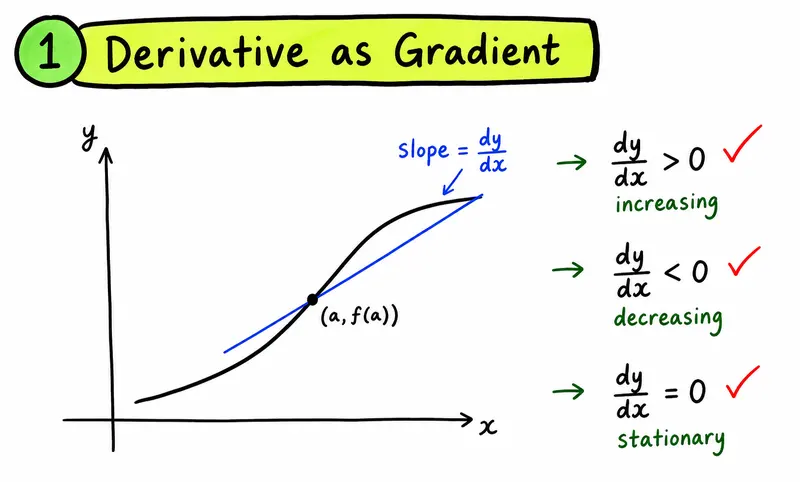
The derivative measures the instantaneous rate of change. On a graph, it is the gradient of the tangent at a point. This meaning is what turns differentiation from a rule list into an exam tool.
| Situation | What derivative tells you |
|---|---|
| dy/dx > 0 | Function increasing |
| dy/dx < 0 | Function decreasing |
| dy/dx = 0 | Possible stationary point |
| Derivative at x = a | Tangent gradient at that point |
Tangents and Normals
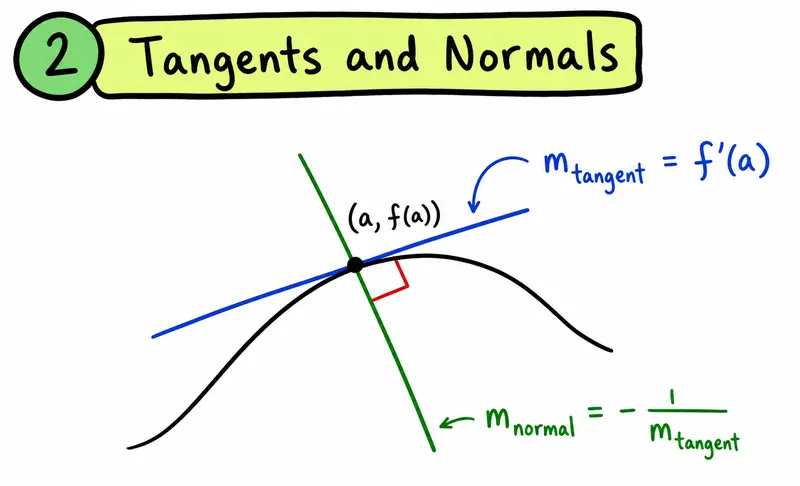
To find a tangent, differentiate, substitute the x-coordinate, then use the point-gradient form of a line.
For a normal, first find the tangent gradient. Then use the negative reciprocal, provided the tangent gradient is not zero. Students often lose marks by using the tangent gradient for the normal.
Stationary Points
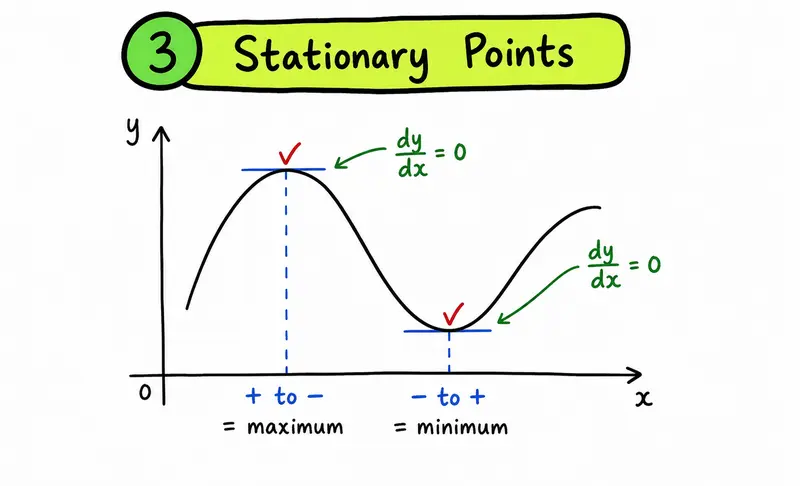
Stationary points occur when the first derivative is zero. But finding dy/dx = 0 is not the end. You may need to classify the point or interpret it in context.
Use increasing and decreasing functions to practise sign charts and interval reasoning.
Common Mistakes That Cost Marks
| Mistake | Fix |
|---|---|
| Treating derivative as y-value | Derivative is gradient |
| Forgetting to substitute the point | Tangent gradient needs the x-coordinate |
| Mixing tangent and normal gradients | Normal uses negative reciprocal |
| Solving dy/dx = 0 but not interpreting | Classify or explain the result |
| Dropping brackets in chain rule | Differentiate inside and outside carefully |
Topic-Specific Revision Route
Spend ten minutes on derivative rules, ten minutes on tangent and normal questions, ten minutes on stationary points, and ten minutes on exam-style mixed practice.
Use Maths AA Notes - Calculus and Maths AA Compressed Syllabus - Topic 5 Calculus as revision resources.
Worked Example 1
Worked Example 1: Set Up the Method Before Calculating
Question: A student sees a Differentiation question and starts substituting numbers immediately. What should they write first?
Worked answer: Write the known values, choose the relevant rule, and state what the question is asking for. For a trigonometry or calculus question, this might mean labelling the side or function, choosing SOHCAHTOA, differentiation, or integration, and only then doing the calculation.
Markscheme-style answer: Identifies the required quantity; selects a valid mathematical method; substitutes values consistently; gives the final answer with correct units or notation where required.
Worked Example 2: Check the Reasonableness of the Answer
Question: Why should you estimate before accepting a final answer in
Worked answer: Estimating catches sign, scale, and calculator-entry errors. If an angle should be acute but the answer is over 90 degrees, or an area is negative when the region is above the axis, the working needs checking.
Markscheme-style answer: Uses a reasonableness check; compares the answer with the diagram or context; corrects inconsistent sign, unit, or magnitude errors.
Question-Type Breakdown
Differentiation questions test rates of change, gradients, and turning points. Decide which role the derivative is playing.
| Question type | What it is really asking | First move | Common trap |
|---|---|---|---|
| Basic derivative | Find dy/dx | Apply power rule carefully | Dropping the coefficient |
| Tangent gradient | Gradient at a point | Differentiate, then substitute x | Substituting before differentiating |
| Normal gradient | Perpendicular gradient | Find tangent gradient, then negative reciprocal | Using the same gradient |
| Stationary point | Where gradient is zero | Set dy/dx = 0 | Forgetting to classify the point |
| Increasing/decreasing | Sign of derivative | Test intervals or solve inequality | Looking only at the original function |
Weak Answer vs Mark-Worthy Answer
Weak method:
- I differentiated because the question had a curve.
Strong method:
- I identified what the derivative represents in this question: a gradient, a rate of change, a stationary point condition, or an increasing/decreasing interval.
When you mark your work, label mistakes as rule, substitution, or interpretation. This makes it obvious whether you need more algebra practice or better question-reading practice.
Exam-Ready Mini Checklist
| Check | What good work looks like |
|---|---|
| task type identified | checked before moving on |
| derivative correct | checked before moving on |
| condition applied | checked before moving on |
| coordinates checked | checked before moving on |
| final format matched | checked before moving on |
How EduNinja Helps
A clean revision loop is easier when the tools sit in one place. Rebuild the idea in EduNinja Notes, test it in the Questionbank, then turn every missed mark into a flashcard or a follow-up AI Tutor prompt. That keeps the article's method practical: learn the concept, answer a real question, mark it, and fix the exact weakness.
FAQ
What does the derivative represent in IB Maths AA?
The derivative represents the rate of change of a function or the gradient of a curve at a point. In questions, decide whether it is being used for tangent gradient, motion, optimisation, or increasing and decreasing intervals.
How do I find the equation of a tangent?
Differentiate to find the gradient function, substitute the x-coordinate to get the tangent gradient, then use the point and gradient in a straight-line equation. Do not substitute before differentiating.
What is the gradient of a normal?
The normal is perpendicular to the tangent. Its gradient is the negative reciprocal of the tangent gradient, provided the tangent gradient is not zero.
How do I identify a stationary point?
Set the first derivative equal to zero and solve for x. Then classify the point using a sign change, second derivative, or context from the graph.
Related Study Links
- Explore the subject Study Hub
- IB Maths AA Notes
- IB Maths AA Question Bank
- Calculus SL content
- Review the inverse skill with IB Maths AA integration as anti-differentiation
Exam Strategy
In IB Maths AA, differentiation questions often hide the real task in the wording. If the question says tangent, you need a gradient and a line equation. If it says stationary point, you need dy/dx = 0 and usually a coordinate or classification. If it says increasing, you need a sign argument for the derivative over an interval.
Before starting, underline the command word and write what the derivative will represent in that question.
Put differentiation back into your full IB Maths AA SL study plan.
Return to the complete course overview, or move directly into the most relevant study tool.
Related articles
More course notes, updates and study resources from the EduNinja blog.
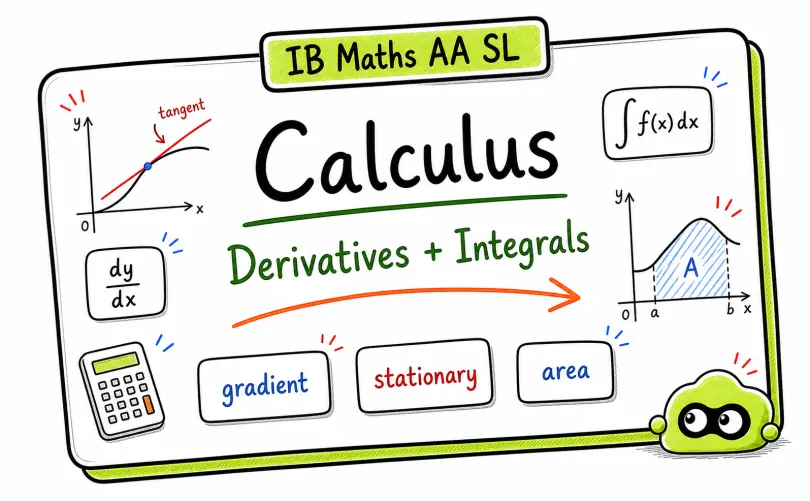
IB Maths AA SL Calculus: Differentiation and Integration Guide
Revise IB Maths AA SL calculus with derivative meaning, tangents, optimisation, integration, area, and calculator-safe exam routines.
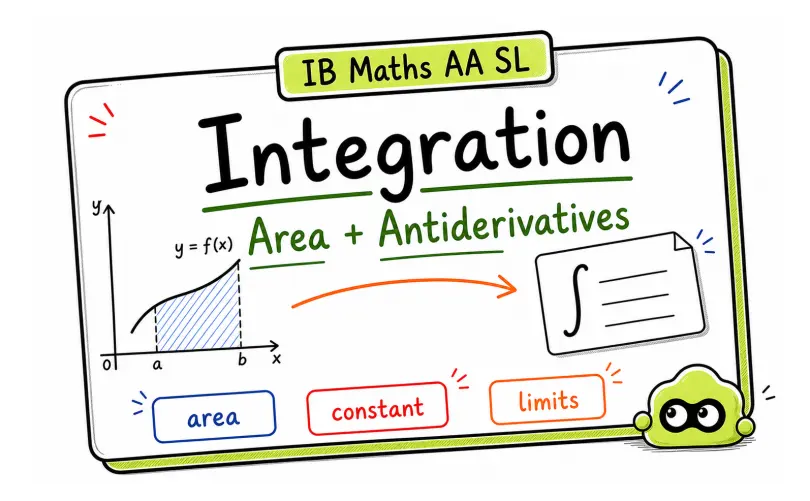
IB Maths AA Integration: Area, Antiderivatives, and Common Mistakes
Revise IB Maths AA integration with antiderivatives, definite integrals, area under curves, + C, limits, and common exam mistakes. Includes examples and targeted FAQ.
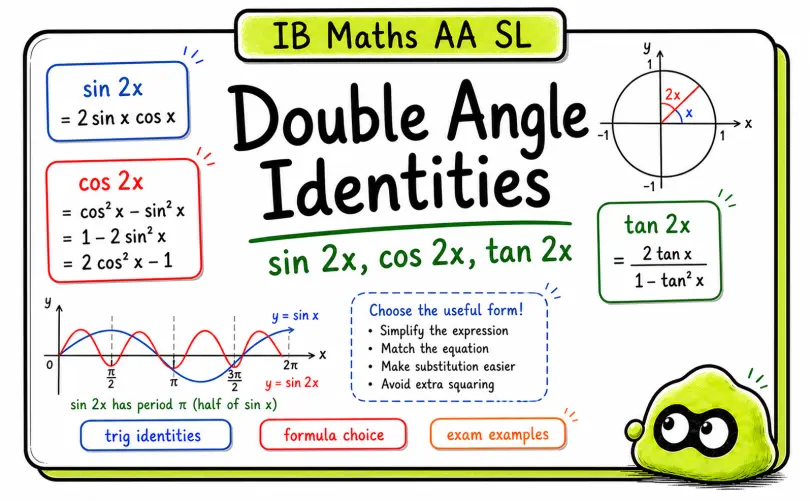
Double Angle Identities Explained with Examples
Learn double angle identities for IB Maths AA with sin 2x, cos 2x, tan 2x formulas, worked examples, common mistakes and practice.