IGCSE Maths Similar Shapes: Scale Factors, Area, and Volume
A source-backed CAIE Mathematics guide for IGCSE Maths similar shapes, using EduNinja PDF notes, worked examples, and markscheme-style answers.
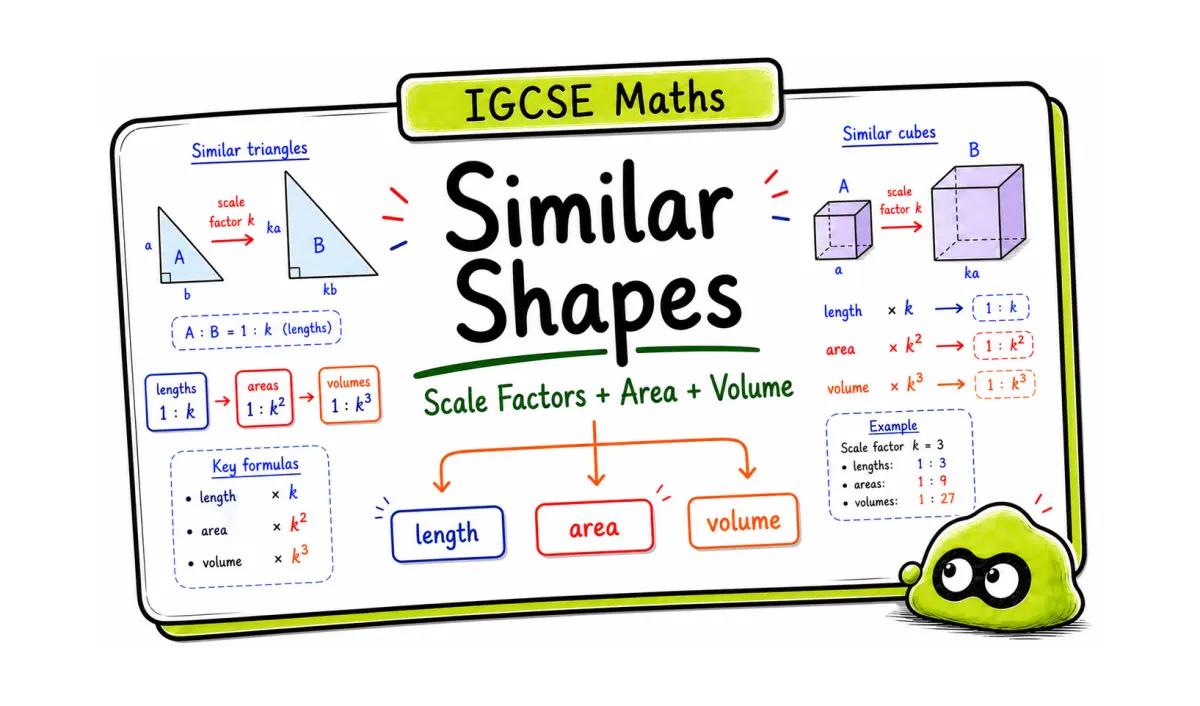
IGCSE Maths similar shapes questions are usually not hard because of the arithmetic. They go wrong because students use the same scale factor for length, area and volume.
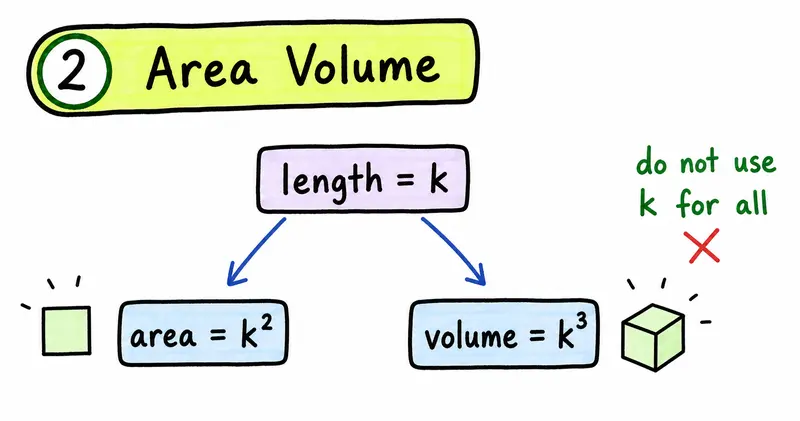
The safe rule is short: use k for lengths, k^2 for areas and k^3 for volumes. Before calculating, decide what kind of quantity the question asks for. A side length, perimeter and radius use the length scale factor. Area and surface area use the square of it. Volume and capacity use the cube of it.
This guide is for CAIE IGCSE Mathematics revision. It is a student revision guide, not an official syllabus document. Use it to rebuild the method, then practise with exam-style questions.
Useful starting points:
- IGCSE Maths notes
- IGCSE Mathematics Question Bank
- IGCSE Maths Past Examination Papers Classified by Topic
- C5.1.1 metric units question bank
- E5.1.1 metric units question bank
Start with the notes if the rule feels unclear. Move to the question bank once you can decide whether the question is asking for length, area or volume without guessing.
Quick answer
- Similar shapes have the same shape but different sizes.
- Corresponding angles are equal.
- Corresponding sides are in the same ratio.
- Length scale factor = new length / original length.
- If the length scale factor is k, the area scale factor is k^2.
- If the length scale factor is k, the volume scale factor is k^3.
- Perimeter uses the length scale factor.
- Surface area uses the area scale factor.
- If you move from the larger shape to the smaller shape, you may need the reciprocal scale factor.
- To find k from areas, take the square root of the area scale factor.
- To find k from volumes, take the cube root of the volume scale factor.
Keep one question in your head: is this length, area or volume?
Similar shapes: what has to match
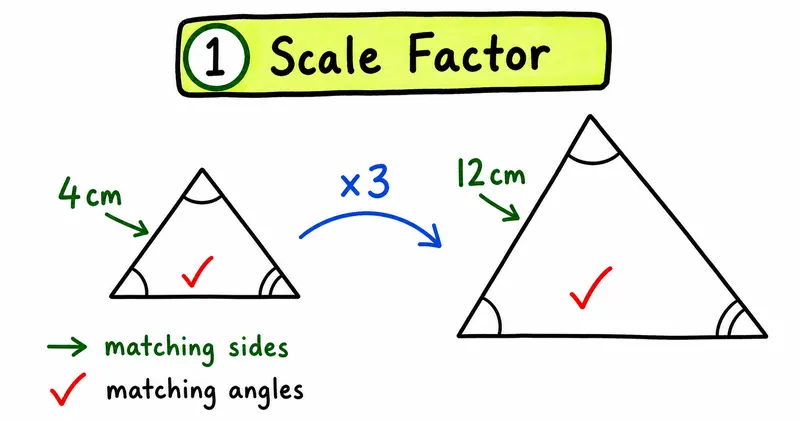
Two shapes are similar when one is an enlargement of the other. The angles stay the same. The side lengths change by the same scale factor.
| Feature | Similar shapes |
|---|---|
| Angles | Corresponding angles are equal |
| Sides | Corresponding sides are in the same ratio |
| Shape | Same shape |
| Size | Can be different |
The word corresponding matters. You must compare matching sides, not whichever two numbers are nearest in the diagram.
Weak:
- The scale factor is 3 because 6 and 18 are in the shapes.
Better:
- The matching side on the larger shape is 18 cm and the corresponding side on the smaller shape is 6 cm, so the length scale factor from small to large is 18 / 6 = 3.
Length, area and volume scale factors
The main exam rule is:
| Quantity | Scale factor to use | Examples |
|---|---|---|
| Length | k | Side length, radius, diameter, perimeter |
| Area | k^2 | Area, surface area, cross-sectional area |
| Volume | k^3 | Volume, capacity |
Area uses k^2 because area depends on two dimensions. Volume uses k^3 because volume depends on three dimensions.
If the length scale factor is 4, the area scale factor is 16 and the volume scale factor is 64. Do not carry the 4 through the whole question unless every quantity is a length.
How to choose the right scale factor
Before using any number, label the quantity in the question.
| Quantity asked for | Use |
|---|---|
| Side length, radius, diameter, perimeter | k |
| Area, surface area, cross-sectional area | k^2 |
| Volume, capacity | k^3 |
| Mass of similar solids with same density | k^3 |
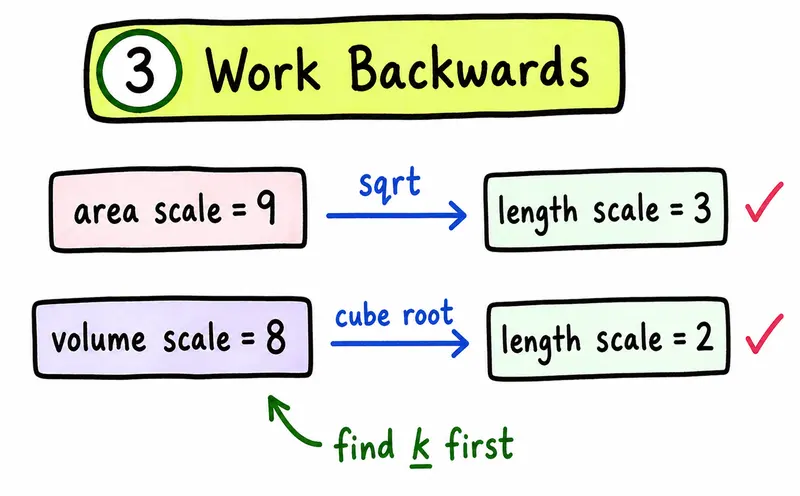
If the question gives area but asks for length, first find the area scale factor, then take the square root. If the question gives volume but asks for length, first find the volume scale factor, then take the cube root.
The exam trap is choosing the wrong row, not the arithmetic.
Worked example 1: finding a missing length
Question: Two similar triangles have corresponding sides of 5 cm and 20 cm. Another side on the smaller triangle is 7 cm. Find the corresponding side on the larger triangle.
Mark-worthy answer:
The length scale factor from small to large is 20 / 5 = 4. The corresponding side on the larger triangle is 7 x 4 = 28 cm.
Why it works:
The answer finds k from corresponding sides before using it. That matters more than the multiplication.
Worked example 2: area scale factor
Question: Two similar shapes have a length scale factor of 3 from shape A to shape B. Shape A has area 12 cm2. Find the area of shape B.
Mark-worthy answer:
The area scale factor is 3^2 = 9. Area of shape B = 12 x 9 = 108 cm2.
Why it works:
The answer squares the length scale factor because area is two-dimensional.
Worked example 3: volume scale factor
Question: Two similar solids have a length scale factor of 2 from solid A to solid B. Solid A has volume 50 cm3. Find the volume of solid B.
Mark-worthy answer:
The volume scale factor is 2^3 = 8. Volume of solid B = 50 x 8 = 400 cm3.
Why it works:
The answer cubes the length scale factor because volume is three-dimensional.
Reverse scale factors
Some questions give information about the larger shape and ask for the smaller one. In that case, check the direction of the scale factor.
If the scale factor from small to large is 5, the scale factor from large to small is 1/5.
| Direction | Length factor | Area factor | Volume factor |
|---|---|---|---|
| Small to large | 5 | 25 | 125 |
| Large to small | 1/5 | 1/25 | 1/125 |
The direction should be written before the calculation. It stops you multiplying when you should divide.
Worked example 4: working backwards from area
Question: Two similar shapes have areas 20 cm2 and 180 cm2. Find the length scale factor from the smaller shape to the larger shape.
Mark-worthy answer:
The area scale factor is 180 / 20 = 9. The length scale factor is the square root of 9, so k = 3.
Why it works:
The question gives areas, so the first ratio is an area scale factor. You must take the square root to get the length scale factor.
Worked example 5: finding length scale factor from volume
Question: Two similar solids have volumes 40 cm3 and 320 cm3. Find the length scale factor from the smaller solid to the larger solid.
Mark-worthy answer:
The volume scale factor is 320 / 40 = 8.
Since volume scale factor is k^3, the length scale factor is the cube root of 8.
k = 2
The length scale factor from the smaller solid to the larger solid is 2.
Why it works:
The answer does not treat the volume ratio as the length scale factor. It recognises that volume uses k^3, so the cube root is needed.
Similar solids: surface area is not volume
For similar solids, all corresponding lengths are in the same ratio. That includes edges, radii, heights and diameters.
Surface area uses k^2 because it is still an area. Volume uses k^3 because it depends on three dimensions.
A common mistake is to use k^3 for surface area just because the shape is 3D. Do not do that. The quantity decides the scale factor, not only the object.
Compound similar shapes: find k first
Some exam questions use compound shapes or diagrams with several lengths. Do not compare random sides. First identify a pair of corresponding sides.
A safe method is:
- Mark the matching sides.
- Find the length scale factor k.
- Decide whether the question asks for length, area or volume.
- Use k, k^2 or k^3.
- Check whether the direction is small to large or large to small.
If you choose the wrong corresponding sides, every later calculation will be wrong even if the scale factor rule is correct.
Surface area, capacity and mass
Surface area follows the area rule. If the length scale factor is k, the surface area scale factor is k^2.
Capacity usually follows the volume rule because it measures how much a container can hold. If the length scale factor is k, the capacity scale factor is k^3.
Mass can follow the volume rule when two similar solids are made from the same material and have the same density. In that case, mass is proportional to volume. If the density changes, you cannot assume the same rule.
| Quantity in the question | Usually use |
|---|---|
| Perimeter | k |
| Surface area | k^2 |
| Capacity | k^3 |
| Mass, same material | k^3 |
Worked example 6: mass of similar solids
Question: Two similar metal blocks are made from the same material. The length scale factor from block A to block B is 3. Block A has mass 2 kg. Find the mass of block B.
Mark-worthy answer:
Since the blocks are made from the same material, mass is proportional to volume. The volume scale factor is 3^3 = 27. Mass of block B = 2 x 27 = 54 kg.
Why it works:
The answer explains the condition. Same material allows mass to scale with volume because density is unchanged.
Common mistakes that cost marks
- Comparing sides that are not corresponding.
- Using k for area.
- Using k^2 for volume.
- Forgetting that perimeter uses the length scale factor.
- Forgetting that surface area uses k^2.
- Multiplying when the question asks from larger to smaller.
- Treating mass like volume when the solids are not made from the same material.
- Giving the right number with the wrong unit.
The fix is to write the quantity type beside the question. For example: "This asks for area, so use k^2."
Exam question types
| Question type | First move | Common trap |
|---|---|---|
| Missing length | Find k from corresponding sides | Using non-matching sides |
| Missing area | Square the length scale factor | Using k |
| Missing volume | Cube the length scale factor | Using k^2 |
| Given area, find length | Take the square root of the area factor | Forgetting to reverse k^2 |
| Given volume, find length | Take the cube root of the volume factor | Treating volume factor as k |
| Larger to smaller | Use the reciprocal factor | Multiplying instead of dividing |
Sort the question before calculating. Most similar shapes errors happen in the first ten seconds.
A short revision route
- Write the three rules from memory: length k, area k^2, volume k^3.
- Practise one missing length question.
- Practise one area question and one volume question.
- Practise one reverse question where the answer gets smaller.
- Mark your work and write the first wrong step as a correction.
Do not only reread the rule. Similar shapes is a method topic. You need to choose the correct scale factor under exam wording.
How to use EduNinja for this topic
Use the notes page to rebuild the rule, then move into question practice. Similar shapes questions are best revised in short sets because one wrong habit repeats fast.
Good next links:
- IGCSE Mathematics Question Bank
- C5.1.1 metric units question bank
- E5.1.1 metric units question bank
- IGCSE Maths notes
Keep an error log with three columns: quantity type, scale factor used, correction. That format makes it easy to spot whether you keep using k when you need k^2 or k^3.
FAQ
What is the scale factor for similar shapes?
The length scale factor is the ratio between corresponding lengths. If a side changes from 4 cm to 12 cm, the length scale factor is 12 / 4 = 3.
What is the area scale factor for similar shapes?
If the length scale factor is k, the area scale factor is k^2. A length scale factor of 4 gives an area scale factor of 16.
What is the volume scale factor for similar solids?
If the length scale factor is k, the volume scale factor is k^3. A length scale factor of 2 gives a volume scale factor of 8.
Does perimeter use k or k^2?
Perimeter uses k because perimeter is a length around the shape. Area uses k^2.
Do similar shapes always have the same angles?
Yes. Similar shapes have equal corresponding angles and corresponding sides in the same ratio.
Is surface area scale factor k^2 or k^3?
Surface area uses k^2, even for 3D solids, because surface area is an area. Volume uses k^3.
How do I find the length scale factor from areas?
Find the area scale factor first, then take the square root. For example, if the area scale factor is 25, the length scale factor is 5.
How do I find the length scale factor from volumes?
Find the volume scale factor first, then take the cube root. For example, if the volume scale factor is 64, the length scale factor is 4.
Closing
Similar shapes becomes manageable when you label the quantity before using the scale factor. Length uses k, area uses k^2 and volume uses k^3. Most marks come from choosing the right row before the arithmetic begins.
Choose a course and continue studying.
Pick your curriculum and subject, then continue into the right question bank or notes.
Related articles
More course notes, updates and study resources from the EduNinja blog.
Piecewise Functions Explained | IB Maths AA
Revise IB Maths AA piecewise functions with interval rules, endpoint notation, graphs, evaluation steps, common mistakes and practice.
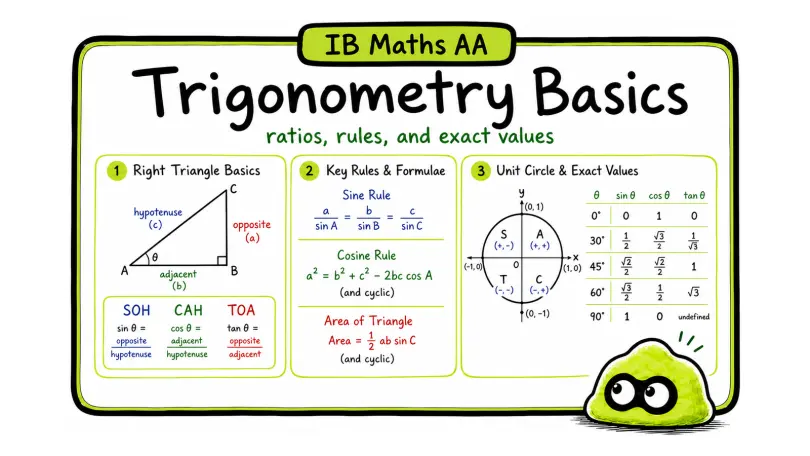
Trigonometry Basics for Exams | IB Maths AA
Learn IB Maths AA trigonometry basics with SOH CAH TOA, sine and cosine rules, area, unit-circle signs, exact values and exam practice.
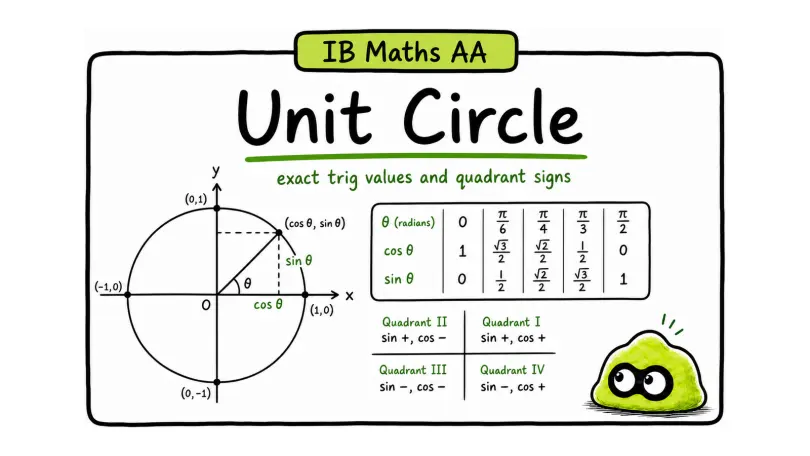
Unit Circle Explained | IB Maths AA
Learn the unit circle for IB Maths AA with exact trigonometric values, radians, quadrants, signs and exam methods.