Ionization Energy Definition and Trends | IB Chemistry
Understand ionization energy with its definition, periodic trends, shielding, atomic radius, anomalies and exam methods.
Ionization energy is the energy required to remove an electron from an atom or ion. In exam questions, the phrase first ionization energy has a precise meaning: the minimum energy required to remove one mole of electrons from one mole of gaseous atoms in their ground state. The main trend is an increase across a period and a decrease down a group, explained by nuclear charge, shielding and atomic radius.
Quick Answer
First ionization energy measures how strongly the nucleus holds the outermost electron. Across a period, nuclear charge increases while the outer electron remains in the same main shell, so ionization energy generally increases. Down a group, extra shells increase shielding and atomic radius, so the outer electron is easier to remove.
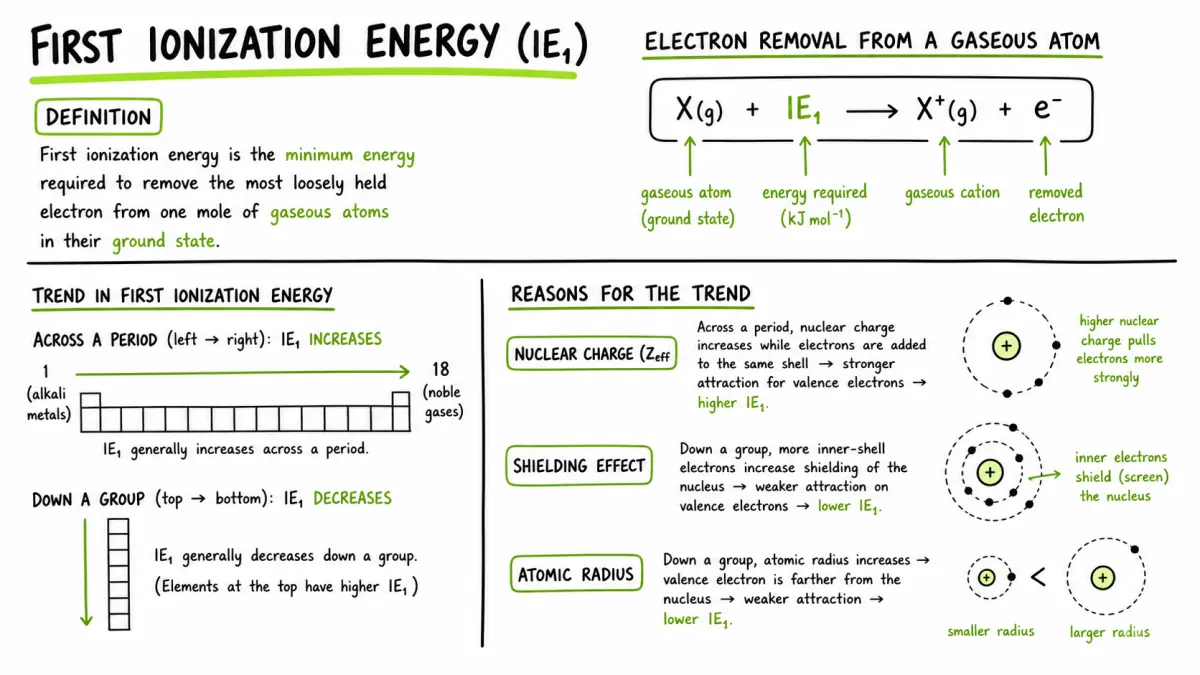
Definition of First Ionization Energy
The definition to learn is:
The minimum energy required to remove one mole of electrons from one mole of gaseous atoms in their ground state.
The state words matter. The atoms must be gaseous, the electrons are removed from atoms rather than ions for the first ionization energy, and the amount is measured per mole. A symbolic equation is:
X(g) -> X+(g) + e-
The process is endothermic because energy must be supplied to overcome the attraction between the positive nucleus and the electron.
Ionization Energy Across a Period
First ionization energy generally increases from left to right across a period. The number of protons increases, so the nuclear charge becomes greater. Electrons are added to the same main energy level, so shielding does not increase enough to cancel the stronger attraction. The outer electron is held more strongly and more energy is needed to remove it.
Use this exam chain:
- Nuclear charge increases.
- Shielding is broadly similar because electrons enter the same shell.
- Effective nuclear attraction increases.
- Atomic radius generally decreases.
- First ionization energy increases.
Ionization Energy Down a Group
First ionization energy generally decreases down a group. Each step adds an occupied electron shell. The outer electron is farther from the nucleus and is shielded by more inner-shell electrons. Although nuclear charge also increases, the greater distance and shielding usually have the larger effect.
Write the explanation as a comparison, not as a list of unrelated facts: the outer electron in the lower element is farther from the nucleus and more shielded, so it experiences weaker attraction and requires less energy to remove.
What Causes the Trend?
| Factor | Effect on the outer electron | Effect on ionization energy |
|---|---|---|
| Nuclear charge | More protons increase attraction | Increases |
| Shielding | Inner electrons reduce attraction from the nucleus | Decreases |
| Atomic radius | A greater distance weakens attraction | Decreases |
| Electron pairing | Repulsion can make one paired electron easier to remove | Can create a small drop |
The final value is a balance between these factors. Do not claim that nuclear charge alone explains every trend.
Common Anomalies Across a Period
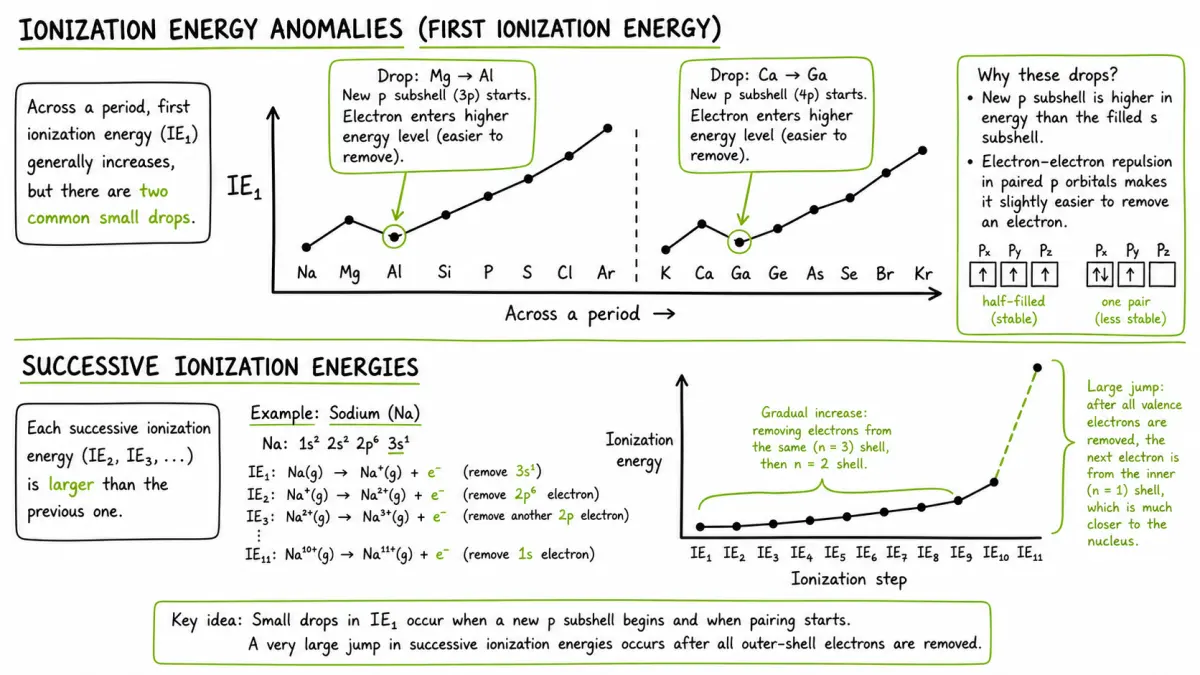
The general increase has small drops. A common example is the drop from magnesium to aluminium. Magnesium has its outer electron in a filled 3s subshell, while aluminium begins a higher-energy 3p subshell. The 3p electron is easier to remove, so aluminium has a slightly lower first ionization energy.
Another drop occurs from phosphorus to sulfur. In sulfur, two electrons occupy one 3p orbital. Repulsion between the paired electrons makes one easier to remove than an electron in the half-filled 3p arrangement of phosphorus.
Successive Ionization Energies
Successive ionization energies remove electrons one at a time from the same species. Each value is larger than the previous one because the ion becomes more positive and holds the remaining electrons more strongly. A very large jump shows that the next electron is being removed from an inner shell rather than the outer shell.
For example, a large jump after the second ionization energy suggests that an atom originally had two outer-shell electrons. This is useful for identifying the group of an element from a graph or data table.
Common Exam Mistakes
| Mistake | Better wording |
|---|---|
| Saying ionization energy is the energy to remove one electron | State one mole of electrons and one mole of gaseous atoms |
| Saying shielding increases across a period by the same amount as nuclear charge | Say electrons enter the same main shell, so shielding changes only slightly |
| Ignoring distance down a group | Include increased atomic radius and weaker attraction |
| Calling every drop an exception without explaining it | Identify a new subshell or electron-pair repulsion |
| Treating successive ionization energies as identical | State that each successive removal requires more energy |
Mini Practice
Explain why the first ionization energy of aluminium is lower than that of magnesium.
Answer guide: Aluminium's outer electron enters a higher-energy 3p subshell, whereas magnesium's outer electron is in the filled 3s subshell. The 3p electron is less strongly held and easier to remove, so less energy is required.
Practice This Topic
Practise IB Chemistry ionization-energy questions, then use the definition, trend and explanation chain in your answers.
FAQ
What is the definition of first ionization energy?
It is the minimum energy required to remove one mole of electrons from one mole of gaseous atoms in their ground state.
Why does ionization energy decrease down a group?
The outer electron is farther from the nucleus and more shielded by inner shells, so the attraction is weaker and less energy is required for removal.
Why are there drops in the general trend across a period?
The common drops occur when an electron enters a higher-energy p subshell or when electron pairing creates additional repulsion, making an electron easier to remove.
Related Study Links
- Review the complete syllabus Study Hub
- IB Chemistry ionization-energy questions
- Transition metals explained for IB Chemistry
- Arrhenius equation explained for IB Chemistry
Final Takeaway
Explain ionization-energy trends through nuclear charge, shielding and distance. Then check for subshell and pairing anomalies before giving a final comparison.
Put ionization energy back into your full IB Chemistry SL study plan.
Return to the complete course overview, or move directly into the most relevant study tool.
Related articles
More course notes, updates and study resources from the EduNinja blog.

IB Chemistry SL 2025 Syllabus Changes: Assessment Guide
A practical IB Chemistry SL guide to the 2025 syllabus and assessment model: structure and reactivity, Paper 1A and 1B, Paper 2, scientific investigation and revision strategy.
Electron Domains and Molecular Geometry | A-Level Chemistry
Revise A-Level Chemistry electron domains, VSEPR shapes, lone pairs, bond angles, molecular geometry and common exam mistakes.
Salt Bridge Explained | A-Level Chemistry
Learn the function of a salt bridge in A-Level Chemistry, including ion movement, electrical neutrality, cell circuits and exam mistakes.