Electron Domains and Molecular Geometry | A-Level Chemistry
Revise A-Level Chemistry electron domains, VSEPR shapes, lone pairs, bond angles, molecular geometry and common exam mistakes.
Electron Domains and Molecular Geometry | A-Level Chemistry
When an A-Level Chemistry question asks for a molecular shape or bond angle, the quickest route is to count electron domains around the central atom. Electron-domain geometry is the VSEPR method for predicting how bonding pairs and lone pairs arrange themselves to minimise repulsion. This guide applies that method to common AS Chemistry shapes and explains the mistakes that cost marks.
Quick Answer
- An electron domain is a region of electron density around a central atom.
- A bonding pair counts as one domain, whether the bond is single, double or triple.
- Each lone pair also counts as one domain.
- Electron domains repel and arrange as far apart as possible.
- Lone-pair repulsion is stronger than bonding-pair repulsion.
- The molecular shape describes the positions of atoms, not the lone pairs.
What Are Electron Domains?
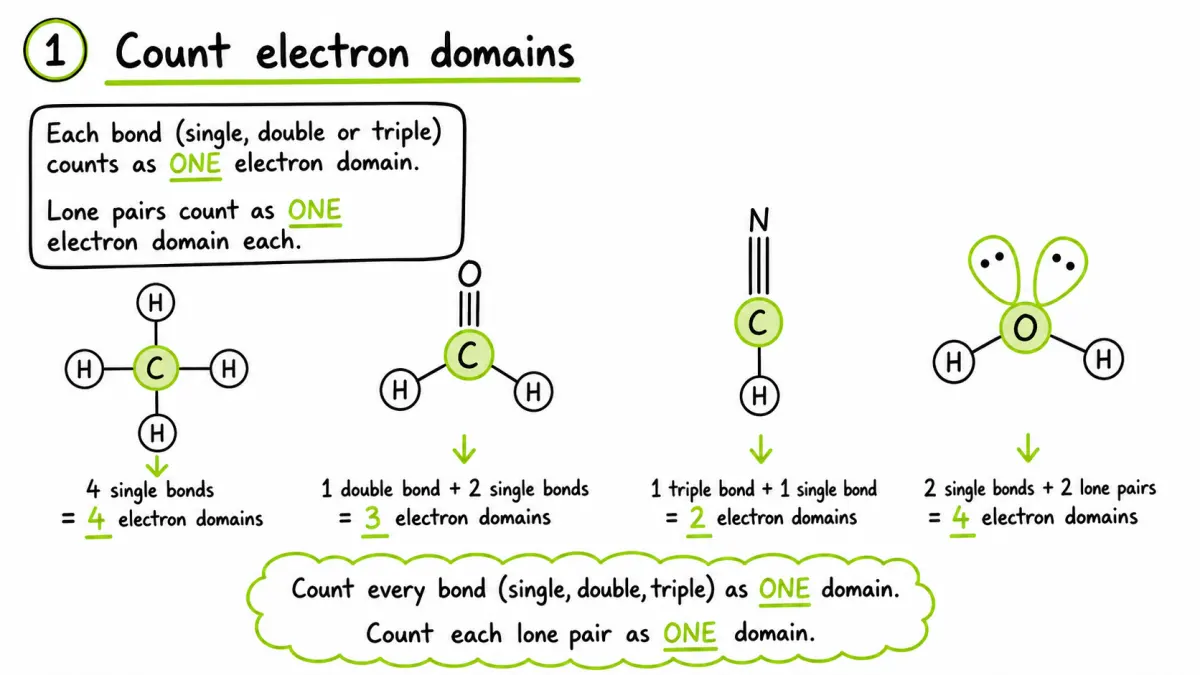
Electron domains are regions of negative charge around a central atom. In A-Level Chemistry, count the regions around the central atom before naming the shape. A single bond, double bond or triple bond is counted as one bonding domain because each bond connects the central atom to one surrounding atom.
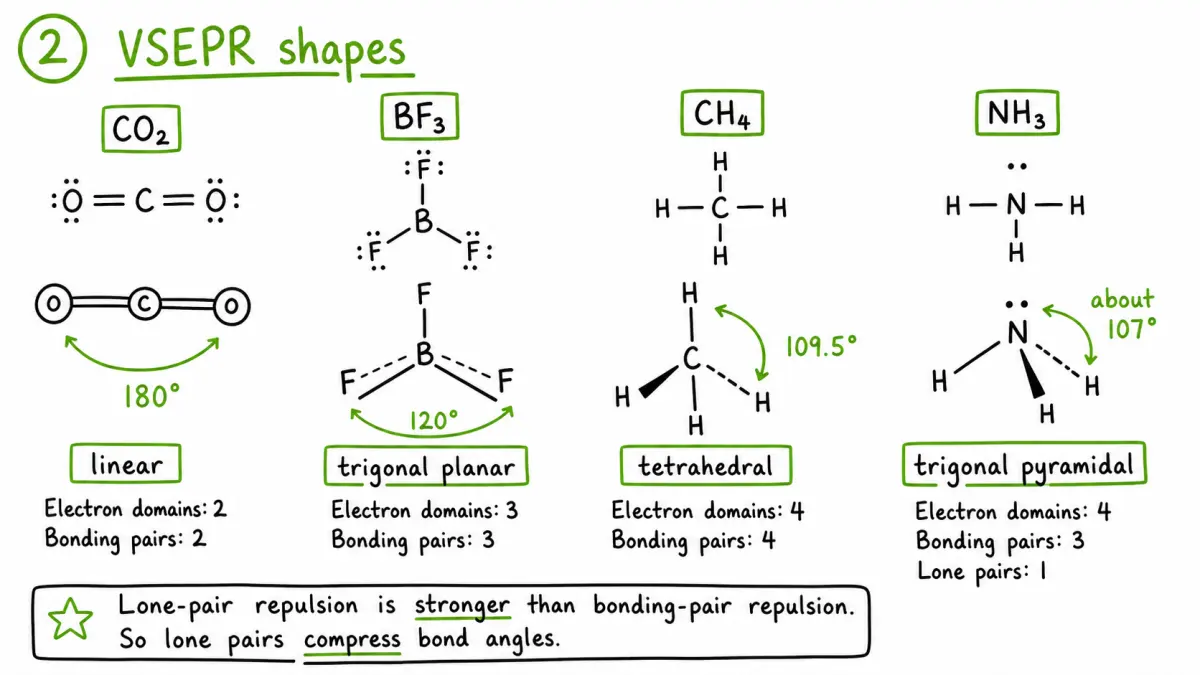
For example, carbon dioxide has two bonding domains around carbon and no lone pairs on the central atom. The domains move to opposite sides, giving a linear shape with a bond angle of 180 degrees. Methane has four bonding domains around carbon, so its shape is tetrahedral.
VSEPR Shapes and Bond Angles
| Electron domains | Lone pairs on central atom | Molecular shape | Approximate angle |
|---|---|---|---|
| 2 | 0 | Linear | 180 degrees |
| 3 | 0 | Trigonal planar | 120 degrees |
| 3 | 1 | Bent | Less than 120 degrees |
| 4 | 0 | Tetrahedral | 109.5 degrees |
| 4 | 1 | Pyramidal | About 107 degrees |
| 4 | 2 | Bent | About 104.5 degrees |
The exact angle changes when lone pairs are present because lone pairs occupy more space than bonding pairs. A lone pair pushes bonding pairs closer together, so the observed bond angle is smaller than the ideal electron-domain angle.
How to Find the Shape Step by Step
- Draw or identify the Lewis structure.
- Choose the central atom and count its bonding domains.
- Count the lone pairs on the central atom.
- Add the domains to identify the electron-domain arrangement.
- Name the molecular shape using the atom positions only.
- State the approximate bond angle and explain any reduction caused by lone pairs.
Worked Example: Ammonia
Ammonia, NH3, has three N-H bonding pairs and one lone pair around nitrogen. That gives four electron domains and a tetrahedral electron-domain arrangement. Because the lone pair is not shown as an atom, the molecular shape is trigonal pyramidal. The lone pair repels the bonding pairs more strongly, reducing the angle from 109.5 degrees to about 107 degrees.
Common Exam Mistakes
- Counting a double bond as two electron domains. It is one domain.
- Calling NH3 tetrahedral without distinguishing electron-domain geometry from molecular shape.
- Saying lone pairs repel less strongly than bonding pairs. The opposite is true.
- Giving an exact-looking angle without explaining why lone pairs change the ideal value.
- Forgetting to identify the central atom before counting domains.
Practice This Topic
Try this exam-style question:
Predict the shape and approximate bond angle of H2O, and explain why its angle is smaller than the tetrahedral angle.
Answer guide:
- Oxygen has two bonding pairs and two lone pairs, giving four electron domains.
- The electron-domain arrangement is tetrahedral.
- The molecular shape is bent because only the hydrogen atom positions are used to name the shape.
- Lone-pair repulsion is stronger than bonding-pair repulsion, so the H-O-H angle is reduced to about 104.5 degrees.
Practice this topic
Practise A-Level Chemistry molecular-shape questions
FAQ
Does a double bond count as two electron domains?
No. A double bond counts as one electron domain because it is one region of electron density between the central atom and one surrounding atom. The additional shared pair affects electron density, but it does not create a second direction of repulsion for VSEPR counting.
What is the difference between electron-domain geometry and molecular shape?
Electron-domain geometry includes bonding pairs and lone pairs. Molecular shape describes the arrangement of atoms only. For example, water has tetrahedral electron-domain geometry but a bent molecular shape because its two lone pairs are not named as atoms in the shape.
Why do lone pairs reduce bond angles?
Lone pairs are attracted only to the central nucleus, so their electron density is concentrated closer to the central atom. They repel other electron domains strongly and push bonding pairs closer together, reducing the measured bond angle.
Related Study Links
- Review the complete syllabus Study Hub
- Review A-Level Chemistry AS concepts
- Practise A-Level Chemistry questions
- Revise sigma and pi bonds
- Open the A-Level Chemistry bonding revision guide
Final Takeaway
Count electron domains first, then separate electron-domain geometry from molecular shape. Treat each bond as one domain, count lone pairs carefully and use their stronger repulsion to explain reduced bond angles.
Put electron domains back into your full A-Level CAIE Chemistry AS study plan.
Return to the complete course overview, or move directly into the most relevant study tool.
Related articles
More course notes, updates and study resources from the EduNinja blog.

IB Chemistry SL 2025 Syllabus Changes: Assessment Guide
A practical IB Chemistry SL guide to the 2025 syllabus and assessment model: structure and reactivity, Paper 1A and 1B, Paper 2, scientific investigation and revision strategy.
Salt Bridge Explained | A-Level Chemistry
Learn the function of a salt bridge in A-Level Chemistry, including ion movement, electrical neutrality, cell circuits and exam mistakes.
Sigma and Pi Bonds Explained | A-Level Chemistry
Revise A-Level Chemistry sigma and pi bonds with orbital overlap, single, double and triple bonds, rotation, common mistakes and practice.