Salt Bridge Explained | A-Level Chemistry
Learn the function of a salt bridge in A-Level Chemistry, including ion movement, electrical neutrality, cell circuits and exam mistakes.
Salt bridges are used in electrochemical cells to maintain electrical neutrality while ions move between the half-cells. In CAIE A-Level Chemistry AS, the key idea is simple: the salt bridge completes the internal circuit, allows ion movement and prevents charge build-up from stopping the cell reaction.
Quick Answer
A salt bridge is a tube or porous connection containing an inert electrolyte. It allows ions to migrate between the half-cells, keeps each solution approximately electrically neutral and completes the circuit without allowing the two main solutions to mix freely.
Why the Salt Bridge Matters
In a Daniell cell, oxidation at the zinc electrode produces Zn2+ ions, so the zinc half-cell becomes increasingly positive. Reduction at the copper electrode removes Cu2+ ions, so the copper half-cell becomes relatively negative. Without ion movement, this charge separation quickly stops electron flow through the external wire.
How a Salt Bridge Works
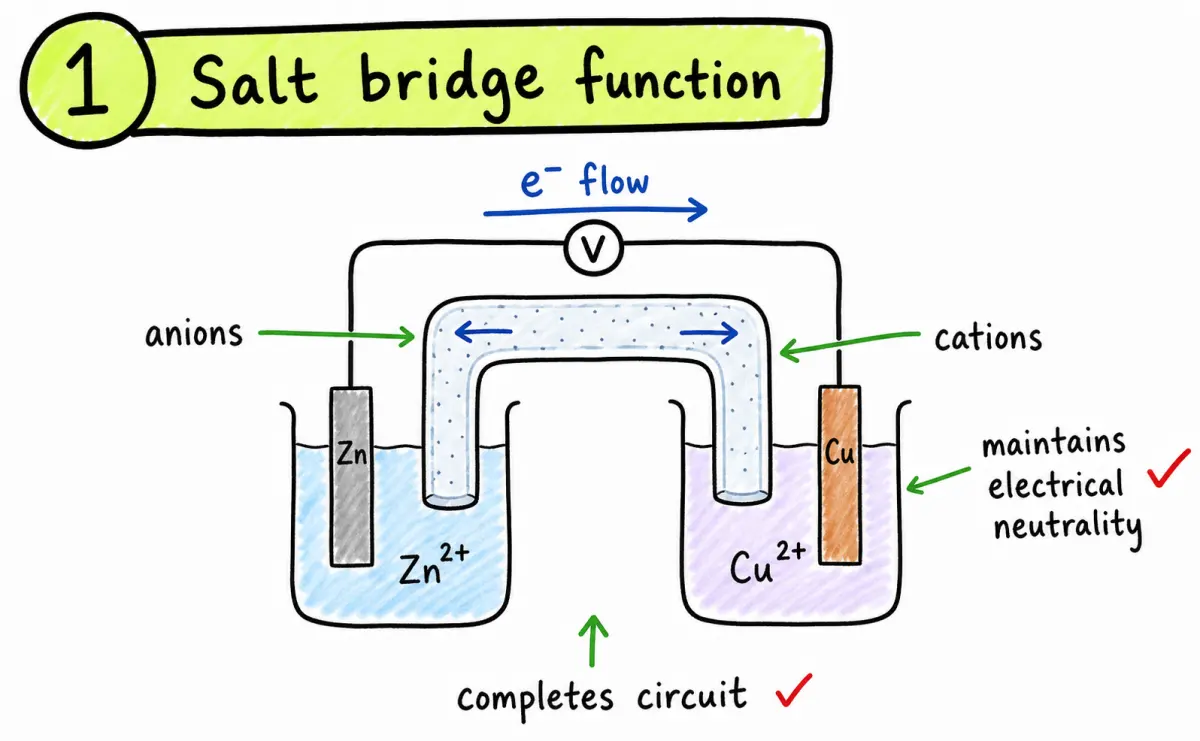
The electrolyte in the bridge should contain ions that do not react with the half-cell solutions, such as KNO3. Anions move towards the oxidation half-cell to balance the extra positive charge, while cations move towards the reduction half-cell to replace positive ions being removed from solution. Electrons still travel through the external circuit, not through the salt bridge.
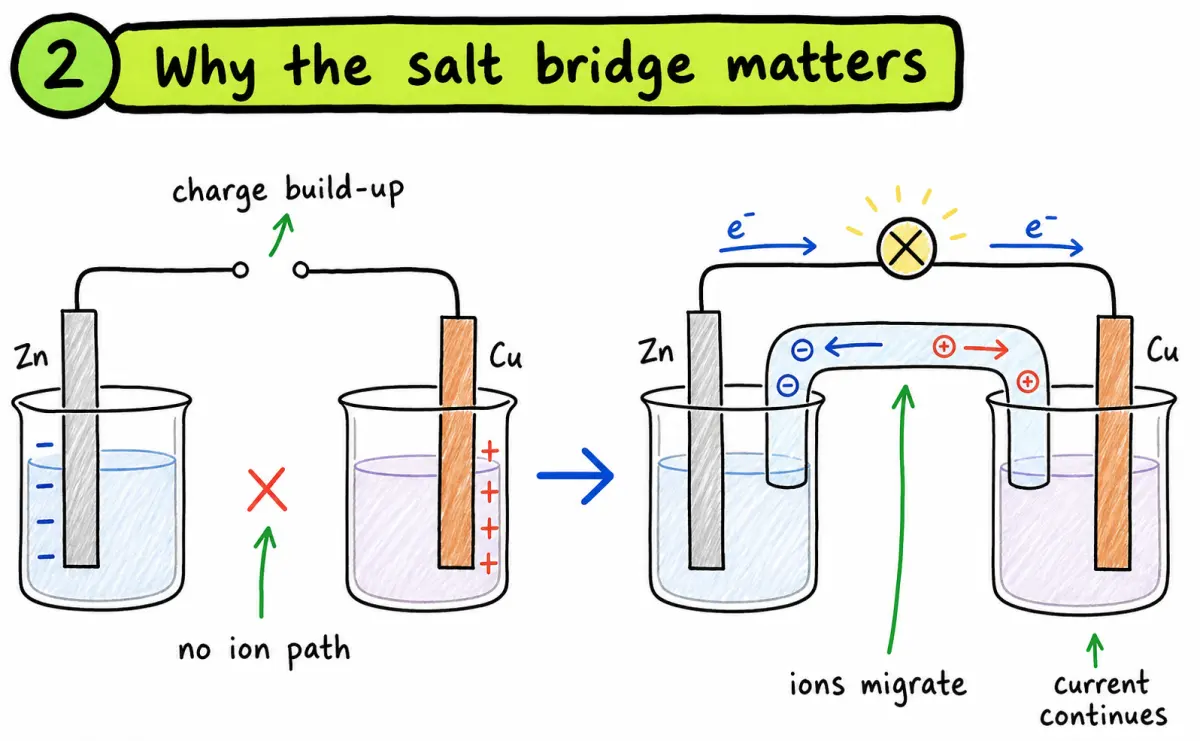
The salt bridge therefore has three linked functions:
- it completes the internal ionic circuit;
- it prevents excessive charge build-up in either half-cell;
- it separates the solutions while allowing charge to be carried by ions.
Worked Example
In a cell made from Zn/Zn2+ and Cu2+/Cu, identify the direction of movement for the salt-bridge ions.
Answer: Zinc is oxidised, so anions move towards the zinc half-cell. Copper ions are reduced, so cations move towards the copper half-cell. Electrons move from zinc to copper through the external wire.
Common Exam Mistakes
- Saying that electrons travel through the salt bridge. They travel through the external circuit.
- Saying that the salt bridge supplies electrons. It supplies mobile ions.
- Naming the salt bridge as the site of oxidation or reduction. Those processes occur at the electrodes.
- Forgetting that the electrolyte should be inert and soluble in the bridge solution.
Practice This Topic
Try this exam-style question:
In a Daniell cell, explain two functions of the salt bridge.
Answer guide:
- It allows ions to move between the half-cells and completes the internal circuit.
- It prevents charge build-up by maintaining approximate electrical neutrality in each half-cell.
Practice this topic
Practise CAIE A-Level Chemistry electrochemistry questions
FAQ
Why can the two solutions not simply be mixed?
Direct mixing could cause unwanted reactions and would remove the separation needed for a useful potential difference. The bridge permits controlled ion movement instead.
Why is potassium nitrate often used?
KNO3 is soluble and its ions are usually sufficiently unreactive in common electrochemical cells. The chosen electrolyte must not react with the electrodes or the ions in the half-cells.
Does the salt bridge carry electrons?
No. The external wire carries electrons. The salt bridge carries ions and maintains charge balance.
Related Study Links
- Open the full revision Study Hub
- Review CAIE A-Level Chemistry concepts
- Study the Faraday constant and electrolysis calculations
- Practise CAIE A-Level Chemistry electrochemistry questions
Final Takeaway
The salt bridge keeps an electrochemical cell running by allowing ions to move, maintaining electrical neutrality and completing the internal circuit. It carries ions, while electrons travel through the external wire.
Put salt bridge back into your full A-Level CAIE Chemistry AS study plan.
Return to the complete course overview, or move directly into the most relevant study tool.
Related articles
More course notes, updates and study resources from the EduNinja blog.

IB Chemistry SL 2025 Syllabus Changes: Assessment Guide
A practical IB Chemistry SL guide to the 2025 syllabus and assessment model: structure and reactivity, Paper 1A and 1B, Paper 2, scientific investigation and revision strategy.
Electron Domains and Molecular Geometry | A-Level Chemistry
Revise A-Level Chemistry electron domains, VSEPR shapes, lone pairs, bond angles, molecular geometry and common exam mistakes.
Sigma and Pi Bonds Explained | A-Level Chemistry
Revise A-Level Chemistry sigma and pi bonds with orbital overlap, single, double and triple bonds, rotation, common mistakes and practice.