IB Biology Enzymes: Active Site and Inhibition Guide
Revise IB Biology enzymes with active-site wording, induced fit, inhibition evidence, rate factors, immobilised enzymes, and markscheme-style answers.
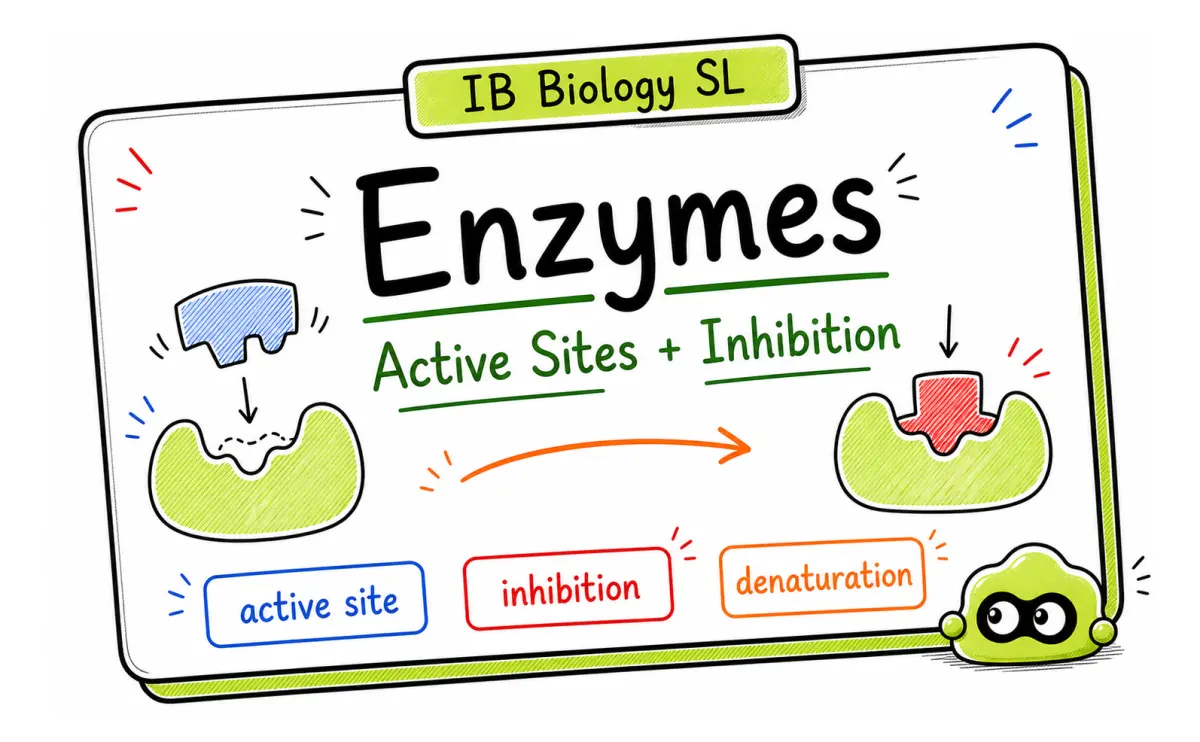
If you can define an enzyme but still lose marks on active site or inhibition questions, the problem is usually wording. IB Biology enzyme questions reward a specific chain: what the enzyme is, how the substrate interacts with the active site, why the rate changes, and what evidence shows the enzyme has been denatured or inhibited.
Current syllabus map: This article is aligned to the IB Biology first assessment 2025 roadmap, especially C1.1 enzymes and metabolism, active sites and inhibition.
This rewritten guide is based on EduNinja's C1.1 Enzymes and metabolism topic context and the IB Biology SL 2.5 Enzymes note. The source material highlights active sites, induced fit, molecular motion, temperature, pH, substrate concentration, denaturation, immobilized enzymes, and lactose-free milk production. The aim here is not to repeat the note. It is to turn it into exam wording you can actually use.
Use the relevant EduNinja course pages as your base:
Do not open every link at once. Start with the notes or topic page, then move into question practice and use any PDF resource only when it helps clarify the exact idea you are revising.
Quick Answer
For IB Biology enzymes, remember this mark-ready chain:
- An enzyme is a biological catalyst, usually a protein, that speeds up a reaction without being used up.
- The substrate binds to the enzyme's active site, forming an enzyme-substrate complex.
- In the induced-fit model, the substrate causes a small change in the enzyme's active site shape.
- Temperature, pH, and substrate concentration affect rate by changing collision frequency, active-site shape, or active-site saturation.
- Denaturation means the enzyme's shape has changed enough that the substrate no longer fits the active site.
- Competitive inhibitors block the active site; non-competitive inhibitors bind elsewhere and change the enzyme's shape.
- Immobilized enzymes are useful in industry because they can be reused and are easier to separate from the product.
The Core Definition That Gets Marks
A weak enzyme definition usually says, "enzymes speed up reactions." That is true, but incomplete. A stronger IB Biology answer says:
Enzymes are biological catalysts, usually proteins, that increase the rate of metabolic reactions in small amounts and remain chemically unchanged after the reaction.
That definition contains the words students often miss: biological catalyst, small amounts, and unchanged. Those words matter because they separate enzymes from reactants, products, and energy sources.
Weak Answer vs Better Answer
| Question | Weak answer | Better answer |
|---|---|---|
| What is an enzyme? | It helps a reaction happen. | It is a biological catalyst that increases reaction rate and remains unchanged after catalysis. |
| Why can enzymes be reused? | They do not disappear. | They are not used up in the reaction, so after releasing products the active site can bind another substrate. |
| Does an enzyme provide energy? | Yes, it gives energy to the reaction. | No. It lowers activation energy by providing a suitable active site and reaction pathway. |
The better answers are not longer for the sake of being longer. They include the mechanism.
Active Site, Substrate, and Induced Fit
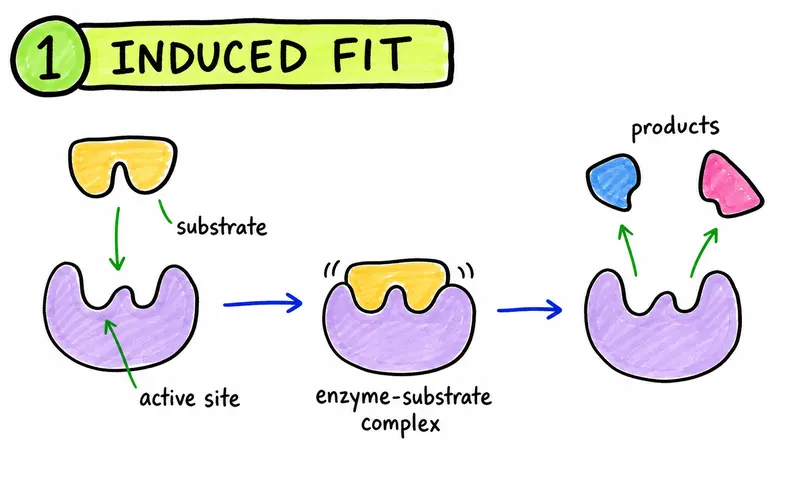
The active site is the small region of the enzyme where the substrate binds. A substrate is the molecule acted on by the enzyme. When the substrate binds, the temporary structure is called the enzyme-substrate complex. After the reaction, products are released and the enzyme can catalyse another reaction.
The old lock-and-key model is useful as a starting image, but IB answers are stronger when they use induced fit. In induced fit, the active site is not a perfectly rigid shape. The substrate binding causes a small shape change that improves the fit and helps catalysis.
Use this sequence in answers:
substrate binds active site -> enzyme-substrate complex forms -> induced fit improves catalysis -> products are released -> enzyme remains unchanged
That sequence prevents a common mistake: writing about enzyme shape without explaining the reaction step.
Worked Example 1: Active Site Wording
Question: Explain why a specific enzyme usually only catalyses one type of reaction.
Markscheme-style answer: A specific enzyme has an active site with a shape and chemical properties complementary to its substrate. The substrate binds to the active site to form an enzyme-substrate complex. In induced fit, binding causes a small change in enzyme shape that helps catalyse the reaction. Other substrates do not bind effectively, so they are not catalysed by that enzyme.
Why this scores: It uses active site, complementary shape, enzyme-substrate complex, induced fit, and specificity. It does not stop at "they fit like a lock and key."
Temperature, pH, and Substrate Concentration
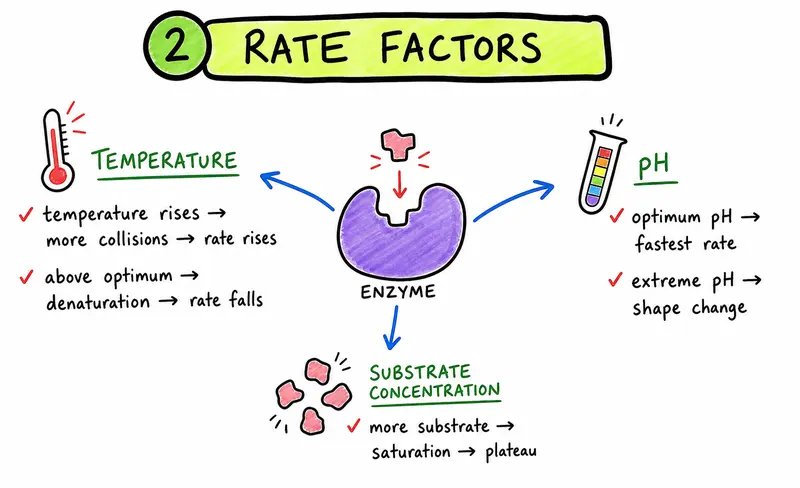
The 2.5 Enzymes note separates the rate factors clearly: temperature, pH, and substrate concentration. The exam skill is knowing what each factor changes.
| Factor | What happens at first | What happens after the limit | Mark-worthy explanation |
|---|---|---|---|
| Temperature | Rate increases as molecules move faster | High temperature denatures the enzyme | More frequent collisions occur until bonds maintaining enzyme shape are disrupted |
| pH | Rate is highest near the optimum pH | Extreme pH changes active-site shape | Changes in charge and bonding alter the enzyme's tertiary structure |
| Substrate concentration | Rate increases as active sites are used more often | Rate plateaus when active sites are saturated | Extra substrate has little effect when all active sites are occupied |
Notice the pattern: the first part of each explanation is about collision or binding. The second part is about shape or saturation.
Denaturation Is About Shape, Not Death
Students often write "the enzyme dies." Avoid that wording. Enzymes are molecules, not living cells. A denatured enzyme has lost the three-dimensional shape needed for the substrate to bind correctly.
For IB Biology, use this wording:
High temperature or extreme pH disrupts bonds maintaining the enzyme's tertiary structure, changing the active-site shape. The substrate no longer binds effectively, so fewer enzyme-substrate complexes form and the reaction rate decreases.
That answer links cause, structure, active site, binding, and rate.
Competitive vs Non-Competitive Inhibition
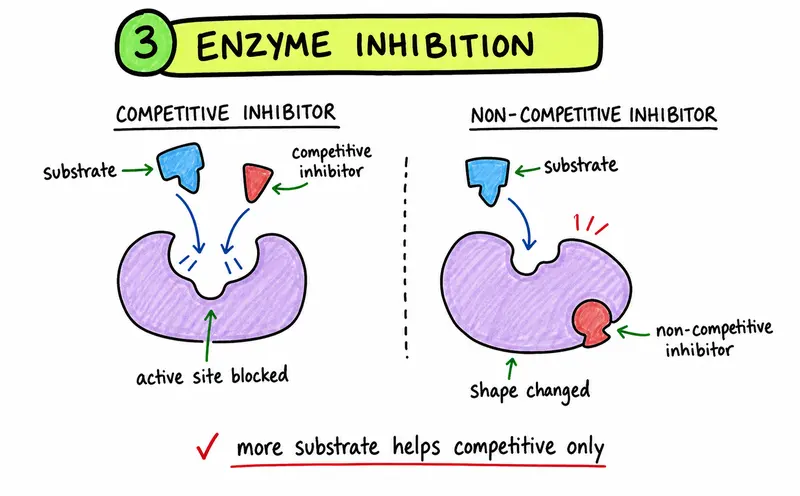
Inhibition questions are where template answers usually fail. You need to state where the inhibitor binds and what that does to substrate binding.
| Inhibition type | Where the inhibitor binds | What changes | Exam phrase to use |
|---|---|---|---|
| Competitive inhibition | Active site | Substrate is blocked from binding | Competes with the substrate for the active site |
| Non-competitive inhibition | A different site on the enzyme | Active-site shape changes | Alters enzyme shape so the substrate binds less effectively |
If a question asks how to reduce competitive inhibition, mention that increasing substrate concentration can reduce the inhibitor's effect because substrate molecules are more likely to occupy active sites. That does not work in the same way for non-competitive inhibition because the inhibitor changes the enzyme's shape from another site.
Worked Example 2: Inhibition Question
Question: A substance reduces the rate of an enzyme-catalysed reaction. Increasing substrate concentration restores the rate close to normal. Suggest what type of inhibition is occurring and explain your answer.
Markscheme-style answer: This is likely competitive inhibition. The inhibitor competes with the substrate for the enzyme's active site. When substrate concentration increases, substrate molecules are more likely to bind to active sites instead of the inhibitor, so more enzyme-substrate complexes form and the reaction rate rises.
Why this scores: The answer uses the evidence in the question. It does not just name competitive inhibition; it explains why substrate concentration changes the effect.
Immobilized Enzymes and Lactose-Free Milk
The source note includes immobilized enzymes because they are a practical application, not a random add-on. An immobilized enzyme is attached to an inert, insoluble material, so its movement is restricted in a fixed space.
The classic example is immobilized lactase. Milk is passed through a column containing immobilized lactase. Lactase breaks lactose into glucose and galactose. The enzyme stays in the column while the product passes through.
Why Immobilized Lactase Is Useful
| Advantage | Why it matters |
|---|---|
| Enzyme can be reused | Reduces cost in repeated production |
| Product is easier to purify | Enzyme is not mixed freely into the milk |
| Enzyme may be more stable | Attachment can reduce denaturation risk |
| Lactose is broken down | Milk becomes suitable for many lactose-intolerant people |
| Glucose and galactose are sweeter | Less added sweetener may be needed in some products |
The common disadvantage is that immobilization takes equipment and setup time. Reaction rate may also be reduced if substrate cannot mix freely with the enzyme.
How to Practise This Topic
Use a three-pass routine:
- Definition pass: Write the enzyme definition from memory using catalyst, protein, small amount, and unchanged.
- Mechanism pass: Draw the active site sequence from substrate binding to product release.
- Evidence pass: Answer one rate graph or inhibition question and underline the evidence that tells you the mechanism.
On EduNinja, start with IB Biology SL notes, then practise C1.1 Enzymes and metabolism questions. If you want broader practice, use the IB Biology question bank and then connect enzymes to cell respiration and photosynthesis.
Common Mistakes That Cost Marks
| Mistake | Why it loses marks | Fix |
|---|---|---|
| Saying enzymes are used up | Contradicts the catalyst definition | Say enzymes remain unchanged after catalysis |
| Saying the enzyme dies | Enzymes are molecules, not organisms | Say the enzyme is denatured |
| Writing "pH affects enzymes" only | Too vague for explanation marks | Link pH to active-site shape and binding |
| Confusing substrate and product | Breaks the reaction sequence | Substrate binds first; products are released after reaction |
| Treating all inhibitors the same | Misses binding-site evidence | State active site vs another site |
Question-Type Breakdown for Enzymes
Use this as a fast filter before you write. Most enzyme questions are not asking for everything you know; they are asking for one mechanism.
| Question type | What the examiner is testing | First move in your answer | Common trap |
|---|---|---|---|
| Active site and specificity | Whether you can link shape to substrate binding | Name the active site, substrate, and enzyme-substrate complex | Saying the enzyme "chooses" the substrate |
| Temperature graph | Whether you can separate collision frequency from denaturation | Explain the rise before the optimum, then the fall after it | Saying high temperature kills enzymes |
| pH graph | Whether you can link pH to active-site shape | Mention bonding/charge changes and substrate binding | Saying pH only makes enzymes slower |
| Substrate concentration graph | Whether you understand active-site saturation | Explain more collisions first, then all active sites occupied | Forgetting why the graph plateaus |
| Competitive inhibition | Whether you can use evidence from substrate concentration | State that inhibitor and substrate compete for the active site | Forgetting that more substrate can reduce the effect |
| Non-competitive inhibition | Whether you know the inhibitor binds away from the active site | Explain shape change and reduced substrate binding | Saying it blocks the active site directly |
| Immobilized lactase | Whether you can apply enzymes in industry | Link lactase to lactose breakdown and enzyme reuse | Listing advantages without explaining why they matter |
Exam-Ready Mini Checklist
Before you finish an enzyme answer, check that you have included the right kind of detail:
- Did I say whether the enzyme is unchanged?
- Did I mention active site and substrate binding?
- Did I explain enzyme-substrate complex if the question asks for mechanism?
- Did I link temperature or pH to shape?
- Did I link substrate concentration to saturation?
- Did I identify the inhibitor type using evidence?
FAQ
What is the active site in IB Biology enzymes?
The active site is the region of an enzyme where the substrate binds. Its shape and chemical properties help determine enzyme specificity. In induced fit, substrate binding causes a small change in enzyme shape, helping catalysis.
What is the difference between lock-and-key and induced fit?
Lock-and-key treats the active site as a fixed shape that matches the substrate. Induced fit is more flexible: substrate binding causes a slight change in enzyme shape, improving catalysis and enzyme-substrate complex formation.
Why does high temperature reduce enzyme activity?
High temperature can disrupt bonds that maintain the enzyme's tertiary structure. This changes the active-site shape, so fewer enzyme-substrate complexes form and the reaction rate decreases.
How do competitive and non-competitive inhibitors differ?
Competitive inhibitors bind to the active site and compete with the substrate. Non-competitive inhibitors bind elsewhere and change the enzyme's shape, so the active site no longer binds the substrate effectively.
Related Study Links
- IB Biology SL Study Hub
- IB Biology SL notes
- C1.1 Enzymes and metabolism question practice
- IB Biology question bank
- IB Biology cell respiration guide
- IB Biology photosynthesis guide
Put enzymes back into your full IB Biology SL study plan.
Return to the complete course overview, or move directly into the most relevant study tool.
Related articles
More course notes, updates and study resources from the EduNinja blog.
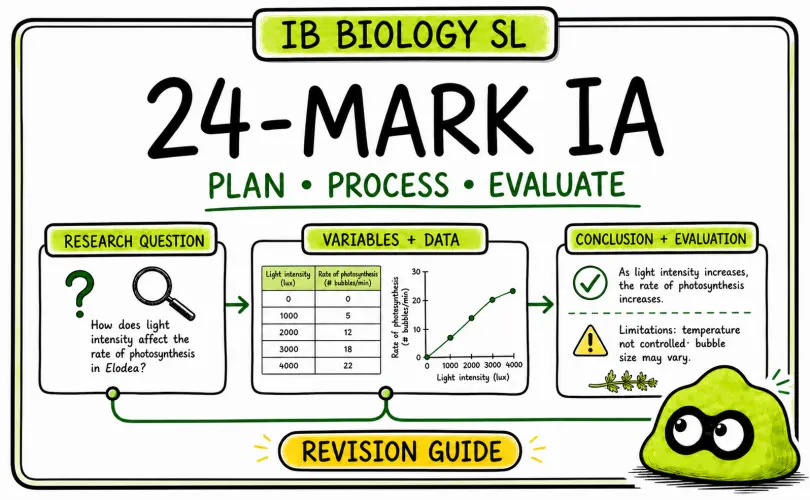
IB Biology Scientific Investigation Guide: How to Build a Strong 24-Mark IA
A practical IB Biology guide to the 24-mark Scientific Investigation: choose a workable research question, control variables, process data, draw a supported conclusion and evaluate limitations with specific improvements.
Abiotic Factors Explained | IB Biology SL
Revise IB Biology SL abiotic factors, tolerance ranges, limiting factors and how environmental variables affect distribution.
Active Transport vs Passive Transport | A-Level Biology
Revise A-Level Biology active and passive transport with concentration gradients, ATP, carrier proteins, examples, common mistakes and practice.