A-Level Biology Biological Molecules: Food Tests and Proteins
Revise A-Level Biology biological molecules with polymer definitions, monomer vs polymer examples, proteins, starch, DNA, food tests and exam-style wording.
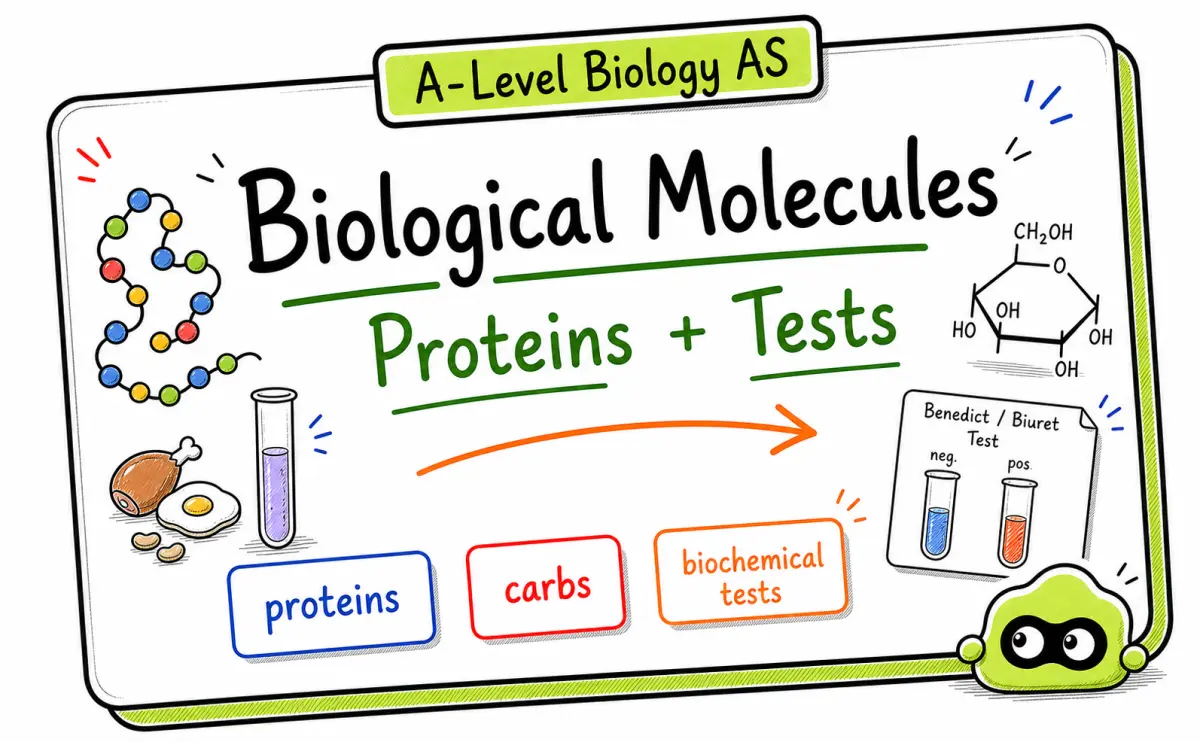
In A-Level Biology, biological molecules questions often begin with four food tests: Benedict's test for reducing sugars, the iodine test for starch, the emulsion test for lipids and the Biuret test for proteins. The method and positive result matter as much as the colour.
This guide follows the EduNinja source PDF, AS Biology Revision Notes - Biomolecules. It covers food tests, carbohydrates, lipids, proteins, water, haemoglobin, and collagen. Use it as a source-backed revision page rather than a loose summary.
Useful starting points:
- A-Level Biology Notes
- A-Level Biology Question Bank
- A-Level Biology Question Bank
- Carbohydrates and lipids questions
- Proteins questions
- AS Biology Revision Notes - Biomolecules
- AS Biology Revision Notes - Cell Structure
For every food test, state the reagent, the method, the observation and the conclusion; this is the reliable mark-by-mark sequence.
Quick answer
For A-Level Biology biological molecules, revise these first:
- Reducing sugars are tested with Benedict's reagent and heat. A positive result gives a brick-red precipitate.
- Non-reducing sugars such as sucrose must be hydrolysed first with acid, then neutralised before Benedict's test.
- Starch is tested with iodine solution. A positive result changes iodine from yellow-brown to blue-black.
- Lipids are tested with ethanol and water. A positive emulsion test forms a cloudy-white suspension.
- Proteins are tested with Biuret reagent. A positive result changes from blue to lilac.
- Proteins give a Biuret result because peptide bonds form a purple or lilac complex with copper(II) ions.
- Carbohydrates contain carbon, hydrogen, and oxygen.
- Monosaccharides join by glycosidic bonds to form disaccharides and polysaccharides.
- Fatty acids and glycerol join by ester bonds to form triglycerides.
- Amino acids join by peptide bonds to form polypeptides and proteins.
- Globular proteins such as haemoglobin are shaped for metabolic or transport roles. Fibrous proteins such as collagen are shaped for structural strength.
If you only remember one exam habit, write the test conclusion as a full sentence: "The sample contains protein because Biuret reagent changed from blue to lilac."
Food tests: what each test proves
Food tests should be learned as reagent, method, positive result and meaning.
| Molecule | Reagent | Method | Positive result | Meaning |
|---|---|---|---|---|
| Reducing sugar | Benedict's reagent | Add Benedict's reagent and heat in a water bath | Brick-red precipitate | Reducing sugar is present |
| Non-reducing sugar | Dilute acid, Benedict's reagent | Hydrolyse with acid, neutralise, then add Benedict's reagent and heat | Brick-red precipitate after hydrolysis | Non-reducing sugar was hydrolysed into reducing sugars |
| Starch | Iodine solution | Add iodine solution to the sample | Blue-black | Starch is present |
| Lipid | Ethanol and water | Shake with ethanol, then add water | Cloudy-white emulsion | Lipid is present |
| Protein | Biuret reagent | Add Biuret reagent to the sample | Lilac or purple | Protein peptide bonds are present |
Benedict's test needs heating. For non-reducing sugars, hydrolysis must come first and the acid must be neutralised before Benedict's test. Iodine's positive result is blue-black, the emulsion test gives cloudy-white, and Biuret gives lilac or purple.
Reducing sugars and Benedict's test
Reducing sugars reduce soluble blue copper sulphate containing copper(II) ions to insoluble brick-red copper(I) oxide. The copper oxide appears as a brick-red precipitate.
The PDF method is:
- Add equal volumes of Benedict's reagent and the food sample to a test tube.
- Heat the tube in a water bath at about 80 degrees C.
- Look for the positive colour change and brick-red precipitate.
Exam wording:
- "A brick-red precipitate forms, so reducing sugar is present."
Weak wording:
- "It goes red."
The weak answer may be understandable, but it loses precision. The stronger answer names the precipitate and the molecule.
Non-reducing sugars: why hydrolysis comes first
The PDF gives sucrose as the example of a non-reducing sugar. A non-reducing sugar will not give the same Benedict's result until it has been broken down into its monosaccharide units.
Use this sequence:
- Add hydrochloric acid to hydrolyse the disaccharide.
- Neutralise the acid with an alkali such as sodium bicarbonate.
- Carry out Benedict's test on the resulting solution.
- A positive Benedict's result shows that reducing sugars were produced by hydrolysis.
The neutralisation step matters. Benedict's test works under alkaline conditions, so leaving the solution acidic can spoil the method.
Starch, lipids, and proteins: the core tests
For starch, add iodine solution to the sample. Iodine solution is yellow-brown. If starch is present, a blue-black colour is produced.
For lipids, use the emulsion test:
- Shake the sample with ethanol.
- Lipids dissolve in the ethanol.
- Pour the ethanol and sample mixture into water.
- If lipids are present, a cloudy-white suspension forms.
The PDF explains why this happens: lipid molecules cannot remain dissolved when mixed with water, so they form droplets throughout the liquid. This mixture is an emulsion.
For proteins, use the Biuret test. Mix equal volumes of the sample and Biuret reagent. If protein is present, the colour changes from blue to lilac. The source PDF notes that peptide bonds contain nitrogen atoms which form a purple complex with copper(II) ions. It also notes that potassium hydroxide and dilute copper sulphate can be used instead of prepared Biuret reagent.
What Is a Polymer in Biology?
A polymer is a large molecule made from many repeating smaller units called monomers. In biology, polymer questions usually test whether you can connect the molecule, its monomer, and the bond that joins the units.
Exam-safe wording:
- A polymer is a macromolecule made when many monomers join together by covalent bonds.
Useful examples:
| Polymer | Monomer or subunit | Bond or link to know | Example exam wording |
|---|---|---|---|
| Starch | alpha-glucose | glycosidic bonds | Starch is a polysaccharide made from many glucose monomers |
| Protein | amino acids | peptide bonds | Amino acids join by peptide bonds to form polypeptides |
| DNA | nucleotides | phosphodiester bonds | DNA is a polynucleotide made from nucleotide monomers |
| Cellulose | beta-glucose | glycosidic bonds | Beta-glucose orientation gives cellulose straight chains |
Monomer vs polymer
A monomer is the smaller repeating unit. A polymer is the larger molecule formed from many monomers. For A-Level Biology, always add an example because the word "polymer" can refer to carbohydrates, proteins, or nucleic acids depending on the question.
Carbohydrates: monomers, polymers, and bonds
Carbohydrates are composed of carbon, hydrogen, and oxygen. The PDF divides them into monosaccharides, disaccharides, and polysaccharides.
| Term | Meaning | Example from the PDF |
|---|---|---|
| Monomer | one of many small molecules that combine to form a polymer | monosaccharides, amino acids, nucleotides |
| Polymer | a large molecule made from many similar repeating subunits | polysaccharides, proteins, nucleic acids |
| Macromolecule | a large molecule formed by polymerisation of monomers | polysaccharides, polypeptides, polynucleotides |
Monosaccharides are single sugar units with the general formula C(H2O)n. They dissolve in water. The source PDF lists trioses, pentoses, and hexoses, with examples including glucose, fructose, galactose, ribose, and deoxyribose.
Monosaccharides matter for two reasons:
- They are a source of energy in respiration because C-H bonds can be broken to release energy for ATP production.
- They are building blocks for larger molecules. Glucose can be used to make starch, glycogen, and cellulose. Ribose is used in RNA and ATP. Deoxyribose is used in DNA.
Disaccharides and glycosidic bonds
A disaccharide contains two monosaccharides joined by a glycosidic bond. The PDF describes glycosidic bond formation as a condensation reaction, where a water molecule is removed.
Use the exam wording:
- "Two monosaccharides join by condensation, removing water and forming a glycosidic bond."
The reverse process is hydrolysis. Water is used to break the bond. This is why non-reducing sugar testing begins by hydrolysing sucrose into monosaccharides.
Polysaccharides: starch, glycogen, and cellulose
Polysaccharides are polymers made from monosaccharide subunits joined by glycosidic bonds. The PDF gives starch, glycogen, and cellulose as examples. All three are polymers of glucose, but their structures and functions differ.
The source also warns that polysaccharides are not sugars in the same sense as small soluble sugars. This matters in cells. If glucose accumulated freely, it would dissolve and make the contents of the cell too concentrated, affecting osmotic properties. Storage polysaccharides are useful because they are compact, inert, and insoluble.
| Polysaccharide | Structure | Why it matters |
|---|---|---|
| Amylose | made by condensation between 1,4 linked alpha-glucose molecules | long unbranching chains that coil into a compact helix |
| Amylopectin | also made of 1,4 linked alpha-glucose, with 1,6 branch points | branches make the molecule more compact |
| Glycogen | chains of 1,4 linked alpha-glucose with 1,6 branches | more branched than amylopectin, with many ends for adding and removing glucose |
| Cellulose | polymer of beta-glucose with alternating glucose orientation | forms microfibrils and fibres with high tensile strength |
Starch is made of amylose and amylopectin. Glycogen is more branched than amylopectin. That branching gives many ends, which helps glucose be added or removed.
Cellulose: why beta-glucose changes the structure
Cellulose is a polymer of beta-glucose. The PDF explains that to form the 1,4 glycosidic bond, every other glucose molecule is rotated 180 degrees. This means successive glucose molecules are linked in alternating orientations.
Cellulose molecules become tightly cross-linked to form bundles called microfibrils. Microfibrils are held together in bundles called fibres by hydrogen bonding. This gives cellulose fibres high tensile strength.
This structure explains the function:
- Cellulose helps cells withstand pressure from osmosis.
- Cellulose fibres are strong but freely permeable.
- Plant cell walls gain support without blocking water and solute movement completely.
Dipoles, hydrogen bonds, and water
The PDF uses water to explain polarity. An unequal distribution of charge in a covalent bond is called a dipole. Molecules with groups that have dipoles are polar.
In water, oxygen is more electronegative than hydrogen. Oxygen gains a small negative charge, while the hydrogen atoms gain small positive charges. The negatively charged oxygen of one water molecule is attracted to the positively charged hydrogen of another water molecule. This attraction is a hydrogen bond.
| Molecule type | Relationship with water | Examples from the PDF |
|---|---|---|
| Polar | attracted to water and hydrophilic | glucose, amino acids, sodium chloride |
| Non-polar | not attracted to water and hydrophobic | oils, cholesterol |
This helps explain why some biological molecules dissolve in water and others do not. It also connects to the emulsion test for lipids.
Lipids: fatty acids, glycerol, and ester bonds
The PDF describes lipids as three fatty acids plus one glycerol. Fatty acids contain the acidic group COOH. Larger fatty acids have long hydrocarbon tails, often 15 to 17 carbon atoms long.
Fatty acids can be saturated or unsaturated. Unsaturated fatty acids have C=C double bonds and do not have the maximum number of hydrogen atoms. The source PDF notes that unsaturated lipids are mostly liquid.
Alcohols contain a hydroxyl group, OH, attached to a carbon atom. A reaction between a fatty acid and an alcohol produces an ester. The chemical link between the acid and the alcohol is called an ester linkage or ester bond, and it forms in a condensation reaction.
Glycerol has three hydroxyl groups, so each glycerol molecule can react with three fatty acids to form a triglyceride.
Triglycerides are insoluble in water because their hydrocarbon tails are non-polar. They do not have an uneven distribution of charge, so they are hydrophobic.
Roles of triglycerides from the PDF:
- energy reserves
- insulation
- protection of vital organs
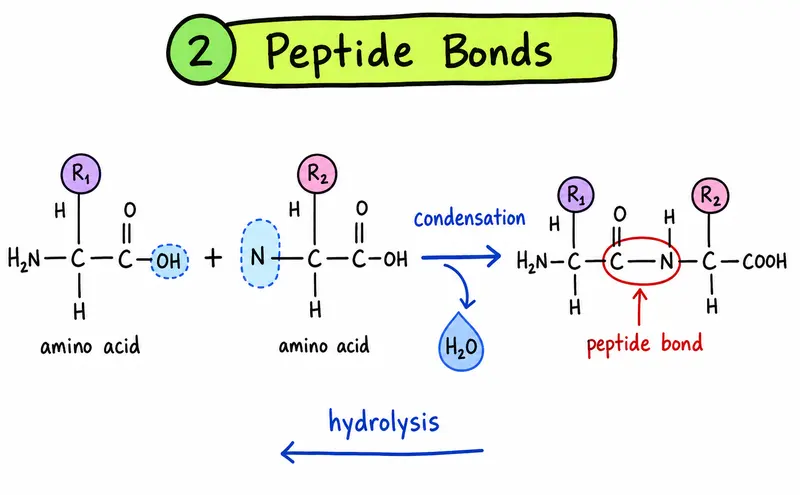
Proteins: amino acids and peptide bonds
All proteins are made from amino acids. The PDF gives the basic amino acid structure: a central carbon atom bonded to an amine group, a carboxylic acid group, a hydrogen atom, and an R group.
| Part of amino acid | Detail |
|---|---|
| Central carbon | bonds to the other groups |
| Amine group | NH2 |
| Carboxylic acid group | COOH |
| Hydrogen | bonded to the central carbon |
| R group | determines the type of amino acid |
A peptide bond forms between amino acids. A molecule made of many amino acids linked together by peptide bonds is a polypeptide. Peptide bonds can be broken by hydrolysis, producing amino acids. The PDF notes that this happens naturally in the stomach and small intestine during digestion.
Use this wording:
- "Amino acids join by condensation to form peptide bonds. Peptide bonds can be broken by hydrolysis."
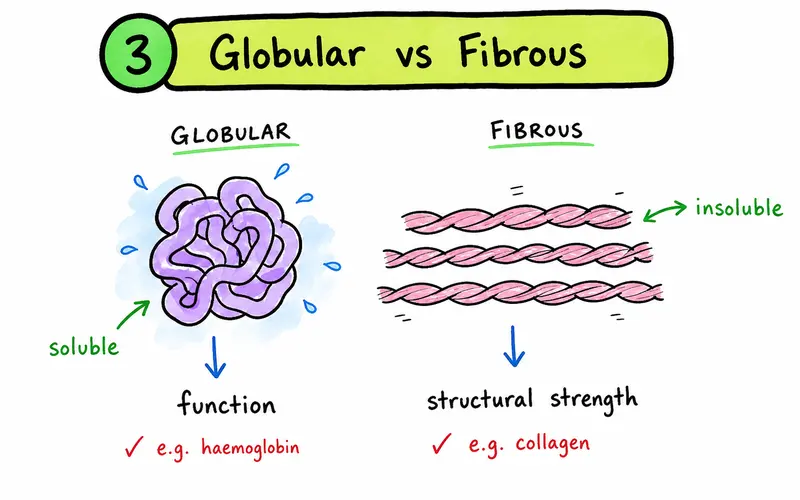
Globular and fibrous proteins
The PDF compares globular and fibrous proteins.
| Feature | Globular proteins | Fibrous proteins |
|---|---|---|
| Shape | spherical or balled shape | long strands |
| Solubility | usually soluble | usually not soluble in water |
| Role | metabolic activities and specific functions | structural roles |
| Examples | enzymes, haemoglobin, myoglobin | keratin, actin, myosin, collagen |
Globular proteins curl up so that non-polar, hydrophobic R groups point toward the centre of the molecule, away from watery surroundings. Polar, hydrophilic R groups face outward, which helps the protein mix with water.
Fibrous proteins form long strands. Their shape suits structural support rather than soluble transport or enzyme activity.
Haemoglobin: a globular protein example
Haemoglobin is a globular protein. The PDF gives several source details:
- Haemoglobin has four polypeptide chains, so it has a quaternary structure.
- Two chains are alpha chains made of alpha-globin.
- Two chains are beta chains made of beta-globin.
- Each polypeptide chain has a haem group attached as a prosthetic group.
- The haem group contains a charged particle of iron.
- The haem group is responsible for the colour of haemoglobin.
- Each polypeptide chain can carry one molecule of oxygen.
That means one haemoglobin molecule can carry four oxygen molecules, or eight oxygen atoms.
Exam wording:
- "Haemoglobin has a quaternary structure with four polypeptide chains, each carrying a haem group that can bind one oxygen molecule."
Collagen: a fibrous protein example
Collagen is a fibrous structural protein found in skin, tendons, cartilage, bone, and teeth.
The PDF describes collagen structure like this:
- A collagen molecule consists of three polypeptide chains.
- Each chain has a helical shape.
- The three helices wind together to form a triple helix.
- The strands are held together by hydrogen bonds and some covalent bonds.
- Every third amino acid in each polypeptide chain is glycine.
- Collagen molecules run parallel to one another.
- Covalent bonds form between R groups of amino acids.
- These cross-links hold many collagen molecules side by side to form fibrils.
- Many fibrils lie alongside each other to form strong fibres.
Collagen is flexible but has high tensile strength. The fibres line up according to the forces they need to withstand.
Worked Example: Protein Food Test
Question: How would you test a sample for protein?
Answer: Add Biuret reagent. A lilac or purple colour shows that protein is present because peptide bonds react with the reagent.
Worked Example: Monomer vs Polymer
Question: Explain why starch and protein are both described as polymers.
Markscheme-style answer: Starch is a polymer because it is made from many glucose monomers joined by glycosidic bonds. Protein is a polymer because it is made from many amino acid monomers joined by peptide bonds.
Why this scores: The answer names the polymer, the monomer and the bond for each molecule.
Common mistakes that cost marks
- Writing only a colour, without naming a precipitate or emulsion.
- Forgetting that Benedict's test needs heating.
- Forgetting to hydrolyse a non-reducing sugar first.
- Forgetting to neutralise the acid before Benedict's test.
- Confusing the protein test with the starch test.
- Giving a positive result without stating which molecule it detects.
- Calling the cloudy-white lipid emulsion a simple colour change.
A 30-minute revision route
| Time | Task |
|---|---|
| 0-6 min | Write the five food tests from memory |
| 6-12 min | Redraw the monomer-polymer-bond map for carbohydrates, lipids, and proteins |
| 12-18 min | Compare starch, glycogen, and cellulose |
| 18-23 min | Explain why triglycerides are insoluble in water |
| 23-28 min | Compare haemoglobin and collagen |
| 28-30 min | Rewrite two vague answers into mark-worthy sentences |
Use EduNinja Notes for the concept, then move into the A-Level Biology Question Bank so food-test methods and protein comparisons become exam answers, not just revision notes.
Weak answer vs mark-worthy answer
Weak:
- Benedict's test turns red for sugar.
Better:
- A reducing sugar gives a brick-red precipitate with Benedict's reagent after heating, because copper(II) ions are reduced to copper(I) oxide.
Weak:
- Lipids are insoluble.
Better:
- Triglycerides are insoluble in water because their hydrocarbon tails are non-polar and hydrophobic.
Weak:
- Collagen is strong.
Better:
- Collagen has three helical polypeptide chains wound into a triple helix, with cross-links between molecules forming fibrils and fibres with high tensile strength.
Weak:
- Haemoglobin carries oxygen.
Better:
- Haemoglobin has four polypeptide chains, each with a haem group, so one haemoglobin molecule can carry four oxygen molecules.
Practice This Topic
Try this exam-style question: An unknown food sample gives a blue-black colour with iodine solution and a lilac colour in the Biuret test. What does this show?
Answer guide:
- The blue-black iodine result shows that starch is present.
- The lilac Biuret result shows that protein is present.
- State the reagent, observation and conclusion for each test.
Practise CAIE A-Level Biology biological molecules questions.
Related Study Links
FAQ
What is a polymer in biology?
A polymer is a large molecule made from many repeating monomers. Examples include starch from glucose monomers, proteins from amino acids, and DNA from nucleotide monomers.
What is the difference between a monomer and a polymer?
A monomer is one small unit. A polymer is made from many monomers joined together. For example, amino acids are monomers and proteins are polymers.
What food tests do I need for A-Level Biology biological molecules?
You should know Benedict's test for reducing sugars, the hydrolysis and Benedict's sequence for non-reducing sugars, iodine solution for starch, the ethanol emulsion test for lipids, and Biuret test for proteins. For each one, learn the reagent, method, positive result, and molecule detected.
Why do non-reducing sugars need acid before Benedict's test?
Non-reducing sugars such as sucrose must first be hydrolysed into their monosaccharide units. The PDF describes adding hydrochloric acid, then neutralising with an alkali such as sodium bicarbonate before carrying out Benedict's test. The resulting monosaccharides are reducing sugars.
What is the difference between starch, glycogen, and cellulose?
Starch and glycogen are storage polysaccharides made from alpha-glucose. Starch contains amylose and amylopectin, while glycogen is more branched. Cellulose is made from beta-glucose and forms microfibrils and fibres with high tensile strength.
Why are triglycerides insoluble in water?
Triglycerides are insoluble because their long hydrocarbon tails are non-polar. They do not have an uneven distribution of charge, so they are hydrophobic and are not attracted to water molecules.
Why is haemoglobin globular but collagen fibrous?
Haemoglobin is a soluble globular protein with a precise shape for oxygen transport. Collagen is a fibrous structural protein made from triple helices and cross-linked fibrils, giving it flexibility and high tensile strength.
Related study links
- Carbohydrates and lipids questions
- Proteins questions
- A-Level Biology Notes
Put biological molecules back into your full A-Level CAIE Biology AS study plan.
Return to the complete course overview, or move directly into the most relevant study tool.
Related articles
More course notes, updates and study resources from the EduNinja blog.
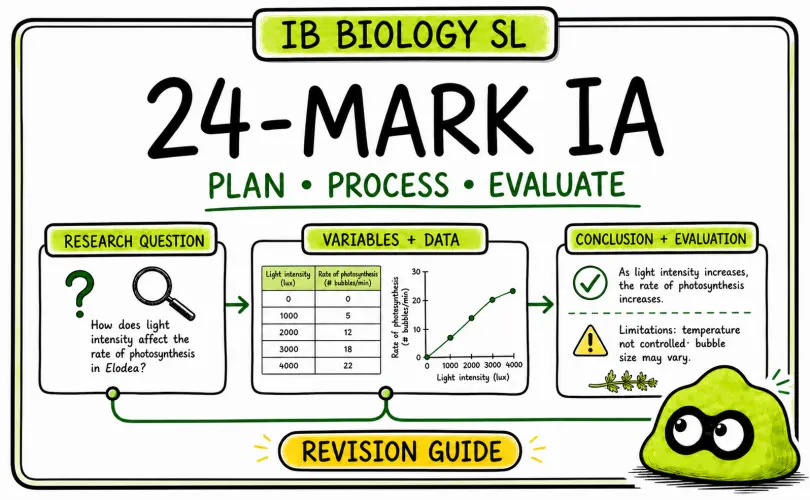
IB Biology Scientific Investigation Guide: How to Build a Strong 24-Mark IA
A practical IB Biology guide to the 24-mark Scientific Investigation: choose a workable research question, control variables, process data, draw a supported conclusion and evaluate limitations with specific improvements.
Abiotic Factors Explained | IB Biology SL
Revise IB Biology SL abiotic factors, tolerance ranges, limiting factors and how environmental variables affect distribution.
Active Transport vs Passive Transport | A-Level Biology
Revise A-Level Biology active and passive transport with concentration gradients, ATP, carrier proteins, examples, common mistakes and practice.