Deposition in Chemistry: IGCSE State Change Guide
Revise deposition in IGCSE Chemistry with gas-to-solid particle theory, sublimation comparisons, exam wording and practice questions.
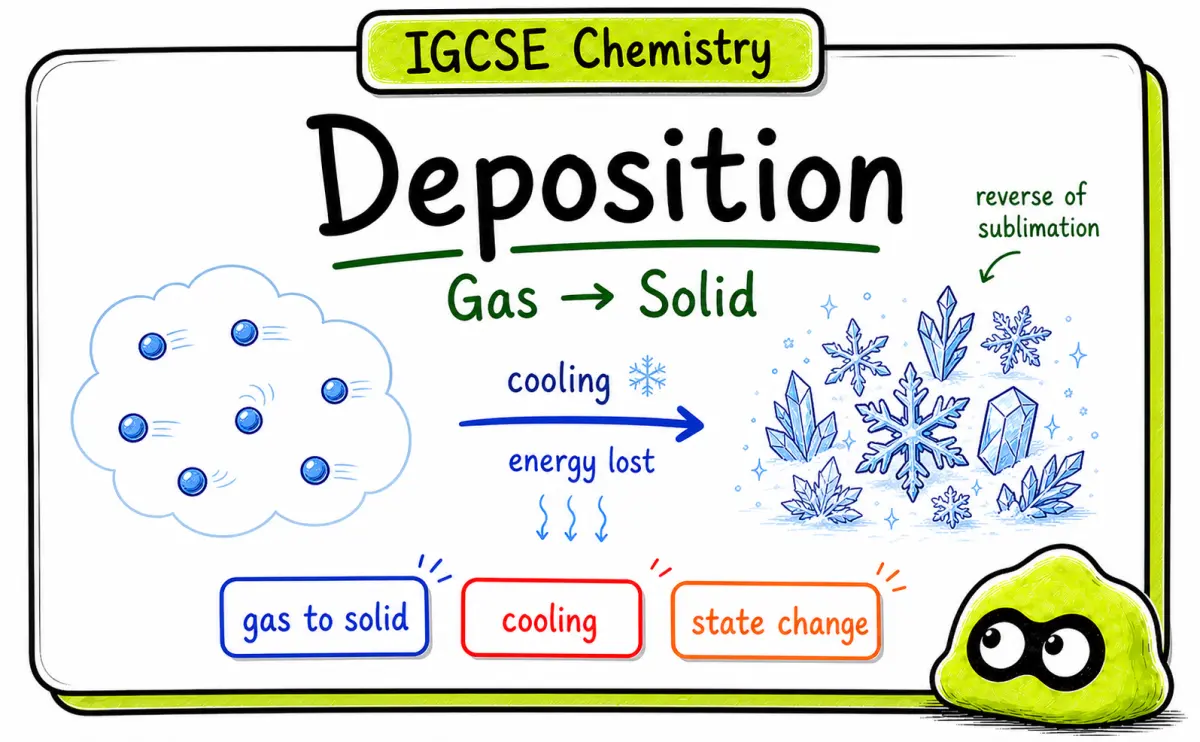
Deposition in chemistry is the state change where a gas turns directly into a solid. In Cambridge IGCSE Chemistry, the key idea is that gas particles lose energy and become fixed in a solid structure without first becoming a liquid.
This guide explains deposition chemistry through particle theory, examples, exam-safe wording, and a short practice question that links to the matching EduNinja Question Bank topic.
Quick Answer
| Question | Exam-safe answer |
|---|---|
| What is deposition? | A gas changes directly into a solid |
| Does it pass through liquid first? | No, there is no liquid stage |
| What happens to particles? | They lose energy and become closely packed |
| Opposite process | Sublimation |
| Common example | Frost forming from water vapour on a cold surface |
What Deposition Means in IGCSE Chemistry
Deposition is a physical change of state. The substance is still the same substance, but its particles are arranged and moving differently. In the gas state, particles are far apart and move randomly. During deposition, cooling removes energy from the particles, so they move less and become arranged as a solid.
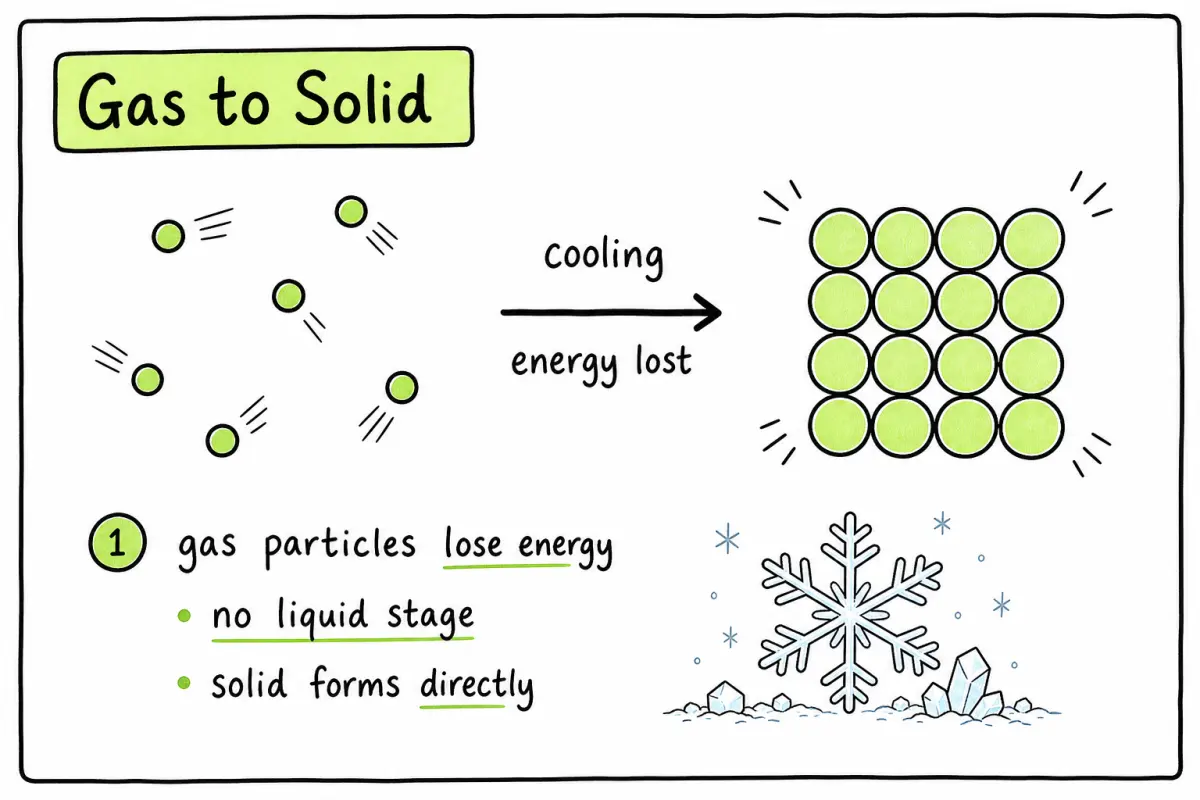
The most important phrase is gas directly to solid. If an answer says gas changes to liquid and then solid, that describes condensation followed by freezing, not deposition.
In particle terms, deposition happens because particles lose kinetic energy. Attractions between particles become more important, and the particles become fixed in position in a solid structure.
Deposition vs Sublimation vs Condensation
| Change of state | Direction | Energy change | Example |
|---|---|---|---|
| Deposition | Gas -> solid | Energy is lost | Frost forming |
| Sublimation | Solid -> gas | Energy is gained | Iodine crystals forming purple vapour |
| Condensation | Gas -> liquid | Energy is lost | Water droplets on a cold window |
| Freezing | Liquid -> solid | Energy is lost | Water becoming ice |
This comparison is useful because exam questions often test similar terms together. Deposition and condensation both involve a gas losing energy, but only deposition forms a solid directly.
Where Deposition Fits on a Cooling Curve
Deposition can appear when particles lose enough energy to change directly from gas to solid. On a cooling curve, this would be linked to energy being removed while particles move closer together and become fixed in a solid arrangement.
For IGCSE Chemistry, the safest exam wording is:
- gas particles lose energy
- particles move closer together
- a solid forms directly
- the liquid state is skipped
- deposition is the reverse of sublimation
Worked Example
Question: A cold metal surface is placed in moist air. After a while, frost appears on the surface. Explain the change of state.
Answer: Water vapour in the air changes directly from a gas into solid ice on the cold surface. This is deposition. The gas particles lose energy, move less, and become arranged as a solid without passing through the liquid state.
Why this works: The answer names the process, identifies gas to solid, includes energy loss, and explains the particle-level change. That is stronger than just saying "frost forms because it is cold".
Exam-Safe Wording
For a definition question, use:
Deposition is the change of state from gas directly to solid without passing through the liquid state.
For an explanation question, add:
- The gas particles lose energy.
- Particle movement decreases.
- Particles become closer together and more fixed in position.
- The substance remains the same; only the state changes.
Avoid saying deposition is "a gas freezing". Freezing means liquid to solid. Deposition means gas to solid.
Common Mistakes
| Mistake | Why it loses marks | Better wording |
|---|---|---|
| Saying deposition is liquid to solid | That is freezing | Deposition is gas directly to solid |
| Saying gas becomes liquid first | That describes condensation before freezing | No liquid stage is involved |
| Forgetting energy change | State changes are often explained using energy | Particles lose energy during deposition |
| Mixing up sublimation and deposition | They are opposite directions | Sublimation is solid to gas; deposition is gas to solid |
Mini Practice Set
- Define deposition using the words gas and solid.
- State whether deposition involves energy being gained or lost.
- Explain why frost forming on a cold surface is an example of deposition.
- Give the opposite change of state to deposition.
- Rewrite this weak answer: "Deposition is when a liquid turns into a solid."
Practice This Topic
Try this exam-style question:
A student writes: "Deposition is when a liquid freezes into a solid." Explain why this answer is incorrect and rewrite the definition using correct IGCSE Chemistry wording.
Answer guide:
- Freezing is liquid to solid, not gas to solid.
- Deposition is gas directly to solid.
- The gas does not pass through the liquid state.
- Particles lose energy and become fixed in a solid arrangement.
Practice this exact topic
Practise IGCSE Chemistry state change questions
Some questions may require an EduNinja membership.
Browse broader practice
Browse the full Cambridge IGCSE Chemistry Question Bank
Use this if you want to explore more available practice by topic.
Related Study Links
- IGCSE Chemistry Particles: Solids, Liquids, Gases, and State Changes
- Vaporization in IB Chemistry: Definition and Energy
- Browse Cambridge IGCSE Chemistry practice
FAQ
What is deposition in chemistry?
Deposition is the change of state from gas directly to solid. It does not pass through the liquid state. In exam answers, include both the starting state and final state, because vague wording such as "it becomes colder" does not define the process clearly enough.
Is deposition the opposite of sublimation?
Yes, deposition is the opposite of sublimation. Sublimation is solid directly to gas, while deposition is gas directly to solid. Both processes skip the liquid state, so the direction of the change is the part students need to check carefully.
Is deposition the same as condensation?
No, deposition and condensation are different changes of state. Condensation is gas to liquid, while deposition is gas to solid. Both involve particles losing energy, but the final state is different, so using the wrong term can lose marks in definition questions.
What happens to particles during deposition?
During deposition, gas particles lose kinetic energy and move less freely. They become closer together and more fixed in position as a solid forms. A good particle explanation should mention energy loss and the direct gas-to-solid change.
What is an example of deposition?
Frost forming on a very cold surface is a common example of deposition. Water vapour in the air changes directly into solid ice crystals. This is different from water droplets forming first, which would involve condensation before freezing.
Final Takeaway
Deposition means gas directly to solid. If you remember that it is the reverse of sublimation, involves energy loss, and has no liquid stage, your IGCSE Chemistry wording will be much safer.
Choose a course and continue studying.
Pick your curriculum and subject, then continue into the right question bank or notes.
Related articles
More course notes, updates and study resources from the EduNinja blog.
London Dispersion Forces Explained for IB Chemistry
Learn London dispersion forces for IB Chemistry with temporary dipoles, induced dipoles, molecular size, boiling point trends, examples and practice.
Transition Metals Explained for IB Chemistry
Revise transition metals in IB Chemistry, including coloured ions, variable oxidation states, complex ions, catalysts and common exam mistakes.
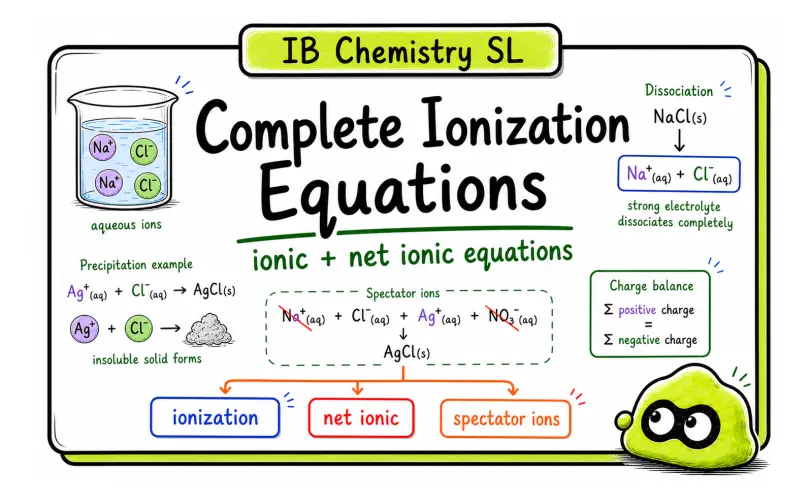
How to Complete Ionization and Net Ionic Equations
Learn complete ionization and net ionic equations for IB Chemistry, with ion charges, state symbols, spectator ions, worked examples and practice.