Vaporization in IB Chemistry: Definition and Energy
Revise vaporization in IB Chemistry with liquid-to-gas particle diagrams, energy input, boiling vs evaporation and practice questions.
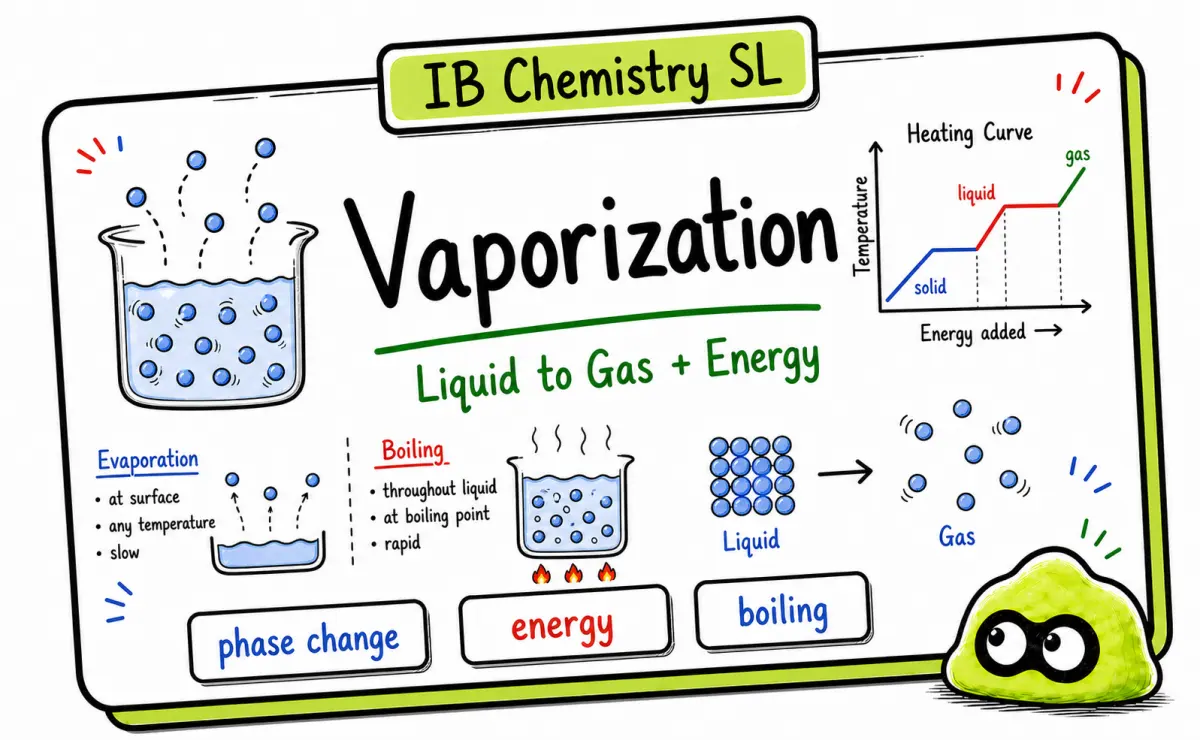
Vaporization means a liquid changing into a gas. In IB Chemistry, the key idea is that particles need energy to overcome intermolecular attractions and move further apart.
Students often know the word but lose marks when they do not separate evaporation from boiling. Both are vaporization, but they happen in different ways and need different exam wording.
Quick Answer
| Term | Meaning | Exam wording |
|---|---|---|
| Vaporization | Liquid changes to gas | Energy is absorbed |
| Evaporation | Vaporization at the surface | Can happen below boiling point |
| Boiling | Vaporization throughout the liquid | Happens at boiling point |
| Particle change | Particles move further apart | Intermolecular forces are overcome |
What Vaporization Means
During vaporization, liquid particles gain enough energy to escape from the liquid phase and become gas particles. The particles move further apart, so the substance changes state from liquid to gas.
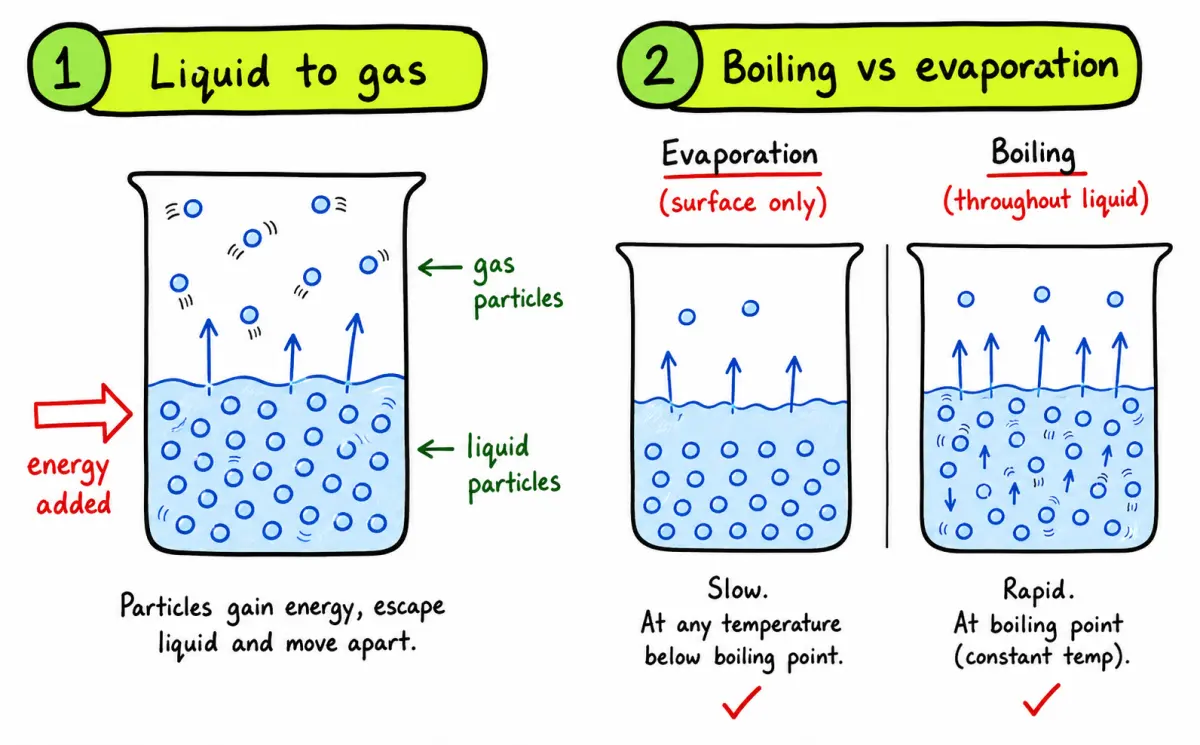
The important phrase is intermolecular forces. In a normal change of state, energy is used to overcome attractions between particles. The covalent bonds inside molecules are not usually broken.
Vaporization vs Condensation vs Sublimation
These three changes are easy to mix up because they all involve state changes.
| Change | Direction | Energy change | Particle idea |
|---|---|---|---|
| Vaporization | Liquid to gas | Energy absorbed | Particles overcome attractions |
| Condensation | Gas to liquid | Energy released | Particles come closer together |
| Sublimation | Solid to gas | Energy absorbed | Particles leave the solid directly |
If the question says liquid to gas, use vaporization. If it says gas to liquid, use condensation. If it says solid directly to gas, use sublimation.
Boiling vs Evaporation
Evaporation happens at the surface of a liquid. It can happen below the boiling point because some surface particles have enough energy to escape.
Boiling happens throughout the liquid at the boiling point. Bubbles of gas form inside the liquid and rise. In exam answers, mention whether the change happens at the surface only or throughout the liquid.
Worked Example
Explain why energy is needed when water vaporizes.
A strong particle-level answer says that energy is absorbed by the water molecules. This energy is used to overcome intermolecular forces between molecules in the liquid. Once these attractions are overcome, the molecules can move further apart and enter the gas phase as water vapour.
Do not write that the O-H covalent bonds are broken. That would describe a chemical change, not ordinary vaporization.
Markscheme-Style Wording
Use wording like this in exam answers:
- The liquid particles gain energy.
- Energy is used to overcome intermolecular forces between particles.
- Particles move further apart and become gas particles.
- Evaporation occurs at the surface; boiling occurs throughout the liquid.
That is stronger than saying the liquid disappears or turns into air.
Common Mistakes
| Mistake | Why it loses marks | Better wording |
|---|---|---|
| Saying all bonds break | Usually intermolecular forces are overcome | Particles separate into gas |
| Mixing evaporation and boiling | They are not identical | Evaporation surface only, boiling throughout |
| Forgetting energy input | Vaporization needs energy | Energy is absorbed |
| Ignoring particle spacing | Gas particles are further apart | Particles move more freely |
Mini Practice Set
- Define vaporization using particle language.
- Explain the difference between evaporation and boiling.
- State why energy is absorbed during vaporization.
- Compare vaporization and condensation in terms of energy transfer.
Practice This Topic
Try this exam-style question:
A student says vaporization breaks the covalent bonds inside water molecules. Explain why this statement is usually incorrect for a change of state.
Answer guide:
- Vaporization is a physical change from liquid to gas.
- Energy is used to overcome intermolecular forces between particles.
- The molecules move further apart into the gas phase.
- Covalent bonds inside the molecules are not normally broken during boiling or evaporation.
Practice this exact topic
Practice IB Chemistry phase change questions
Some questions may require an EduNinja membership.
Browse broader practice
Use the IB Chemistry SL Question Bank to explore more available practice by topic.
Related Study Links
- Explore the course Study Hub
- Electron Affinity in IB Chemistry: Definition and Trend
- Arrhenius Equation Explained: IB Chemistry
- IB Chemistry Acids and Bases: pH, Neutralisation, and Common Mistakes
FAQ
What is vaporization in chemistry?
Vaporization is the change of state from liquid to gas. In particle terms, liquid particles gain enough energy to overcome intermolecular attractions and move further apart. It is usually a physical change, so the molecules themselves are not chemically changed. In exam answers, name the state change and explain the energy input.
Is vaporization the same as evaporation?
Evaporation is one type of vaporization, but vaporization also includes boiling. Evaporation happens at the surface of a liquid and can occur below boiling point. Boiling happens throughout the liquid when the boiling point is reached. If the question asks for a comparison, mention both location and temperature conditions clearly.
Why does vaporization require energy?
Vaporization requires energy because particles in a liquid are attracted to each other. Energy is absorbed to overcome these intermolecular forces, allowing particles to separate and enter the gas phase. A common mistake is saying chemical bonds inside the molecules are broken. For ordinary boiling or evaporation, focus on forces between molecules.
What is the difference between boiling and evaporation?
Boiling happens throughout the liquid at the boiling point, while evaporation happens only at the surface and can occur at lower temperatures. In exam answers, mention where it happens and whether the whole liquid is involved. This distinction is often more mark-worthy than simply saying both processes make a gas.
Is condensation the opposite of vaporization?
Yes, condensation is the opposite direction of vaporization. In vaporization, a liquid becomes a gas and energy is absorbed. In condensation, a gas becomes a liquid and energy is released as particles come closer together and form stronger intermolecular attractions. Use this pair when a question asks about energy transfer during state changes.
Final Takeaway
For vaporization questions, write liquid to gas, energy absorbed, particles further apart, and intermolecular forces overcome. That wording is much safer than simply saying the liquid disappears.
Put topic practice back into your full IB Chemistry SL study plan.
Return to the complete course overview, or move directly into the most relevant study tool.
Related articles
More course notes, updates and study resources from the EduNinja blog.
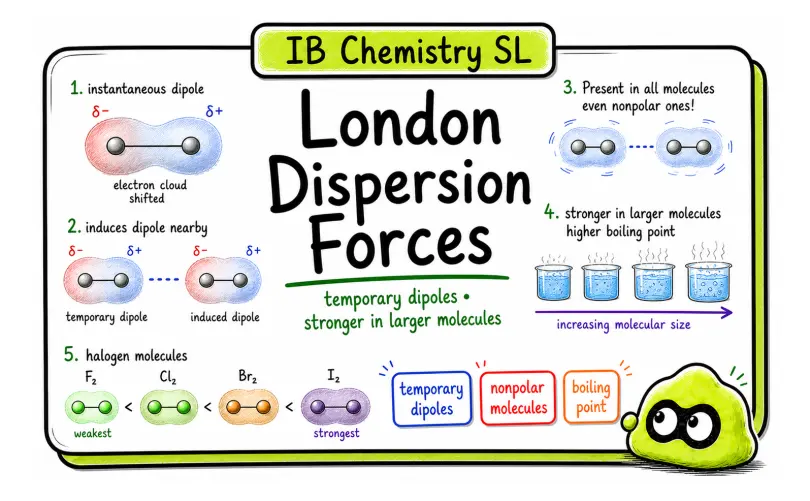
London Dispersion Forces Explained for IB Chemistry
Learn London dispersion forces for IB Chemistry with temporary dipoles, induced dipoles, molecular size, boiling point trends, examples and practice.
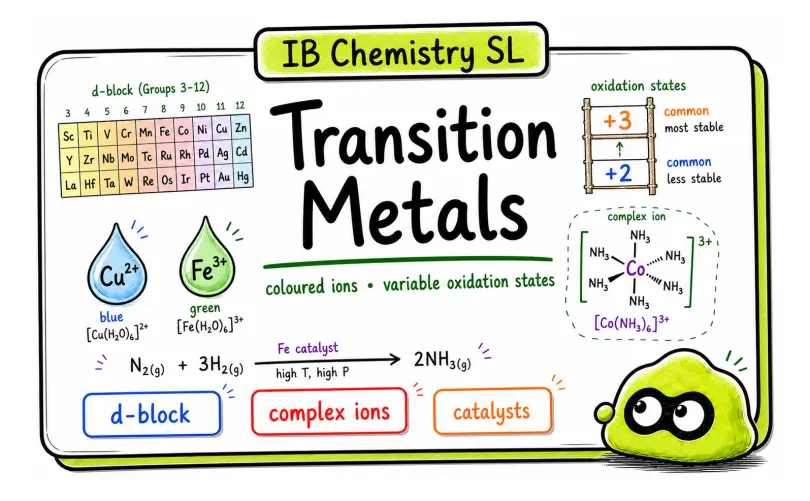
Transition Metals Explained for IB Chemistry
Revise transition metals in IB Chemistry, including coloured ions, variable oxidation states, complex ions, catalysts and common exam mistakes.
How to Complete Ionization and Net Ionic Equations
Learn complete ionization and net ionic equations for IB Chemistry, with ion charges, state symbols, spectator ions, worked examples and practice.