IGCSE Chemistry Particles: Solids, Liquids, Gases, and State Changes
A source-backed CAIE Chemistry guide for IGCSE Chemistry particles, using EduNinja PDF notes, worked examples, and markscheme-style answers.
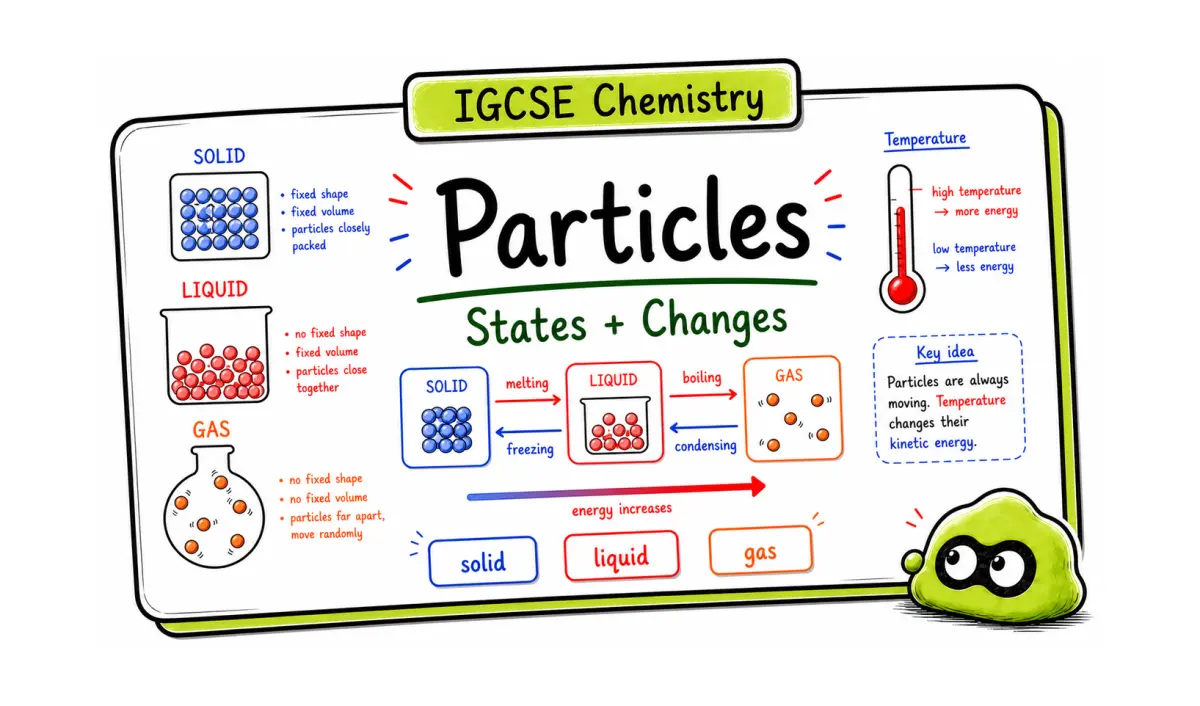
IGCSE Chemistry particles questions are easy to recognise but easy to under-answer. A diagram of solids, liquids and gases is not enough. The markscheme usually wants arrangement, movement, attraction and energy.
For CAIE IGCSE Chemistry, particle theory sits under the kinetic particle model and changes of state. Use this guide to practise the wording behind the diagram: how particles are arranged, how they move, how strong the attractions are, and what energy does during melting, boiling, freezing and condensation.
This is a student revision guide, not an official syllabus document. Check your teacher's current syllabus guide for the exact wording your class uses.
Useful starting points:
- IGCSE Chemistry Notes
- IGCSE Chemistry Question Bank
- 1.1.5 changes of state using kinetic theory
- 6.2.6 rate changes using collision theory
- Chemistry Topical Notes
Start with notes if the particle model feels vague. Move to questions once you can compare two states using the same three ideas: arrangement, movement and attraction.
Quick answer
- In a solid, particles are closely packed in fixed positions and vibrate.
- In a liquid, particles are close together in a random arrangement and move past each other.
- In a gas, particles are far apart and move randomly at high speed.
- Heating gives particles more kinetic energy.
- Cooling removes energy from particles.
- Melting and boiling require energy to overcome attractions between particles.
- Freezing and condensation release energy as stronger attractions form.
- Particles do not expand when heated. Their movement and spacing change.
- During a flat section of a heating or cooling curve, temperature stays constant while the state changes.
- Boiling happens throughout the liquid at the boiling point; evaporation happens at the surface and can occur below the boiling point.
- Diffusion is faster when particles have more kinetic energy or when the concentration gradient is steeper.
Keep the exam answer simple: state the arrangement, describe the movement, then explain attraction or energy.
The particle model: three features to compare
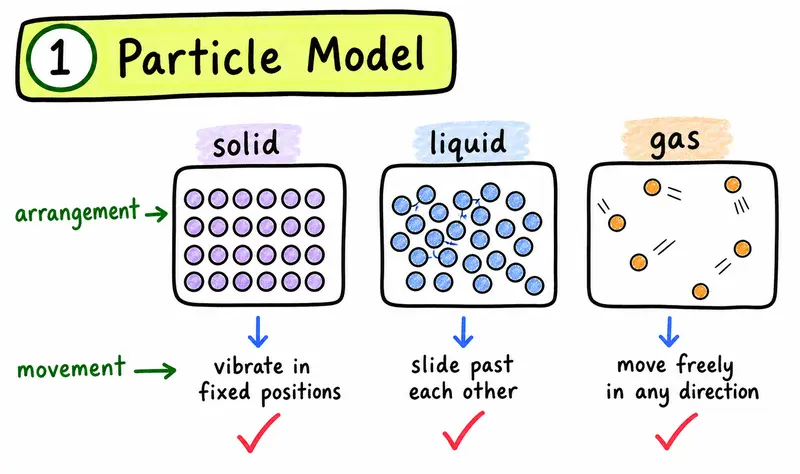
When a question asks you to compare solids, liquids and gases, use the same features for each state.
| State | Arrangement | Movement | Attraction |
|---|---|---|---|
| Solid | Closely packed, regular arrangement | Vibrate about fixed positions | Strong attractions |
| Liquid | Close together, random arrangement | Move or slide past each other | Weaker than in solids |
| Gas | Far apart, random arrangement | Move randomly and rapidly | Very weak attractions |
The best answers compare like with like. Do not write three lines about solids and one short phrase about gases. If the question says "compare", keep the same headings for both states.
Weak:
- Gas particles are loose and solid particles are tight.
Better:
- In a solid, particles are closely packed in fixed positions and vibrate. In a gas, particles are far apart, move randomly and rapidly, and have very weak attractions between them.
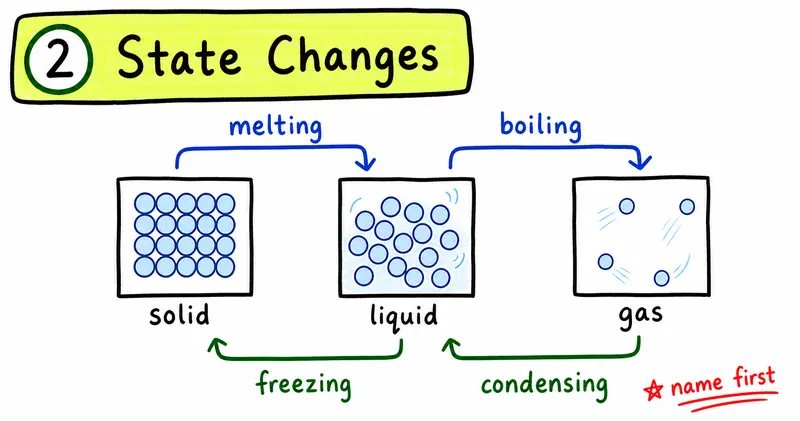
State changes: name the process first
State changes are physical changes. The particles stay the same substance, but their arrangement, movement and energy change.
| Change of state | Direction | Energy change |
|---|---|---|
| Melting | Solid to liquid | Energy is taken in |
| Freezing | Liquid to solid | Energy is released |
| Boiling | Liquid to gas throughout the liquid | Energy is taken in |
| Evaporation | Liquid to gas at the surface | Energy is taken in |
| Condensation | Gas to liquid | Energy is released |
| Sublimation | Solid to gas | Energy is taken in |
For IGCSE answers, do not say "heat disappears" or "particles melt". The substance melts. The particles gain energy, move more and overcome some attractions.
Worked example 1: melting
Question: Explain melting using the kinetic particle model.
Mark-worthy answer:
During melting, particles gain kinetic energy and vibrate more. They overcome some of the attractions holding them in fixed positions, so the particles can move past each other. The solid becomes a liquid.
Why it works:
The answer mentions energy, movement and attractions. It also avoids saying the particles themselves melt.
Worked example 2: boiling
Question: Explain why a liquid changes to a gas during boiling.
Mark-worthy answer:
The particles gain enough energy to overcome the attractions between them. They move far apart and move randomly at high speed, so the liquid becomes a gas.
Why it works:
The answer links energy to attraction and particle spacing. That is the mark-bearing chain.
Boiling and evaporation: do not mix them up
Boiling and evaporation both form gas, but they are not the same process.
| Process | Where it happens | Temperature |
|---|---|---|
| Boiling | Throughout the liquid | At the boiling point |
| Evaporation | At the surface of the liquid | Can happen below the boiling point |
Evaporation happens when higher-energy particles at the surface escape from the liquid. Boiling happens when particles throughout the liquid have enough energy to form gas bubbles.
This difference is a common exam trap. If the question says bubbles form throughout the liquid, it is describing boiling, not evaporation.
Heating and cooling curves
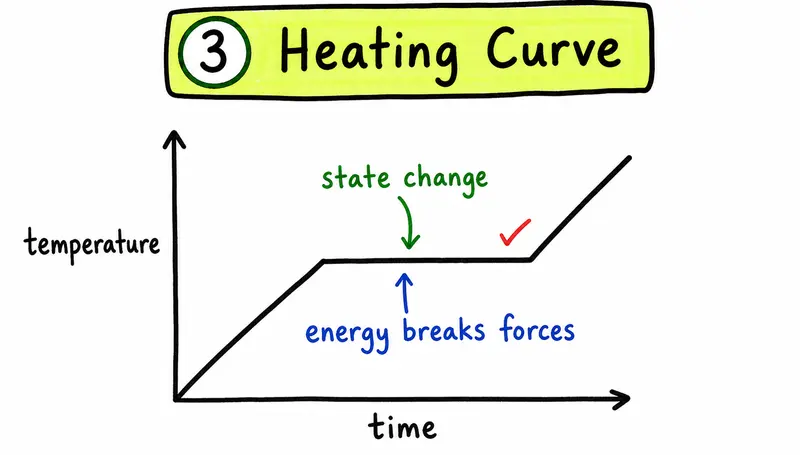
Heating curves and cooling curves test whether you can connect temperature, energy and state changes.
During a sloping part of a heating curve, the temperature increases because particles gain kinetic energy. During a flat part, the temperature stays constant because energy is being used to overcome attractions during a state change.
During a sloping part of a cooling curve, the temperature decreases because particles lose kinetic energy. During a flat part, the temperature stays constant because energy is released while attractions form during a state change.
| Part of graph | What is happening |
|---|---|
| Sloping heating section | Particles gain kinetic energy and temperature rises |
| Flat melting section | Energy overcomes attractions; temperature stays constant |
| Flat boiling section | Energy overcomes attractions; temperature stays constant |
| Sloping cooling section | Particles lose kinetic energy and temperature falls |
| Flat freezing or condensation section | Energy is released as attractions form |
The flat section is not "nothing happening". The state is changing while temperature stays constant.
How to read heating and cooling curves
When you see a heating or cooling curve, identify the section before explaining it.
| Graph section | Temperature | Particle explanation |
|---|---|---|
| Sloping line on a heating curve | Increases | Particles gain kinetic energy and move faster |
| Flat line on a heating curve | Stays constant | Energy is used to overcome attractions during melting or boiling |
| Sloping line on a cooling curve | Decreases | Particles lose kinetic energy and move more slowly |
| Flat line on a cooling curve | Stays constant | Energy is released as attractions form during freezing or condensation |
A common mistake is to say the temperature does not change because no energy is transferred. That is wrong. Energy is still being transferred, but it changes the arrangement of particles rather than their kinetic energy.
Worked example 3: flat section on a heating curve
Question: A heating curve has a flat section while a solid is melting. Explain why the temperature stays constant.
Mark-worthy answer:
The energy supplied is used to overcome attractions between particles rather than increase their kinetic energy. The temperature stays constant while the solid changes to a liquid.
Why it works:
The answer explains where the energy goes. It does not say the substance stops heating.
Diffusion and random motion
Diffusion is the movement of particles from a region of higher concentration to a region of lower concentration. It happens because particles move randomly.
Diffusion is faster in gases than in liquids because gas particles move faster and have more space between them. Heating a substance can also increase the rate of diffusion because particles gain kinetic energy and move faster.
Brownian motion is the random movement of tiny visible particles caused by collisions with smaller, fast-moving particles. In IGCSE answers, link the visible motion to collisions. Do not only write "they move randomly" without naming the collisions.
Worked example 4: diffusion
Question: Explain why ammonia gas spreads through a room.
Mark-worthy answer:
Ammonia particles move randomly. They spread from a region of higher concentration near the source to regions of lower concentration in the room. This is diffusion.
Why it works:
The answer gives the direction of movement and the reason. It does not describe diffusion as a smell "travelling" by itself.
What affects the rate of diffusion?
Diffusion is faster when particles move faster or when the concentration difference is larger.
| Factor | Effect on diffusion |
|---|---|
| Higher temperature | Particles have more kinetic energy and move faster |
| Larger concentration gradient | There is a bigger difference between high and low concentration |
| Gas instead of liquid | Gas particles move faster and are farther apart |
| Shorter distance | Particles have less distance to spread through |
Do not write that particles choose to move to empty space. They move randomly. The overall spreading happens from higher concentration to lower concentration.
Worked example 5: flat section on a cooling curve
Question: A cooling curve has a flat section while a gas is condensing. Explain why the temperature stays constant.
Mark-worthy answer:
During condensation, particles lose energy and move closer together. Attractions form between particles. The temperature stays constant because energy is released during the state change rather than the particles continuing to lose kinetic energy.
Why it works:
The answer links the flat section to condensation, energy release and attraction formation. It does not say that nothing is happening.
Gas pressure and particle collisions
Gas pressure comes from particles colliding with the walls of a container. If the gas is heated, particles gain kinetic energy and move faster. They collide with the walls more often and with greater force, so pressure increases if volume stays the same.
| Change | Particle explanation |
|---|---|
| Higher temperature | Particles move faster |
| Smaller volume | Particles collide with walls more often |
| More gas particles | More collisions with the container walls |
This topic can connect with collision theory later in chemistry. For particle theory, keep the answer focused on random motion and collisions.
Common mistakes that cost marks
- Saying particles expand when a substance is heated.
- Saying heat disappears during melting or boiling.
- Writing that particles in a solid do not move at all.
- Comparing solids and gases but forgetting liquids.
- Describing arrangement but not movement.
- Describing movement but not attraction.
- Mixing up boiling and evaporation.
- Saying temperature rises during a flat part of a heating curve.
- Explaining diffusion without mentioning random motion or concentration.
Write corrections as full sentences. "Particles expand" is the wrong idea. A better correction is: "When heated, particles gain kinetic energy and move more; the particles themselves do not get bigger."
Exam question types
| Question type | First move | What to include |
|---|---|---|
| Compare states | Use the same features for both states | Arrangement, movement, attraction |
| Explain a state change | Name the change first | Energy change, particle movement, attractions |
| Interpret a heating curve | Identify sloping or flat section | Kinetic energy or overcoming attractions |
| Explain diffusion | State concentration direction | Random motion of particles |
| Explain gas pressure | Name collisions | Particle speed, frequency of collisions and force |
If a question asks for a particle explanation, avoid everyday wording. Use particles, kinetic energy, attractions, concentration or collisions.
A short revision route
- Draw simple particle diagrams for solid, liquid and gas.
- Write one sentence for arrangement, movement and attraction in each state.
- Explain melting and boiling without using the phrase "particles melt".
- Practise one heating curve question.
- Practise one diffusion or gas pressure question.
- Mark the first missing particle phrase and add it to an error log.
This topic improves fast when you practise short explanations. Long rereading is less useful than one marked answer.
How to use EduNinja for this topic
Use the notes page to rebuild the kinetic particle model. Then use the question bank for state change, diffusion and collision theory practice.
Good next links:
- IGCSE Chemistry Notes
- IGCSE Chemistry Question Bank
- 1.1.5 changes of state using kinetic theory
- 6.2.6 rate changes using collision theory
- Chemistry Topical Notes
Keep a small error log with two columns: weak wording and markscheme wording. Particle theory is a wording topic as much as a diagram topic.
FAQ
How do I compare solids, liquids and gases in IGCSE Chemistry?
Use the same three features for each state: arrangement, movement and attraction. For example, solids have closely packed particles in fixed positions that vibrate, while gases have particles far apart moving randomly and rapidly.
What happens to particles during melting?
Particles gain kinetic energy and vibrate more. They overcome some attractions holding them in fixed positions, so they can move past each other as a liquid.
What is the kinetic particle theory?
Kinetic particle theory explains solids, liquids, gases and state changes by describing particle arrangement, movement, attraction and energy.
Do particles expand when heated?
No. In the IGCSE particle model, particles do not get bigger. They gain kinetic energy, move more and may become farther apart.
What is the difference between boiling and evaporation?
Boiling happens throughout a liquid at its boiling point. Evaporation happens at the surface and can happen below the boiling point.
Why is temperature constant during a state change?
The energy supplied is used to overcome attractions between particles rather than increase kinetic energy. That is why the graph has a flat section.
How does diffusion happen?
Particles move randomly from a region of higher concentration to a region of lower concentration. This spreading is diffusion.
Why is diffusion faster at higher temperature?
Particles have more kinetic energy at higher temperature, so they move faster and spread out more quickly.
Closing
Particle theory gets easier when you stop relying on diagrams alone. For each answer, write what the particles are doing, how far apart they are, how strong the attractions are and where energy is going.
Put CAIE back into your full IGCSE CAIE Chemistry study plan.
Return to the complete course overview, or move directly into the most relevant study tool.
Related articles
More course notes, updates and study resources from the EduNinja blog.

IB Chemistry SL 2025 Syllabus Changes: Assessment Guide
A practical IB Chemistry SL guide to the 2025 syllabus and assessment model: structure and reactivity, Paper 1A and 1B, Paper 2, scientific investigation and revision strategy.
Electron Domains and Molecular Geometry | A-Level Chemistry
Revise A-Level Chemistry electron domains, VSEPR shapes, lone pairs, bond angles, molecular geometry and common exam mistakes.
Salt Bridge Explained | A-Level Chemistry
Learn the function of a salt bridge in A-Level Chemistry, including ion movement, electrical neutrality, cell circuits and exam mistakes.