A-Level Chemistry Bonding: Covalent Bonds and Intermolecular Forces
Revise A-Level Chemistry bonding with covalent bond definitions, ionic vs covalent bonding, intermolecular forces, molecular shape and exam-style property explanations.
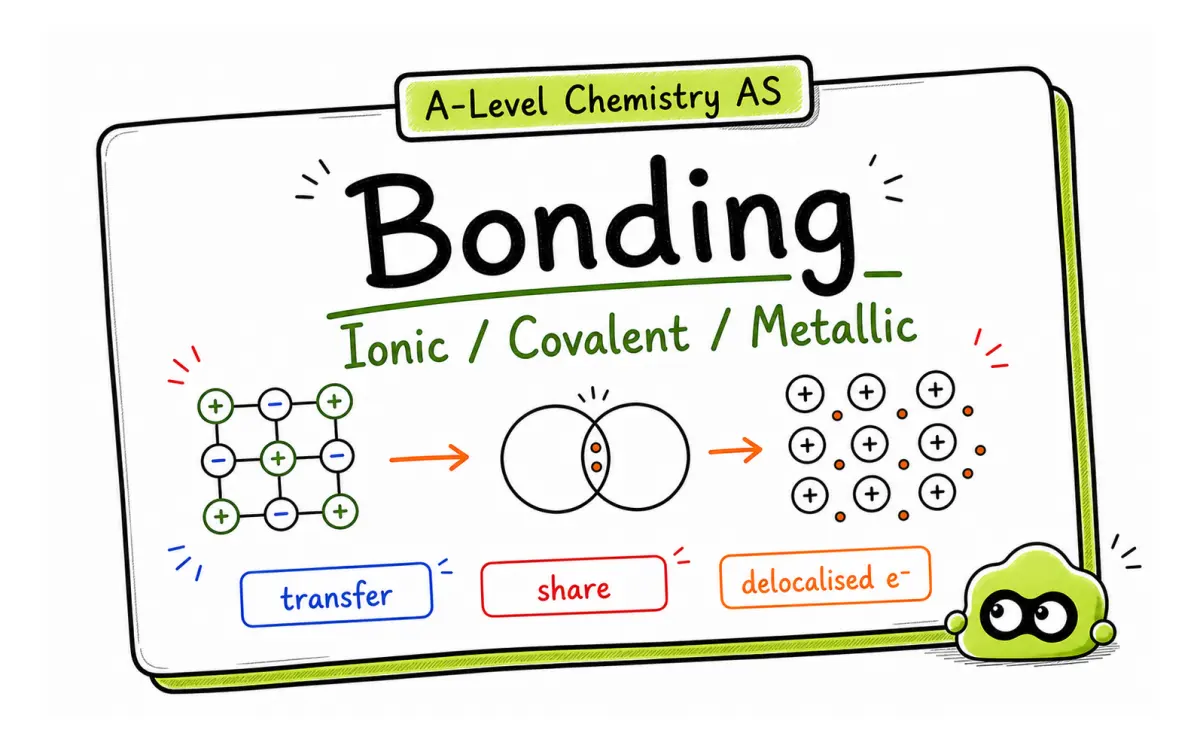
A-Level Chemistry bonding can feel deceptively simple at first. You learn ionic, covalent, and metallic bonding early, then suddenly the exam asks you to define a covalent bond, compare it with ionic bonding, separate covalent bonds from intermolecular forces, and explain melting point, conductivity, polarity, shape, bond angle, and dot-and-cross diagrams in the same topic.
That is where many AS students lose marks. They know the definition, but they do not connect the definition to the evidence in the question. This guide gives you a practical way to revise A-Level Chemistry bonding without turning it into a list of disconnected facts.
Use the relevant EduNinja course pages as your base:
- A-Level Chemistry Question Bank
- Covalent and coordinate bonding questions
- Intermolecular forces and bond properties
- A-Level Chemistry Notes
- A Level CIE Chemistry Notes with questions
- AS CIE Chemistry Notes - Unit 1 Atomic structure
Do not open every link at once. Start with the notes or topic page, then move into question practice and use any PDF resource only when it helps clarify the exact idea you are revising.
Quick Answer
For A-Level Chemistry bonding, revise in this order:
- Start with what particles are attracted: ions, nuclei and shared electrons, or metal ions and delocalised electrons.
- Link each bond type to electron movement: transfer, sharing, or delocalisation.
- Practise dot-and-cross diagrams for ionic, covalent, and coordinate bonding.
- Learn VSEPR shapes through electron pairs, not by memorising drawings alone.
- Separate bonding within a substance from intermolecular forces between molecules.
- Explain properties using structure: melting point, boiling point, conductivity, and solubility.
- Finish each session with exam-style questions from the A-Level Chemistry Question Bank.
If you only revise definitions, bonding questions will feel random. If you revise by particle attraction, structure, and evidence, the topic becomes much more predictable.
Core Concept That Gets Marks
Bonding questions are property explanations. Start from particles and attractions, then connect structure to melting point, conductivity, shape, polarity, or intermolecular force.
What A-Level Chemistry Bonding Includes
The AS Chemistry bonding topic is bigger than the three bond types. In the CAIE-style structure used by EduNinja, Chemical bonding includes electronegativity, ionic bonding, metallic bonding, covalent and coordinate bonding, sigma and pi bonds, bond energy and bond length, molecular shapes, intermolecular forces, bond polarity, and dot-and-cross diagrams.
That means a bonding question may begin with a simple definition but end by asking for a property explanation. For example, a student may need to explain why magnesium oxide has a high melting point, why carbon dioxide is non-polar overall, or why water has a higher boiling point than expected for its molecular size.
Use A-Level Chemistry Notes when you need the concept rebuilt, then move into questions quickly. Bonding improves fastest when you test whether you can apply the idea to unfamiliar substances.
Ionic, Covalent, and Metallic Bonding
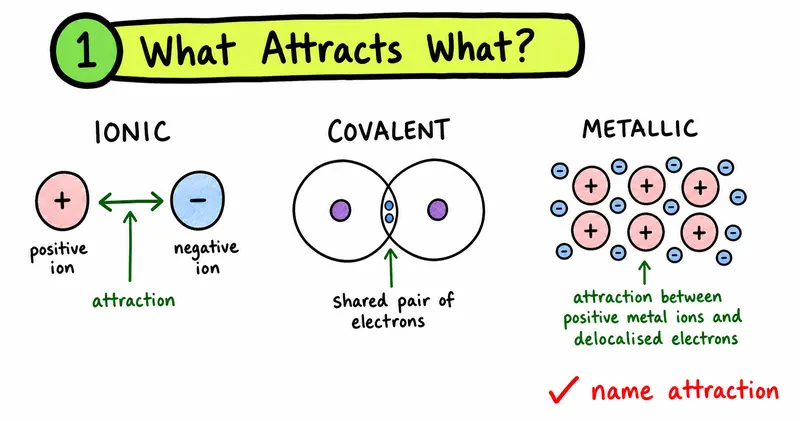
The fastest way to choose the right explanation is to ask: what is being attracted to what?
| Bond type | What is attracted? | Electron idea | Common exam evidence |
|---|---|---|---|
| Ionic | Oppositely charged ions | Electrons are transferred | High melting point, conducts when molten or aqueous |
| Covalent | Shared electron pair and nuclei | Electrons are shared | Simple molecules often have lower boiling points; giant covalent structures have high melting points |
| Metallic | Positive metal ions and delocalised electrons | Electrons are delocalised | Conducts electricity, malleable, ductile |
Ionic bonding is usually described as the electrostatic attraction between oppositely charged ions formed by electron transfer. Covalent bonding is the strong attraction between a shared pair of electrons and the nuclei of the bonded atoms. Metallic bonding is attraction between positive metal ions and delocalised electrons.
This is why "electron transfer" and "electron sharing" are not enough by themselves. Examiners often want the electrostatic attraction named clearly. In a full answer, say what the particles are and why they attract.
For targeted practice, use the EduNinja topic page for covalent and coordinate bonding, then compare it with ionic and metallic questions in the wider question bank.
What is a covalent bond?
A covalent bond is the strong electrostatic attraction between a shared pair of electrons and the nuclei of the bonded atoms. In A-Level Chemistry, that full definition matters. Do not stop at "atoms share electrons" if the question asks for a definition.
Exam-safe wording:
- A covalent bond is the electrostatic attraction between a shared pair of electrons and the nuclei of two atoms.
This wording helps with dot-and-cross diagrams, molecular shape, bond polarity and giant covalent structures. It also stops you from confusing covalent bonds inside molecules with forces between molecules.
Ionic vs covalent bond definitions
| Bond type | Core definition | Electron idea | Common exam wording trap |
|---|---|---|---|
| Ionic bond | Electrostatic attraction between oppositely charged ions | Electrons are transferred | Saying electrons are shared |
| Covalent bond | Electrostatic attraction between a shared pair of electrons and nuclei | Electrons are shared | Forgetting nuclei or electrostatic attraction |
| Metallic bond | Attraction between positive metal ions and delocalised electrons | Electrons are delocalised | Saying electrons belong to one atom |
Practise this with covalent and coordinate bonding questions, then compare it with intermolecular forces and bond properties.
Dot-and-Cross Diagrams
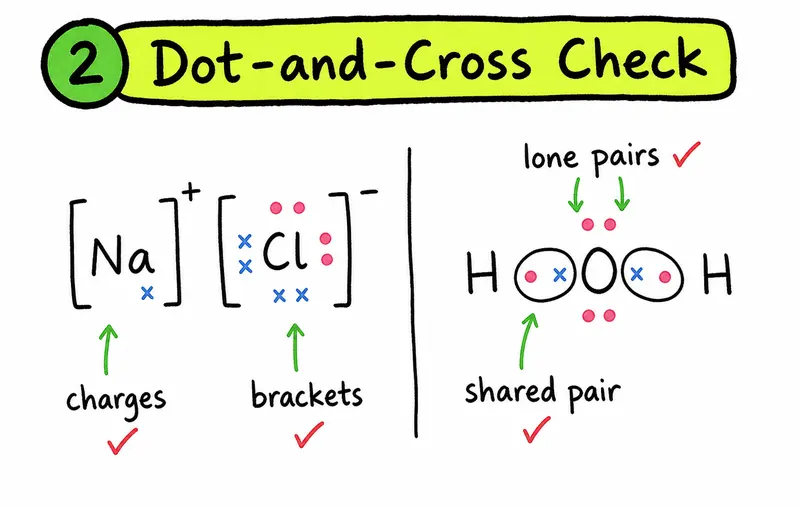
Dot-and-cross diagrams are not just drawings. They test whether you understand where electrons came from, which atoms gained or lost electrons, and which electron pairs are shared.
For ionic diagrams, check:
- The metal atom has lost electron(s).
- The non-metal atom has gained electron(s).
- Ions have charges.
- Outer shells are complete where expected.
- Brackets and charges are included when needed.
For covalent diagrams, check:
- Shared electron pairs are shown between atoms.
- Lone pairs remain on the correct atoms.
- The total number of outer-shell electrons is sensible.
- Multiple bonds are shown as multiple shared pairs.
For coordinate bonding, the shared pair comes from one atom, but the resulting bond is still a covalent bond after it has formed. That is a common wording trap. Practise this through dot-and-cross diagram questions rather than only copying examples from notes.
Shapes, Polarity, and Intermolecular Forces
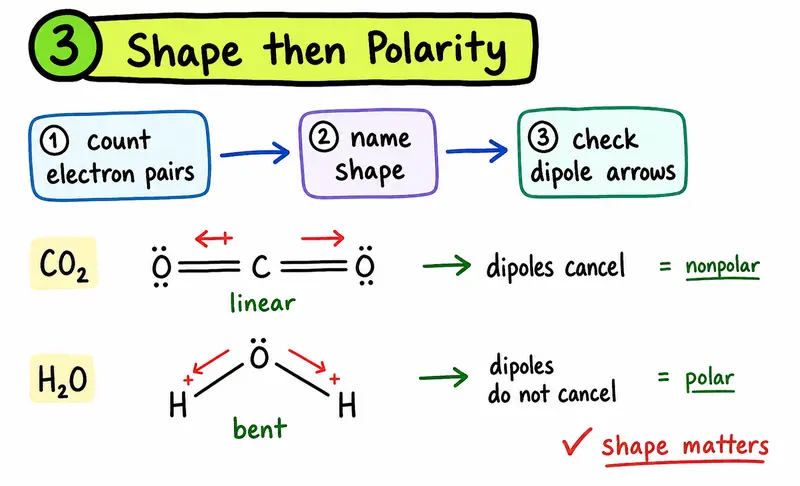
Molecular shape questions are usually VSEPR questions. Count electron pairs around the central atom, separate bonding pairs from lone pairs, then predict the shape and bond angle.
Typical AS examples include:
| Example | Shape | Approximate angle | What to watch |
|---|---|---|---|
| CO2 | Linear | 180 degrees | Two bonding regions, no lone pairs on carbon |
| BF3 | Trigonal planar | 120 degrees | Three bonding regions |
| CH4 | Tetrahedral | 109.5 degrees | Four bonding regions |
| NH3 | Pyramidal | 107 degrees | One lone pair reduces the angle |
| H2O | Non-linear | 104.5 degrees | Two lone pairs reduce the angle further |
Polarity needs two checks. First, decide whether the bonds are polar using electronegativity. Second, decide whether the molecule is polar overall using shape and symmetry. A molecule can contain polar bonds but be non-polar overall if the dipoles cancel.
Intermolecular forces are another frequent source of lost marks. Covalent bonds are inside molecules. Intermolecular forces act between molecules. Hydrogen bonding is a special case of permanent dipole-permanent dipole attraction, commonly involving hydrogen bonded to highly electronegative atoms such as nitrogen or oxygen in the AS examples.
Use intermolecular forces and bond properties when you need to practise the jump from bonding to physical properties.
Covalent bond vs intermolecular force
A covalent bond is a strong attraction inside a molecule. An intermolecular force is an attraction between molecules. This difference is a common reason students lose marks in boiling point and volatility questions.
| Question asks about | Usually explain using | Example wording |
|---|---|---|
| Bond length or bond energy | Covalent bond strength | Stronger covalent bonds require more energy to break |
| Boiling point of simple molecules | Intermolecular forces | More energy is needed to overcome stronger intermolecular forces |
| Giant covalent structures | Many strong covalent bonds | Diamond has a high melting point because many covalent bonds must be broken |
| Polarity and shape | Bond polarity plus molecular geometry | Polar bonds may cancel in a symmetrical molecule |
If the substance is a simple molecular substance, boiling usually separates molecules. It does not break the covalent bonds inside each molecule. If the substance is a giant covalent structure, melting requires breaking many covalent bonds.
Common Mistakes That Cost Marks
Most bonding mistakes are not because the student knows nothing. They happen because the answer uses the wrong level of explanation.
| Mistake | Why it loses marks | Fix |
|---|---|---|
| Saying "ionic bonds share electrons" | Ionic bonding involves electron transfer and attraction between ions | Name ions and electrostatic attraction |
| Calling intermolecular forces "covalent bonds" | Bonds within molecules and forces between molecules are different | Ask whether the force is inside or between molecules |
| Saying a polar bond always means a polar molecule | Symmetrical molecules can cancel dipoles | Check the shape and direction of dipoles |
| Ignoring lone pairs in shape questions | Lone pairs repel more strongly than bonding pairs | Count all electron pairs before naming shape |
| Explaining properties without structure | Property questions need structure and bonding evidence | Link melting point, boiling point, or conductivity to particles |
The biggest fix is to force every answer through a three-part sentence:
- Name the structure or bonding.
- Name the particles or forces involved.
- Link that to the observed property.
For example: "Magnesium oxide has a high melting point because it has a giant ionic lattice with strong electrostatic attractions between Mg2+ and O2- ions, so a lot of energy is needed to overcome them."
Worked Example: Covalent Bond vs Intermolecular Force
Question: Chlorine has a low boiling point. Explain this using bonding.
Markscheme-style answer: Chlorine is a simple molecular substance. There are covalent bonds between the atoms in each Cl2 molecule, but boiling separates the molecules from each other. Only weak intermolecular forces between Cl2 molecules are overcome, so little energy is needed.
Why this scores: The answer separates covalent bonds within molecules from intermolecular forces between molecules.
Topic-Specific Revision Route
Use this routine when you are short on time but still need useful practice.
Minutes 0-5: rebuild the map. Write the three bond types and one definition for each. Add one property clue beside each type.
Minutes 5-12: draw, do not read. Draw one ionic dot-and-cross diagram, one covalent diagram, and one coordinate bonding example. Check charges, lone pairs, and shared pairs.
Minutes 12-20: practise properties. Pick three substances and explain melting point, boiling point, or conductivity using structure and bonding.
Minutes 20-27: do exam-style questions. Use the A-Level Chemistry Question Bank and choose one bonding subtopic only. Do not mix ten topics at once.
Minutes 27-30: write an error note. Turn each mistake into a sentence beginning with "Next time, I will check..." This is where EduNinja Flashcards can help: one repeated error becomes one recall card.
How EduNinja Helps
A good workflow is Notes, then Question Bank, then error review.
Start with AS CIE Chemistry Notes - Unit 3 Chemical bonding or the broader A Level CIE Chemistry Notes with questions if you need a source to rebuild the topic. Then use EduNinja questions for one subtopic at a time.
If intermolecular forces are the weak point, add the focused AS Edexcel Chemistry note - Intermolecular forces as comparison reading. If you are revising across boards, the AS AQA Chemistry Note - 1.3 Bonding can also be useful, but always check your own exam-board syllabus before treating any note as final.
Worked Example 1
Worked Example 1: Turn the Topic Into a Marked Explanation
Question: A student writes a short answer about Bonding but loses marks. What is usually missing?
Worked answer: The answer often names the idea but does not connect it to particles, bonding, moles, energy, or observations. A stronger answer explains the chemical reason and uses the correct technical term.
Markscheme-style answer: Uses correct chemical terminology; identifies the relevant particles or quantities; links the idea to the observation or calculation; avoids vague phrases such as "it reacts more".
Worked Example 2: Check Units, State Symbols, or Conditions
Question: What should you check before moving on from a Bonding calculation or equation?
Worked answer: Check whether the answer needs moles, concentration, mass, energy, pH, or percentage. For equations, check balancing, charges, state symbols where required, and whether the question asks for observations or explanation.
Markscheme-style answer: Balanced chemistry is shown; units are consistent; the final quantity matches the question; explanation is linked to evidence from the reaction or data.
Question-Type Breakdown
Bonding questions reward precise language about particles and forces.
| Question type | What it is really asking | First move | Common trap |
|---|---|---|---|
| Ionic bonding | Electron transfer and ion attraction | Name cations, anions, and electrostatic attraction | Saying atoms share electrons |
| Covalent bonding | Shared electron pairs | Count outer electrons and bonds | Saying molecules have ionic lattices |
| Metallic bonding | Positive ions and delocalised electrons | Describe lattice and electron movement | Saying electrons are free without context |
| Molecular shape | Electron-pair repulsion | Count bonding and lone pairs | Ignoring lone pairs |
| Intermolecular forces | Explain boiling point or solubility | Identify the force between molecules | Confusing covalent bonds with intermolecular forces |
Weak Answer vs Mark-Worthy Answer
Weak answer:
- Ionic compounds have strong bonds so they have high melting points.
Mark-worthy answer:
- Ionic compounds have giant ionic lattices with strong electrostatic attractions between oppositely charged ions, so a large amount of energy is needed to overcome these attractions.
Weak answer:
- Covalent molecules conduct because they have electrons.
Mark-worthy answer:
- Simple covalent molecules usually do not conduct electricity because they do not contain mobile charged particles.
Exam-Ready Mini Checklist
| Check | What good work looks like |
|---|---|
| particles identified | checked before moving on |
| attraction named | checked before moving on |
| structure linked to property | checked before moving on |
| bonding separated from forces | checked before moving on |
| example substance checked | checked before moving on |
Practice This Topic
Try an exam-style question on this exact topic, then check the worked guidance in the Question Bank.
Practice this topic: Practise A-Level Chemistry covalent bonding questions
FAQ
What is a covalent bond?
A covalent bond is the electrostatic attraction between a shared pair of electrons and the nuclei of the bonded atoms. For A-Level Chemistry, include both the shared pair and the nuclei in the definition.
What is the difference between a covalent bond and an intermolecular force?
A covalent bond acts inside a molecule, holding atoms together. An intermolecular force acts between molecules. Boiling simple molecular substances usually overcomes intermolecular forces, not covalent bonds.
What is the difference between ionic and covalent bonding?
Ionic bonding involves electron transfer and electrostatic attraction between oppositely charged ions. Covalent bonding involves shared pairs of electrons between atoms.
Why do ionic compounds have high melting points?
Ionic compounds have giant ionic lattices with strong electrostatic attractions between oppositely charged ions. A large amount of energy is needed to overcome these attractions.
Why do simple covalent molecules have low boiling points?
Simple covalent molecules have strong covalent bonds within molecules but weaker intermolecular forces between molecules. Boiling usually overcomes intermolecular forces, not the covalent bonds inside each molecule.
How do lone pairs affect molecular shape?
Lone pairs repel more strongly than bonding pairs, so they reduce bond angles and change molecular shape. Count bonding pairs and lone pairs before naming the shape.
Related Study Links
- Explore the course Study Hub
- A-Level Chemistry Notes
- A-Level Chemistry Question Bank
- Covalent and coordinate bonding questions
- Intermolecular forces and bond properties
- Covalent and coordinate bonding practice
- Intermolecular forces and bond properties
- Dot-and-cross diagram practice
Put chemical bonding back into your full A-Level CAIE Chemistry AS study plan.
Return to the complete course overview, or move directly into the most relevant study tool.
Related articles
More course notes, updates and study resources from the EduNinja blog.

IB Chemistry SL 2025 Syllabus Changes: Assessment Guide
A practical IB Chemistry SL guide to the 2025 syllabus and assessment model: structure and reactivity, Paper 1A and 1B, Paper 2, scientific investigation and revision strategy.
Electron Domains and Molecular Geometry | A-Level Chemistry
Revise A-Level Chemistry electron domains, VSEPR shapes, lone pairs, bond angles, molecular geometry and common exam mistakes.
Salt Bridge Explained | A-Level Chemistry
Learn the function of a salt bridge in A-Level Chemistry, including ion movement, electrical neutrality, cell circuits and exam mistakes.