CAIE AS Chemistry Group 2: Atomic Radius, Ionisation Energy, and Reactivity
A source-backed CAIE Chemistry guide for CAIE AS Chemistry Group 2, using EduNinja PDF notes, worked examples, and markscheme-style answers.
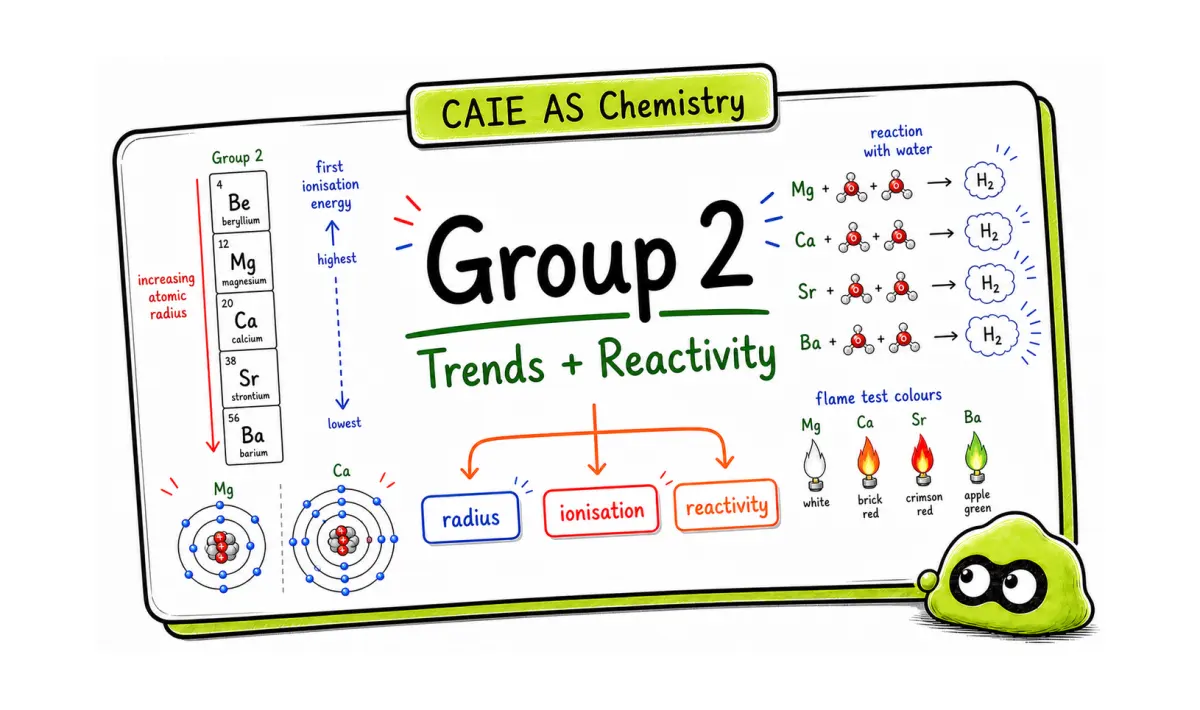
CAIE AS Chemistry Group 2 questions often look like simple trend questions. The marks come from the explanation chain: more shells, greater shielding, larger atomic radius, weaker attraction to outer electrons, easier electron loss.
If you only remember one thing: Group 2 metals become more reactive down the group because they lose their two outer electrons more easily. Do not explain the trend by saying the atoms are heavier. Use shells, shielding, distance from the nucleus, and attraction between the nucleus and outer electrons.
Useful starting points:
- A-Level Chemistry Notes
- CAIE AS Chemistry Group 2 Question Bank
- AS CIE Chemistry Notes - Unit 10 Group 2
- AS CIE Chemistry Notes - Unit 1 Atomic structure
Use the notes to rebuild the explanation, then move into question practice. One well-marked Group 2 answer is worth more than rereading the trend table five times.
Quick answer
- Atomic radius increases down Group 2 because each element has an extra electron shell.
- First ionisation energy decreases down Group 2 because shielding and distance from the nucleus increase.
- Reactivity increases down Group 2 because the two outer electrons are lost more easily.
- Group 2 metals form 2+ ions.
- Group 2 metals react with acids to form a salt and hydrogen.
- Group 2 oxides are basic and react with acids to form salts and water.
- Group 2 hydroxides become more soluble down the group.
- Group 2 sulfates become less soluble down the group.
- Group 2 carbonates and nitrates become more thermally stable down the group.
- Reactivity with water increases down Group 2, so reactions become more vigorous.
- Group 2 hydroxides become more soluble down the group, but Group 2 sulfates become less soluble.
- Group 2 carbonates and nitrates become harder to decompose down the group because larger 2+ ions polarise the anion less.
- In observation questions, name the gas, precipitate, colour, or pH change. Do not only write that a reaction happens.
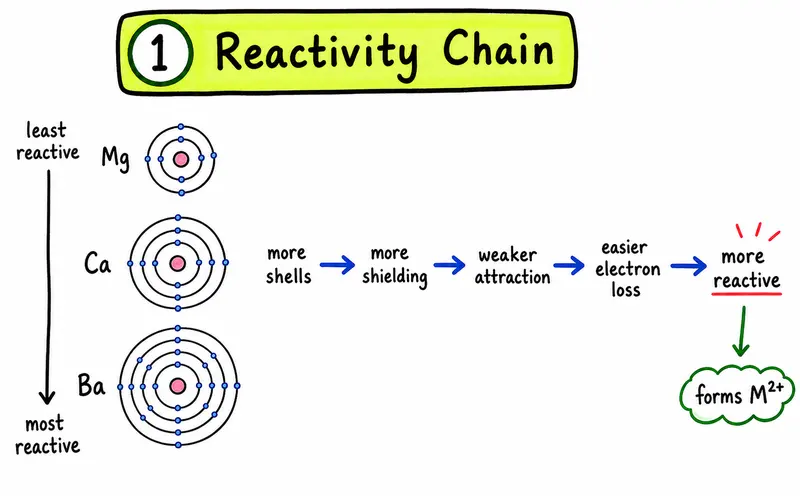
The explanation chain that earns marks
Most Group 2 trend answers use the same reasoning. Learn the chain in order.
| Step | What to say | Why it matters |
|---|---|---|
| 1 | Down the group, atoms have more electron shells | This explains the larger atomic radius |
| 2 | The outer electrons are further from the nucleus | Distance weakens attraction |
| 3 | Inner shells provide more shielding | Shielding reduces nuclear attraction |
| 4 | Attraction between nucleus and outer electrons is weaker | Less energy is needed to remove electrons |
| 5 | The metal loses two outer electrons more easily | Reactivity increases |
The common mistake is jumping from "bigger atoms" to "more reactive" without explaining electron attraction. CAIE markschemes tend to reward the middle of the chain.
Atomic radius down Group 2
Atomic radius increases down Group 2 from beryllium to barium. Each element has one more occupied electron shell than the element above it.
Weak:
- Atomic radius increases because the atoms are lower down.
Better:
- Atomic radius increases down Group 2 because each element has an additional electron shell, so the outer electrons are further from the nucleus.
That second answer gives the reason. It also avoids using mass as the explanation.
First ionisation energy down Group 2
First ionisation energy is the energy needed to remove one electron from each atom in one mole of gaseous atoms to form one mole of gaseous 1+ ions.
For Group 2, first ionisation energy decreases down the group.
The exam explanation is:
- Atoms have more electron shells down the group.
- The outer electron is further from the nucleus.
- Shielding by inner electrons increases.
- Nuclear attraction to the outer electron is weaker.
- Less energy is needed to remove the outer electron.
Markscheme-style answer:
- First ionisation energy decreases down Group 2 because the outer electron is further from the nucleus and more shielded by inner shells. The attraction between the nucleus and the outer electron is weaker, so less energy is needed to remove it.
Do not write that the nucleus is weaker. The nuclear charge increases down the group, but shielding and distance have the larger effect on the outer electron.
Reactivity down Group 2
Group 2 metals react by losing two outer electrons to form 2+ ions. Reactivity increases down the group because those outer electrons are removed more easily.
| Trend | Direction down Group 2 | Explanation |
|---|---|---|
| Atomic radius | Increases | More electron shells |
| Shielding | Increases | More inner shells block attraction |
| First ionisation energy | Decreases | Outer electron is easier to remove |
| Reactivity | Increases | Two outer electrons are lost more easily |
This is a metal trend. Do not use Group 17 logic. Halogens react by gaining electrons, so their reactivity trend is explained differently.
Group 2 trend summary table
| Property | Trend down Group 2 | Reason |
|---|---|---|
| Atomic radius | Increases | More occupied electron shells |
| Shielding | Increases | More inner electron shells |
| First ionisation energy | Decreases | Outer electron is further away and more shielded |
| Reactivity | Increases | Two outer electrons are lost more easily |
| Hydroxide solubility | Increases | More OH- ions in solution, more alkaline |
| Sulfate solubility | Decreases | BaSO4 is very insoluble |
| Carbonate thermal stability | Increases | Larger 2+ cation has lower charge density |
| Nitrate thermal stability | Increases | Larger 2+ cation polarises nitrate ion less |
Use this table as a check before writing. The trend alone is rarely enough; the reason column is where the explanation mark usually sits.
Reactions with oxygen
Group 2 metals react with oxygen to form metal oxides. Magnesium burns with a bright white flame and forms magnesium oxide.
2Mg + O2 -> 2MgO
The product is an ionic oxide. Magnesium oxide is a white solid with a high melting point because it has strong ionic bonding.
For exam observations, write what you would see:
- bright white flame for burning magnesium
- white solid product
- faster or more vigorous reaction for more reactive metals
Reactions with water and steam
Magnesium reacts slowly with cold water, but it reacts more clearly with steam to form magnesium oxide and hydrogen.
Mg + H2O -> MgO + H2
Calcium, strontium, and barium react with cold water to form hydroxides and hydrogen.
Ca + 2H2O -> Ca(OH)2 + H2 Sr + 2H2O -> Sr(OH)2 + H2 Ba + 2H2O -> Ba(OH)2 + H2
The reactions become more vigorous down the group. A good observation answer may mention fizzing, the metal dissolving, heat being released, and an alkaline solution forming.
Reactions with acids
Group 2 metals react with acids to form a salt and hydrogen.
Mg + 2HCl -> MgCl2 + H2 Ca + 2HCl -> CaCl2 + H2
The reaction becomes more vigorous down Group 2 because the metals lose electrons more easily.
A stronger answer links observation to chemistry:
- Fizzing is caused by hydrogen gas.
- The metal dissolves as metal ions form in solution.
- The solution warms because the reaction releases heat.
Observation wording for Group 2 reactions
Observation questions need visible evidence. Write what a student would see, then name the chemistry behind it.
| Reaction | Observation | What it means |
|---|---|---|
| Metal + water | Fizzing | Hydrogen gas is produced |
| Calcium + water | White suspension may form | Calcium hydroxide is only slightly soluble |
| Barium + water | More vigorous fizzing | Barium loses electrons more easily |
| Metal + acid | Effervescence and metal dissolves | Hydrogen forms and metal ions enter solution |
| Magnesium + oxygen | Bright white flame and white solid | Magnesium oxide forms |
Avoid vague observation sentences. "Fizzing is seen because hydrogen gas is produced" is stronger than "it reacts more".
Oxides and hydroxides
Group 2 oxides are basic. They react with acids to form salts and water.
MgO + 2HCl -> MgCl2 + H2O
Some Group 2 oxides react with water to form hydroxides.
CaO + H2O -> Ca(OH)2
Group 2 hydroxides become more soluble down the group. That means barium hydroxide produces more hydroxide ions in solution than magnesium hydroxide, so it is more alkaline.
| Compound type | Trend down Group 2 | Exam consequence |
|---|---|---|
| Hydroxides | More soluble | Solutions become more alkaline |
| Sulfates | Less soluble | Barium sulfate is very insoluble |
This pair of trends is easy to mix up. Hydroxides: more soluble down the group. Sulfates: less soluble down the group.
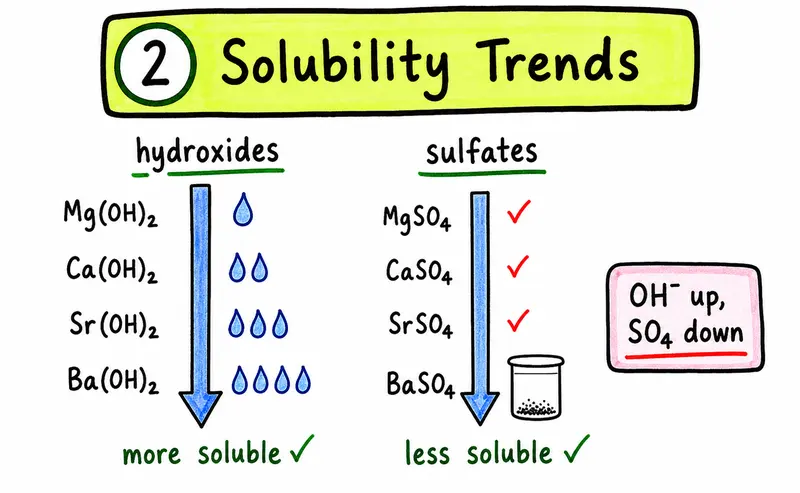
Hydroxides vs sulfates: do not mix the trends
Group 2 hydroxides become more soluble down the group. This means the solutions contain more OH- ions and become more alkaline.
Group 2 sulfates become less soluble down the group. Barium sulfate is very insoluble, which is why acidified barium chloride is used to test for sulfate ions.
A safe exam sentence is:
Hydroxide solubility increases down Group 2, but sulfate solubility decreases down Group 2.
Sulfates and the barium sulfate test
Group 2 sulfates become less soluble down the group. Barium sulfate is insoluble enough to form a white precipitate.
The sulfate ion test uses acidified barium chloride.
Ba2+ + SO4^2- -> BaSO4
Observation:
- A white precipitate forms if sulfate ions are present.
The solution is acidified first to remove carbonate ions, which could otherwise give a false white precipitate.
Thermal decomposition products
| Compound | Products on heating | Example |
|---|---|---|
| Group 2 carbonate | Metal oxide + carbon dioxide | CaCO3 -> CaO + CO2 |
| Group 2 nitrate | Metal oxide + nitrogen dioxide + oxygen | 2Mg(NO3)2 -> 2MgO + 4NO2 + O2 |
Nitrogen dioxide is a brown gas. Carbon dioxide can be tested by bubbling it through limewater, which turns milky.
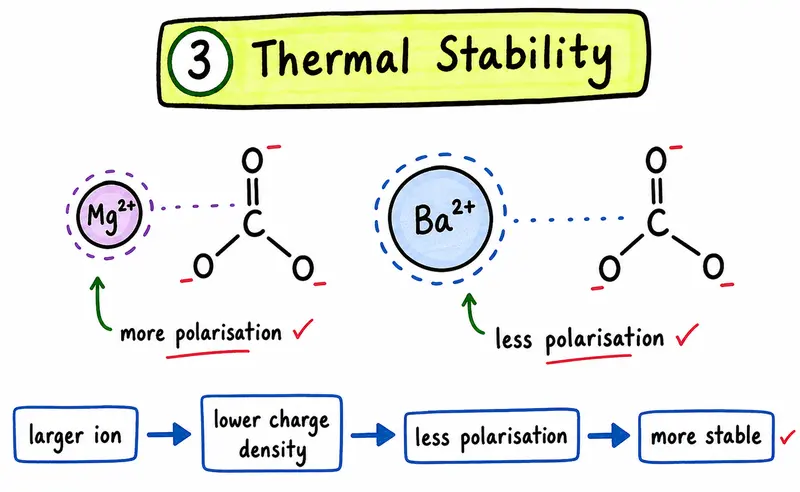
Thermal decomposition of carbonates
Group 2 carbonates decompose on heating to form a metal oxide and carbon dioxide.
CaCO3 -> CaO + CO2 MgCO3 -> MgO + CO2
Thermal stability increases down Group 2. The cations get larger, so they have lower charge density and polarise the carbonate ion less. The carbonate ion is distorted less, so the C-O bonds are weakened less and decomposition is harder.
Markscheme-style answer:
- Group 2 carbonates become more thermally stable down the group because the 2+ cations get larger and have lower charge density. They polarise the carbonate ion less, so the C-O bonds are weakened less and more heat is needed for decomposition.
Thermal decomposition of nitrates
Group 2 nitrates decompose on heating to form a metal oxide, nitrogen dioxide, and oxygen.
2Mg(NO3)2 -> 2MgO + 4NO2 + O2
You may see a brown gas because nitrogen dioxide is produced. Like carbonates, Group 2 nitrates become more thermally stable down the group because the larger cations polarise the nitrate ion less.
Do not confuse this with Group 1 nitrate decomposition. Group 1 nitrates usually form nitrites and oxygen, except lithium nitrate, which behaves more like Group 2 nitrates.
Weak answer vs mark-worthy answer
| Prompt | Weak answer | Why it loses marks | Mark-worthy answer |
|---|---|---|---|
| Explain why first ionisation energy decreases | The atoms are bigger. | It misses shielding and nuclear attraction. | Down Group 2, the outer electron is further from the nucleus and more shielded, so attraction is weaker and less energy is needed to remove it. |
| Explain why reactivity increases | The elements are lower down the group. | It states position, not cause. | The two outer electrons are lost more easily because shielding and distance increase, so Group 2 metals become more reactive down the group. |
| Explain carbonate stability | The carbonate is stronger. | It does not name polarisation. | Larger 2+ cations have lower charge density and polarise the carbonate ion less, so the carbonate is more thermally stable. |
| Explain sulfate test | It turns white. | It misses the precipitate and ion. | Acidified barium chloride gives a white precipitate of barium sulfate if sulfate ions are present. |
The better answer names the particles or ions responsible for the observation. That is the difference between a remembered trend and a chemistry explanation.
Worked example 1: first ionisation energy
Question: Explain why the first ionisation energy of barium is lower than that of magnesium.
Markscheme-style answer: Barium atoms have more electron shells than magnesium atoms. The outer electron in barium is further from the nucleus and more shielded by inner electrons, so the attraction to the nucleus is weaker. Less energy is needed to remove the outer electron.
Why this scores: It compares the two elements and gives the full attraction argument.
Worked example 2: reactivity with water
Question: Why does barium react more vigorously with water than calcium?
Markscheme-style answer: Barium has more electron shells than calcium, so its outer electrons are further from the nucleus and more shielded. The attraction to the outer electrons is weaker, so barium loses electrons more easily and reacts more vigorously.
Why this scores: It links the observation, more vigorous reaction, to electron loss.
Worked example 3: thermal stability
Question: Explain why barium carbonate is more thermally stable than magnesium carbonate.
Markscheme-style answer: The Ba2+ ion is larger than the Mg2+ ion and has lower charge density. It polarises the carbonate ion less, so the C-O bonds are weakened less. More heat is needed to decompose barium carbonate.
Why this scores: It uses the expected words: charge density, polarisation, carbonate ion, and thermal stability.
Common mistakes that cost marks
- Explaining Group 2 reactivity using mass instead of electron attraction.
- Saying shielding decreases down the group. It increases.
- Forgetting that Group 2 metals form 2+ ions.
- Mixing up hydroxide and sulfate solubility trends.
- Writing the wrong products for nitrate decomposition.
- Saying magnesium reacts with cold water as vigorously as calcium.
- Giving observations without naming the gas, precipitate, or ion.
The fastest fix is to write one corrected explanation chain after marking. Do not make a flashcard that only says "reactivity increases". Make one that says why.
Exam-ready checklist
- Did I say atomic radius increases because more shells are added?
- Did I explain first ionisation energy using distance, shielding, and nuclear attraction?
- Did I link reactivity to loss of two outer electrons?
- Did I know the products with oxygen, water, steam, and acids?
- Did I remember hydroxides become more soluble down the group?
- Did I remember sulfates become less soluble down the group?
- Did I explain carbonate and nitrate thermal stability using cation size and polarisation?
- Did I include observations where the question asks for them?
How EduNinja helps
Use this page as the explanation layer for CAIE AS Chemistry Group 2. Then use the notes and question bank to practise the exact answer move: state the trend, explain it with particles or ions, and connect it to the observation.
A short study loop works well here. Read one trend, answer one question, mark the missing wording, and rewrite the explanation in one clean sentence.
Related Study Links
FAQ
Why does atomic radius increase down Group 2?
Atomic radius increases down Group 2 because each element has an extra occupied electron shell. The outer electrons are further from the nucleus.
Why does first ionisation energy decrease down Group 2?
First ionisation energy decreases because the outer electron is further from the nucleus and more shielded by inner electrons. The attraction to the nucleus is weaker, so less energy is needed to remove the electron.
Why does Group 2 reactivity increase down the group?
Group 2 metals react by losing two outer electrons. Down the group, those electrons are further from the nucleus and more shielded, so they are lost more easily.
What are the products when Group 2 metals react with water?
Calcium, strontium, and barium react with cold water to form the metal hydroxide and hydrogen gas.
What is the trend in Group 2 hydroxide solubility?
Group 2 hydroxides become more soluble down the group. Their solutions become more alkaline because more hydroxide ions are present.
What is the trend in Group 2 sulfate solubility?
Group 2 sulfates become less soluble down the group. Barium sulfate is very insoluble and forms a white precipitate in the sulfate ion test.
Why do Group 2 carbonates become more thermally stable down the group?
The 2+ cations get larger down the group and have lower charge density. They polarise the carbonate ion less, so the carbonate ion is distorted less and decomposes less easily.
Why do Group 2 hydroxides become more alkaline down the group?
Group 2 hydroxides become more soluble down the group, so more hydroxide ions are present in solution. More OH- ions make the solution more alkaline.
Why is barium sulfate used in the sulfate ion test?
Barium sulfate is very insoluble, so it forms a white precipitate when Ba2+ ions meet sulfate ions. The solution is acidified first to remove carbonate ions that could also form a white precipitate.
What are the products when Group 2 nitrates decompose?
Group 2 nitrates decompose to form the metal oxide, nitrogen dioxide, and oxygen. Nitrogen dioxide is seen as a brown gas.
Related study links
- A-Level Chemistry Notes
- A-Level Chemistry Question Bank
- AS CIE Chemistry Notes - Unit 10 Group 2
- AS CIE Chemistry Notes - Unit 1 Atomic structure
Use the links as a study path: rebuild the trend explanation, practise the closest matching question, then move on after correcting one answer.
Closing
CAIE AS Chemistry Group 2 is mostly about causal wording. If you can connect trend, particle explanation, reaction observation, and equation, the topic becomes much easier to mark and much easier to revise.
Put CAIE back into your full A-Level CAIE Chemistry AS study plan.
Return to the complete course overview, or move directly into the most relevant study tool.
Related articles
More course notes, updates and study resources from the EduNinja blog.

IB Chemistry SL 2025 Syllabus Changes: Assessment Guide
A practical IB Chemistry SL guide to the 2025 syllabus and assessment model: structure and reactivity, Paper 1A and 1B, Paper 2, scientific investigation and revision strategy.
Electron Domains and Molecular Geometry | A-Level Chemistry
Revise A-Level Chemistry electron domains, VSEPR shapes, lone pairs, bond angles, molecular geometry and common exam mistakes.
Salt Bridge Explained | A-Level Chemistry
Learn the function of a salt bridge in A-Level Chemistry, including ion movement, electrical neutrality, cell circuits and exam mistakes.