CAIE AS Chemistry Atomic Structure: Protons, Electrons, Isotopes, and Ions
A source-backed CAIE Chemistry guide for CAIE AS Chemistry atomic structure, using EduNinja PDF notes, worked examples, and markscheme-style answers.
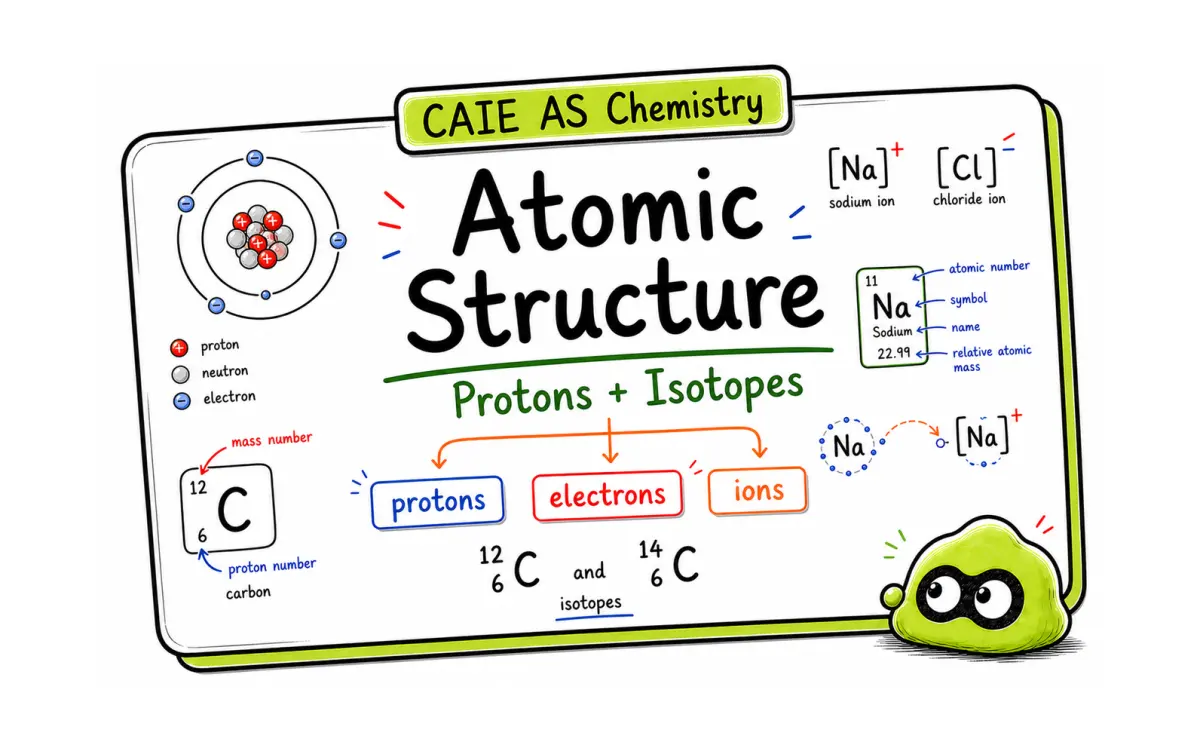
You can know the particle table and still lose marks when the question changes from atoms to ions, isotopes, or electron configuration. That is why this guide treats CAIE AS Chemistry atomic structure as an exam-answer problem, not just a notes topic.
The source context is EduNinja's CAIE AS Chemistry material, but the article below is rewritten as an original revision path: key idea, answer wording, worked examples, traps, and next study links.
Use the relevant EduNinja course pages as your base:
- Particles in the atom and atomic radius questions
- AS CIE Chemistry Notes - Unit 1 Atomic structure
- AS CIE Chemistry Notes - Unit 10 Group 2
Do not open every link at once. Start with the notes or topic page, then move into question practice and use any PDF resource only when it helps clarify the exact idea you are revising.
Quick Answer
- Focus on this task: use atomic and nucleon numbers to identify particles, isotopes, ions, and electron arrangements.
- Use this rule first: Start with proton number, then mass number, then charge. Do not decide electrons before you have checked whether the particle is neutral or an ion.
- Practise one short question before rereading the notes.
- Mark the reasoning step, not only the final answer.
- Turn the repeated mistake into one flashcard or one follow-up question.
Core Concept That Gets Marks
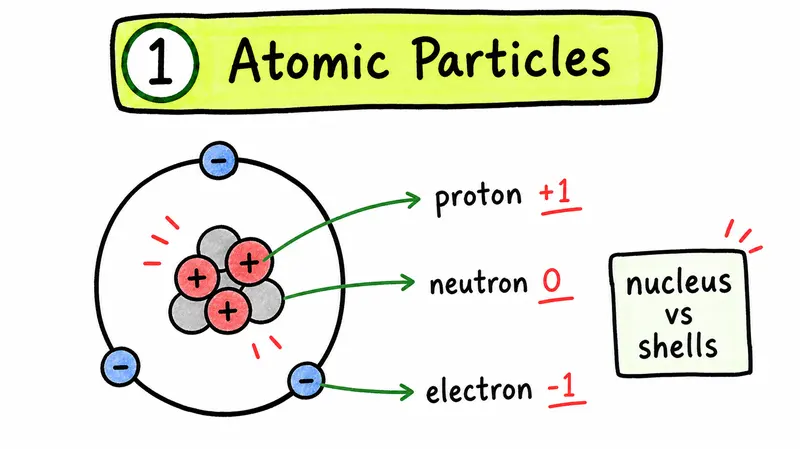
For atomic structure, keep the particle table close: proton is +1 and mass 1, neutron is 0 and mass 1, electron is -1 and much smaller mass. Then apply it to symbols and ions rather than memorising isolated definitions.
| Idea | What it means | How it scores |
|---|---|---|
| Proton number | Number of protons | Identifies the element |
| Nucleon number | Protons plus neutrons | Use neutrons = A - Z |
| Ion charge | Electrons lost or gained | Positive ions have fewer electrons |
| Isotope | Same protons, different neutrons | Chemical properties are usually similar |
The table is the part to revise actively. Cover the right-hand column and ask whether you can explain why that idea earns the mark.
Weak Answer vs Mark-Worthy Answer
| Weak answer | Why it loses marks | Mark-worthy answer |
|---|---|---|
| Isotopes are different atoms with different masses. | It is too vague and risks using the mass number as the number of electrons. | Isotopes are atoms of the same element with the same number of protons but different numbers of neutrons, so they have the same proton number and different nucleon numbers. |
A better answer is usually not much longer. It is more controlled: it names the exact concept, applies the condition in the question, and avoids replacing exam language with everyday wording.
Worked Example 1
Question: An atom has proton number 11 and nucleon number 23. State the number of protons, neutrons, and electrons in the neutral atom.
Markscheme-style answer: It has 11 protons. Neutrons = 23 - 11 = 12. A neutral atom has the same number of electrons as protons, so it has 11 electrons.
Why this scores: It shows the key method or explanation step clearly enough for a marker to follow. It also uses the topic vocabulary rather than a general memory cue.
Worked Example 2
Question: Explain the difference between isotopes.
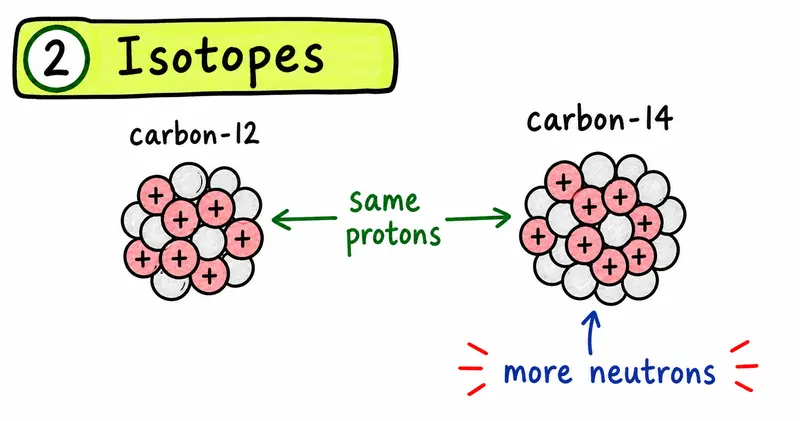
Markscheme-style answer: Isotopes are atoms of the same element with the same number of protons but different numbers of neutrons. They have the same proton number but different nucleon numbers.
Why this scores: It shows the key method or explanation step clearly enough for a marker to follow. It also uses the topic vocabulary rather than a general memory cue.
Question-Type Breakdown
For CAIE AS Chemistry Atomic Structure: Protons, Electrons, Isotopes, and Ions, sort the prompt before you start writing. Most lost marks come from using the right knowledge in the wrong answer shape.
| Question type | What the examiner is testing | First move in your answer | Common trap |
|---|---|---|---|
| Symbol interpretation | A, Z, charge and particle counts | Write protons first, then neutrons, then electrons | Forgetting the ion charge |
| Definition | Isotope and subatomic-particle wording | Use same/different wording exactly | Saying isotopes are different elements |
| Electronic structure | Shells, subshells, and ions | Count total electrons before filling | Removing electrons from the wrong shell |
Use this section as a routing table. Before answering, decide which row the question belongs to; then write the first move before calculating or explaining.
Topic-Specific Revision Route
- Read the quick answer and say the rule aloud: Start with proton number, then mass number, then charge. Do not decide electrons before you have checked whether the particle is neutral or an ion.
- Cover the worked answer and attempt the question from scratch.
- Mark only the first missing reasoning step, not the whole page.
- Create one correction card for this trap: using the mass number as the number of electrons.
- Do one related practice task or related guide before moving to a new topic.
This route keeps revision short but active. The goal is to leave the page with one corrected answer habit, not a longer set of highlighted notes.
Common Mistakes That Cost Marks
- Using the mass number as the number of electrons.
- Answering from memory without matching the command word.
- Skipping the first reasoning step because the final answer feels obvious.
- Using a correct formula or definition in the wrong context.
The fastest repair is to write one corrected sentence immediately after marking. Do not only highlight the answer key; write the missing phrase you should have included.
Exam-Ready Mini Checklist
- Did I separate proton number from nucleon number?
- Did I adjust electrons for ion charge?
- Did I use same protons but different neutrons for isotopes?
- Did I state relative charge and mass only when asked?
- Did I check every internal study link and image before trusting the page?
How EduNinja Helps
Use this article as the explanation layer for CAIE AS Chemistry atomic structure. Then use the verified links below to continue into related guides or question practice where the live EduNinja page exists.
A good study loop is simple: rebuild the concept, answer one exam-style prompt, mark the missing wording, and save the correction. If a question bank link is available for this subject, use it after the worked examples. If not, stay with the related guide links that have been checked as live.
FAQ
How do I find neutrons in CAIE AS Chemistry?
Subtract the proton number from the nucleon number. If an atom is written with mass number A and proton number Z, neutrons = A - Z. Ion charge changes the number of electrons, not the number of protons or neutrons.
Why do isotopes have similar chemical properties?
They have the same number of protons and the same electronic structure, so they react in similar ways. Their physical properties may differ slightly because the number of neutrons changes the mass.
What is the common mistake with ions?
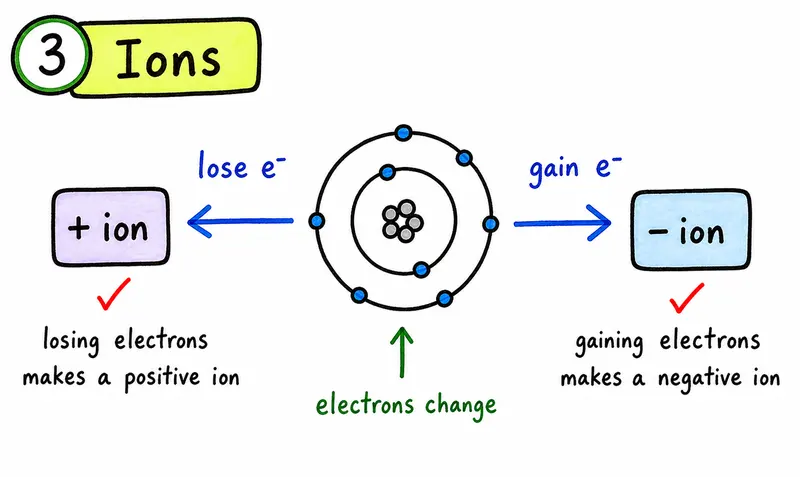
Students often change protons instead of electrons. A positive ion has lost electrons; a negative ion has gained electrons. The proton number still identifies the element.
Related Study Links
- Open the full revision Study Hub
- A-Level Chemistry Concept pages
- EduNinja study guides
- CAIE AS Chemistry Group 2 trends
- IB Chemistry mole calculations
Use the links as a study path, not a link dump: read the guide, practise the closest matching questions where available, then move to the related topic only after correcting one mistake.
Closing
CAIE AS Chemistry Atomic Structure: Protons, Electrons, Isotopes, and Ions becomes much easier when you stop treating it as a page to reread and start treating it as a small set of answer moves. Learn the rule, test it once, correct the wording, and then move on.
Put CAIE back into your full A-Level CAIE Chemistry AS study plan.
Return to the complete course overview, or move directly into the most relevant study tool.
Related articles
More course notes, updates and study resources from the EduNinja blog.

IB Chemistry SL 2025 Syllabus Changes: Assessment Guide
A practical IB Chemistry SL guide to the 2025 syllabus and assessment model: structure and reactivity, Paper 1A and 1B, Paper 2, scientific investigation and revision strategy.
Electron Domains and Molecular Geometry | A-Level Chemistry
Revise A-Level Chemistry electron domains, VSEPR shapes, lone pairs, bond angles, molecular geometry and common exam mistakes.
Salt Bridge Explained | A-Level Chemistry
Learn the function of a salt bridge in A-Level Chemistry, including ion movement, electrical neutrality, cell circuits and exam mistakes.