EduNinja

IGCSE Physics(c) Stellar evolutionTopic Practice

(c) Stellar evolution

Edexcel IGCSE Physics (c) Stellar evolution question practice helps you revise this syllabus point with the course map in view. Use this page to focus on one topic, check the style of questions available, and connect each attempt back to the knowledge area it is testing.

EduNinja keeps Physics practice aligned to Edexcel, so you can move from topic review into exam-style question bank work without losing the syllabus structure. Start with a small set, mark the weak steps, then return to nearby topic links when a definition, graph, calculation, or explanation needs repair.

Question 1

[Maximum number: 5]

This question is about stars.

Question 1(c)

(a)

Physicists classify stars according to their colour.

Each group of stars of similar colour is called a spectral class.
The table gives information about colour and surface temperature for three spectral classes of stars.

The Sun belongs to spectral class G.
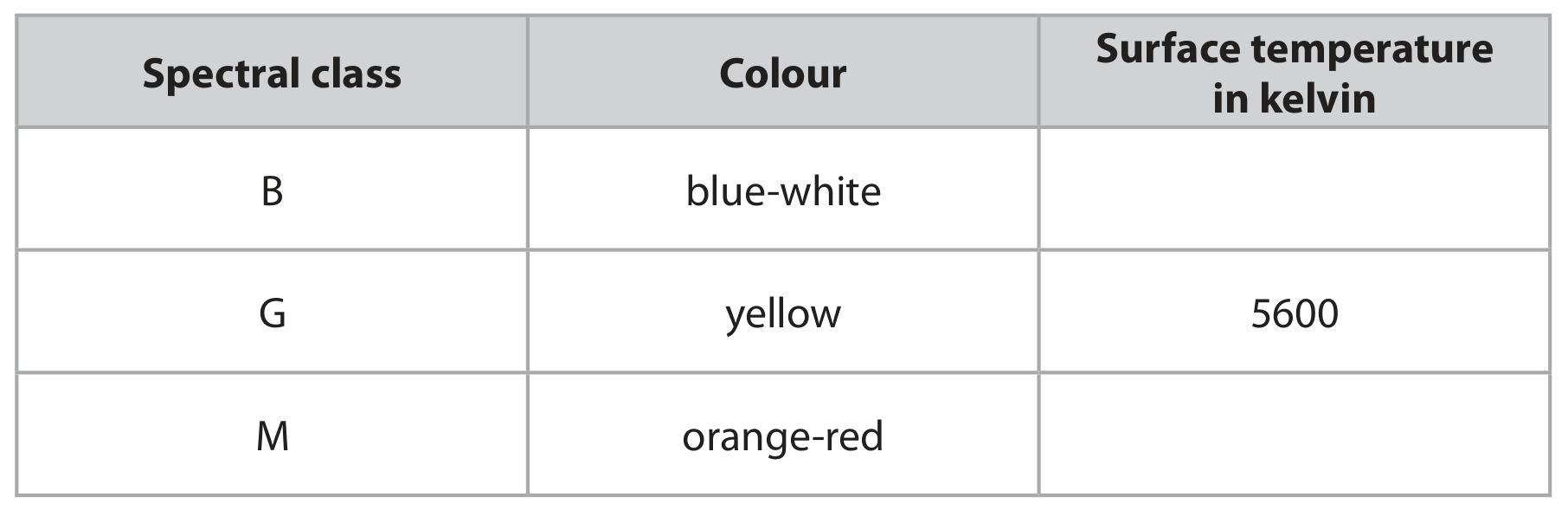
Table

Complete the table by suggesting values for the missing surface temperatures.

[ 2 ]

Question 1(d)

(b)

There are stars in the universe with masses much greater than the mass of the Sun.

Describe what happens to these high-mass stars when they leave the main sequence stage of their evolution.

[ 3 ]
Question 1(c)

[Maximum number: 1]

Which of these represents the brightness of stars at a standard distance?

A

absolute magnitude

B

colour

C

diameter

D

temperature

Question 1

[Maximum number: 6]

The passage describes the evolution of a star with a mass that is much larger than the mass of the Sun.

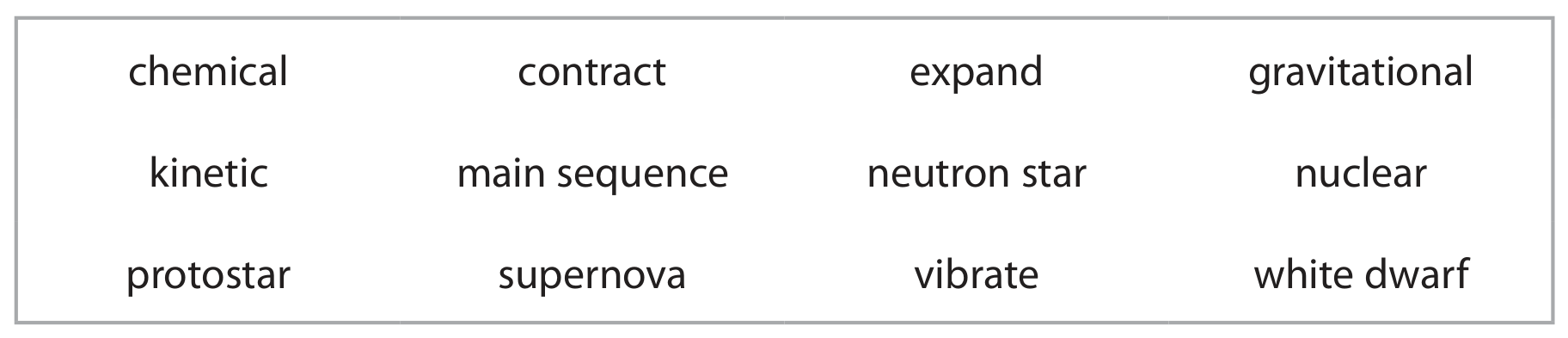
Use words or phrases from the box to complete the passage.
Each word or phrase may be used once, more than once, or not at all.

Table

Hydrogen atoms in a nebula move towards each other due to the force of gravity.

As the atoms move towards each other, their energy
store increases, which increases the temperature. If the temperature becomes
high enough, nuclear fusion of hydrogen will start and the star enters the stage of its evolution.

When hydrogen fusion stops in the core of the star, the core of the star will start to This increases the temperature in a layer surrounding the core. Hydrogen fusion restarts in a layer surrounding the core.

This causes the star to and its surface temperature decreases. The star is now a red super giant. Eventually nuclear fusion stops in the core of the star and the star explodes as a


The core of the star collapses to form either a or a black hole.

Question 1

Question 1(a)

(a)

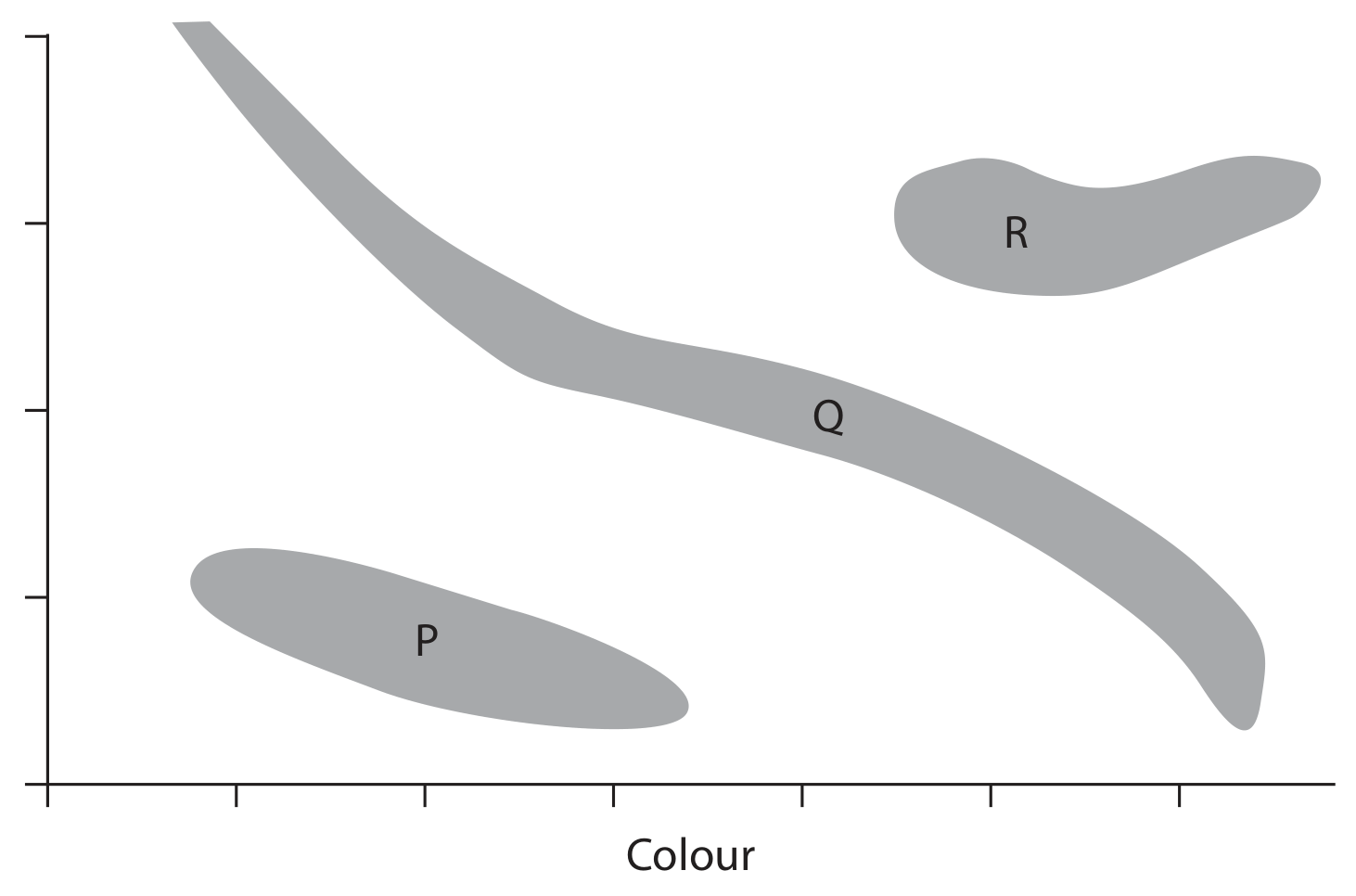
This is an incomplete Hertzsprung-Russell diagram.

Question image
[ 5 ]

Question 1(a)(i)

(i)

Which of these is in the shaded area of the diagram?

A

black holes

B

main sequence stars

C

neutron stars

D

protostars

[ 1 ]

Question 1(a)(ii)

(ii)

On the diagram, draw the area to show the position of white dwarf stars. Label this area WD.

[ 1 ]

Question 1(a)(iii)

(iii)

On the diagram, draw the area to show the position of red giant stars.

Label this area RG.

[ 1 ]

Question 1(a)(iv)

(iv)

State what is meant by the term absolute magnitude.

[ 2 ]

Question 1

[Maximum number: 6]

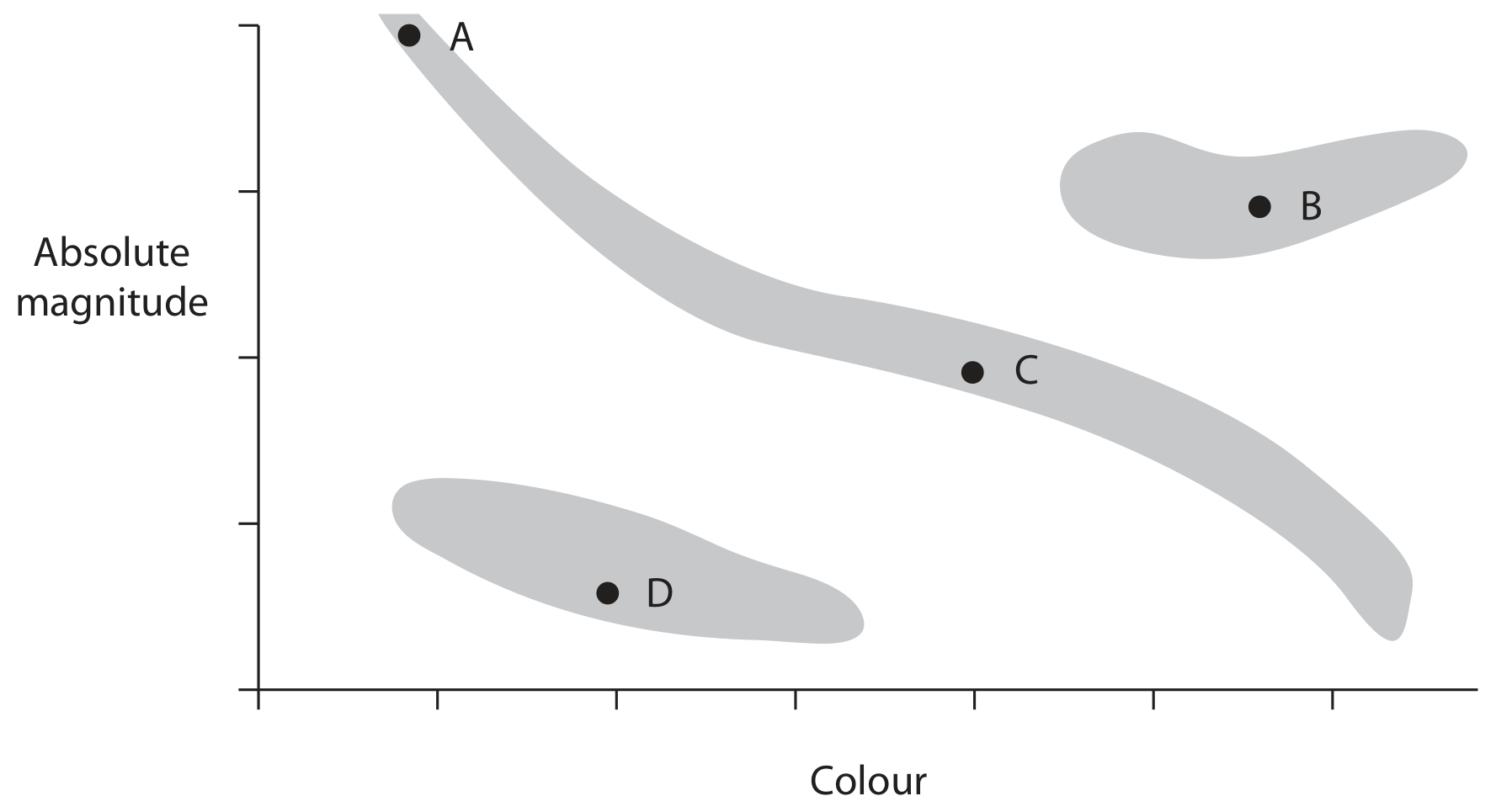
The Hertzsprung-Russell diagram shows stars classified into different regions.

Question image

Question 1(a)

(a)

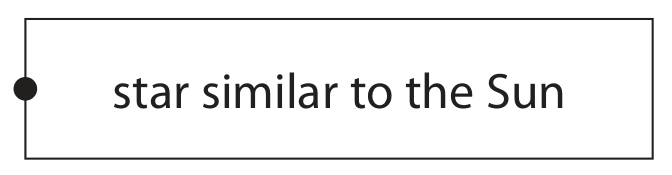
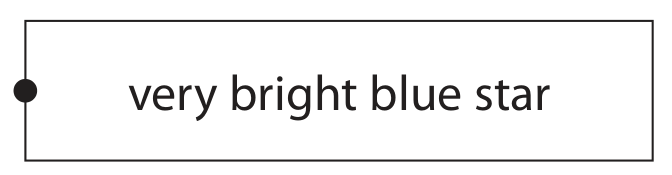
The boxes give four points, A, B, C and D, and four star classifications.

Draw lines connecting each point to the correct star classification.

Point

Question image
Question image
Question image
Question image
Star classification

Star classification

Question image
Question image
Question image
[ 4 ]

Question 1(b)

(b)

Describe what is meant by the term absolute magnitude.

[ 2 ]

Question 1

[Maximum number: 6]

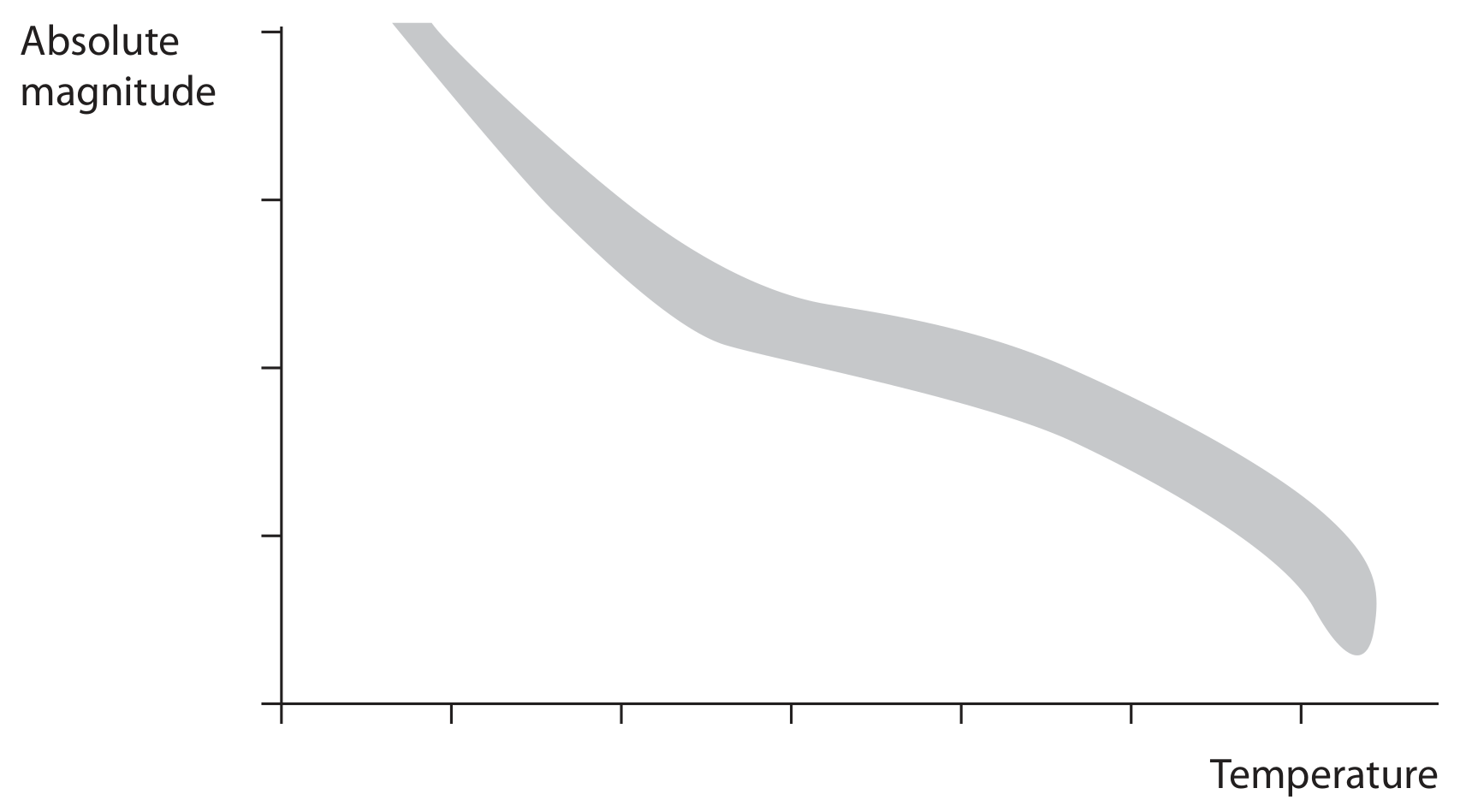
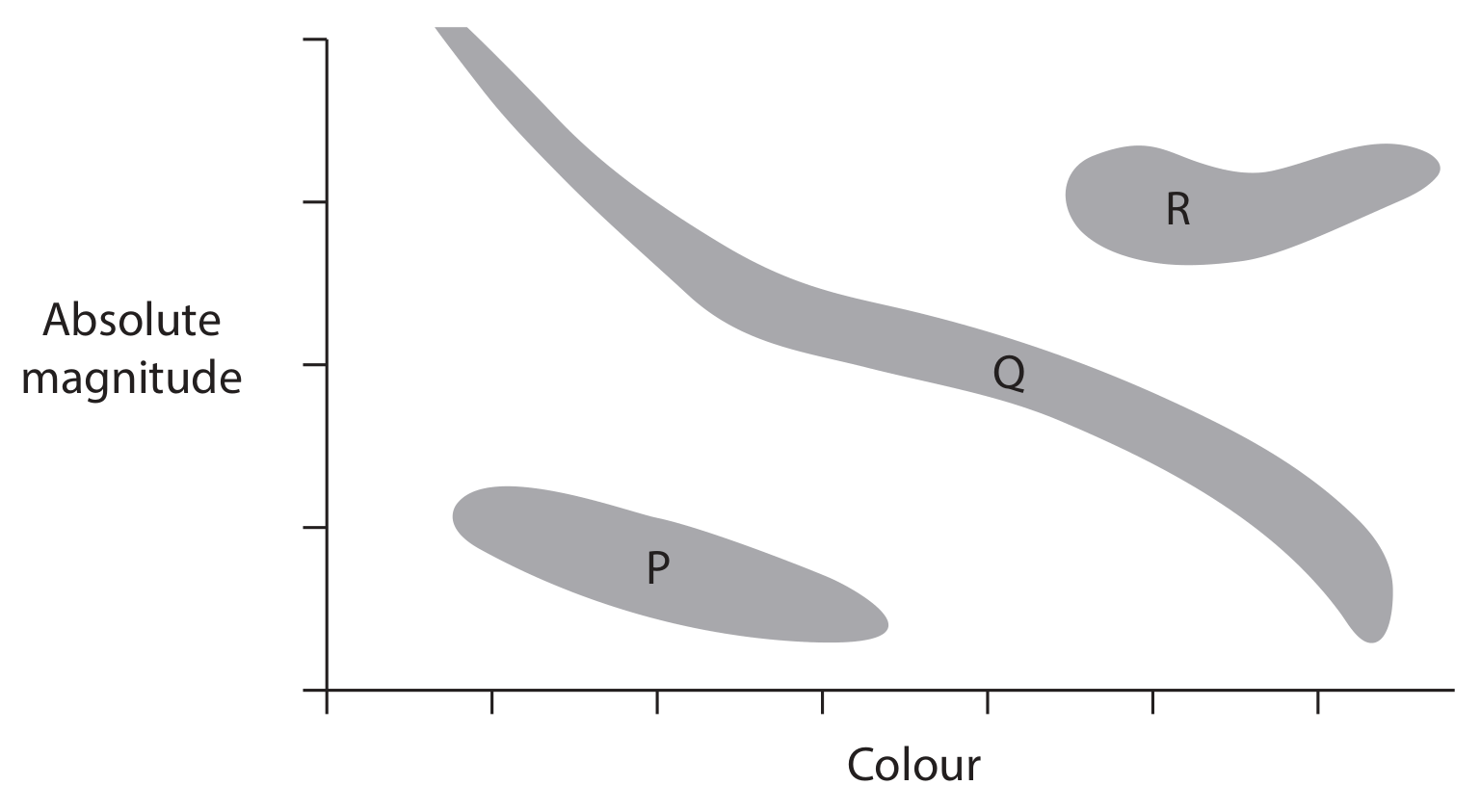
The diagram is an incomplete Hertzsprung-Russell diagram which astronomers use to compare stars.

Question image

Question 1(a)

(a)

The y-axis label is missing.

Which of these is the correct label for the y-axis?

A

absolute magnitude

B

apparent magnitude

C

scalar magnitude

D

vector magnitude

[ 1 ]

Question 1(b)

(b)

The box contains words to identify the shaded areas P, Q and R on the Hertzsprung-Russell diagram.

Table

Use words from the box to identify P, Q and R.

P Q R

[ 3 ]

Question 1(c)

(c)

Explain which side of the diagram contains stars with the highest surface temperature.

[ 2 ]

Question 1

[Maximum number: 5]

The Hertzsprung-Russell (HR) diagram shown can be used to classify stars.

Question image

Question 1(a)

(a)

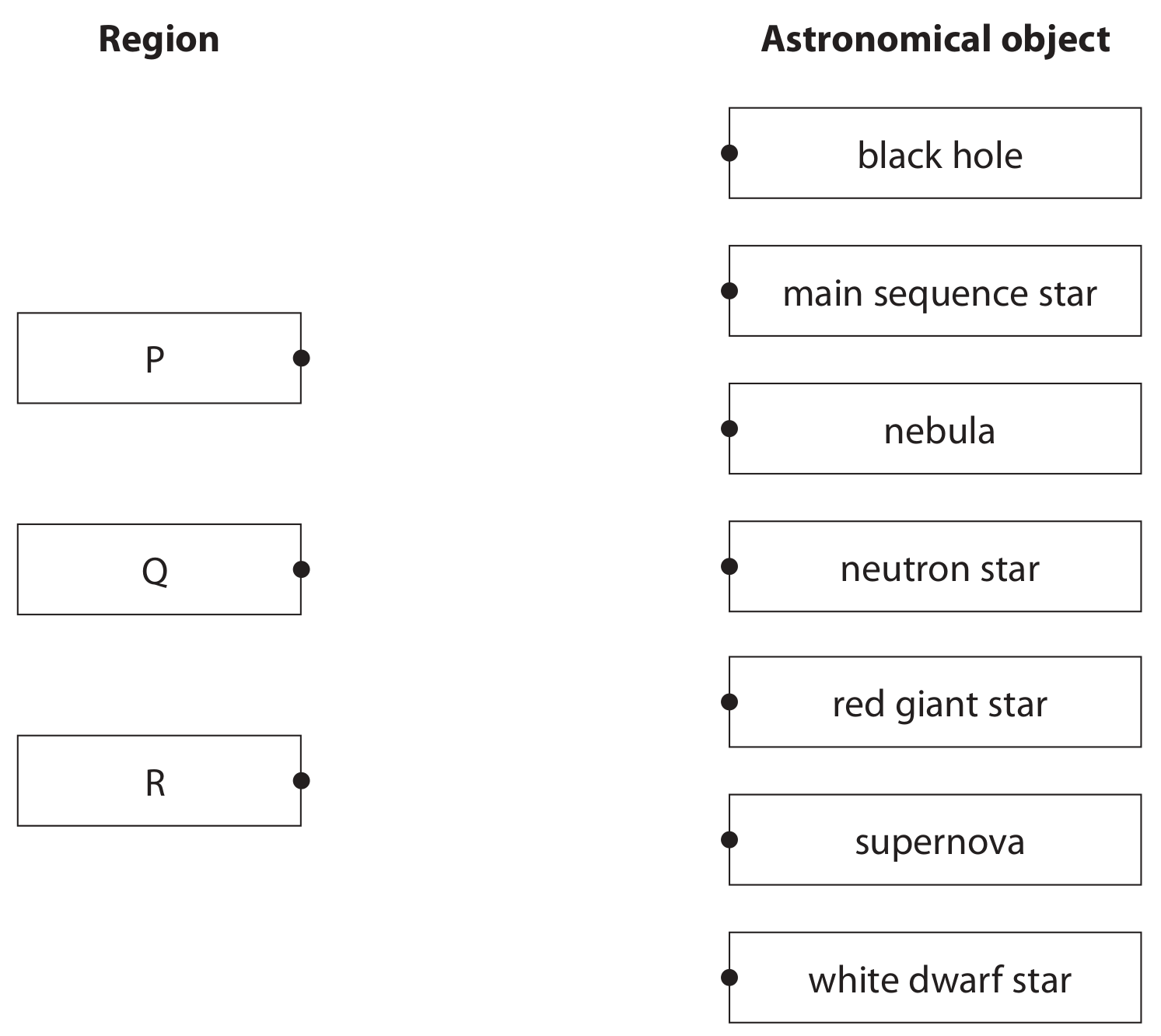
Three regions in the HR diagram are labelled P, Q and R.

The boxes show the three regions and different astronomical objects.
Draw a straight line from each region to the type of astronomical object contained in that region.

Question image
[ 3 ]

Question 1(b)

(b)

Define the term absolute magnitude.

[ 2 ]

Question 1

[Maximum number: 5]

This question is about stars.
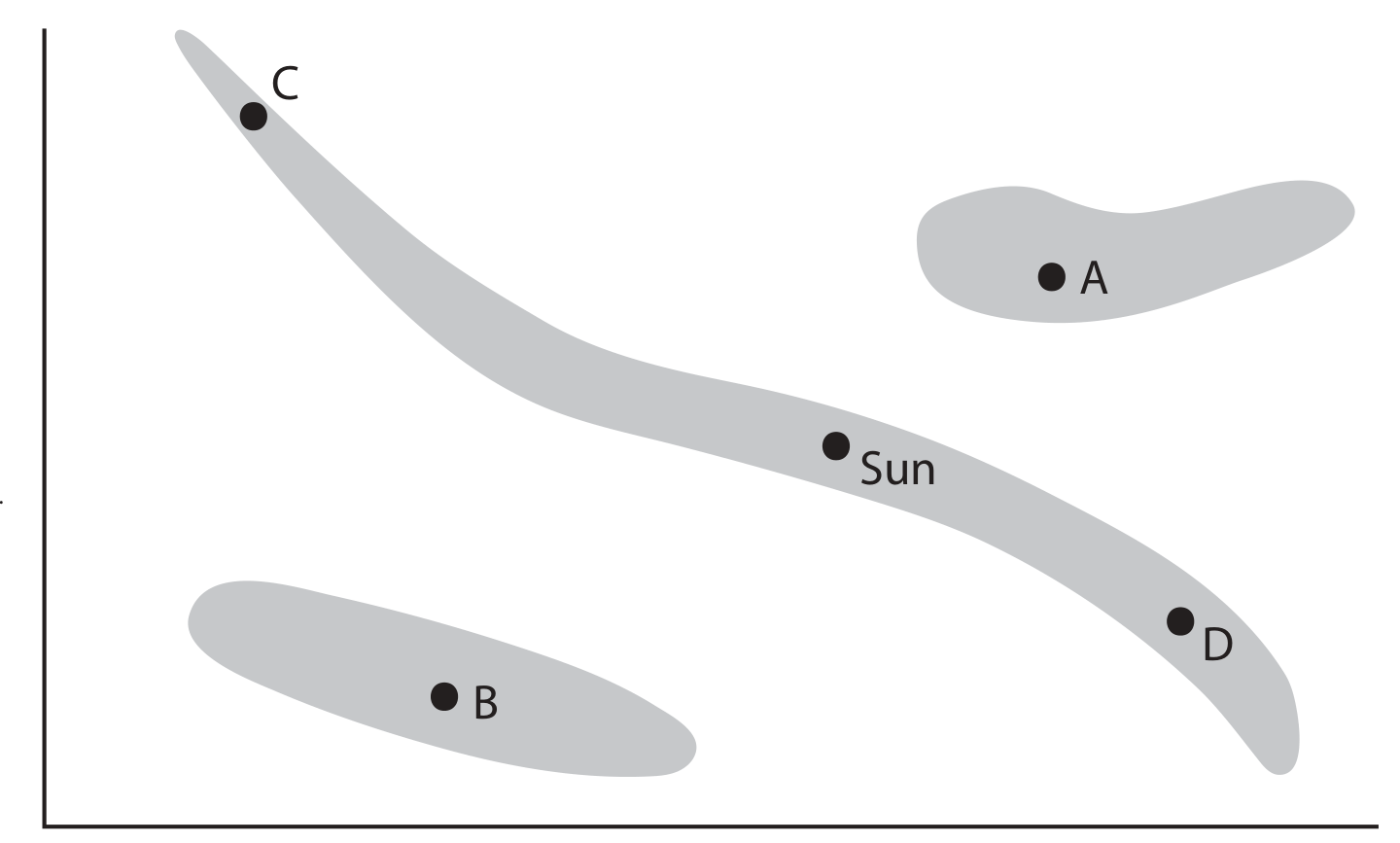
The diagram shows an incomplete Hertzsprung-Russell (H-R) diagram.

Question image

Question 1(a)

(a)

Label the axes on the diagram.

[ 2 ]

Question 1(b)

(b)

There are three shaded areas on the diagram.

State the name of the shaded area that contains the Sun.

[ 1 ]

Question 1(c)

(c)

Which star is a white dwarf?

[ 1 ]

Question 1(d)

(d)

At a standard distance from the Earth, which star is brighter than the Sun and has a greater surface temperature than the Sun?

[ 1 ]

Question 1

[Maximum number: 4]

This question is about stars.

Question 1(a)

(a)

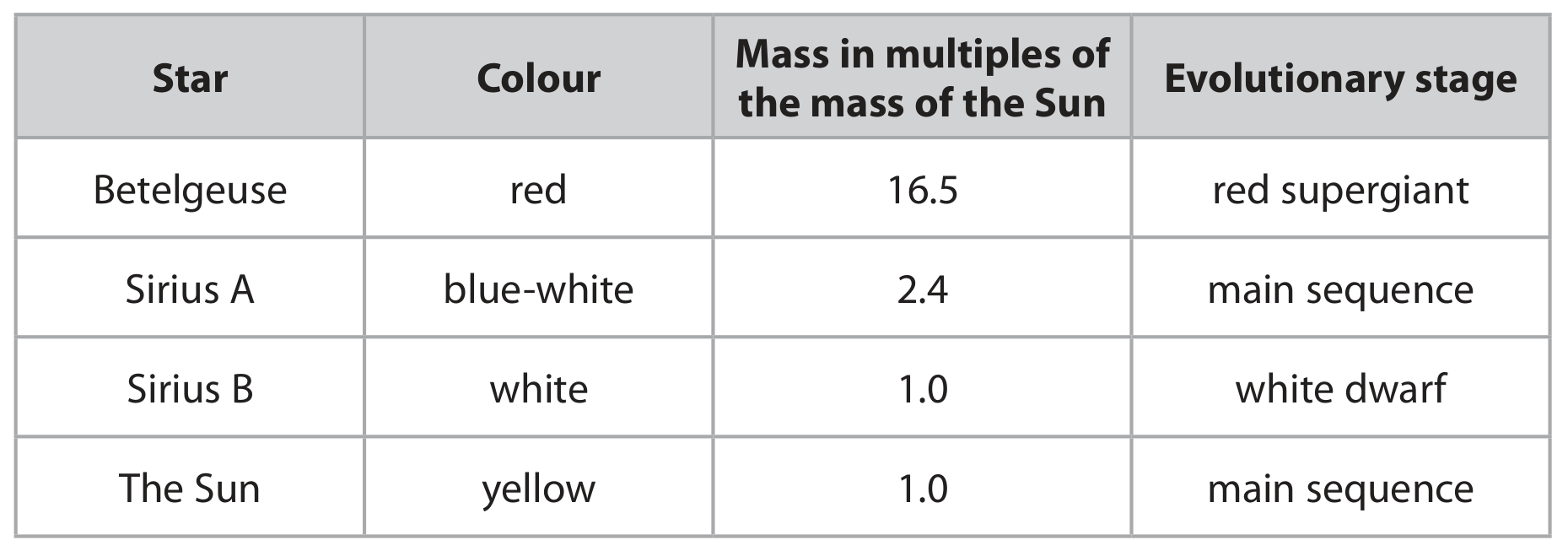
The table gives information about four different stars.

Table
[ 4 ]

Question 1(a)(i)

(i)

Which of these stars has the lowest surface temperature?

A

Betelgeuse

B

Sirius A

C

Sirius B

D

The Sun

[ 1 ]

Question 1(a)(ii)

(ii)

Which of these stars will become a supernova in the future?

A

Betelgeuse

B

Sirius A

C

Sirius B

D

The Sun

[ 1 ]

Question 1(a)(iii)

(iii)

Sirius B and the Sun have approximately the same mass but are different colours and in different evolutionary stages.

Describe two other differences between Sirius B and the Sun.

1 ............
2 ............

[ 2 ]

Question 3(a)

[Maximum number: 4]

This question is about stars.

Describe the stages in the evolution of a star similar in mass to the Sun.

0 selected