EduNinja

IGCSE Physics(d) CosmologyTopic Practice

(d) Cosmology

Edexcel IGCSE Physics (d) Cosmology question practice helps you revise this syllabus point with the course map in view. Use this page to focus on one topic, check the style of questions available, and connect each attempt back to the knowledge area it is testing.

EduNinja keeps Physics practice aligned to Edexcel, so you can move from topic review into exam-style question bank work without losing the syllabus structure. Start with a small set, mark the weak steps, then return to nearby topic links when a definition, graph, calculation, or explanation needs repair.

Question 6

[Maximum number: 6]

This question is about cosmic microwave background radiation (CMBR) and the Big Bang.

Question 6(b)

(a)

CMBR was first released after the Big Bang.

When CMBR was first released it had a wavelength of about 9×105 mm9 \times 10^{-5} \mathrm{~mm}, but now it has a wavelength of about 2 mm .

Using this information, explain how CMBR supports the Big Bang theory.

[ 2 ]

Question 6(c)

(b)

Explain how the cosmological red-shift of galaxies also supports the Big Bang theory.

[ 4 ]
Question 6(c)(i)

[Maximum number: 3]

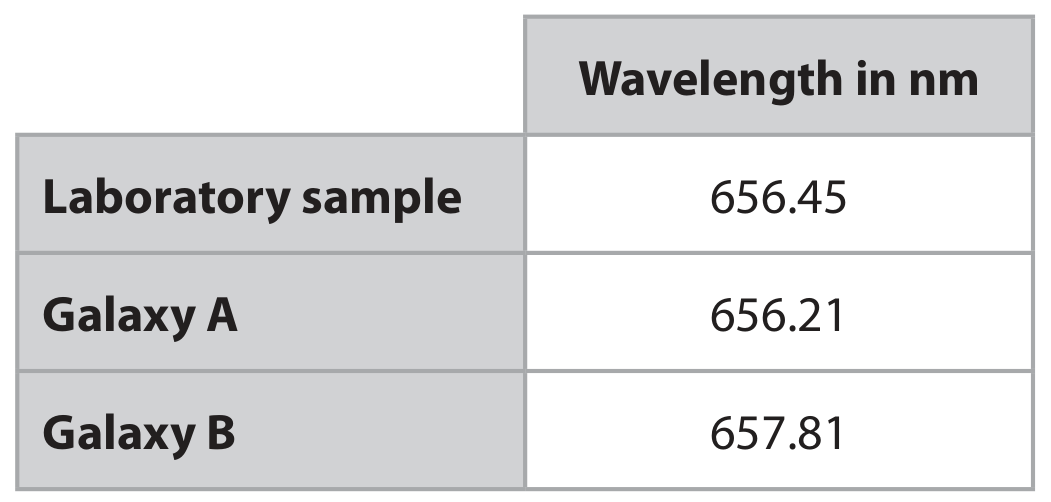
Hydrogen is an element that can emit visible light waves.

The table shows the wavelength of one of these waves when detected from a laboratory sample of hydrogen and when detected from the hydrogen in two different galaxies.

The detected wavelengths from the galaxies are different from the detected wavelength from the laboratory sample because of the Doppler effect.

Table

Galaxy A and galaxy B are both moving relative to Earth.

Compare the motions of galaxy A and galaxy B relative to Earth.

Question 6

[Maximum number: 7]

Galaxies A, B and C are different distances from the Earth.
Galaxy A is moving away from the Earth with a velocity of 1.7×10⁴ km/s1.7 \times 10^{4} \mathrm{~km} / \mathrm{s}.

Question 6(a)

(a)

The reference wavelength for light arriving at the Earth from galaxy A is 506 nm.

Calculate the observed wavelength for the light arriving from galaxy A.
[speed of light = 3.0 x 10^5 km/s]

wavelength = ............ nm

[ 3 ]

Question 6(b)

(b)

Galaxy B is twice as far away from the Earth as galaxy A is from the Earth.

Galaxy C is four times as far away from the Earth as galaxy A is from the Earth.
Explain how the velocities of galaxies B and C are different.

[ 2 ]

Question 6(c)

(c)

The universe started with an event called the Big Bang.

Explain how evidence from cosmic microwave background radiation shows how the temperature of the universe has changed since the Big Bang.

[ 2 ]

Question 7

Question 7(a)

(a)

Give two pieces of evidence for the Big Bang theory.

[ 2 ]

Question 7(b)

(b)

Explain how this evidence supports the Big Bang theory.

[ 4 ]
Question 8

Question 8(a)(i)

(a)

A galaxy moves away from the Earth at a speed of 3.9 x 10^4 km/s.
The speed of light is 3.0 x 10^5 km/s.
Light from the galaxy is emitted with a wavelength of 6.2 x 10^-7 m.
Calculate the change in the wavelength of the light that is received by an observer on the Earth.

change in wavelength = ............ m

[ 3 ]

Question 8(a)(ii)

(b)

Calculate the wavelength of light that is received by an observer on the Earth.

wavelength = ............ m

[ 1 ]

Question 8(b)

(c)

One of the pieces of evidence for the Big Bang theory is the red-shift of galaxies.

Explain how the red-shift of galaxies supports the Big Bang theory.

[ 3 ]

Question 8(b)

[Maximum number: 3]

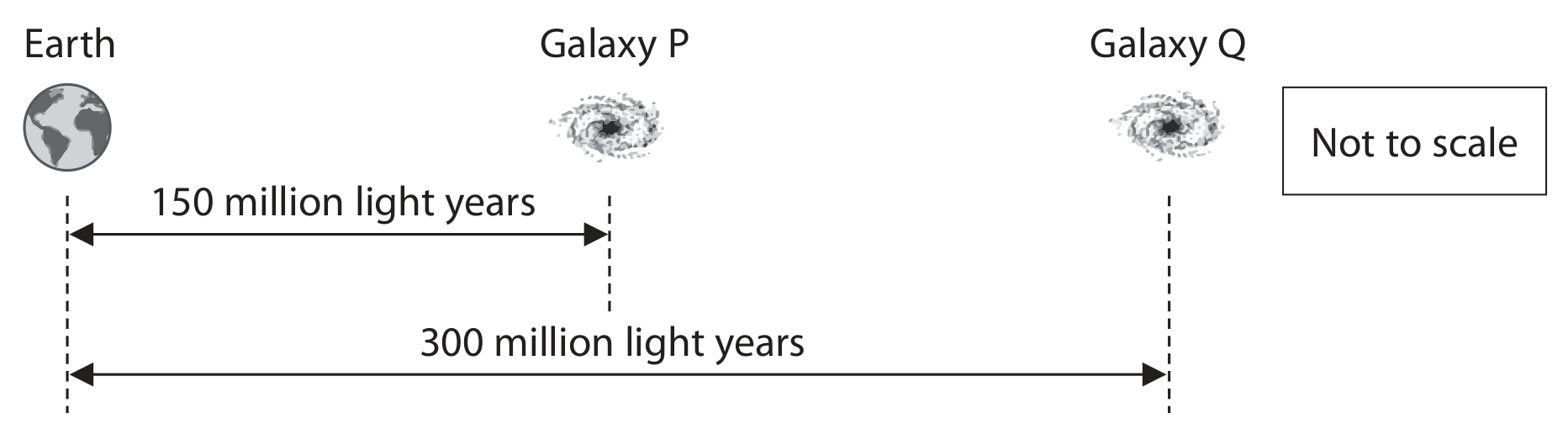
A binary star system has two nearby stars, which orbit each other in a circular path around a common centre of gravity.

Question image

A different binary star system is in a distant galaxy.

When observed from the Earth, light from this galaxy has a longer wavelength
than the wavelength of the light when it is emitted from the galaxy.

Explain why this gives evidence for the Big Bang theory.

Question 6

[Maximum number: 6]

The Big Bang theory describes the evolution of the universe.

Question 6(a)

(a)

Explain how cosmic microwave background radiation (CMBR) supports the Big Bang theory.

[ 2 ]

Question 6(b)

(b)

Hydrogen gas in a laboratory on Earth emits light with a wavelength of 605 nm.

A distant galaxy contains hydrogen which emits light of the same wavelength.
The wavelength of the light from the distant galaxy is measured as 683 nm on Earth.

Calculate the speed of the distant galaxy.

[speed of light = 3.0 x 10^8 m/s]

speed = ............ m/s

[ 4 ]

Question 6

[Maximum number: 8]

The universe began with an event known as the Big Bang.

Question 6(a)

(a)

Describe how the size and temperature of the universe have changed since the Big Bang.

[ 2 ]

Question 6(b)

(b)

Discuss two pieces of evidence that support the Big Bang theory.

[ 6 ]

Question 8

[Maximum number: 7]

Diagram 1 shows two identical buzzers connected with springs.

Diagram 1

Diagram 1

Spring A is connected to a post.
A force acts on the apparatus for a short period of time, pulling both buzzers to the right. During this time, buzzer A moves 2 cm and buzzer B moves 4 cm .

Question 8(c)

(a)

Diagram 3 shows two distant galaxies and the Earth.

Question image

Diagram 3

Light emitted from a nearby star has a wavelength of 590 nm.
The light from an identical star in galaxy P arrives at the Earth.
The wavelength of the light from the star in galaxy P is 600 nm.

[ 7 ]

Question 8(c)(i)

(i)

Calculate the change in wavelength for light from the star in galaxy P.

change in wavelength = ............ nm

[ 1 ]

Question 8(c)(ii)

(ii)

Galaxy Q is twice as far away from the Earth as galaxy P.

Suggest how the speed of galaxy Q relates to the speed of galaxy P.

[ 1 ]

Question 8(c)(iii)

(iii)

Suggest a value for the change in wavelength of light from an identical star in galaxy Q when the light arrives at the Earth.

change in wavelength = ............ nm

[ 1 ]

Question 8(c)(iv)

(iv)

Explain how comparing the speeds of the two galaxies provides evidence for the Big Bang theory.

[ 4 ]

Question 8

[Maximum number: 9]

Between 1929 and 1931, physicists Hubble and Humason investigated the red-shift of light from galaxies at different distances from the Earth.

The distance unit they used is the megaparsec (Mpc).

Question 8(a)

(a)

Describe what is meant by the term red-shift.

[ 2 ]

Question 8(b)

(b)

The graph shows some of the results of their investigation.

Question image
[ 7 ]

Question 8(b)(i)

(i)

Draw a circle to show the anomalous data point.

[ 1 ]

Question 8(b)(ii)

(ii)

Draw the line of best fit on the graph.

[ 1 ]

Question 8(b)(iii)

(iii)

The reference wavelength of the light used in this investigation is 660 nm.
Use information from the graph to determine the velocity of a galaxy at a distance of 0.75 Mpc.

[speed of light = 300000 km/s]

velocity = ............ km/s

[ 3 ]

Question 8(b)(iv)

(iv)

Explain why the graph from Hubble's investigation provides evidence for the expansion of the universe.

[ 2 ]
0 selected