EduNinja

IGCSE Physics(b) RadioactivityTopic Practice

(b) Radioactivity

Edexcel IGCSE Physics (b) Radioactivity question practice helps you revise this syllabus point with the course map in view. Use this page to focus on one topic, check the style of questions available, and connect each attempt back to the knowledge area it is testing.

EduNinja keeps Physics practice aligned to Edexcel, so you can move from topic review into exam-style question bank work without losing the syllabus structure. Start with a small set, mark the weak steps, then return to nearby topic links when a definition, graph, calculation, or explanation needs repair.

Question 2

[Maximum number: 7]

Uranium-239 is an isotope of the element uranium.

Question 2(a)

(a)

State what is meant by the term isotopes.

[ 2 ]

Question 2(b)

(b)

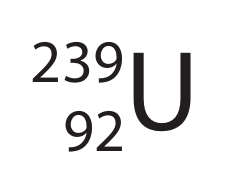
Uranium-239 can be represented using the symbol
Question image

Protons are one type of particle found in the nucleus of an atom.

[ 2 ]

Question 2(b)(i)

(i)

How many protons are in the nucleus of an atom of uranium-239?

A

92

B

147

C

239

D

331

[ 1 ]

Question 2(b)(ii)

(ii)

Give the name of the other particle found in the nucleus of an atom of uranium-239.

[ 1 ]

Question 2(c)

(c)

Uranium-239 is radioactive and decays by beta emission.

Uranium-239 has a half-life of 23 minutes.

[ 3 ]

Question 2(c)(i)

(i)

A sample of uranium-239 has an initial mass of 60 g.

Calculate the mass of uranium-239 remaining after 46 minutes.

mass = ............ g

[ 2 ]

Question 2(c)(ii)

(ii)

When uranium-239 undergoes beta decay, an isotope of the element neptunium, Np, is produced.

Which of these is the correct symbol for the neptunium nucleus produced in the beta decay of uranium-239?

A

239Np with proton number 92

B

240Np with proton number 92

C

239Np with proton number 93

D

240Np with proton number 93

Question image
[ 1 ]

Question 2

Question 2(a)

(a)

Which statement describes the term atomic number for a nucleus?

A

number of electrons in the nucleus

B

number of neutrons in the nucleus

C

number of protons in the nucleus

D

number of protons and neutrons in the nucleus

[ 1 ]

Question 2(b)

(b)

Which statement describes the term mass number for a nucleus?

A

number of electrons in the nucleus

B

number of neutrons in the nucleus

C

number of protons in the nucleus

D

number of protons and neutrons in the nucleus

[ 1 ]

Question 2(c)

(c)

Which statement describes the term isotopes?

A

atoms with the same number of electrons but a different number of protons

B

atoms with the same number of neutrons but a different number of electrons

C

atoms with the same number of neutrons but a different number of protons

D

atoms with the same number of protons but a different number of neutrons

[ 1 ]

Question 2(d)

(d)

An atom contains 8 protons, 8 neutrons and 8 electrons.

Which of these would result in a negatively charged ion of the same element?

A

adding an electron

B

adding a proton

C

removing an electron

D

removing a proton

[ 1 ]

Question 2(e)

(e)

It is not possible to predict exactly when a radioactive nucleus will decay.

Which feature of radioactive decay best explains this observation?

A

radioactive decay can change the structure of the nucleus

B

radioactive decay happens at random

C

radioactive decay is irreversible

D

radioactive decay makes a nucleus more stable

[ 1 ]

Question 2(f)

(f)

Which of these is the correct unit for measuring the activity of a radioactive sample?

A

becquerel (Bq)

B

coulomb (C)

C

joule (J)

D

watt (W)

[ 1 ]

Question 2(a)

[Maximum number: 1]

The nuclear equation shows how a nucleus of uranium-236 may undergo nuclear fission.

^236_92 U -> ^140_54 Xe + ^94_38 Sr + ............ ^1_0 n

Determine how many neutrons are released in this fission process.

number of neutrons = ............

Question 2(a)(iii)

[Maximum number: 2]

Some of the energy stored in the nuclei of atoms can be used to generate electricity.

A nuclear fission power station generates electricity.

The daughter nuclei can cause contamination and irradiation.

Describe the difference between contamination and irradiation.

Question 3

[Maximum number: 4]

This question is about food preservation.

Question 3(a)

(a)

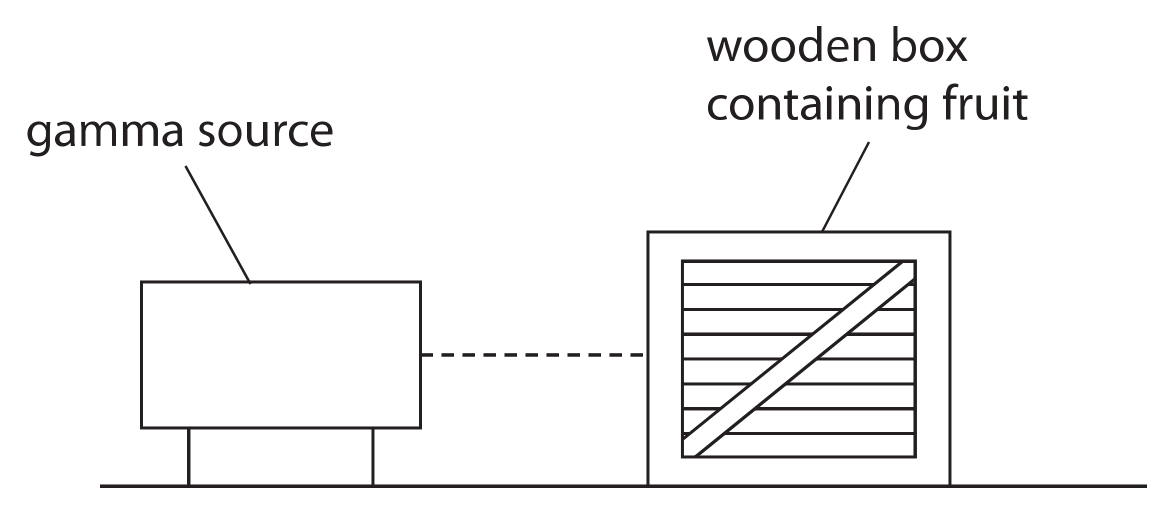
The diagram shows how gamma radiation is used to irradiate fruit stored in a wooden box.

The radiation kills bacteria on the fruit.

Question image

Explain why gamma radiation is used instead of alpha radiation to kill bacteria.

[ 2 ]

Question 3(b)

(b)

The wooden box has this label.
these fruits
have been
irradiated

Explain why fruit irradiated with gamma radiation is safe to eat.

[ 2 ]

Question 3

[Maximum number: 7]

Lead-210 is a radioactive isotope of lead and is represented using this symbol.

82210 Pb{ }_{82}^{210} \mathrm{~Pb}

Question 3(a)

(a)

State what is meant by the term isotope.

[ 2 ]

Question 3(b)

(b)

How many protons are in the nucleus of lead-210?

A

82

B

128

C

210

D

292

[ 1 ]

Question 3(c)(i)

(c)

A sample of lead-210 has an initial activity of 240 Bq .

After 66 years, the activity of the sample is 30 Bq .
Calculate the half-life of lead-210.
half-life = years

[ 2 ]

Question 3(c)(ii)

(d)

Lead-210 decays into lead-206 through a number of stages.

This involves one alpha decay and a number of beta decays.

This incomplete equation summarises these stages.

82210Pb82206Pb+α+10β{}_{82}^{210}\mathrm{Pb} \rightarrow {}_{82}^{206}\mathrm{Pb} + {}_{\ldots}^{\ldots}\alpha + \ldots{}_{-1}^{0}\beta

Complete the equation by giving the missing numbers.
Write your answers in the spaces provided.

[ 2 ]

Question 4(a)

[Maximum number: 1]

This is a question about alpha particles.

Describe the nature of an alpha particle.

Question 4

[Maximum number: 11]

A teacher investigates the count rate detected from a radioactive source.

Question 4(a)(i)

(a)

State one source of background radiation.

[ 1 ]

Question 4(a)(ii)

(b)

Describe how the teacher could measure the count rate from a radioactive source and correct the count rate for background radiation.

[ 4 ]

Question 4(b)

(c)

The teacher places a piece of lead sheet between the radioactive source and a radiation detector.

The teacher determines the corrected count rate from the radioactive source three times and calculates the mean.

They repeat this process using different thicknesses of lead sheet.
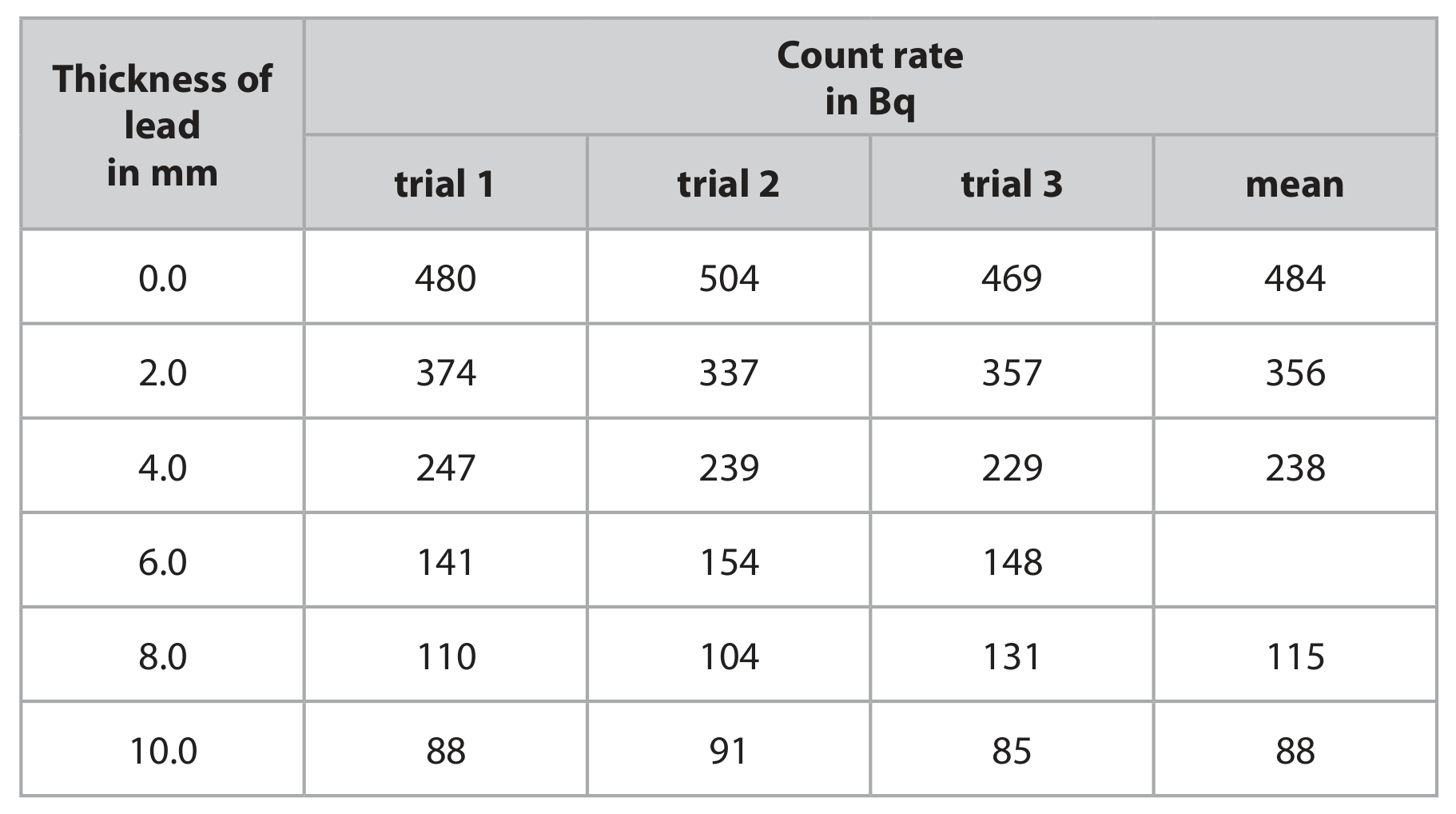
The table shows their results.

Table
[ 4 ]

Question 4(b)(i)

(i)

Calculate the mean count rate when the thickness of lead is 6.0 mm .

[ 2 ]

Question 4(b)(iv)

(ii)

When there is not a sheet of lead between the radioactive source and the radiation detector, the mean count rate is 484 Bq.

Use the graph to determine the thickness of lead needed to reduce the mean count rate by 25%.
thickness = mm

[ 2 ]

Question 4(c)

(d)

The radioactive source emits only one type of radiation.

Explain which type of radiation this radioactive source emits.

[ 2 ]

Question 5

[Maximum number: 10]

This question is about radioactivity.

Question 5(a)

(a)

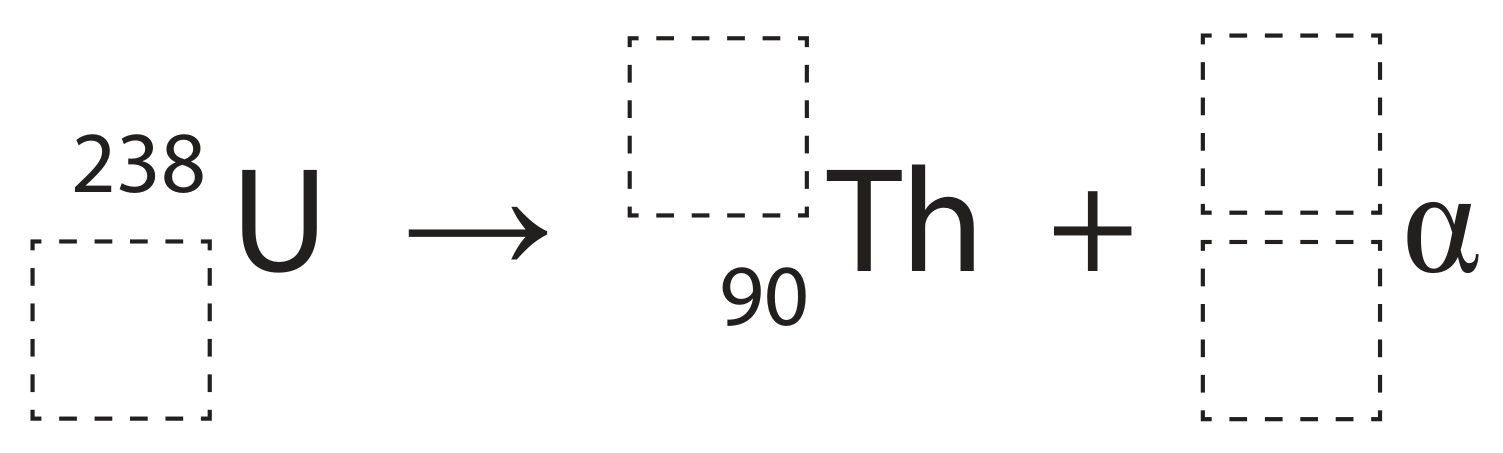
Uranium-238 decays by emitting an alpha particle to become an isotope of thorium.

Complete the equation for the alpha decay of uranium-238.

Question image
[ 3 ]

Question 5(b)

(b)

The isotope of thorium produced in the decay of uranium-238 is also radioactive.

Thorium decays by emitting a beta particle.
Describe how the structure of a thorium nucleus changes when a beta particle is emitted.

[ 2 ]

Question 5(c)

(c)

A teacher demonstrates radioactivity using a radioactive rock.

The rock contains uranium-238 and other radioactive isotopes.
The teacher takes precautions to reduce the risk of contamination and irradiation by the radioactive rock.

[ 5 ]

Question 5(c)(i)

(i)

Suggest a safety precaution that would reduce the risk of contamination by the radioactive rock.

[ 1 ]

Question 5(c)(ii)

(ii)

Suggest a safety precaution that would reduce the risk of irradiation by the radioactive rock.

[ 1 ]

Question 5(c)(iii)

(iii)

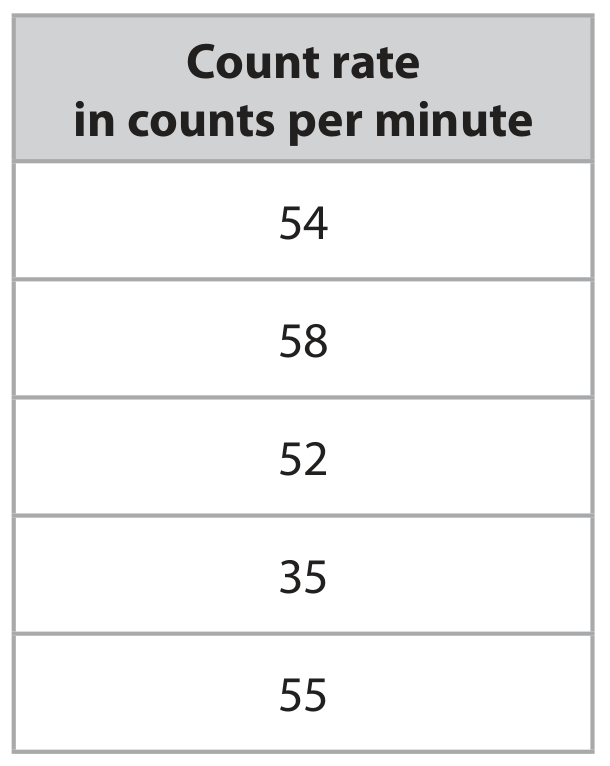
The teacher measures the amount of radiation emitted by the radioactive rock in a time of 1 minute using a Geiger-Müller (GM) tube and counter.

The teacher repeats this measurement to obtain a total of five measurements of the count rate.

The table shows the teacher's results.

Table

Calculate the mean count rate.
Give your answer to 2 significant figures.

mean count rate = …………counts per minute

[ 3 ]

Question 5(a)(i)

[Maximum number: 1]

This question is about nuclear fusion.

The incomplete nuclear equation shows the fusion of two isotopes of hydrogen.

12H+13H24He+X{ }_{1}^{2} \mathrm{H}+{ }_{1}^{3} \mathrm{H} \rightarrow{ }_{2}^{4} \mathrm{He}+\mathrm{X}

Identify particle X in the nuclear equation.

0 selected