EduNinja

IGCSE Economics5.1. Living standardsTopic Practice

5.1. Living standards

CAIE IGCSE Economics 5.1. Living standards question practice helps you revise this syllabus point with the course map in view. Use this page to focus on one topic, check the style of questions available, and connect each attempt back to the knowledge area it is testing.

EduNinja keeps Economics practice aligned to CAIE, so you can move from topic review into exam-style question bank work without losing the syllabus structure. Start with a small set, mark the weak steps, then return to nearby topic links when a definition, graph, calculation, or explanation needs repair.

Question 1(f)

[Maximum number: 5]

Read the source material carefully before answering Question 1.

Source Material: The eSports industry and Malta
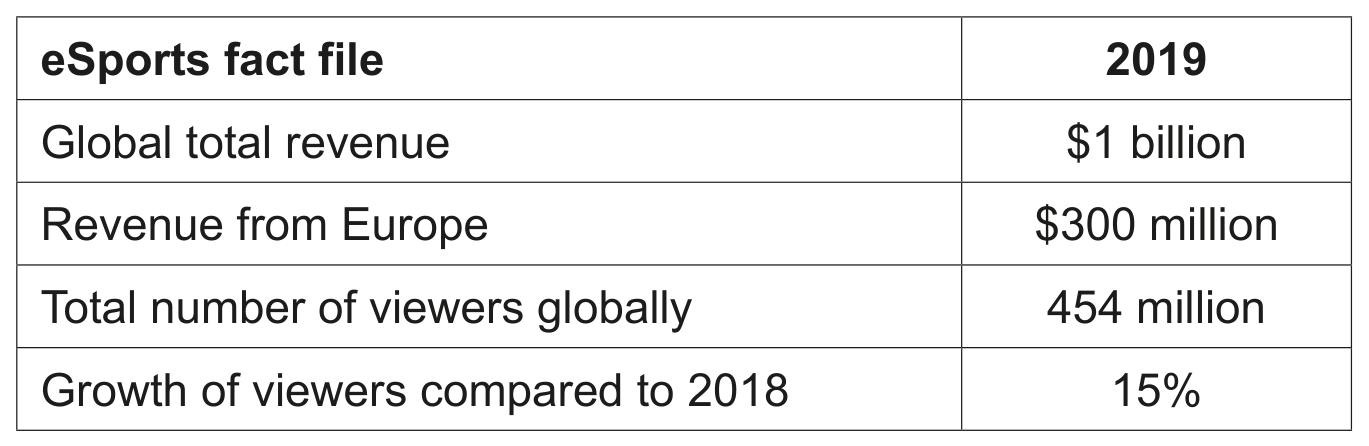
Table

eSports is now recognised as a sports competition, just like playing other competitive sports such as football and basketball. In eSports, participants compete through video games either as an individual or as part of a team. eSports also attracts large audiences who watch these online competitions. eSports is growing rapidly, both in terms of revenue generated and in the number of viewers. Demand has increased because of increases in incomes and decreases in the price of the technology needed to play or watch eSports. A change in social attitudes has also increased female participation in eSports.

The fast growth in this industry has attracted both private and public sector investment. Private sector firms sponsor various eSports teams and also advertise their products during eSports competitions. Public sector investment has come from the governments of China, Denmark, Malaysia and Malta, mainly in development and training programmes for young eSports participants. The government of Malta, a small island country, hopes to make Malta a main centre for eSports in Europe, to attract visitors for eSports events. The aim is for the eSports industry to contribute 1%1 \% to Malta's GDP, provide 3000 more jobs and improve the current account of its balance of payments.

Malta's service sector has always been important and contributes approximately 90%90 \% of its GDP. Malta is an attractive tourist destination due to its mild weather. The island is used as a location for many movies and TV series, which also attracts visitors who want to see the filming locations. However, to ensure growth is sustainable, the government sees the importance of economic diversification and does not want the economy to overspecialise.

To achieve this, the labour force has to be adaptable and the government has to invest in education and training. The government provides new scholarship schemes, organises work placements and brings in professionals from other countries to help train Maltese students. However, there are concerns that these measures may be too expensive and take too long to have a significant impact on the economy.

Female participation in the labour force is also encouraged. Table 1.1 shows the proportion of women in the labour force (\%) and GDP per head ($) of selected countries in 2019.
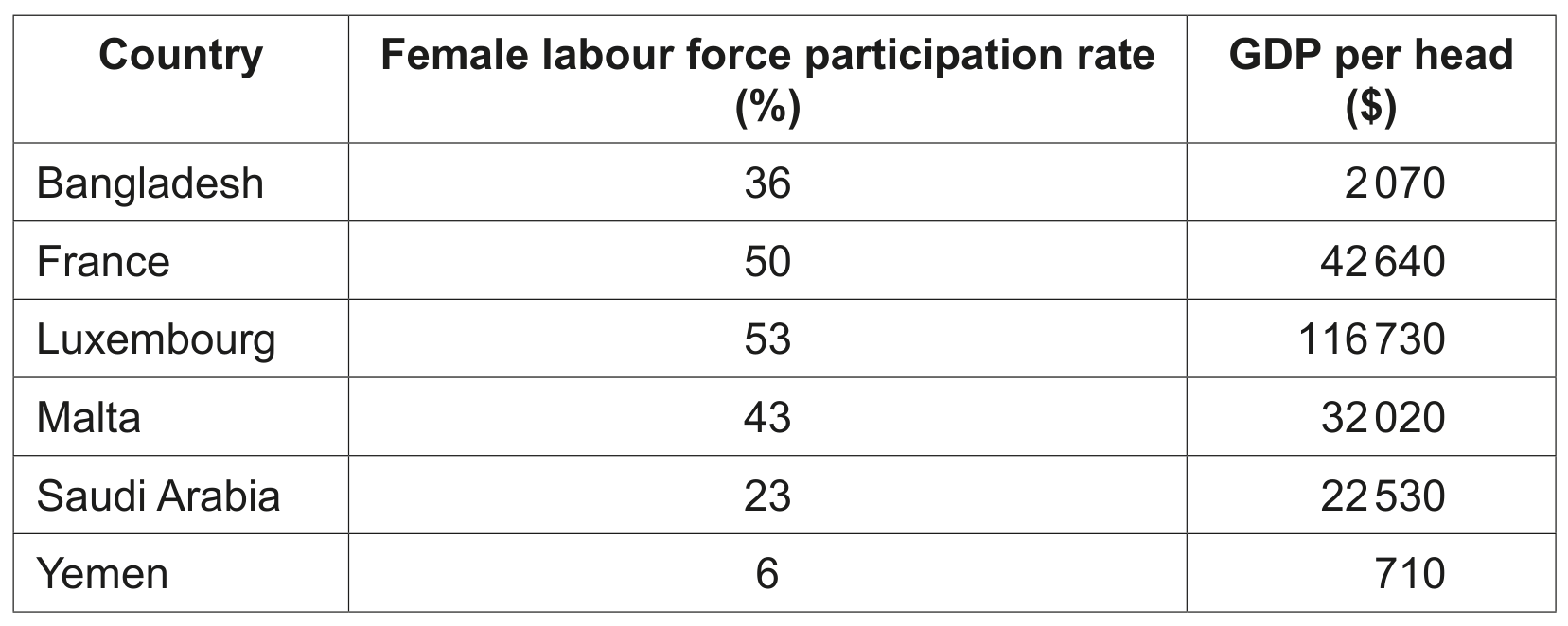
Table 1.1 Female labour force participation rate and GDP per head of selected countries 2019

Table 1.1 Female labour force participation rate and GDP per head of selected countries 2019

Analyse the relationship between GDP per head and the proportion of females in the labour force.
Question 1(g)

[Maximum number: 6]

Read the source material carefully before answering Question 1.
Source material: How will oil change Guyana?

Table

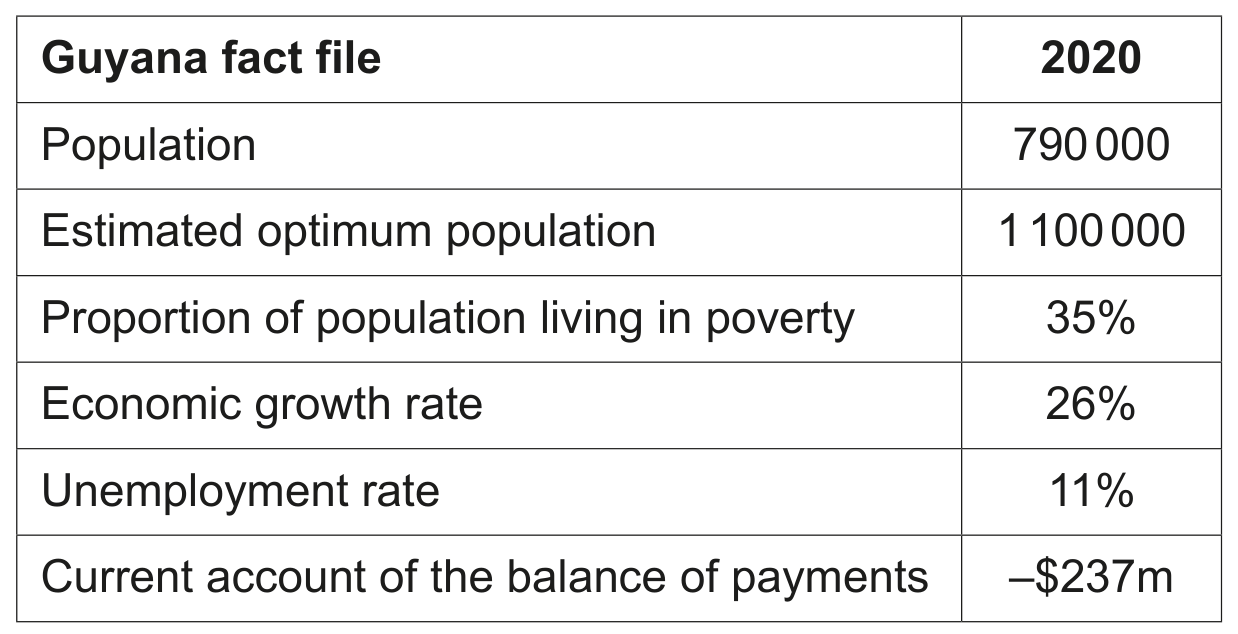
Guyana was the fastest growing economy in the world in 2020. Sugar, gold and timber have accounted for a relatively high proportion of the country's output and exports for some time. In 2020, the sugar industry was hit by bad weather and falling global demand. In contrast, the output of gold and timber increased.

The main reason why Guyana's real GDP increased so rapidly was the increase in oil production. Oil was discovered offshore by a foreign multinational company (MNC) in 2015 and the MNC started production in 2019. It is predicted that Guyana will become the world's largest oil producer per head by 2025 .

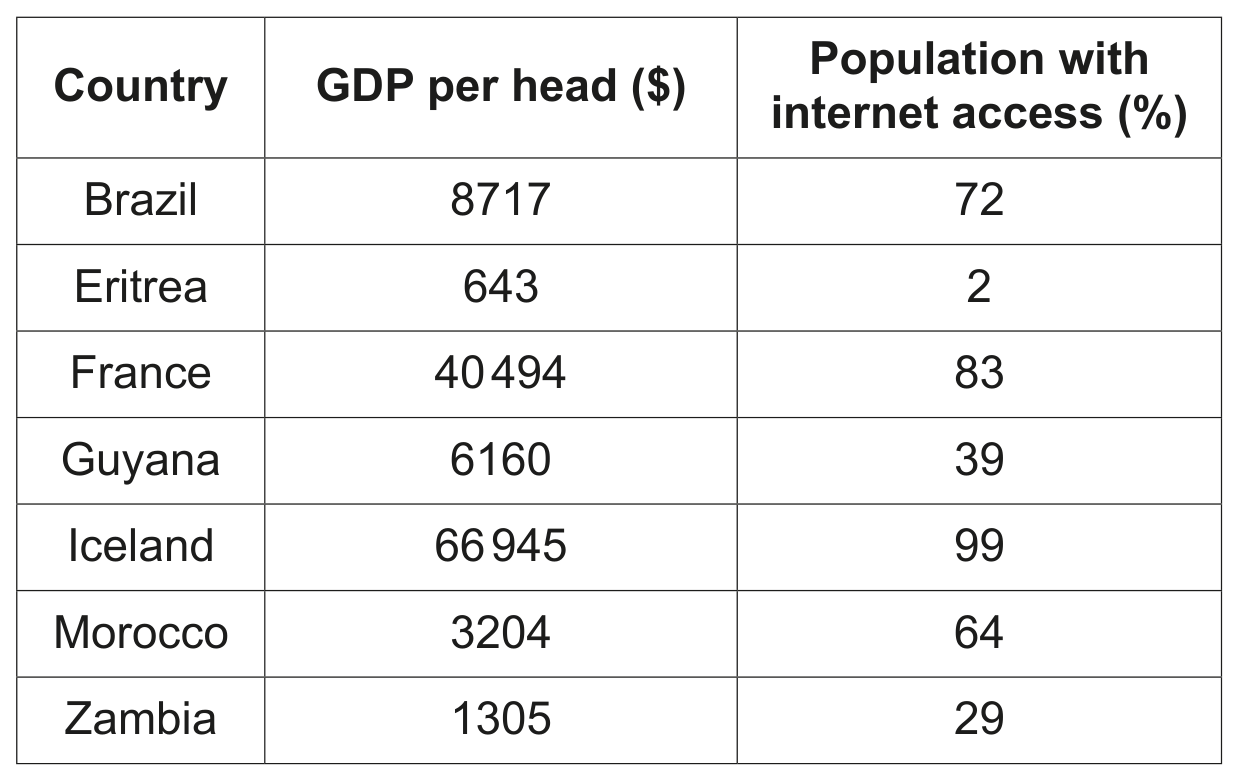
The Guyanese government is planning to use some of the tax revenue it will raise from oil to spend on education and improvements to the country's infrastructure. Planned projects include new railway lines and stations. A more extensive and cheaper rail service may enable more people to work further from home and may influence the market for substitutes, such as car transport. The Guyanese government is also planning to spend some of the tax revenue on improving the country's access to the internet. Table 1.1 shows GDP per head and internet access in seven countries in 2020.

Table 1.1 GDP per head and internet access in selected countries in 2020

Table 1.1 GDP per head and internet access in selected countries in 2020

Guyana has experienced a slow growth in its population size in recent years. In 2020, its birth rate was 16.5 , its death rate was 6.8 and its net migration rate was -7.7 . With increases in oil production, emigration may decline and the country may start to experience net immigration. A higher population may affect Guyana in a number of ways including changing the size of its labour force and affecting the environment.

Discuss whether or not the discovery of oil is likely to increase living standards in Guyana.

Question 1(g)

[Maximum number: 6]

Read the source material carefully before answering Question 1.

Source material: The United Arab Emirates (UAE)

Source material: The United Arab Emirates (UAE)

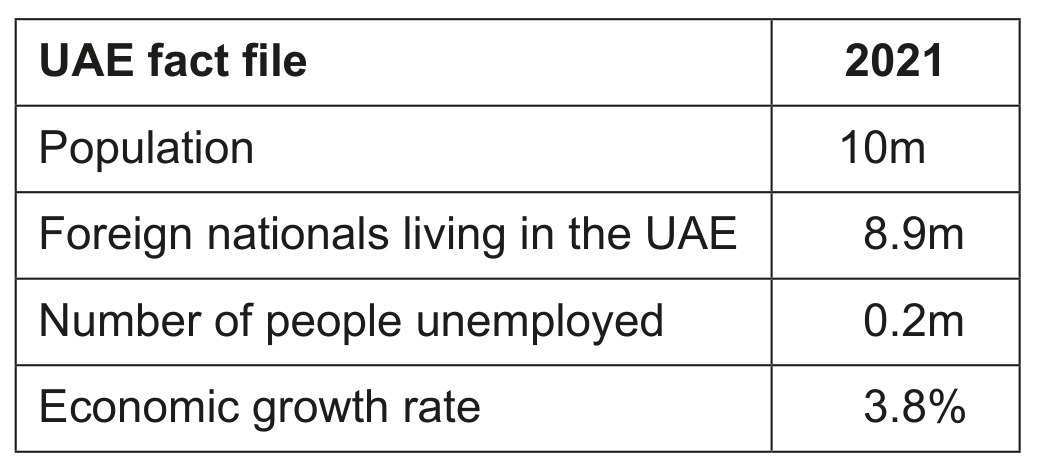
The number of foreign nationals living in the UAE is higher than the number of citizens of the UAE. Labour mobility between the UAE and other countries is high with, for example, many daily flights landing in the UAE from India and Pakistan.

The UAE was the host of the World Expo in 2021-2022 where countries from all over the world demonstrated their economic achievements. The increased connection of people through migration, the trade of goods and services and the sharing of ideas were major features of the World Expo. Another common theme that was presented in the World Expo was the technological progress which has improved global living standards. Technological development has increased both the quality and quantity of the factors of production in the UAE.

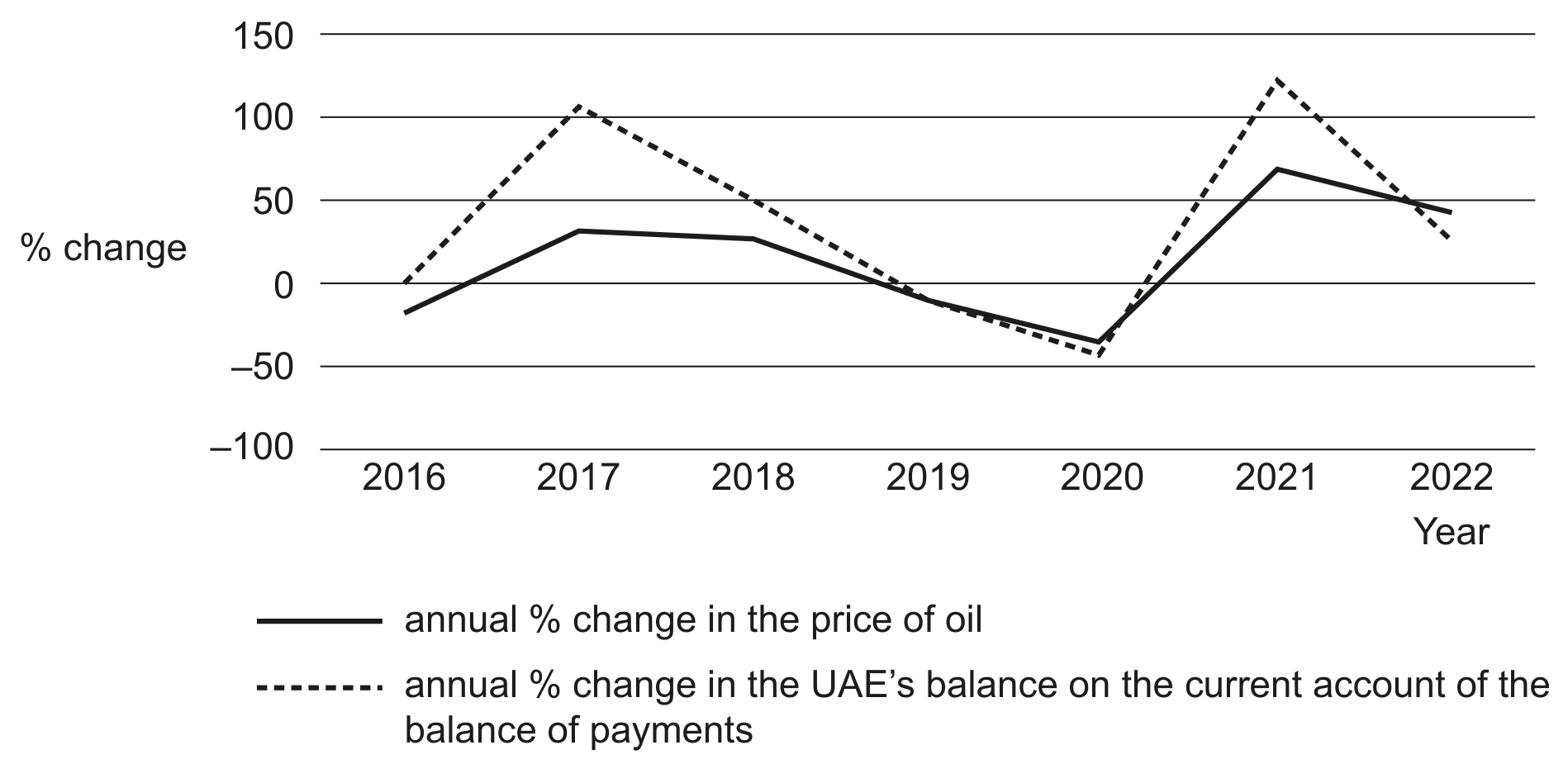
This technological progress was supported by a huge amount of finance gained from their oil production and exports of oil. Oil is a necessity and its price inelasticity of demand has brought both advantages and disadvantages to the economy. Figure 1.1 shows the annual percentage change in the oil price and the annual percentage change in the UAE's balance on the current account of the balance of payments.

Figure 1.1 Annual percentage change in the price of oil and the annual percentage change in the UAE's balance on the current account of the balance of payments 2016-2022

Figure 1.1 Annual percentage change in the price of oil and the annual percentage change in the UAE's balance on the current account of the balance of payments 2016-2022

Dubai, one of the cities in the UAE, is not dependent on oil as 95%95 \% of its economy is non-oil based. Dubai is known internationally for its luxury tourism and financial services, which affect employment, tax revenues and export revenues. However, there are concerns over sustainable water use in a desert area and the level of inequality in the distribution of income.

Despite rapid changes in the economy, the value of the domestic currency, the dirham, has always been very stable as the government has maintained a fixed exchange rate system since 1980. This has helped maintain investor confidence in the economy. However, a fixed rate exchange rate affects the government's ability to deliver other macroeconomic objectives.

Discuss whether or not luxury tourism and financial services have helped Dubai achieve economic development.

Question 1

[Maximum number: 6]

Read the source material carefully before answering Question 1.

Source material: Indonesia and climate change

Source material: Indonesia and climate change

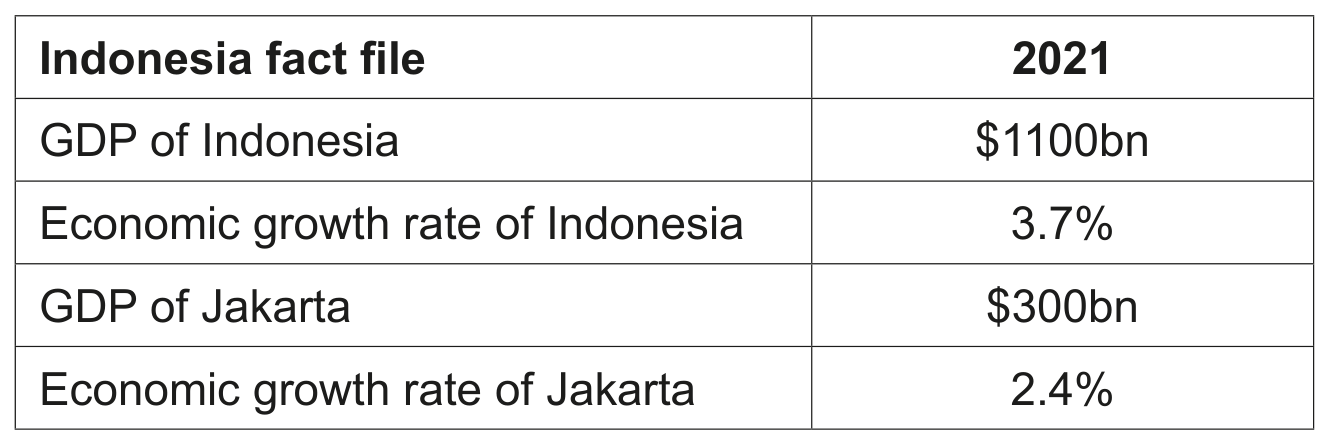
Jakarta, Indonesia's capital city from 1945 to 2024, is one of the world's fastest sinking and most polluted cities. The city is expected to record a large decrease in real Gross Domestic Product (GDP) per head which could lead to a fall in living standards.

The free market can be blamed for air pollution and rising sea levels across some areas of Indonesia. Schools and other buildings have been flooded and roads have been destroyed. Floods have also led to an increase in diseases transmitted through water and mosquitoes which breed in water.

Farmland has been submerged, cutting off a vital source of income for many farmers. This has led to internal migration (people moving between regions of the same country). For example, some farmers have moved to areas where climate change has led to the production of different crops. There has been less pressure on both natural and local government resources in areas which people have left. However, these movements could lead to the collapse of entire communities and increase the inequality between workers who are more mobile and those who are less mobile.

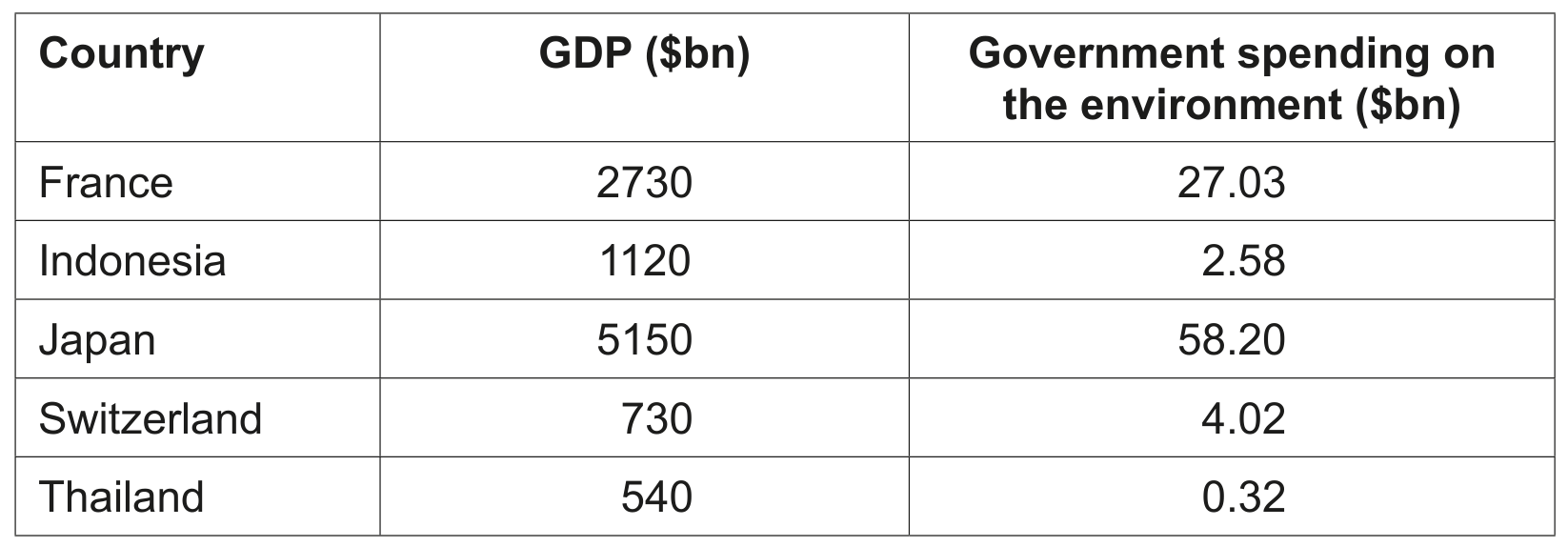
Governments around the world have reacted to climate change by spending more on the environment. Table 1.1 shows the GDP and government spending on the environment of selected countries in 2019.

Table 1.1 GDP and government spending on the environment of selected countries in 2019

Table 1.1 GDP and government spending on the environment of selected countries in 2019

The Indonesian government has also reacted to environmental issues by relocating its capital city. The city of Nusantara will replace Jakarta as the capital city in 2024. The cost of building this new city is expected to be $32.5\$ 32.5 billion. This city will not only provide job opportunities but could also reduce the inequality between the different regions of Indonesia. Jakarta is located on the island of Java which is a wealthier region than Kalimantan. The new city, Nusantara, will be located in Kalimantan region. In addition, the government intends for the new capital city to be carbon-neutral. However, opponents of this project have said that the cost is too high. They also claimed that the project will only benefit a small number of wealthy and powerful people.

Question 1(c)

(a)

Explain how real GDP per head can be an indicator of living standards.

[ 2 ]

Question 1(d)

(b)

Explain two ways climate change can lead to a fall in the Human Development Index (HDI) of Indonesia.

[ 4 ]

Question 1(a)

[Maximum number: 1]

Read the source material carefully before answering Question 1.

Source material: New Zealand's aim for carbon-neutrality

Table

New Zealand is a relatively small economy that intends to be carbon-neutral by the year 2050. Carbon-neutrality is when a country removes the same amount of carbon dioxide from the environment as it emits or simply eliminating carbon dioxide emissions altogether.

There are now various plans in place to reduce external costs in industries such as the milk and car industries. Both industries are major contributors to air pollution and the milk industry damages the environment where many wild animals live. The government intends to end imports of petrol-powered cars by 2032 and also limit the number of cows that each farmer can keep. However, good substitutes will need to be found to achieve these targets. Consumers will want a cheaper substitute for petrol-powered cars and farmers will need a different source of revenue than cows.

The success of the government plans will be important for New Zealand's macroeconomic performance. New Zealand exporters rely on a clean and green brand image, and this will help economic growth and reduce the deficit on the current account of the balance of payments. However, not all firms will benefit from government plans to achieve carbon-neutrality and inflation rates may also increase.

A switch to a carbon-neutral economy could result in increased unemployment due to significant job losses in the coal, oil and gas industries. This could lead to increased poverty in certain communities and large losses in the firms that serve these communities. However, these changes may be temporary and an economy with a high mobility of factors of production could avoid such problems.

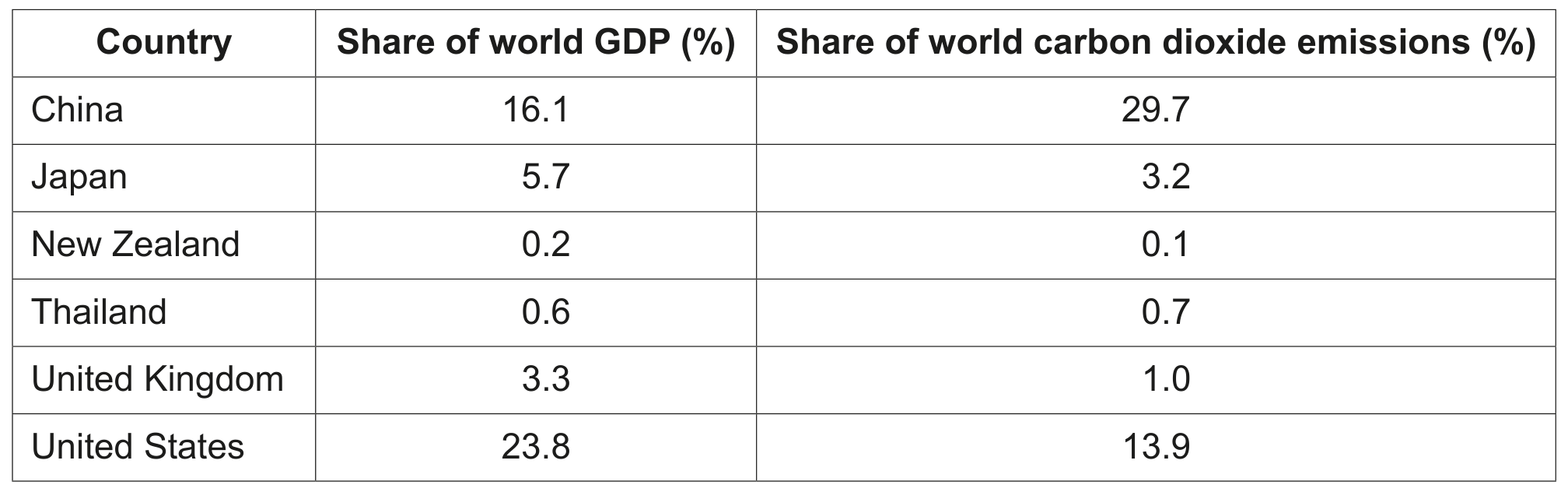
The good news is that New Zealand already has a low level of carbon dioxide emissions. However, not all countries can easily take the route New Zealand is planning to take. For selected countries, Table 1.1. shows their share of world GDP (\%) and their share of world carbon dioxide emissions (\%) in 2018.

Table 1.1 Share of world GDP (\%) and share of world carbon dioxide emissions (\%) in 2018 for selected countries

Table 1.1 Share of world GDP (\%) and share of world carbon dioxide emissions (\%) in 2018 for selected countries

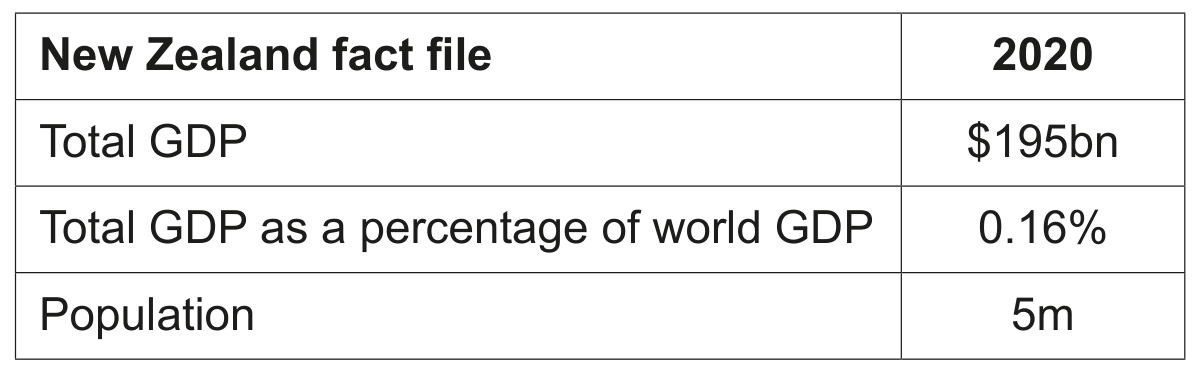
Calculate New Zealand's GDP per head in 2020.

Question 1

[Maximum number: 6]

Read the source material carefully before answering Question 1.
Source material: Will Honduras become a more successful economy?

Table

Honduras is a lower middle-income country which relies heavily on trade with the US. More than half of Honduran exports go to the US and 40\% of its imports come from the US. A high number of Hondurans work in the US and send money back home to their relatives.

Honduras used to concentrate on growing bananas and coffee, gaining skills and a good reputation in those industries. Now, Honduras produces a greater range of products including clothes, chemicals and paper. This diversification has reduced the uncertainty arising from sudden changes in demand and supply. For example, tariffs could be imposed on Honduran coffee or there could be a report stating that eating bananas is good for health.

While employment is declining in agriculture, it is increasing in the clothes industry in Honduras. Training for workers in the clothes industry is expected to increase and working conditions to improve. The firms are also using more capital goods. It is, however, uncertain what will happen to the prices of cotton, wool and other materials used to make clothes.

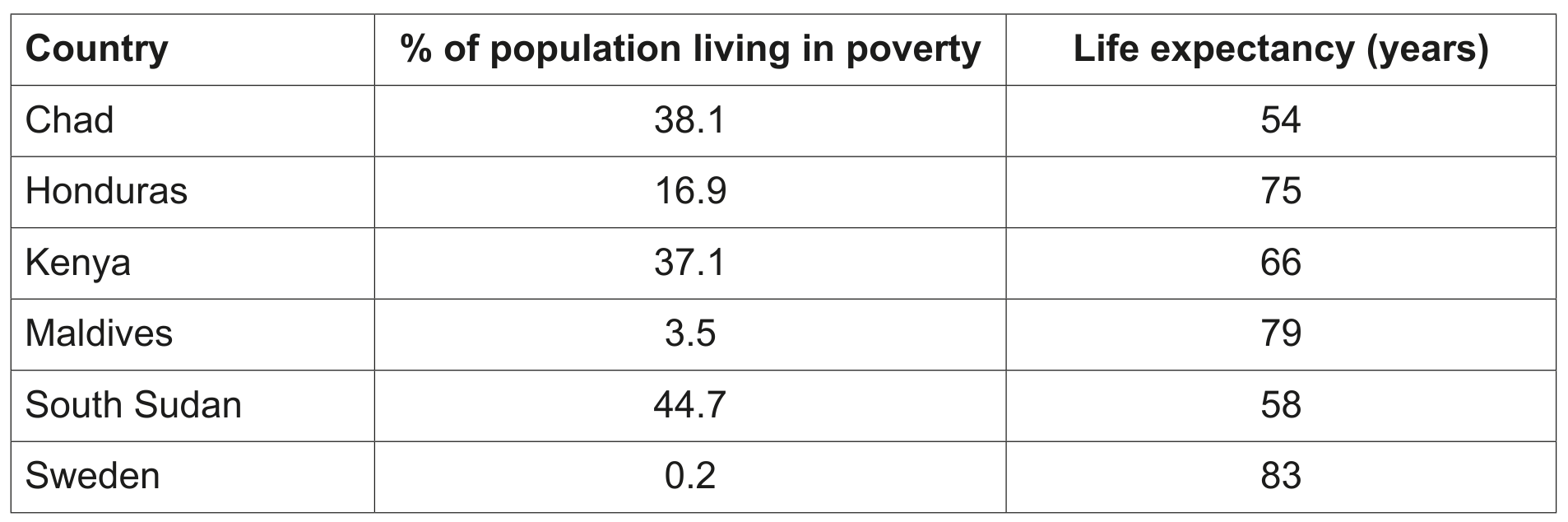
A successful clothes industry has the potential to reduce poverty in Honduras. The Honduran government tries to reduce poverty by, for example, providing unemployment benefit. A major reason for the government seeking to lower poverty is to increase life expectancy. Table 1.1 shows levels of poverty (percentage of population living on less than $1.90 a day) and life expectancy in selected countries.

Table 1.1 Percentage of population living in poverty and life expectancy in selected countries

Table 1.1 Percentage of population living in poverty and life expectancy in selected countries

A more successful Honduran economy would raise incomes. The country has a progressive income tax system, so there could be a significant rise in tax revenue. A more successful economy would also be likely to encourage more investment. Unemployment would be expected to fall which, in turn, could influence consumer spending.

Question 1(a)

(a)

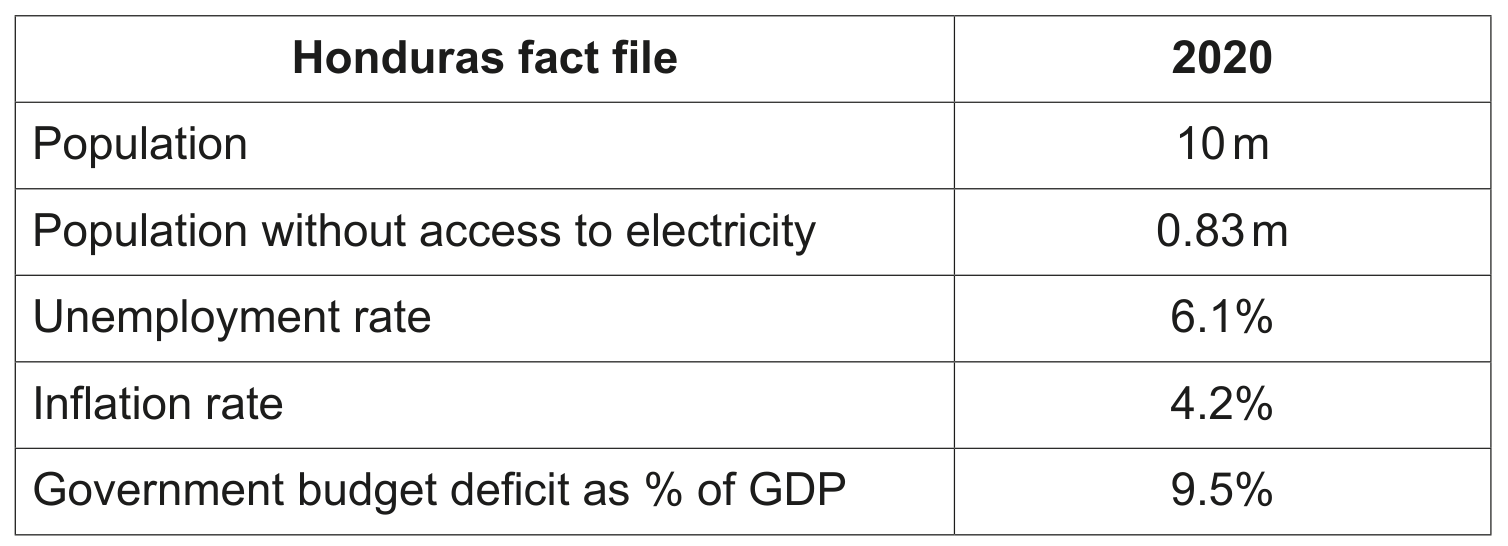
Calculate what percentage of Honduran people did not have access to electricity in 2020. [1]

[ 1 ]

Question 1(f)

(b)

Analyse the relationship between the percentage of population living in poverty and life expectancy.

[ 5 ]

Question 1(f)

[Maximum number: 5]

Read the source material carefully before answering Question 1.

Source material: Changes in Ecuador's economy

Source material: Changes in Ecuador's economy

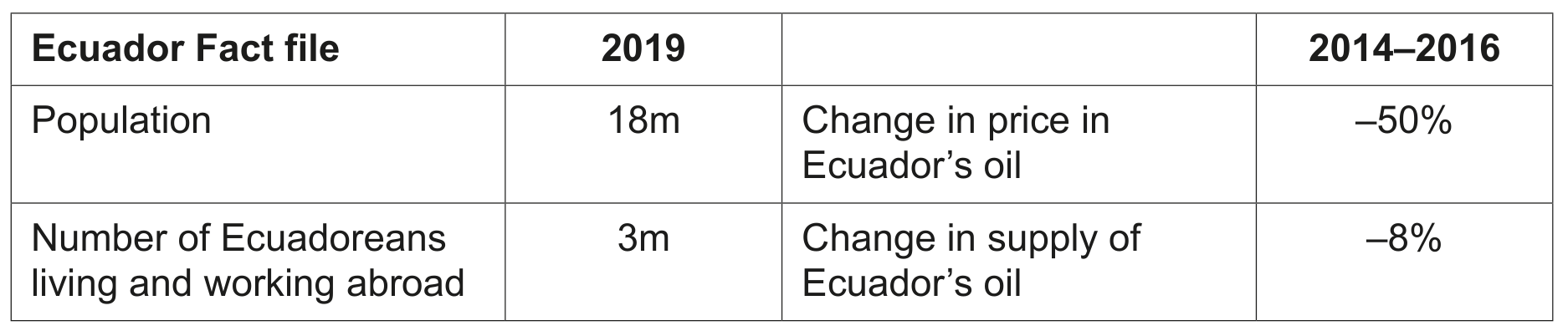
Oil makes up one third of Ecuador's exports. Ecuador has, however, decided to produce less oil and more of other goods and services. This decision has affected how products are made in Ecuador. For example luxury textile production, such as luxury scarves and jumpers, uses fewer capital goods than oil production. Tourism relies on natural resources including sunshine and beaches.

One reason Ecuador's government has encouraged less reliance on oil, is the large changes that often occur in the oil market. Between 2014 and 2016, demand for Ecuador's exports fell which caused a significant reduction in export revenue. This reduction, combined with a decrease in government spending, caused the country's output to decline.

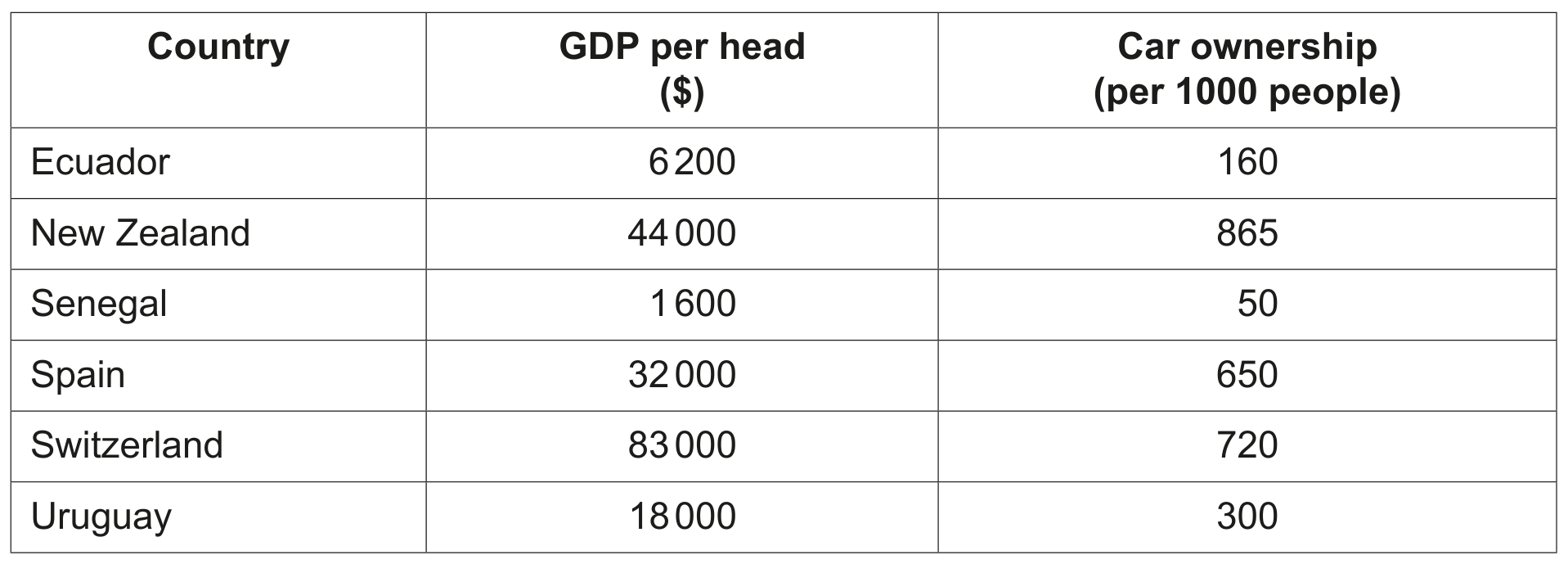
Between 2016 and 2019, there was some improvement in Ecuador's economy. Incomes and household spending increased and more cars were purchased. Table 1.1 shows the GDP per head ($) and car ownership (per 1000 people) in selected countries in 2019.

Table 1.1 GDP per head (\$) and car ownership (per 1000 people) in selected countries 2019

Table 1.1 GDP per head (\$) and car ownership (per 1000 people) in selected countries 2019

Ecuador's government borrowed from China to spend on building more roads. The construction of these roads increased employment and was expected to influence transport costs in the long run.

Between 2016 and 2019, Ecuador's textile industry benefited from the improvement in the road network. Despite strong competition from foreign textile firms, Ecuador's textile firms increased the scale of their production. Wages paid in the textile industry did not rise significantly. A very small wage increase can affect trade union activity and emigration.

Some of Ecuador's workers emigrate to find jobs in other countries, particularly Italy, Spain and the US. These workers have a range of skills and they work in a variety of jobs abroad, some of which provide training. Many, but not all, workers send money home to their families.

Analyse the relationship between GDP per head and car ownership.

Question 1(c)

[Maximum number: 2]

Read the source material carefully before answering Question 1.

Source material: Mauritius's international reach

Source material: Mauritius's international reach

Mauritius is an island nation in the Indian Ocean. The economy of Mauritius has grown since it changed from an economy based on the primary sector to one based on the tertiary sector. The growth of the economy not only increased income per head but also improved healthcare in Mauritius. Life expectancy has increased and the infant mortality rate (number of infant deaths per thousand births) has fallen significantly.

Mauritius is known for many attractions, including its beautiful beaches, and more than a million tourists visit each year. Tourists from most countries only need their passport to visit Mauritius as a visa is not required. The tourism industry not only creates many jobs, it also raises tax revenue for the government. The tax revenue from the tourism industry is used to fund development projects that benefit the entire population, not just those working in tourism. There are also more than 32000 foreign firms based in Mauritius. Firms set up in Mauritius due to its fast growth and political stability, as well as having few regulations to set up and run a firm.

The government tries to attract more investment by providing good infrastructure. The government spent more than $1\$ 1 billion on infrastructure development in 2019. It upgraded the international airport on the island, the seaport, and public transportation around the island. This could reduce the cost of doing business in Mauritius and increase the size of a firm's market. Critics are worried, however, that the money has been used to fund projects which have not benefited the economy as much as spending on education or healthcare would have.

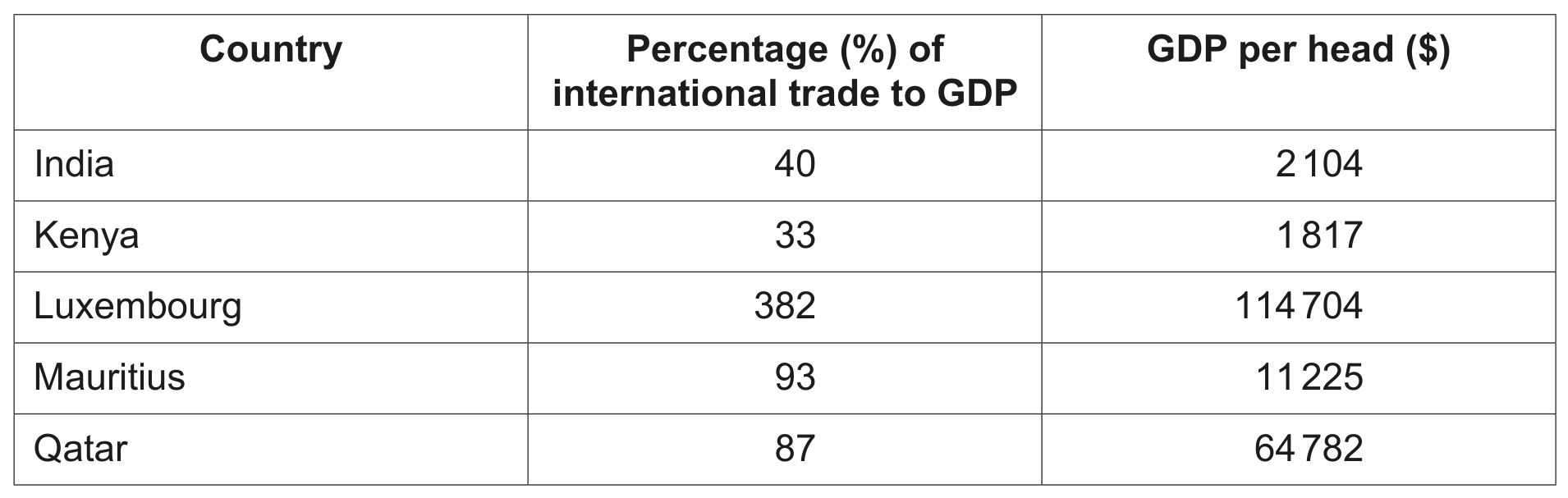
The government is also looking for new sources of economic growth, including increasing international trade and foreign investment. More international trade is seen as key to economic growth. Table 1.1 shows the percentage of international trade to GDP and the GDP per head in selected countries in 2019.

Table 1.1 Percentage (\%) of international trade to GDP and GDP per head (\$) in selected countries 2019

Table 1.1 Percentage (\%) of international trade to GDP and GDP per head (\$) in selected countries 2019

The Mauritian government encourages both inward and outward investment. By country, Mauritius is one of the largest foreign investors in India. Mauritian firms plan to invest in the new Special Economic Zones (SEZs) being set up in Kenya. Outward investment enables Mauritian firms to enter new markets in other countries, to import at a lower cost and increase access to foreign technology. However, the risk is that profit earned abroad may not be reinvested back to the domestic economy. Any changes in the international economy may also affect potential profits.

Identify two indicators of improving healthcare in Mauritius.

Question 1(c)

[Maximum number: 2]

Read the source material carefully before answering Question 1.

Source material: Changes in the Danish economy

Source material: Changes in the Danish economy

Denmark is a high-income, North European country. The Danish population have high living standards and enjoy relatively long hours of leisure time. They spend this time in a variety of ways including cycling, jogging and playing golf.

Danish workers are employed in a range of industries. Denmark used to be a leading shipbuilding country but now the industry is in decline. Ships have substitutes in other forms of transport. Also, it may be possible to postpone the purchase of ships, they take a long time to produce and they are expensive to store. In contrast to the shipbuilding industry, the Danish toy industry has grown in recent years.

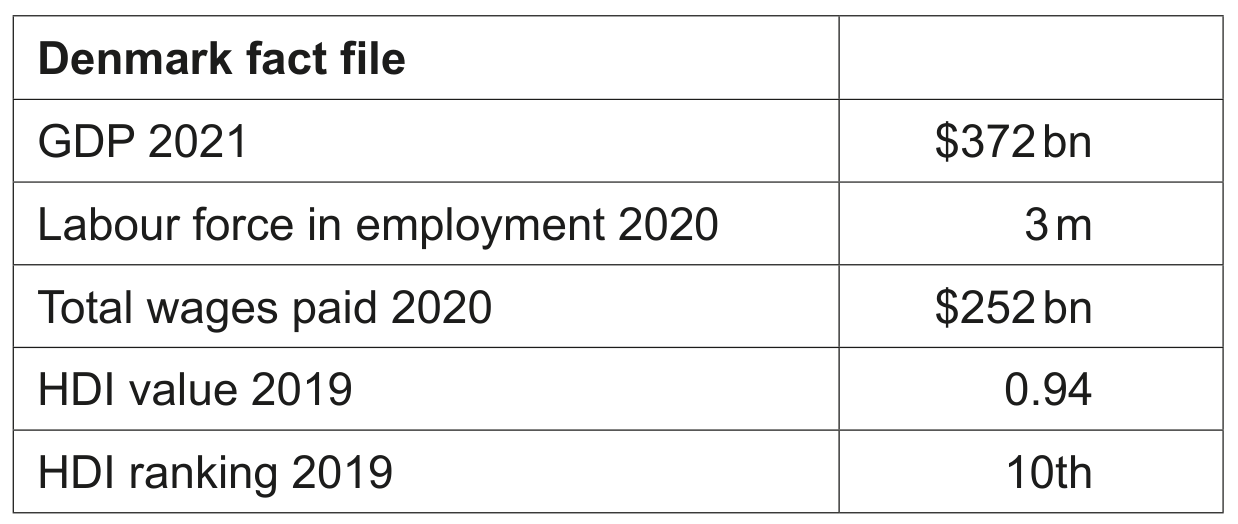
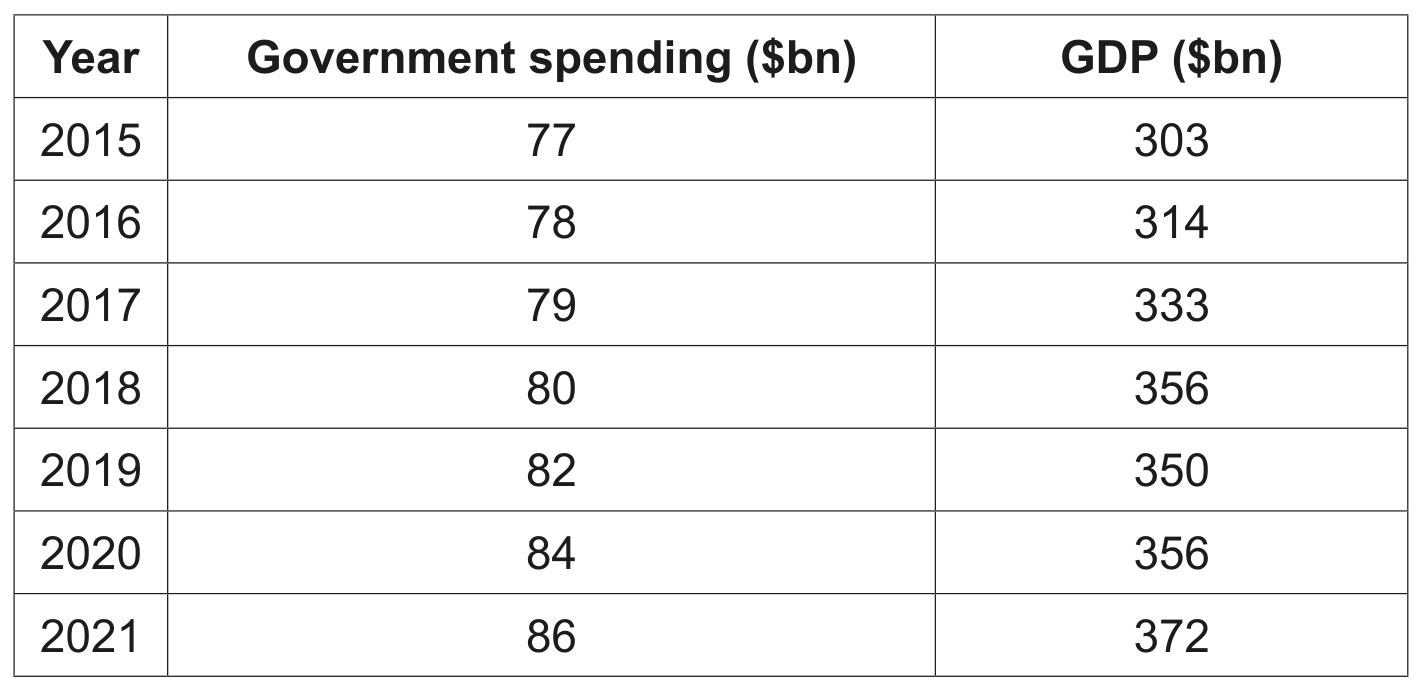
Denmark's shipbuilding and toy industries are in the private sector. Denmark's economic performance is also influenced by changes in the public sector. Table 1.1 shows Danish government spending and GDP over the period 2015 to 2021.

Table 1.1 Danish government spending and GDP 2015-2021

Table 1.1 Danish government spending and GDP 2015-2021

Denmark is heavily involved in international trade. It usually has a surplus on the current account of its balance of payments. International trade affects the availability of products in the country and the country's foreign exchange rate. It also affects the country's GDP and level of employment.

How people work in Denmark, as in most countries, has changed in recent years. More people now spend at least some of their working hours working from home. This change is expected to affect productivity and help firms keep their workers. Households may be encouraged to move out of cities and to buy larger homes. There may also be changes in demand for transport, demand for food sold in city centres and firms' need for office space.

Explain one way that living standards are measured in Denmark.

Question 1(b)

[Maximum number: 2]

Read the source material carefully before answering Question 1.

Source material: Happiness

Table

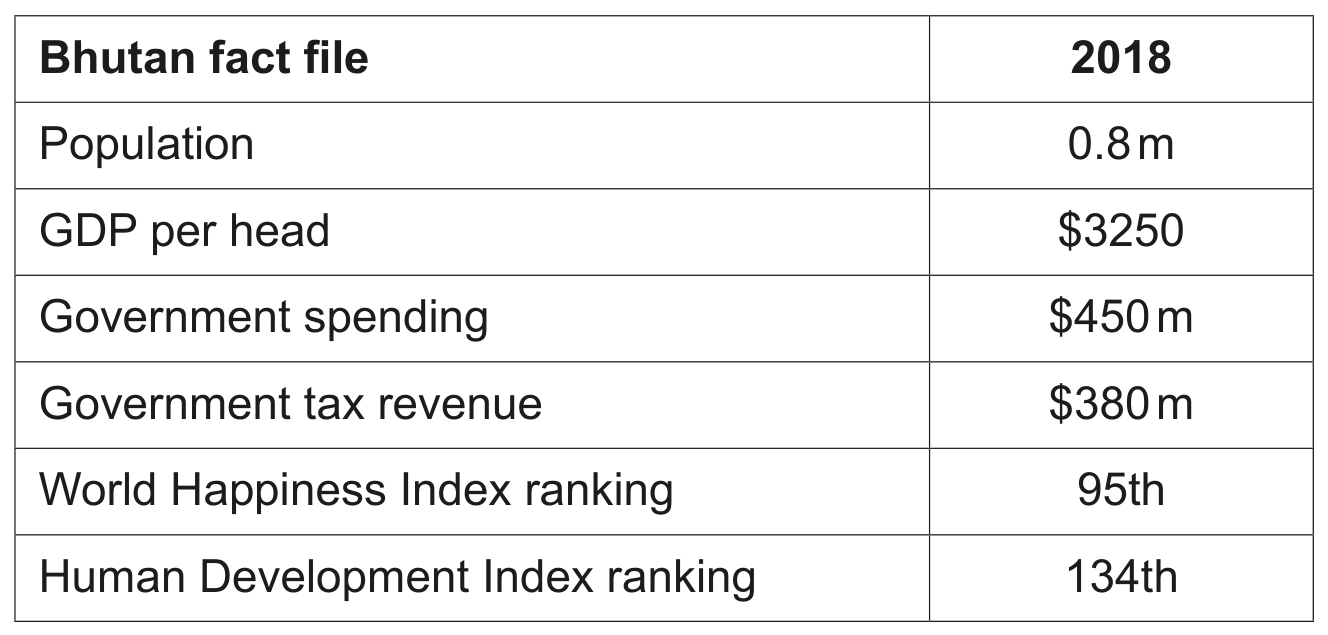
The United Nations has published a World Happiness Index every year since 2012. This index ranks countries according to life expectancy, freedom, social support, trust, generosity and GDP per head. New Zealand was ranked 8th in the World Happiness Index in 2019. The governments of both Bhutan and New Zealand now consider a number of influences on the happiness of their populations.

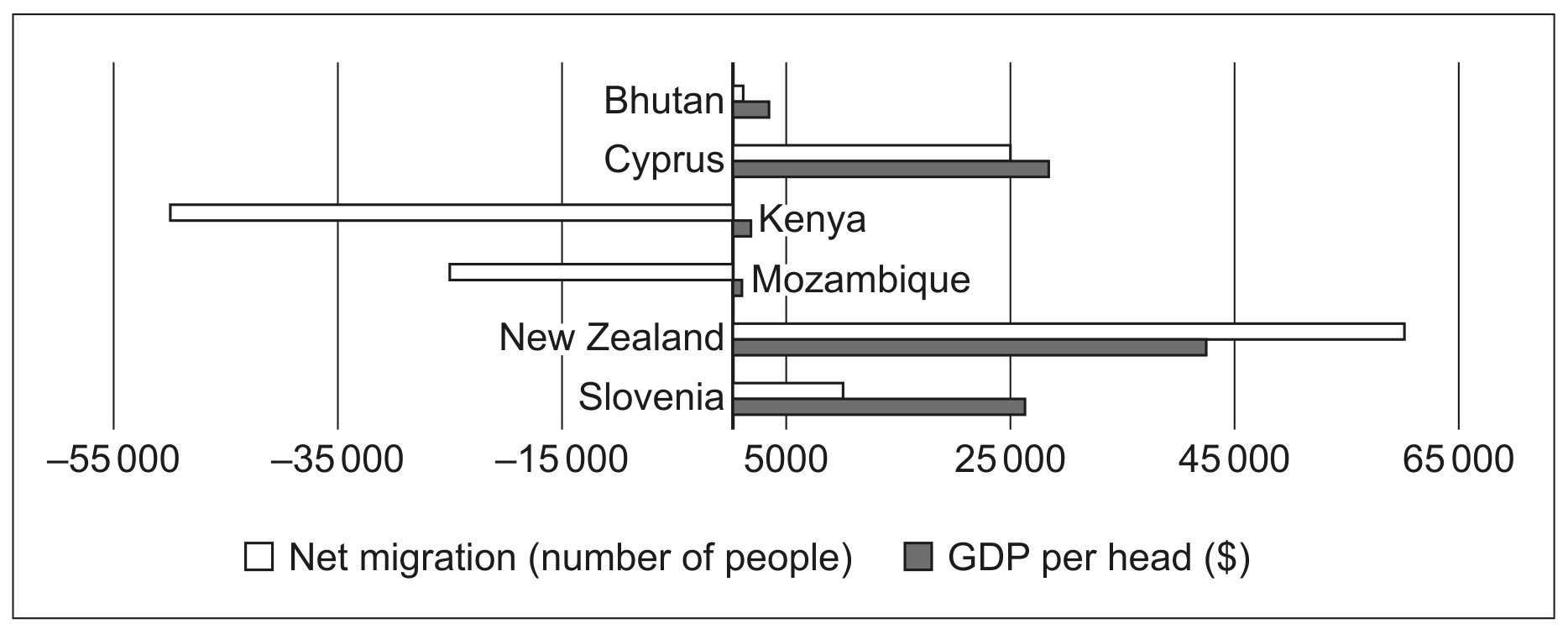
While more than half of Bhutan's labour force is employed in agriculture, most people in New Zealand are employed in the tertiary sector. Working conditions, working hours, the type of work and pay vary between the primary and tertiary sectors. Productivity is higher in all sectors in New Zealand than in Bhutan. This is partly the result of higher investment in capital goods and education in New Zealand. New Zealand also has a higher GDP per head. GDP per head ($) can influence net migration (number of people) as shown for selected countries in 2017 in Fig. 1.1.

Fig. 1.1 GDP per head (\$) and net migration (number of people) of selected countries 2017

Fig. 1.1 GDP per head (\$) and net migration (number of people) of selected countries 2017

In its 2019 budget, the New Zealand government said it would measure its progress not by increases in GDP but by increases in the quality of people's lives. To achieve this, it announced increased spending on some areas including mental health, child poverty and pollution. Some economists criticised this approach. They argued that the best way the government could improve living standards is to reduce income tax rates. This reduction could change government spending and the quantity of products that people buy, including cars.

Tax revenue had increased in New Zealand in 2019, partly because of a rise in revenue from corporation tax. It was, however, difficult to predict firms' future profits. This was because of uncertainty about what would happen to its GDP and its corporation tax rates.

Answer all parts to Question 1. Refer to the source material in your answers.

Identify two indicators that are in both the World Happiness Index and the Human Development Index.

0 selected