EduNinja

IGCSE Economics6.3. Foreign exchange ratesTopic Practice

6.3. Foreign exchange rates

CAIE IGCSE Economics 6.3. Foreign exchange rates question practice helps you revise this syllabus point with the course map in view. Use this page to focus on one topic, check the style of questions available, and connect each attempt back to the knowledge area it is testing.

EduNinja keeps Economics practice aligned to CAIE, so you can move from topic review into exam-style question bank work without losing the syllabus structure. Start with a small set, mark the weak steps, then return to nearby topic links when a definition, graph, calculation, or explanation needs repair.

Question 1(a)

[Maximum number: 1]

Read the source material carefully before answering Question 1.
Source material: Bank mergers

Source material: Bank mergers

In 2019, there was a merger between three Nigerian commercial banks to form Nigeria's largest commercial bank. In 2019, two US commercial banks merged to form the US's 6th largest commercial bank. In the US, the three largest banks controlled 32%32 \% of the market. In the US and Nigeria, large banks have opened more branches, carried out advertising campaigns and improved online banking.

Bank mergers can result in some bank employees losing their jobs. Unemployment did rise in Nigeria in 2019. This is likely to have affected the government's budget as both government tax revenue and government spending will have changed. Most commercial bank workers are well-educated. The number of years of education people receive can affect a country's birth rate. Fig. 1.1 shows average years of schooling and the birth rate in selected countries in 2019.
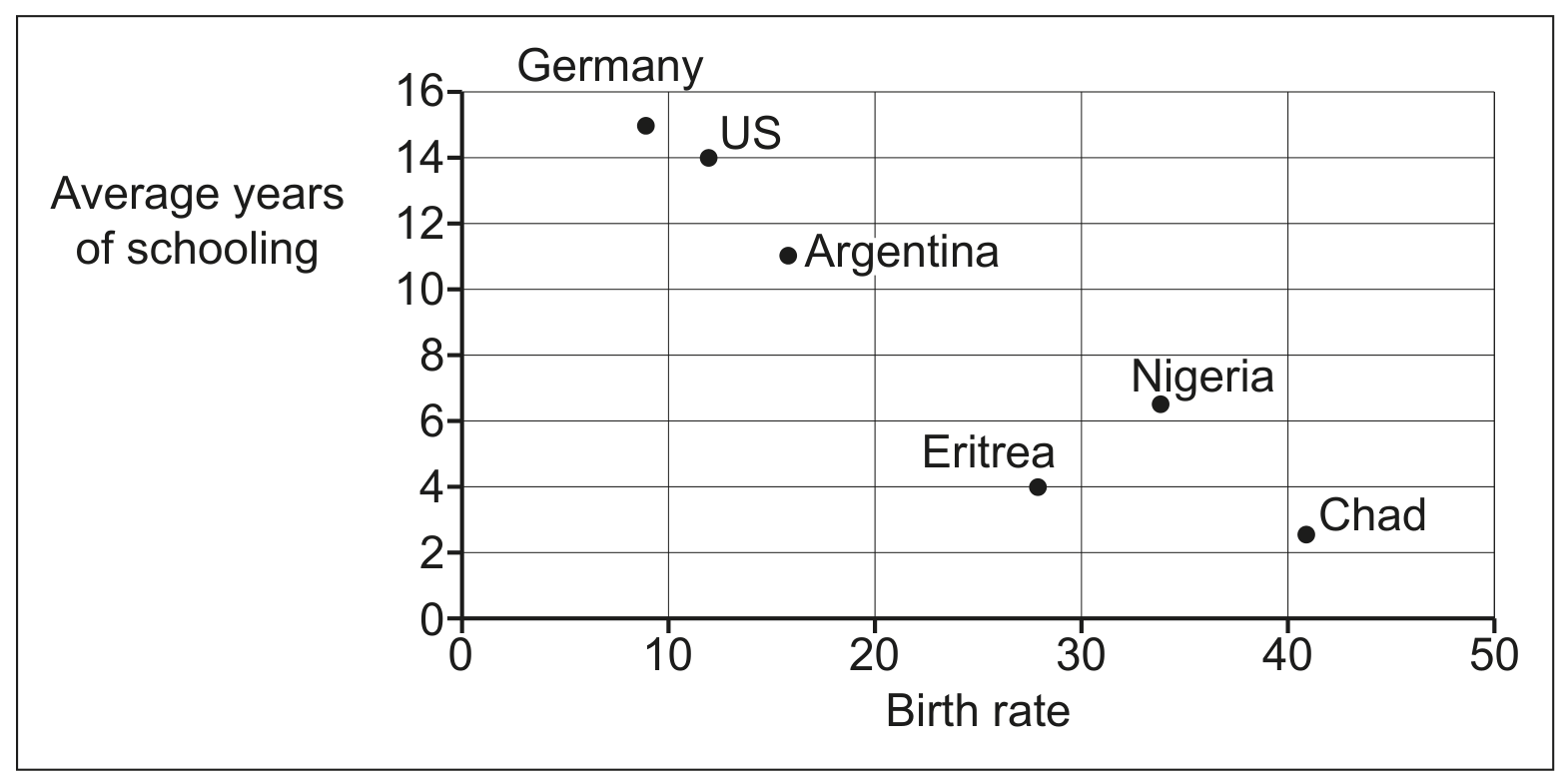
Fig. 1.1 Average years of schooling and birth rate in selected countries 2019

Fig. 1.1 Average years of schooling and birth rate in selected countries 2019

Some households in both Nigeria and the US, who spend more than they earn, borrow from commercial banks. Some children in Nigeria, in low-income households, do not have enough to eat due to the high price of food. A government subsidy to farmers could be used to help low-income Nigerian households. The subsidy could also help to reduce the deficit on the current account of its balance of payments. This will depend on Nigeria's inflation rate compared with other countries and incomes at home and abroad.

In the US, nearly 35%35 \% of children are overweight. One cause of this is the consumption of high-sugar food and drinks. The US government could impose a minimum price on such products, including chocolate. A minimum price could move the market closer to where social benefit equals social cost. However, some consumers think it would be unfair and some firms think it would reduce profits. A minimum price may also impose a cost on the government and its success would be influenced by how high the minimum price is set.

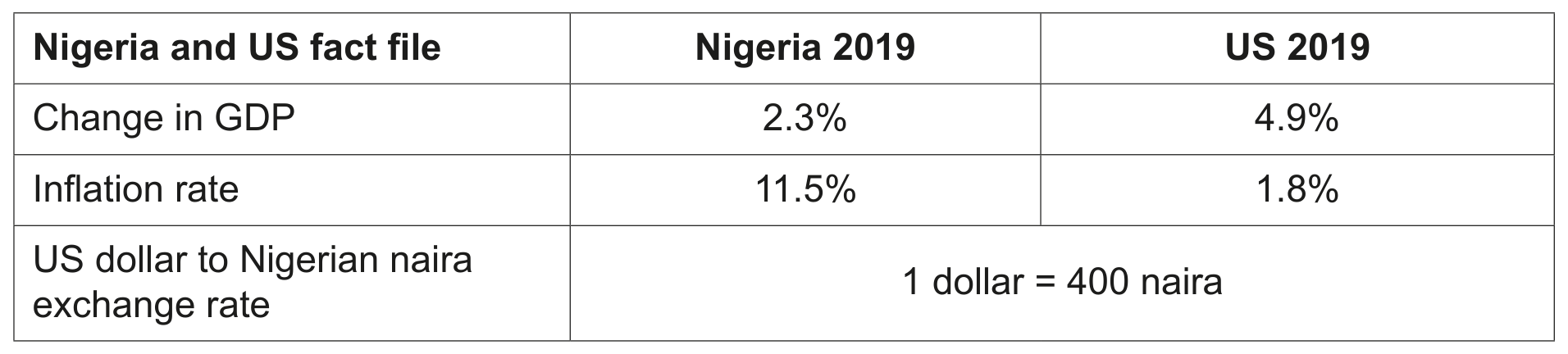
Calculate how many dollars 6400 Nigerian naira would have bought in 2019.
Question 1(h)

[Maximum number: 6]

Read the source material carefully before answering Question 1.
Source material: Changes in the Malawian economy

Table

Malawi is a low-income East African country. It is often affected by natural disasters including droughts, floods and storms. In January 2022, Malawi was hit by Storm Ana. This damaged agricultural crops, factories, forests and power stations.

More than three-quarters of Malawi's labour force are employed in agriculture. Two of the country's main crops are tea and sugar. The quantity of tea offered for sale is affected by weather conditions, government subsidies and the price of fertilisers. The global market for sugar has been affected by health reports which identified the possible harmful effects of consuming too much sugar.

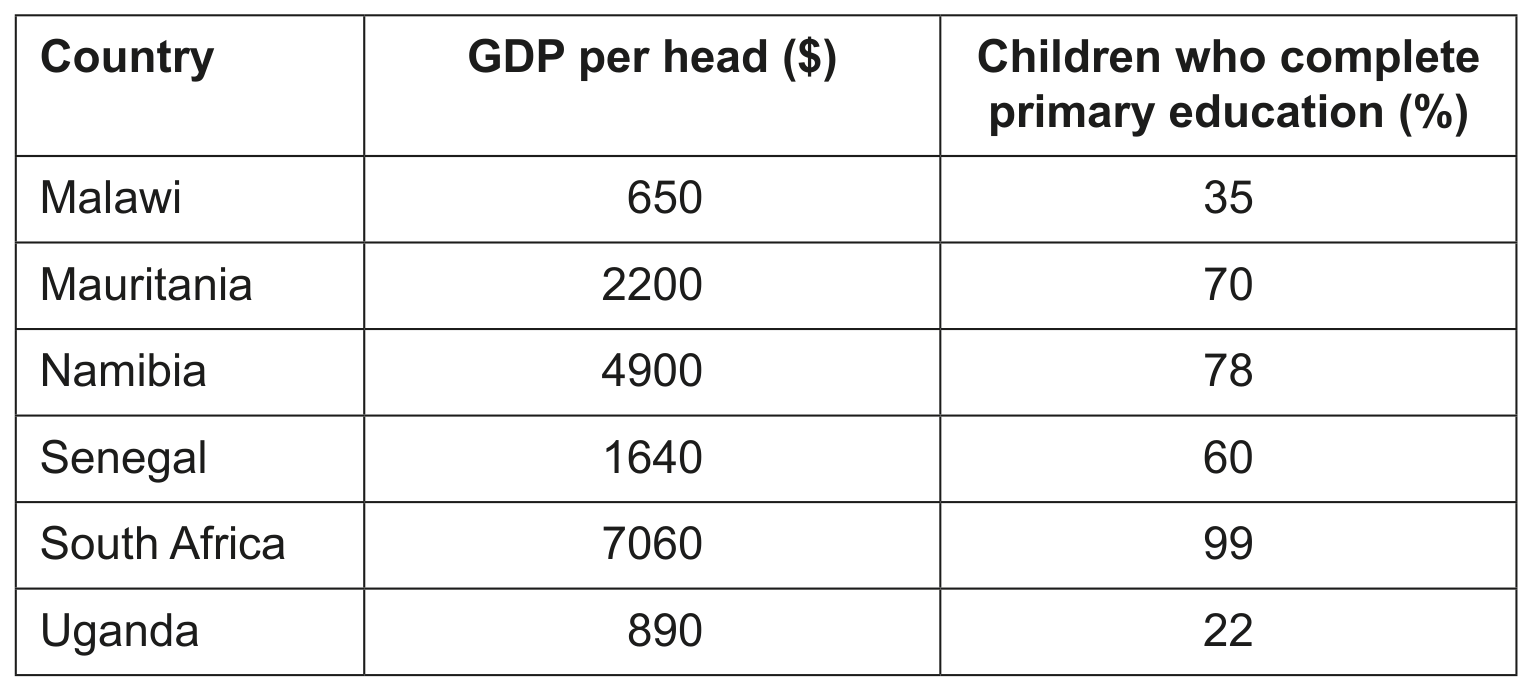
Three of the priorities of the Malawian Government are to develop new industries, raise education standards and develop more sustainable sources of energy. The proportion of Malawian children who finish their primary education ( 5-11 years of age) is relatively low. Table 1.1 shows GDP per head and the percentage of children who complete primary education in selected countries in 2022.

Table 1.1 GDP per head and the percentage of children who complete primary education in selected countries in 2022

Table 1.1 GDP per head and the percentage of children who complete primary education in selected countries in 2022

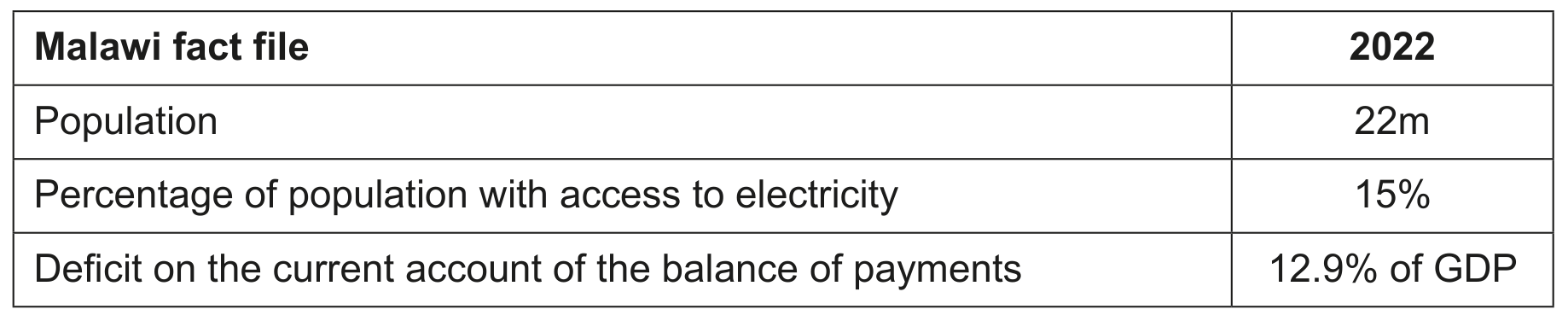
Only a small proportion of Malawi's population has access to electricity. Most households rely on wood and charcoal for cooking and heating. Using wood as a fuel contributes to the destruction of the country's forests and reduces air quality. The country does, however, get 3000 hours of sunshine a year. This means it could develop solar energy. There would be an initial cost to install solar panels and to reduce the risk of storm damage. Solar energy plants (also known as solar farms) can take up a large area and create visual pollution. However, a successful solar energy industry could decrease Malawi's imports of fuel and might affect its exchange rate.

Malawi's foreign exchange rate fell in 2022. The country's currency, the kwacha, bought fewer US dollars. This depreciation affected Malawi's current account of the balance of payment, its inflation rate and its economic growth rate. Some economists suggested that the Malawian Government should stop the kwacha falling further in value.

Discuss whether or not a government should try to stop its country's foreign exchange rate falling in value.

Answer any three questions.

Each question is introduced by stimulus material. In your answer you may refer to this material and/or to other examples that you have studied.

Question 1(h)

[Maximum number: 6]

Read the source material carefully before answering Question 1.

Source material: The challenges facing the Tunisian government

Source material: The challenges facing the Tunisian government

Tunisia had a government budget deficit for a number of years. Between 2015 and 2020, the Tunisian government carried out reforms to reduce the tax burden, to rely more on indirect taxes and to make the tax system more efficient and more economical.

As well as taxing a range of products, the Tunisian government also regulates the price of some products including flour and milk. Government control of the price of flour and milk can help reduce poverty and prevent monopoly firms exploiting their market power. The Tunisian government also subsidises the production of electricity. The subsidy affects the cost of producing electricity, and the change in the price of electricity affects other firms' costs. This form of government spending can help reduce inflationary pressure but can also affect the efficiency of electricity production.

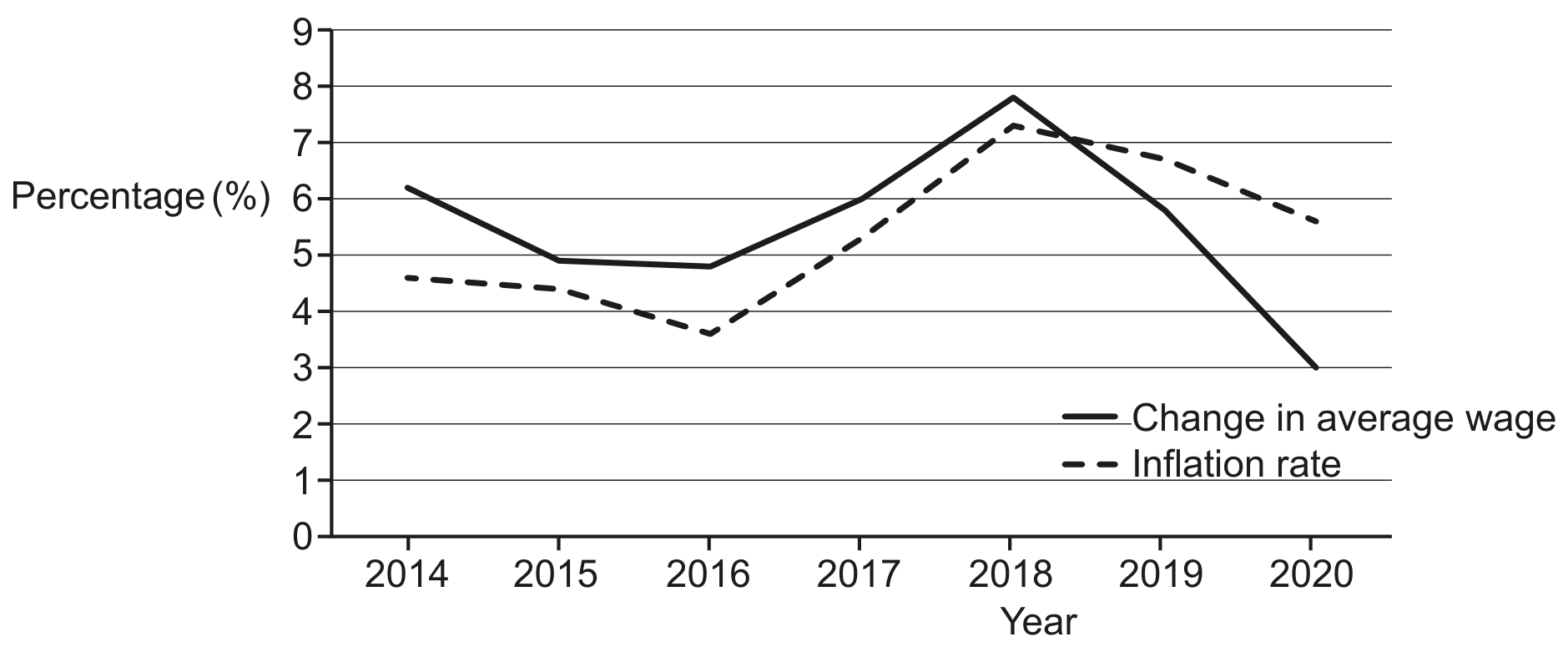
While some firms benefit from the subsidy on electricity production, they also experience periods when their other costs of production rise. Tunisian shoe producers have recently experienced a rise in wage costs and a decline in the number of workers they employ. The average wage paid to Tunisian workers and the Tunisian inflation rate changed between 2014 and 2020 as shown in Fig. 1.1.

Fig. 1.1 Change in average wage and the inflation rate in Tunisia 2014-2020

Fig. 1.1 Change in average wage and the inflation rate in Tunisia 2014-2020

Unemployment has been a problem in Tunisia for many years. In 2020, the government passed a law which promised that workers who had been unemployed for ten years or more would be employed by the public sector. To reduce the time spent moving between jobs, it increased labour market information available to workers and employers and did not raise unemployment benefit in line with inflation.

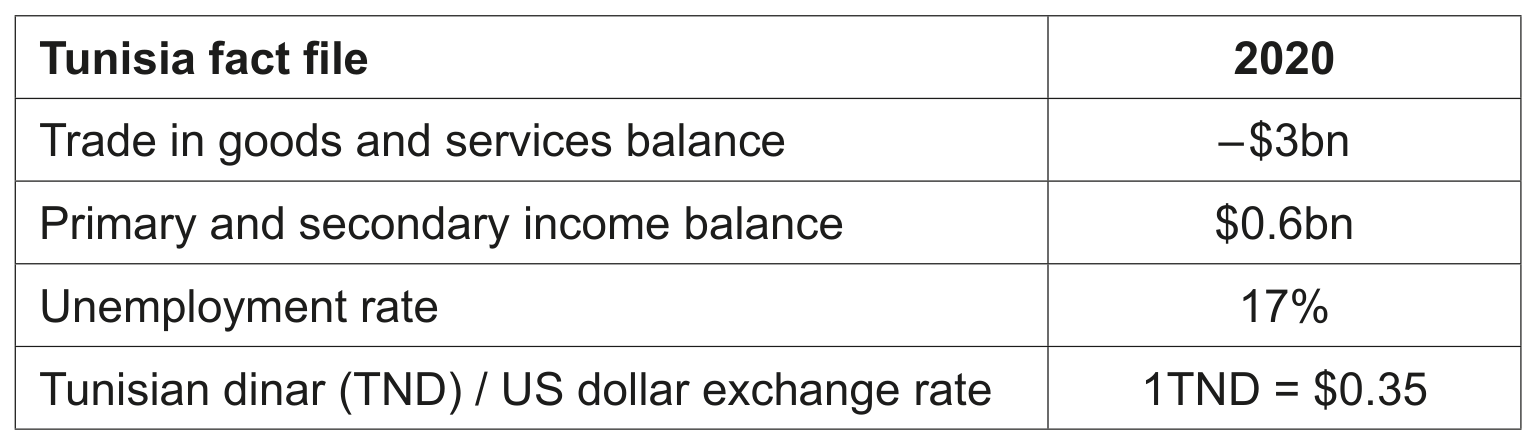
The Tunisian foreign exchange rate fluctuated in 2020. This affected the price of the country's exports and imports. It also affected the current account of its balance of payments, economic growth, inflation and unemployment.

Discuss whether or not a rise in the value of the Tunisian dinar would benefit the Tunisian economy.

Answer any three questions.

Each question is introduced by stimulus material. In your answers you may refer to the material and/or other examples you have studied.

Question 1(g)

[Maximum number: 6]

Read the source material carefully before answering Question 1.

Source material: some problems affecting the Greek economy

Source material: some problems affecting the Greek economy

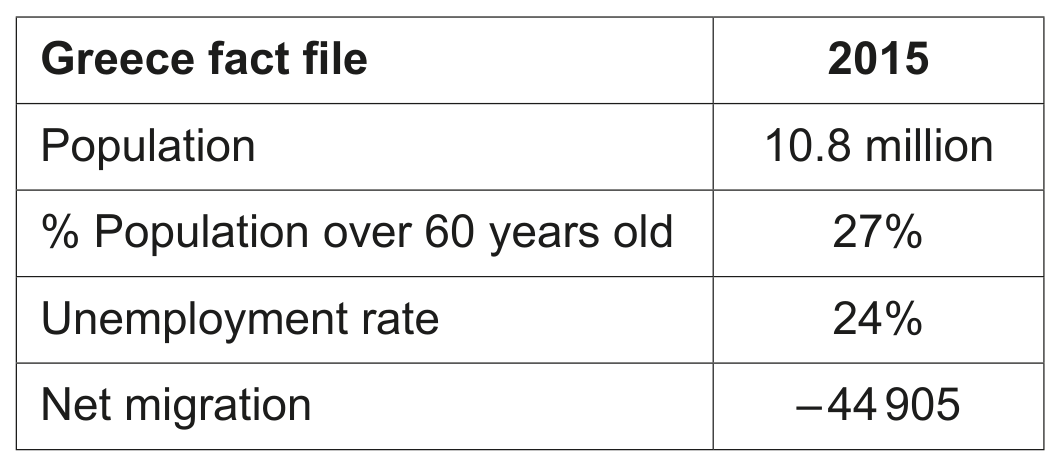
Greece is the country that was worst affected by the European financial crisis that began in 2008. From the start of the crisis, no other European economy had such a large percentage fall in GDP. Greece's GDP fell by 9%9 \% in 2011 . One reason for this was a very strong foreign exchange rate.

Since 2014, other European economies have recorded positive economic growth rates. Among the reasons for this were successful supply-side policy measures and an improving global economy. The Greek government introduced market-friendly measures, including privatisation and labour market reforms. These measures brought back some investors and moved the Greek economy closer to a market economic system. However, Greece's output still fell. This may be due to the fact that none of the government policies have managed to change population trends.

The Greek population has been falling since 2010 . Greece has the third most rapidly ageing population in the world, behind Japan and Italy. The economy has not made good use of its older population because a significant percentage of workers retire earlier than the national retirement age of 67. For example, 74%74 \% of employees in the public sector retire before 61 years old. In addition, the crisis also led to high levels of emigration.

However, those living on some Greek islands have escaped the effects of the crisis. Income from tourism has continued to flow into the islands. An island called Ikaria has also managed to gain international attention as one of the healthiest places in the world. Approximately 30%30 \% of the people who live on this island, live until they are over 90 . Health problems are also much less frequent than those living elsewhere. Overall, however, Greece has managed to improve its Human Development Index (HDI) value as shown in Fig. 1.

Discuss whether or not having a strong foreign exchange rate is a problem for Greece's economy.

Question 1(f)

[Maximum number: 5]

Read the source material carefully before answering Question 1.

Source material: The Swiss economy

Source material: The Swiss economy

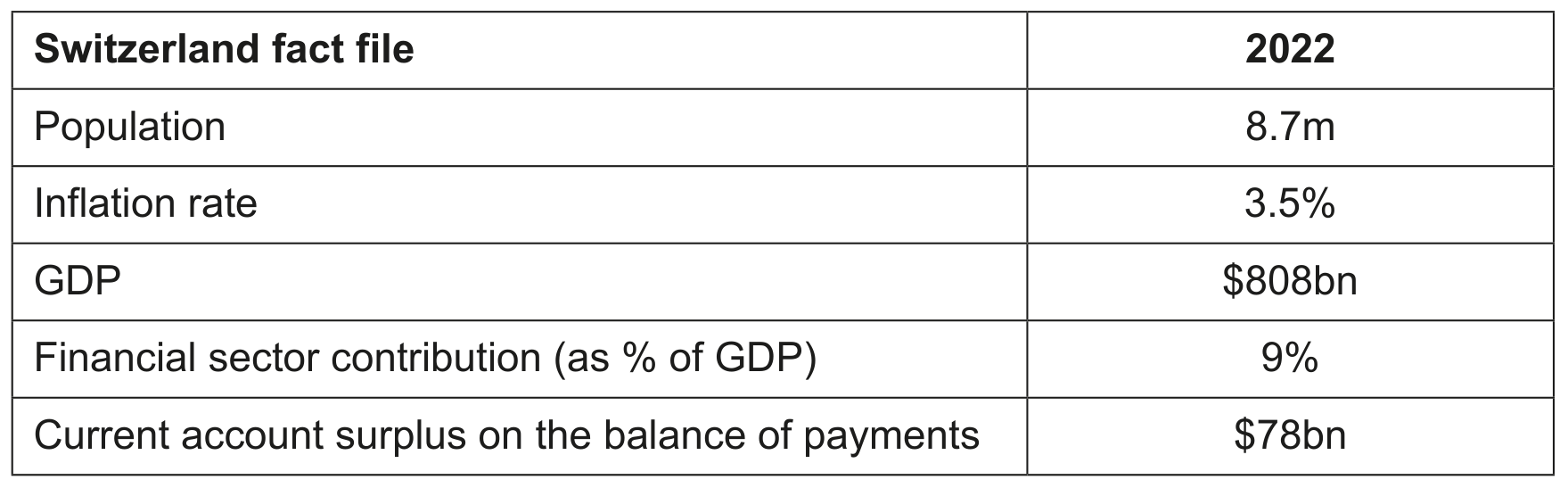
Although inflation in Switzerland in 2022 was above its target of 2%2 \%, it was below the inflation rate of other high-income economies, such as the US ( 9.1%9.1 \% ), the UK ( 11.1%11.1 \% ) and Germany ( 7.9%7.9 \% ). Price levels are more stable because of a combination of microeconomic and macroeconomic policy measures. These include maximum prices, subsidies and a contractionary monetary policy.

To encourage the production of solar energy, the Swiss Government has provided more than $500\$ 500 million in subsidies to producers. This is part of the government's plan to move away from non-renewable sources of energy which are mainly imported. Overdependence on foreign markets could lead to the economy becoming more exposed to external shocks.

Switzerland's current account of the balance of payments has been in surplus from 2015 to 2022. Low inflation, along with the production of very high-quality products, may have contributed to this surplus. A strong currency has also kept the cost of imported raw materials low in Switzerland.

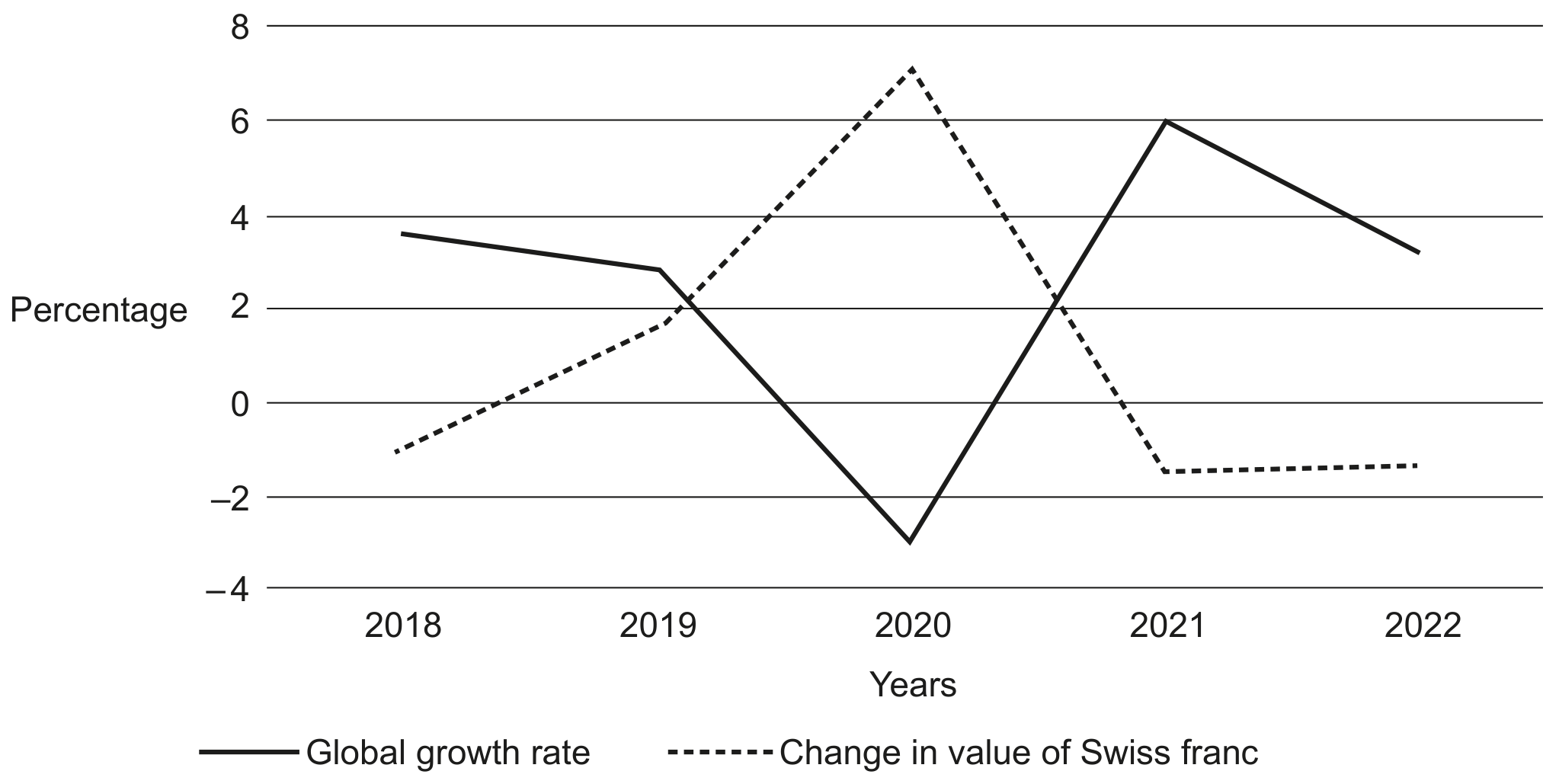
The Swiss franc is one of the more stable currencies in the world. During times of economic uncertainty, the Swiss franc usually strengthens. Fig. 1.1 shows global growth rate (\% change in GDP) and the percentage change in the value of the Swiss franc, against the USD($), from 2018-2022.

Fig. 1.1 Global growth rate (\% change in GDP) and the percentage change in the value of the Swiss franc against the USD(\$) from 2018-2022

Fig. 1.1 Global growth rate (\% change in GDP) and the percentage change in the value of the Swiss franc against the USD(\$) from 2018-2022

Although inflation was not high compared to other countries, the Swiss central bank increased interest rates in 2022. This was done to reduce inflationary pressures. However, there was a risk that higher interest rates might increase unemployment.

The rise in interest rates affected some firms negatively. The Swiss Government had to organise a merger between the two largest banks in Switzerland. This was to avoid one of them collapsing which would have reduced confidence in the whole banking system. A merger might also have helped the merged bank to gain greater economies of scale. However, the merger resulted in some workers losing their jobs and gave the merged bank greater monopoly power.

Analyse the relationship between the global GDP growth rate and the change in the value of the Swiss franc.

Question 1(c)

[Maximum number: 2]

Read the source material carefully before answering Question 1.

Source material: Vietnam's growing population and economy

Source material: Vietnam's growing population and economy

Vietnam's population and its output are increasing. Consumers, workers and firms are benefiting from the higher output. Some Vietnamese people are receiving more generous pensions and higher wages while some firms are earning higher profits.

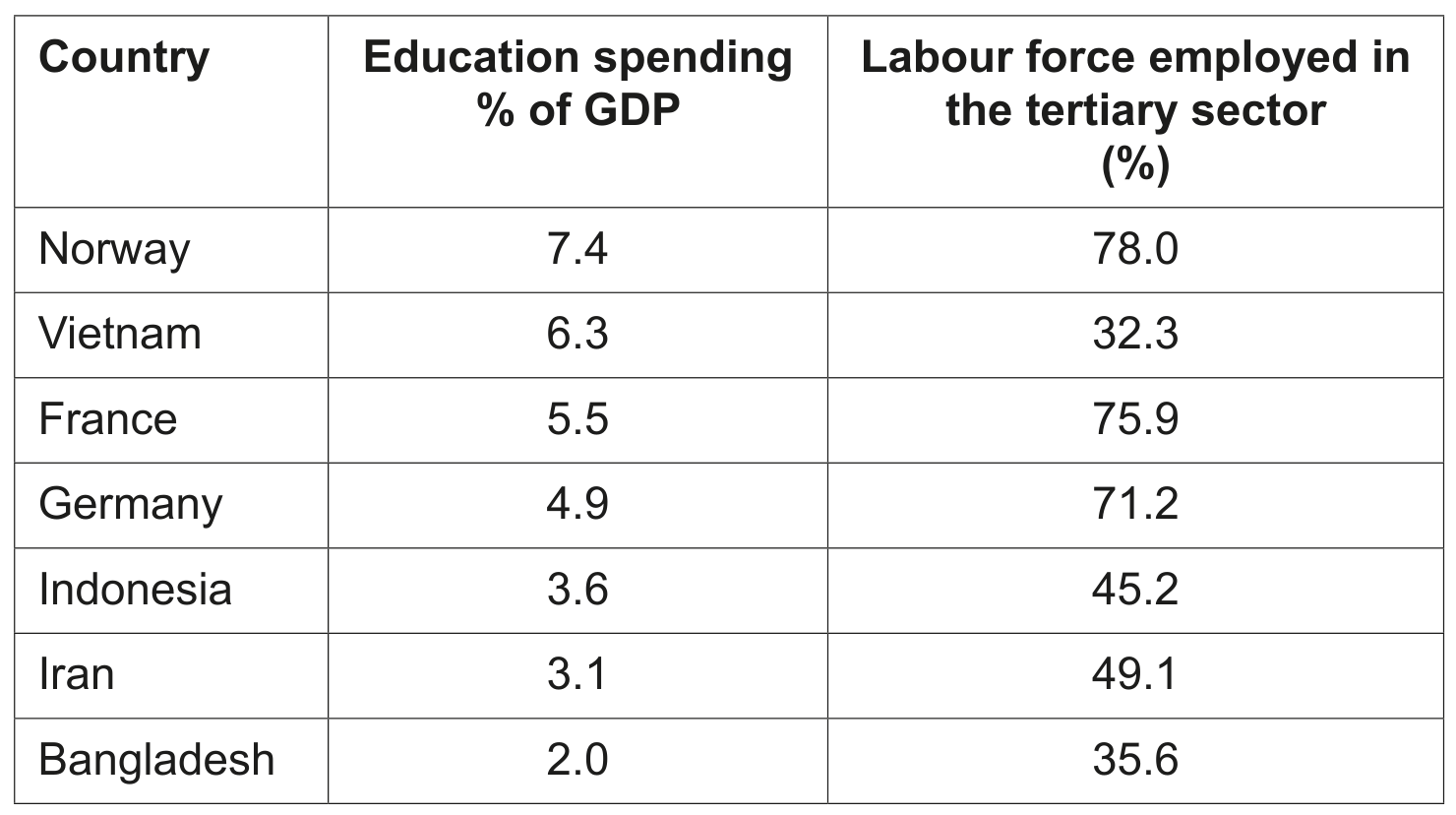
Vietnam's population is ageing but the country still has a relatively young labour force. Age can affect workers' flexibility, mobility, level of experience and their knowledge of the latest technology. The Vietnamese government wants to raise the quality of its labour force by spending more on education. Vietnamese children have recently performed better in international tests than children in richer countries. Education spending can influence the percentage of the labour force working in the tertiary sector as shown in Table 1.

Table 1 Education spending as a percentage of GDP and the percentage of the labour force employed in the tertiary sector in selected countries in 2017.

Table 1 Education spending as a percentage of GDP and the percentage of the labour force employed in the tertiary sector in selected countries in 2017.

Vietnam has had a budget deficit since 2008. The country's high economic growth rate and changes in government policies will affect its budget balance in the future. The government is privatising a number of public sector firms. It also plans to spend more on education and defence and is likely to raise some tax rates.

Deregulation has increased the number of firms, both foreign and domestically owned, in a number of markets. For instance, in 2007 there was only one Vietnamese airline. It operated only two routes and the fares it charged were not affordable to most Vietnamese. Now the country has seven airlines offering domestic and international flights.

Borrowing by both households and firms increased in Vietnam between 2010 and 2017. Households borrowed mainly to purchase more consumer goods while firms borrowed mainly to invest.

Answer all parts to Question 1. Refer to the source material in your answers.

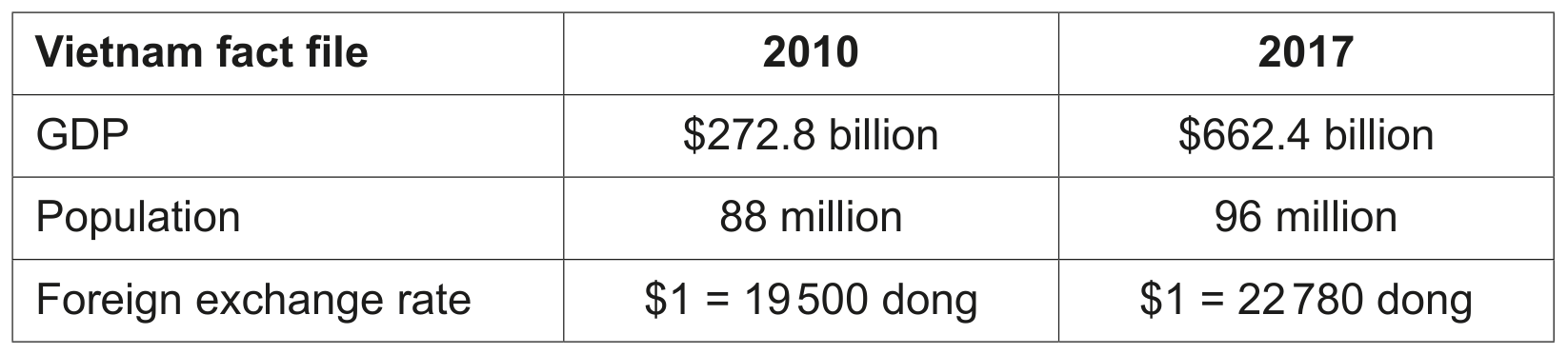
Explain what happened to Vietnam's foreign exchange rate between 2010 and 2017.

Question 2(c)

[Maximum number: 6]

South Africa (SA) experienced a recession in the second half of 2019 and an unemployment rate of 29%. Only a small proportion of this unemployment was frictional. South Africa's foreign exchange rate fell from 1 SA rand = US $ 0.08 in 2018 to 1 SA rand = US $ 0.06 in 2019. South Africa had reduced import tariffs, but in 2019 some South African economists suggested tariffs should be used to protect its infant industries.

Analyse how a fall in a country's foreign exchange rate could reduce a deficit on the current account of its balance of payments.

Question 3(a)

[Maximum number: 2]

The central bank of Madagascar intervenes in the country's foreign exchange market. However, Madagascar has a largely market economic system. Nearly 70% of Madagascar's population live in poverty. Most of the country's industries are labour-intensive. In 2020, Madagascar had an economic growth rate of 6\% and a deficit on the current account of its balance of payments of $0.6bn.

Define foreign exchange market.

Question 18

[Maximum number: 1]

Why would devaluing the international value of an economy's currency help reduce unemployment?

A

Devaluing the currency would increase the cost of production.

B

Devaluing the currency would increase the confidence of investors.

C

Devaluing the currency would increase the foreign demand for domestic products.

D

Devaluing the currency would increase the demand for imports.

Question 18

[Maximum number: 1]

Which government measure would lead directly to more exports of goods?

A

a devaluation of the currency

B

a restriction of bank credit creation

C

an increase in the rate of interest

D

the issue of more bank notes and coins

0 selected