EduNinja

IGCSE Economics5.1.2—Comparing living standards and income distributionTopic Practice

5.1.2—Comparing living standards and income distribution

• reasons for differences in living standards and income distribution within and between countries

Question 1(f)

[Maximum number: 5]

Read the source material carefully before answering Question 1.

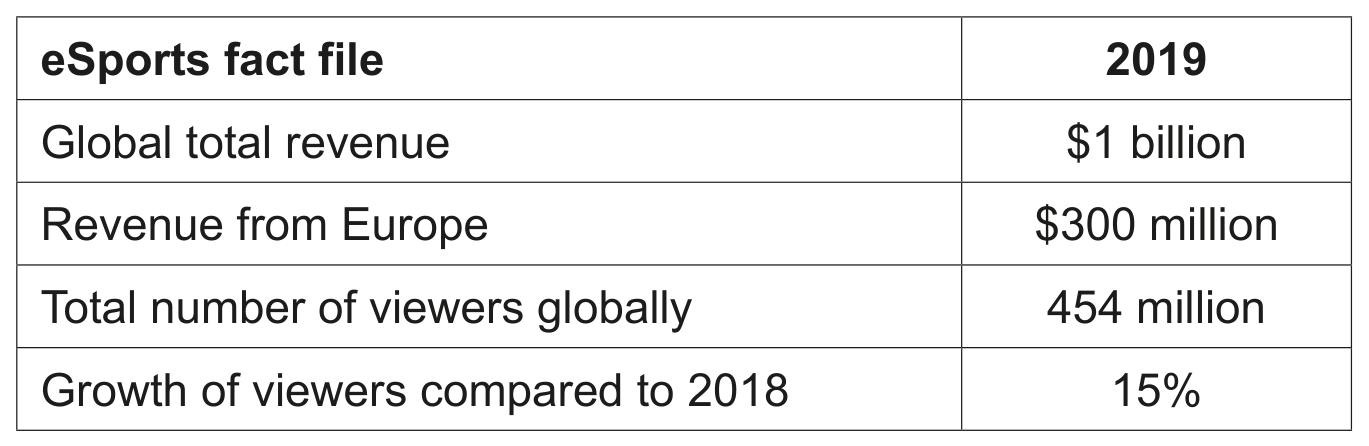
Source Material: The eSports industry and Malta
Table

eSports is now recognised as a sports competition, just like playing other competitive sports such as football and basketball. In eSports, participants compete through video games either as an individual or as part of a team. eSports also attracts large audiences who watch these online competitions. eSports is growing rapidly, both in terms of revenue generated and in the number of viewers. Demand has increased because of increases in incomes and decreases in the price of the technology needed to play or watch eSports. A change in social attitudes has also increased female participation in eSports.

The fast growth in this industry has attracted both private and public sector investment. Private sector firms sponsor various eSports teams and also advertise their products during eSports competitions. Public sector investment has come from the governments of China, Denmark, Malaysia and Malta, mainly in development and training programmes for young eSports participants. The government of Malta, a small island country, hopes to make Malta a main centre for eSports in Europe, to attract visitors for eSports events. The aim is for the eSports industry to contribute 1%1 \% to Malta's GDP, provide 3000 more jobs and improve the current account of its balance of payments.

Malta's service sector has always been important and contributes approximately 90%90 \% of its GDP. Malta is an attractive tourist destination due to its mild weather. The island is used as a location for many movies and TV series, which also attracts visitors who want to see the filming locations. However, to ensure growth is sustainable, the government sees the importance of economic diversification and does not want the economy to overspecialise.

To achieve this, the labour force has to be adaptable and the government has to invest in education and training. The government provides new scholarship schemes, organises work placements and brings in professionals from other countries to help train Maltese students. However, there are concerns that these measures may be too expensive and take too long to have a significant impact on the economy.

Female participation in the labour force is also encouraged. Table 1.1 shows the proportion of women in the labour force (\%) and GDP per head ($) of selected countries in 2019.
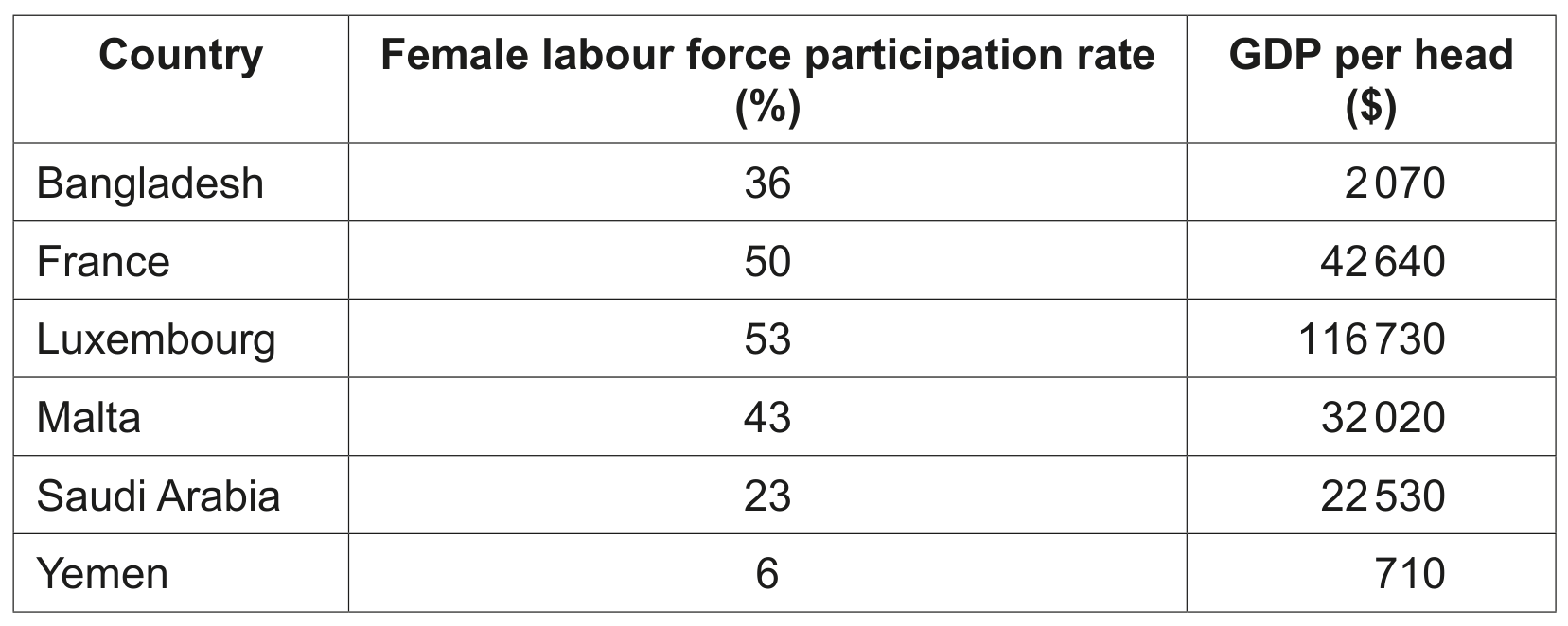
Table 1.1 Female labour force participation rate and GDP per head of selected countries 2019

Table 1.1 Female labour force participation rate and GDP per head of selected countries 2019

Analyse the relationship between GDP per head and the proportion of females in the labour force.
Question 1(g)

[Maximum number: 6]

Read the source material carefully before answering Question 1.
Source material: How will oil change Guyana?

Table

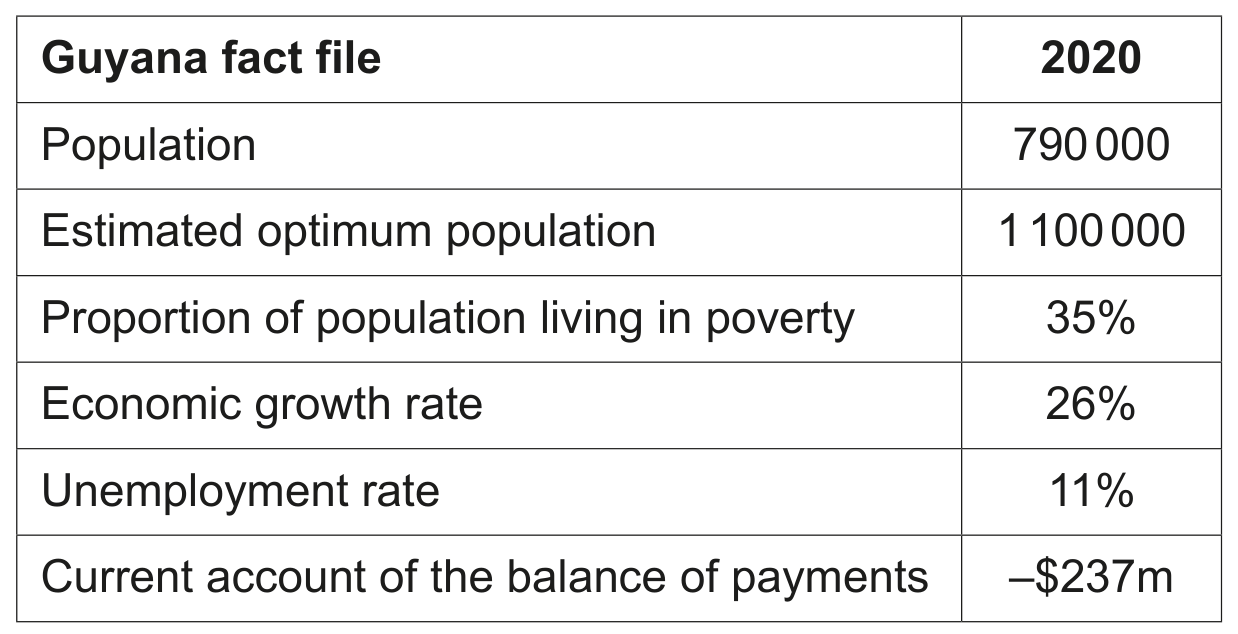
Guyana was the fastest growing economy in the world in 2020. Sugar, gold and timber have accounted for a relatively high proportion of the country's output and exports for some time. In 2020, the sugar industry was hit by bad weather and falling global demand. In contrast, the output of gold and timber increased.

The main reason why Guyana's real GDP increased so rapidly was the increase in oil production. Oil was discovered offshore by a foreign multinational company (MNC) in 2015 and the MNC started production in 2019. It is predicted that Guyana will become the world's largest oil producer per head by 2025 .

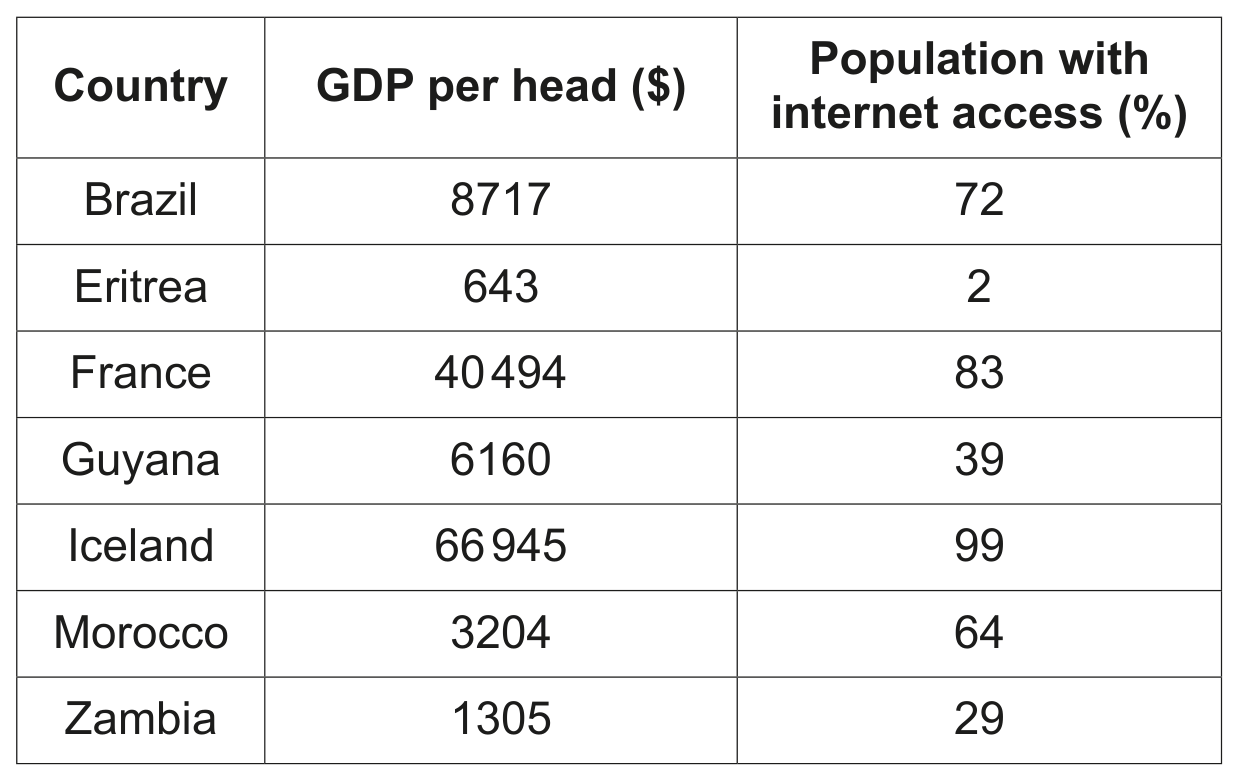
The Guyanese government is planning to use some of the tax revenue it will raise from oil to spend on education and improvements to the country's infrastructure. Planned projects include new railway lines and stations. A more extensive and cheaper rail service may enable more people to work further from home and may influence the market for substitutes, such as car transport. The Guyanese government is also planning to spend some of the tax revenue on improving the country's access to the internet. Table 1.1 shows GDP per head and internet access in seven countries in 2020.

Table 1.1 GDP per head and internet access in selected countries in 2020

Table 1.1 GDP per head and internet access in selected countries in 2020

Guyana has experienced a slow growth in its population size in recent years. In 2020, its birth rate was 16.5 , its death rate was 6.8 and its net migration rate was -7.7 . With increases in oil production, emigration may decline and the country may start to experience net immigration. A higher population may affect Guyana in a number of ways including changing the size of its labour force and affecting the environment.

Discuss whether or not the discovery of oil is likely to increase living standards in Guyana.

Question 1(f)

[Maximum number: 5]

Read the source material carefully before answering Question 1.
Source material: Will Honduras become a more successful economy?

Table

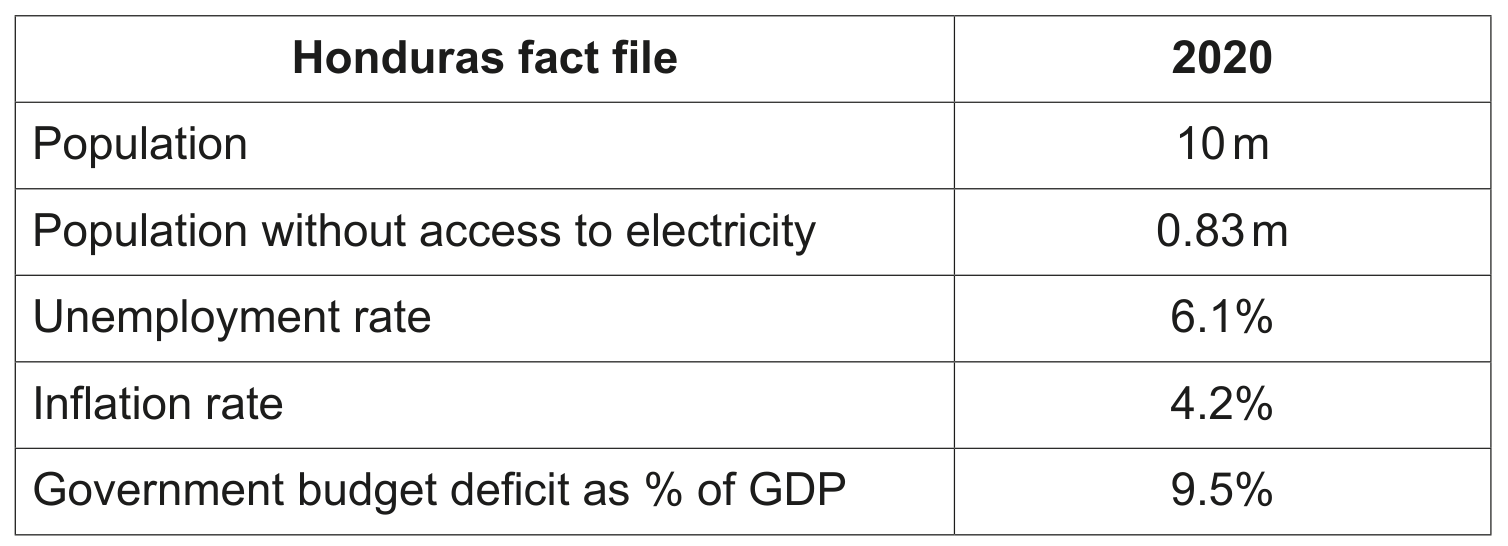
Honduras is a lower middle-income country which relies heavily on trade with the US. More than half of Honduran exports go to the US and 40\% of its imports come from the US. A high number of Hondurans work in the US and send money back home to their relatives.

Honduras used to concentrate on growing bananas and coffee, gaining skills and a good reputation in those industries. Now, Honduras produces a greater range of products including clothes, chemicals and paper. This diversification has reduced the uncertainty arising from sudden changes in demand and supply. For example, tariffs could be imposed on Honduran coffee or there could be a report stating that eating bananas is good for health.

While employment is declining in agriculture, it is increasing in the clothes industry in Honduras. Training for workers in the clothes industry is expected to increase and working conditions to improve. The firms are also using more capital goods. It is, however, uncertain what will happen to the prices of cotton, wool and other materials used to make clothes.

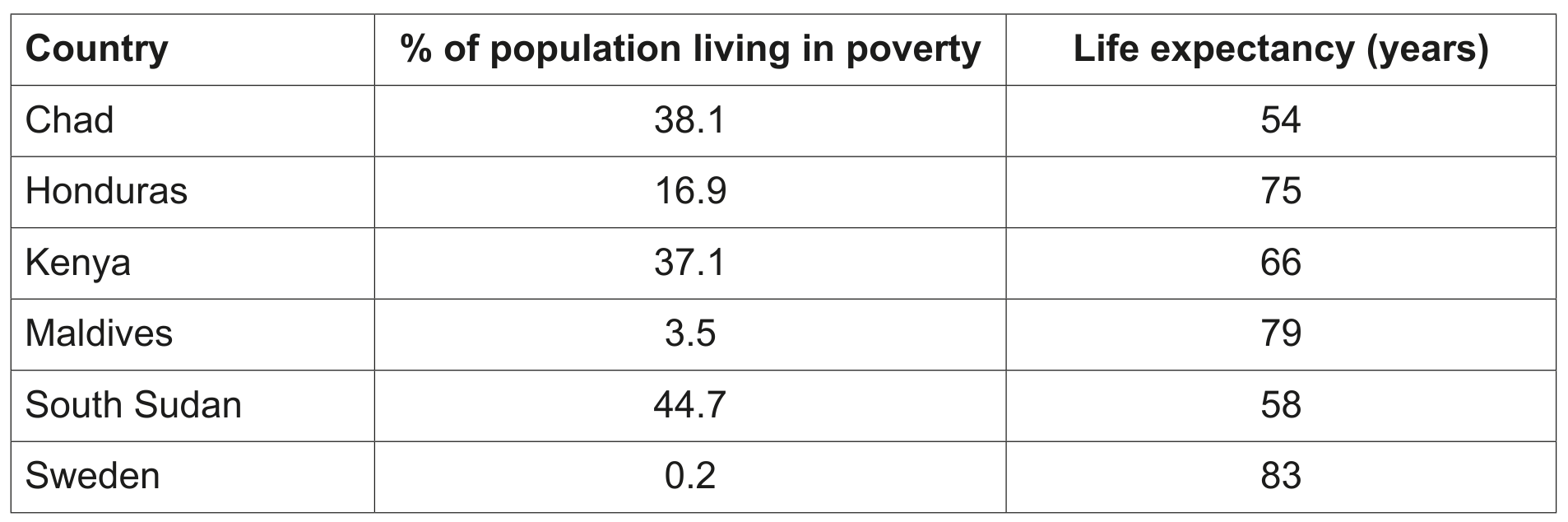
A successful clothes industry has the potential to reduce poverty in Honduras. The Honduran government tries to reduce poverty by, for example, providing unemployment benefit. A major reason for the government seeking to lower poverty is to increase life expectancy. Table 1.1 shows levels of poverty (percentage of population living on less than $1.90 a day) and life expectancy in selected countries.

Table 1.1 Percentage of population living in poverty and life expectancy in selected countries

Table 1.1 Percentage of population living in poverty and life expectancy in selected countries

A more successful Honduran economy would raise incomes. The country has a progressive income tax system, so there could be a significant rise in tax revenue. A more successful economy would also be likely to encourage more investment. Unemployment would be expected to fall which, in turn, could influence consumer spending.

Analyse the relationship between the percentage of population living in poverty and life expectancy.

Question 1(g)

[Maximum number: 6]

Read the source material carefully before answering Question 1.

Source material: The United Arab Emirates (UAE)

Source material: The United Arab Emirates (UAE)

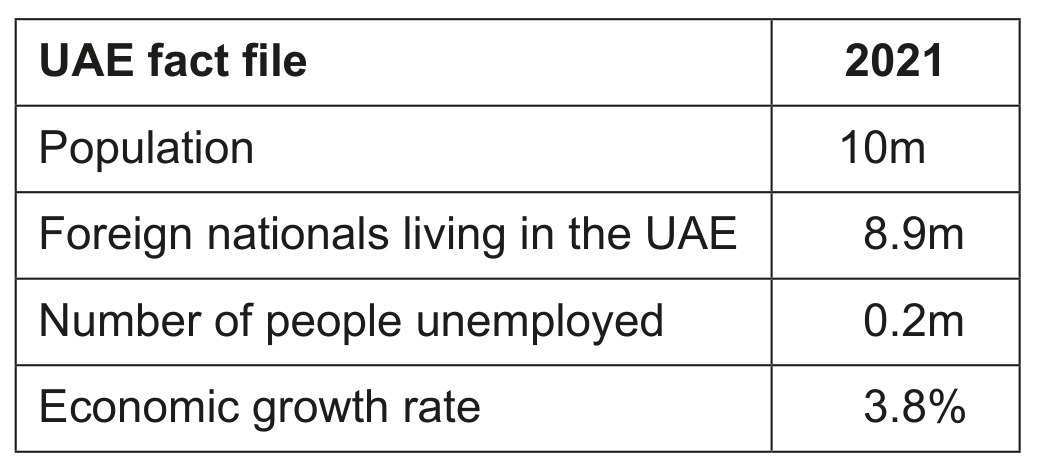
The number of foreign nationals living in the UAE is higher than the number of citizens of the UAE. Labour mobility between the UAE and other countries is high with, for example, many daily flights landing in the UAE from India and Pakistan.

The UAE was the host of the World Expo in 2021-2022 where countries from all over the world demonstrated their economic achievements. The increased connection of people through migration, the trade of goods and services and the sharing of ideas were major features of the World Expo. Another common theme that was presented in the World Expo was the technological progress which has improved global living standards. Technological development has increased both the quality and quantity of the factors of production in the UAE.

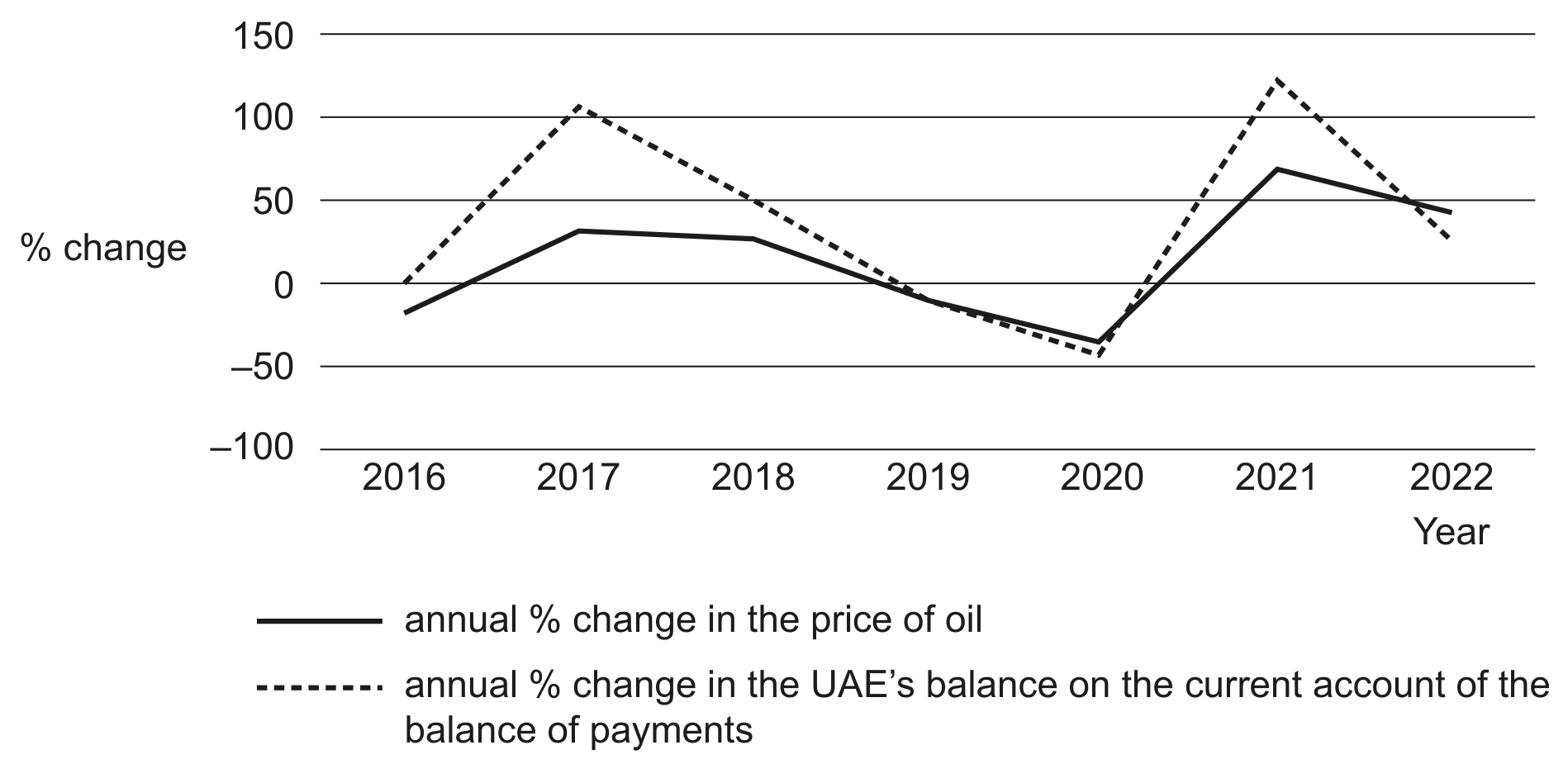
This technological progress was supported by a huge amount of finance gained from their oil production and exports of oil. Oil is a necessity and its price inelasticity of demand has brought both advantages and disadvantages to the economy. Figure 1.1 shows the annual percentage change in the oil price and the annual percentage change in the UAE's balance on the current account of the balance of payments.

Figure 1.1 Annual percentage change in the price of oil and the annual percentage change in the UAE's balance on the current account of the balance of payments 2016-2022

Figure 1.1 Annual percentage change in the price of oil and the annual percentage change in the UAE's balance on the current account of the balance of payments 2016-2022

Dubai, one of the cities in the UAE, is not dependent on oil as 95%95 \% of its economy is non-oil based. Dubai is known internationally for its luxury tourism and financial services, which affect employment, tax revenues and export revenues. However, there are concerns over sustainable water use in a desert area and the level of inequality in the distribution of income.

Despite rapid changes in the economy, the value of the domestic currency, the dirham, has always been very stable as the government has maintained a fixed exchange rate system since 1980. This has helped maintain investor confidence in the economy. However, a fixed rate exchange rate affects the government's ability to deliver other macroeconomic objectives.

Discuss whether or not luxury tourism and financial services have helped Dubai achieve economic development.

Question 2(b)

[Maximum number: 4]

Unemployment in the United Kingdom (UK) fell in December 2021 to 4.1\%. Market forces would usually mean that wages would increase due to this lower unemployment. However, workers' living standards did not increase. New international trade deals were not made fast enough to offset the decreasing trade between the UK and the European Union.

Explain two factors that could influence living standards, apart from unemployment rates.

Question 2(b)

[Maximum number: 4]

The shape of Colombia's population pyramid is changing. The income distribution of this South American country, however, is not changing significantly. The country has one of the most unequal income distributions in the world. Some Colombians work in its footwear industry which produces shoes, sandals and boots. Although footwear is produced in the private sector, Colombia has a mixed economic system.

Explain two reasons why income may become more unevenly distributed.

Question 3(c)

[Maximum number: 6]

In 2019, India became the world's largest producer of sugar. Sugar cane is grown in the country by a large number of mainly low-income farmers. They sell sugar cane to mills which process the sugar cane into sugar. Processing the sugar cane is more capital-intensive than growing it. The Indian government sets a minimum price for sugar cane and subsidises the export of sugar.

Analyse why low-income farmers are likely to have low living standards.

Question 4(d)

[Maximum number: 8]

In the US, the supply of meat from emus, a large bird, is price-elastic. Recently, US farmers have switched to keeping other livestock and growing crops that changed their demand for labour. US farmers are influenced by the subsidies the government provides for the production of selected food items. Some people are reluctant to become farm workers as they think living standards are low in rural areas.

Discuss whether or not people living in cities have a higher living standard than those living in rural areas.

Question 4(c)

[Maximum number: 6]

In 2021, there were extensions and contractions in demand for a number of South African products. In that year, a South African court stopped a multinational company (MNC) exploring for oil along South Africa's coastline. South Africa experienced an increase in output, driven largely by the growth in its tertiary sector. However, its unemployment rate was 35%, a long way from full employment.

Analyse how growth in a country's tertiary sector can increase its living standards.

Question 4(b)

[Maximum number: 4]

In 2022, more than a quarter of a million workers, including doctors, left Sri Lanka to work in other countries. This was largely due to economic problems, including an inflation rate of 50% and a concern that unemployment might rise. The Sri Lankan Government increased direct taxation. It also encouraged some public sector workers to work abroad temporarily. People who work abroad often send money home to relatives.

Explain two ways that money received from relatives working abroad could raise their families' living standards.

0 selected