Question 1(c)
Read the source material carefully before answering Question 1.
Source material: some problems affecting the Greek economy
Greece is the country that was worst affected by the European financial crisis that began in 2008. From the start of the crisis, no other European economy had such a large percentage fall in GDP. Greece's GDP fell by in 2011 . One reason for this was a very strong foreign exchange rate.
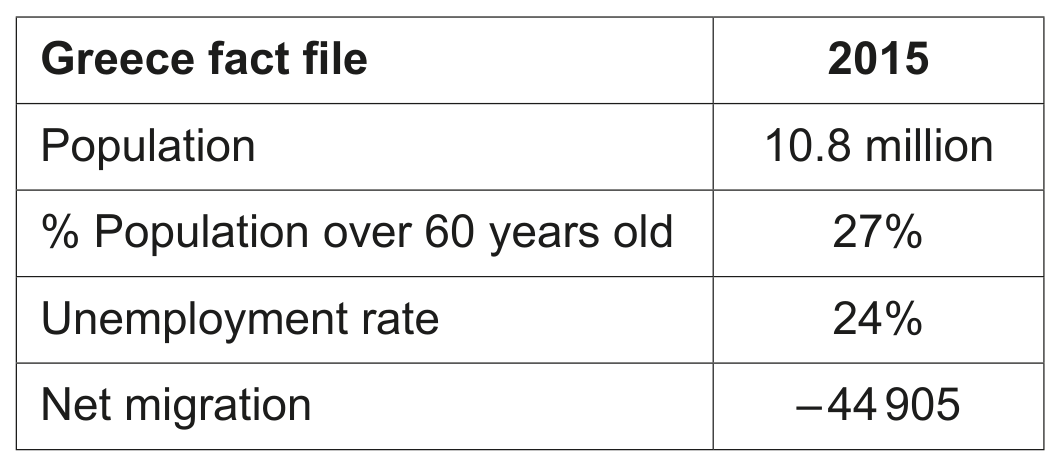
Since 2014, other European economies have recorded positive economic growth rates. Among the reasons for this were successful supply-side policy measures and an improving global economy. The Greek government introduced market-friendly measures, including privatisation and labour market reforms. These measures brought back some investors and moved the Greek economy closer to a market economic system. However, Greece's output still fell. This may be due to the fact that none of the government policies have managed to change population trends.
The Greek population has been falling since 2010 . Greece has the third most rapidly ageing population in the world, behind Japan and Italy. The economy has not made good use of its older population because a significant percentage of workers retire earlier than the national retirement age of 67. For example, of employees in the public sector retire before 61 years old. In addition, the crisis also led to high levels of emigration.
However, those living on some Greek islands have escaped the effects of the crisis. Income from tourism has continued to flow into the islands. An island called Ikaria has also managed to gain international attention as one of the healthiest places in the world. Approximately of the people who live on this island, live until they are over 90 . Health problems are also much less frequent than those living elsewhere. Overall, however, Greece has managed to improve its Human Development Index (HDI) value as shown in Fig. 1.
Identify two reasons for the recovery of the European economies, other than Greece.