
EduNinja

IGCSE Economics4.5.4—Causes and consequences of recessionTopic Practice

4.5.4—Causes and consequences of recession

• definition of recession

• how a recession may be caused by a decrease in total demand, a decrease in the quantity of resources or a decrease in the quality of resources

• consequences of recession for consumers, workers, producers/firms and the government

Question 1(d)

[Maximum number: 4]

Read the source material carefully before answering Question 1.
Source material: Changes in Ecuador's economy

Source material: Changes in Ecuador's economy

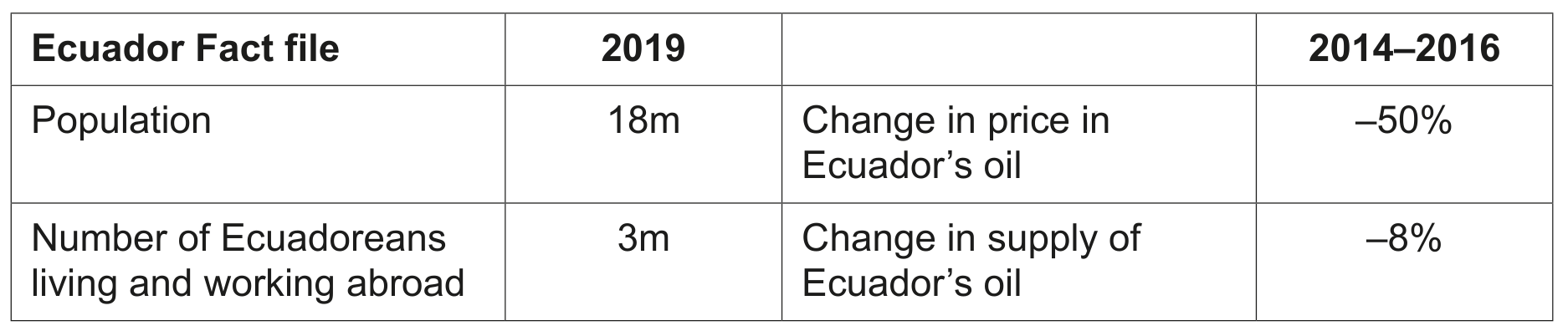
Oil makes up one third of Ecuador's exports. Ecuador has, however, decided to produce less oil and more of other goods and services. This decision has affected how products are made in Ecuador. For example luxury textile production, such as luxury scarves and jumpers, uses fewer capital goods than oil production. Tourism relies on natural resources including sunshine and beaches.

One reason Ecuador's government has encouraged less reliance on oil, is the large changes that often occur in the oil market. Between 2014 and 2016, demand for Ecuador's exports fell which caused a significant reduction in export revenue. This reduction, combined with a decrease in government spending, caused the country's output to decline.

Between 2016 and 2019, there was some improvement in Ecuador's economy. Incomes and household spending increased and more cars were purchased. Table 1.1 shows the GDP per head ($) and car ownership (per 1000 people) in selected countries in 2019.
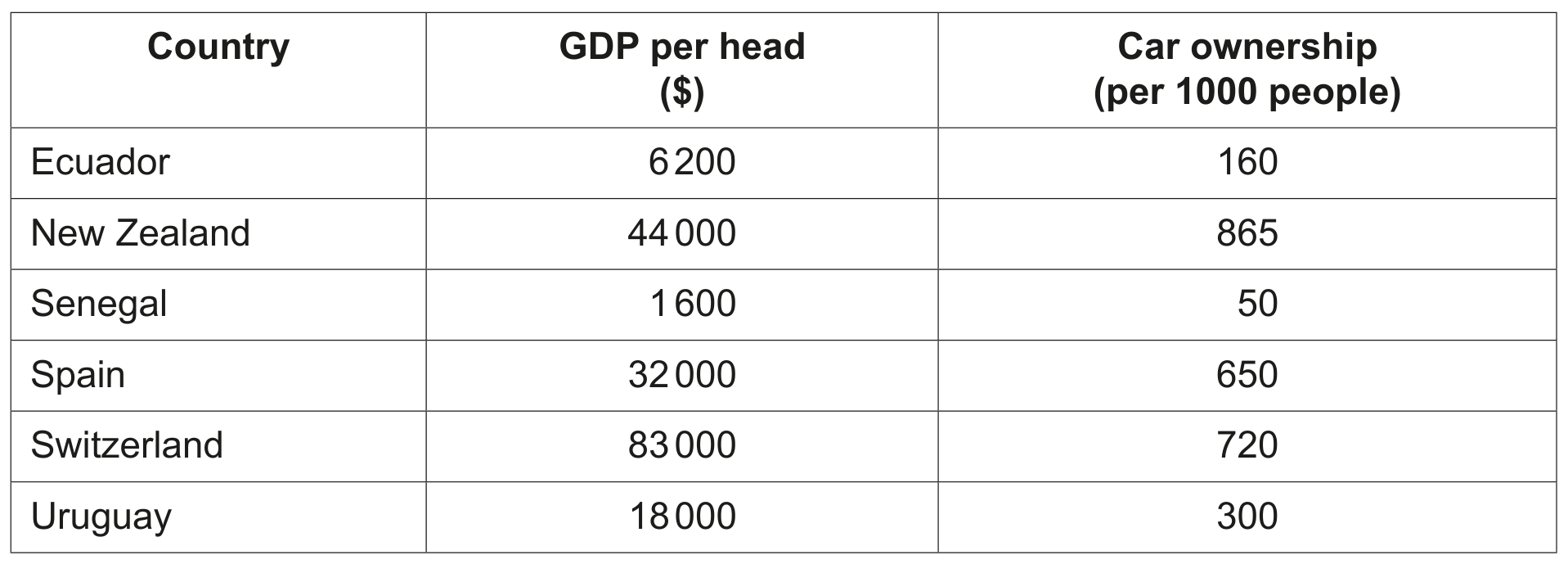
Table 1.1 GDP per head (\$) and car ownership (per 1000 people) in selected countries 2019

Table 1.1 GDP per head (\$) and car ownership (per 1000 people) in selected countries 2019

Ecuador's government borrowed from China to spend on building more roads. The construction of these roads increased employment and was expected to influence transport costs in the long run.

Between 2016 and 2019, Ecuador's textile industry benefited from the improvement in the road network. Despite strong competition from foreign textile firms, Ecuador's textile firms increased the scale of their production. Wages paid in the textile industry did not rise significantly. A very small wage increase can affect trade union activity and emigration.

Some of Ecuador's workers emigrate to find jobs in other countries, particularly Italy, Spain and the US. These workers have a range of skills and they work in a variety of jobs abroad, some of which provide training. Many, but not all, workers send money home to their families.

Explain two reasons why Ecuador experienced a recession between 2014 and 2016.
Question 20

[Maximum number: 1]

What may cause a recession?

A

an increase in consumer spending

B

an increase in government spending

C

an increase in imports

D

an increase in investment

Question 4(b)

[Maximum number: 4]

After the recession that struck Albania in 2013, the country experienced a significant rise in emigration. Albanian workers and students in other countries have expressed little desire to return. However, the government is trying to implement policy measures that could attract more people to return to the country.

Explain two causes of a recession.

Question 4(a)

[Maximum number: 2]

Tajikistan is one of Asia's low-income countries. Its currency, the somoni, has the key characteristics of money. More than one million Tajik people work abroad, mostly in Russia. In 2020, the Tajik government was concerned that the country's economy might experience a recession which could cause a fall in tax revenue. Despite this possibility, some Tajik firms bought new capital equipment.

Identify two reasons why tax revenue is likely to fall during a recession.

Question 21

[Maximum number: 1]

Brazil's real GDP fell by 3.8% in a year.
What might have caused this?

A

a decrease in imports

B

a decrease in income tax

C

an increase in interest rates

D

an increase in output per worker

Question 23

[Maximum number: 1]

Why would standards of living fall when there is a recession?

A

The government would increase taxes to combat the recession.

B

The purchasing power of households would fall.

C

The value of the domestic currency would increase.

D

There would be a rise in the level of immigration.

Question 5(b)

[Maximum number: 4]

In 2020, the price of gold fell in Vietnam. That year, Vietnam was one of Asia's best performing economies. Unlike some Asian economies, Vietnam did not experience a recession. Its total output, exports and imports all increased. Unemployment did increase from 2.0% to 2.3% but remained very low. One of the aims of fiscal policy can be to achieve full employment.

Explain two disadvantages of a recession.

Question 27

[Maximum number: 1]

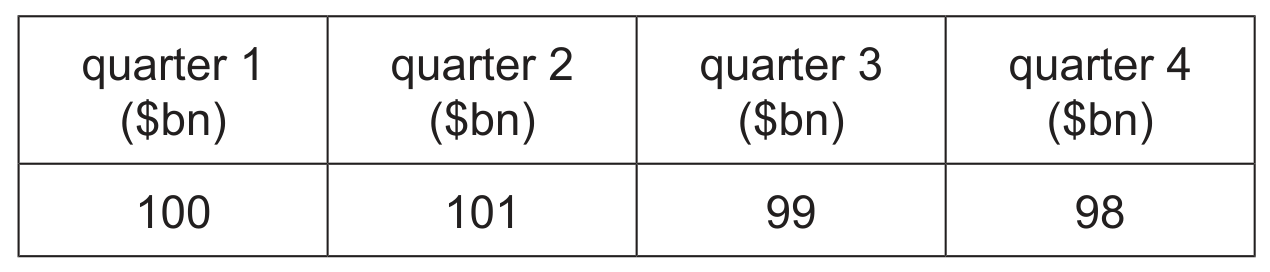
The table shows figures for the real GDP of a country in a particular year.

Table

A quarter is three months.
At the end of which quarter had the economy experienced a recession?

A

quarter 1

B

quarter 2

C

quarter 3

D

quarter 4

Question 29

[Maximum number: 1]

What is not likely to cause a recession?

A

a government reducing its spending

B

a natural disaster caused by climate change

C

mining a new source of a useful metal

D

problems with global supply of raw materials

0 selected