IB Physics SL B.2.8 Infrared Absorption

Practise explaining selective absorption of Earth's outgoing infrared radiation through molecular energy levels, followed by re-emission in random directions including towards…

Syllabus
First assessment 2025
Objective
Level
SL

Exam points

  • identify outgoing long-wave infrared, rather than incoming visible sunlight, as the main absorbed radiation
  • match photon energy or frequency to molecular vibrational or rotational energy-level differences
  • explain random re-emission so part of the absorbed energy returns towards Earth's surface

B.2.8—Infrared absorption question 1

[Maximum number: 2]

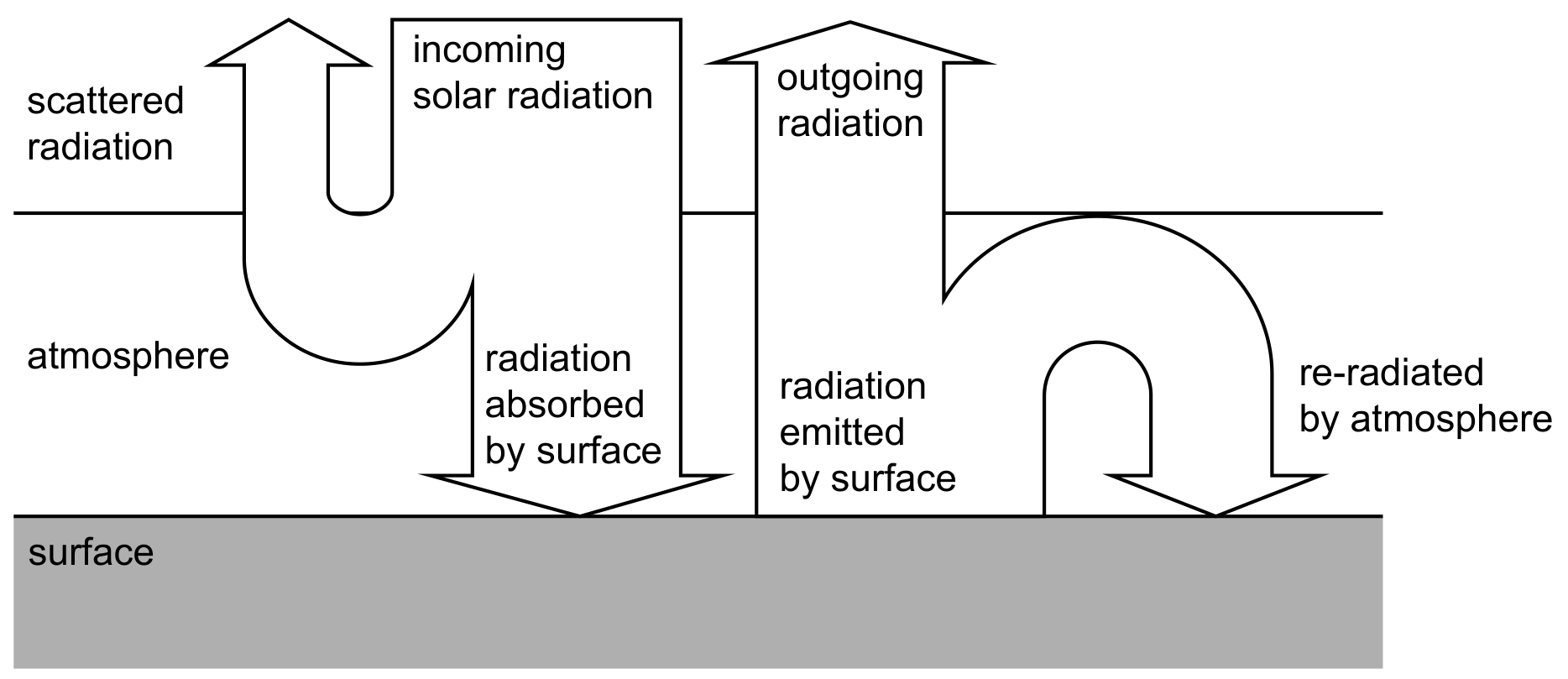
The diagram shows a simplified energy-balance model for the Earth surface–atmosphere system.

Figure for Question B.2.8—Infrared absorption question 1 — IB Physics SL

The following data are given:

 Average albedo of Earth =0.30 Average global temperature of the surface =288 K Average Earth-Sun distance =1.5×10¹¹ m\begin{aligned} \text { Average albedo of Earth } & =0.30 \\ \text { Average global temperature of the surface } & =288 \mathrm{~K} \\ \text { Average Earth-Sun distance } & =1.5 \times 10^{11} \mathrm{~m} \end{aligned}

Outline the physical mechanism by which some of the radiation emitted by the surface is absorbed by greenhouse gases in the atmosphere and re-radiated towards the surface.

All question bank results loaded