
EduNinja

3.1 Measuring economic activity and illustrating its variations Topic Practice

3.1 Measuring economic activity and illustrating its variations Topic Practice
IB Economics syllabusEconomics SL/HLFirst assessment 2025

Students practise calculating national income aggregates, converting units, and interpreting real GDP per capita as a limited but widely used welfare indicator.

Exam points

  • calculate real GDP per capita in USD from nominal GDP, deflator, and exchange rates
  • explain why real GDP per capita omits unpaid work, inequality, and pollution costs
  • outline how income sums factor earnings while expenditure sums C, I, G, and net exports

Question 1

[Maximum number: 3]

Read the extracts and answer the questions that follow.
Text A - The economy of Argentina

(1) Argentina, the third-largest economy in Latin America, has experienced several cycles of high economic growth and deep recessions over the last 70 years. It has vast natural resources in energy and agriculture and potential for renewable energy. Its leading exports include soybeans and beef products, which contribute significantly to gross domestic product (GDP) and employment and are major sources of foreign currency. However, Argentina faces unfavourable climate conditions that create problems for the agriculture sector. A drought in 2023 caused over 20 billion United States dollars (USD) in losses for soybean farmers.

(2) Argentina faces high relative poverty rates despite redistribution policies such as transfer payments. Argentina is known for extensive government intervention, including price ceilings on rent and strong protection for labour unions and workers.

(3) For many years, Argentina managed its exchange rate by limiting the amount of foreign currency that citizens could purchase as well as by restricting imports. The aim was to protect reserve assets and prevent currency depreciation. This led to the establishment of an informal (unofficial) foreign exchange market and discouraged foreign direct investment (FDI). However, the foreign currency limitations resulted in an overvalued currency and failed to stop the level of reserve assets from decreasing.

(4) In 2018, Argentina requested a loan from the International Monetary Fund (IMF) to help fund its budget deficit and large external debt repayments. However, Argentina defaulted on its debt repayments to the IMF, which led to low consumer and business confidence, causing large FDI and portfolio investment outflows. To receive future loans, the IMF requires Argentina to promote good governance, reduce government spending, increase reserve assets and control inflation.

(5) In 2022, Argentina's economic challenges continued with high inflation and a persistent budget deficit, leading to unsustainable debt. High inflation has led to declining real wages. Moreover, uncertainty about future prices has contributed to lower business investment.
Text B - Argentina's new economic reforms

(1) In December 2023, Argentina's new government initiated reforms to help solve its economic challenges. The new economic reforms included:
- deregulating markets, such as removing price controls and restrictions on buying foreign currency
- privatization of 41 state-owned enterprises to improve efficiency, including the national airline, rail networks, state media, and major oil, water and sewage companies
- increasing labour market flexibility by reducing labour union power and lowering labour costs
- reducing government spending by cancelling infrastructure projects, reducing the size of the public sector and eliminating transport and energy subsidies.

(2) The immediate result of removing restrictions on foreign currency purchases was a large depreciation of the Argentine peso (ARS), Argentina's currency, as predicted by speculators. Moreover, inflation increased to over 250 %. The new government maintained that while the reforms may cause a short-term recession, the policies would ultimately lead to long-term price stability and economic growth, despite predictions that relative poverty rates could increase to 60 %. However, the government has stated it will continue spending on programmes to decrease poverty.

(3) To address the budget deficit and maintain a trade surplus, the government increased taxes on cigarettes and imposed tariffs on imports such as laptops. Income taxes were increased, but the level of income on which no income tax is paid was raised from ARS 1.35 million to ARS 1.55 million per month.

(4) The IMF supported the reforms and agreed to grant future loans to Argentina. The loans are important to establish international credibility and finance government spending.
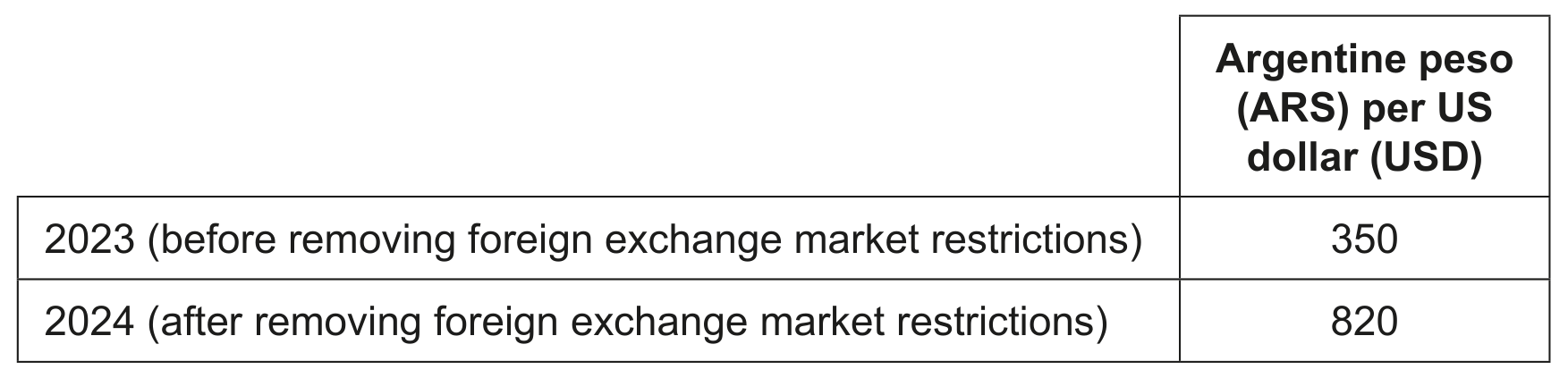
Table 1: Argentina's exchange rates

Table 1: Argentina's exchange rates

Text C - Education and productivity in Argentina
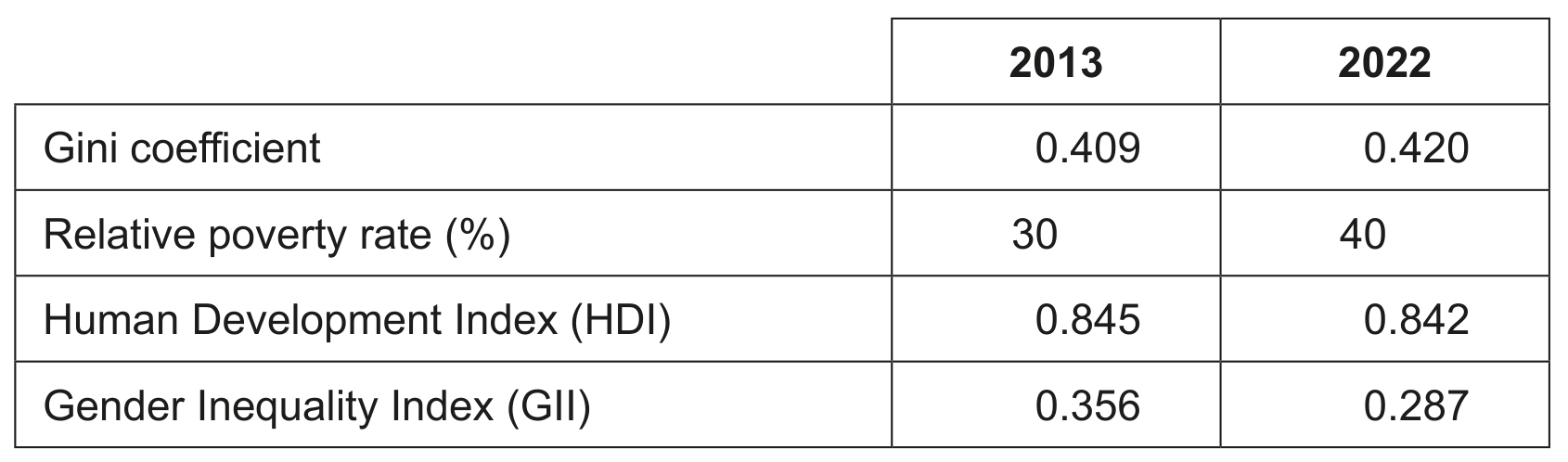
Despite significant investments in education, achievement levels are not improving. Experts recommend that Argentina focus on improving the quality of education to decrease poverty rates and increase the economy's productive capacity. Additionally, Argentina's low female labour force participation rate indicates an underutilized resource. An improved education system could increase female participation in the economy and raise household incomes.
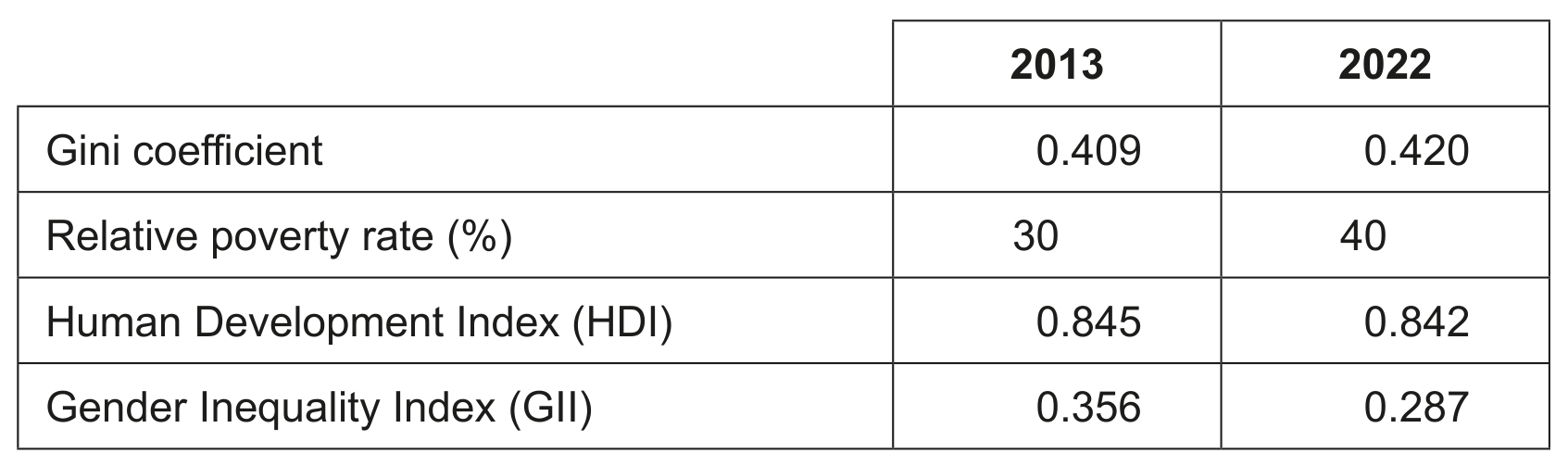
Table 2: Development data for Argentina
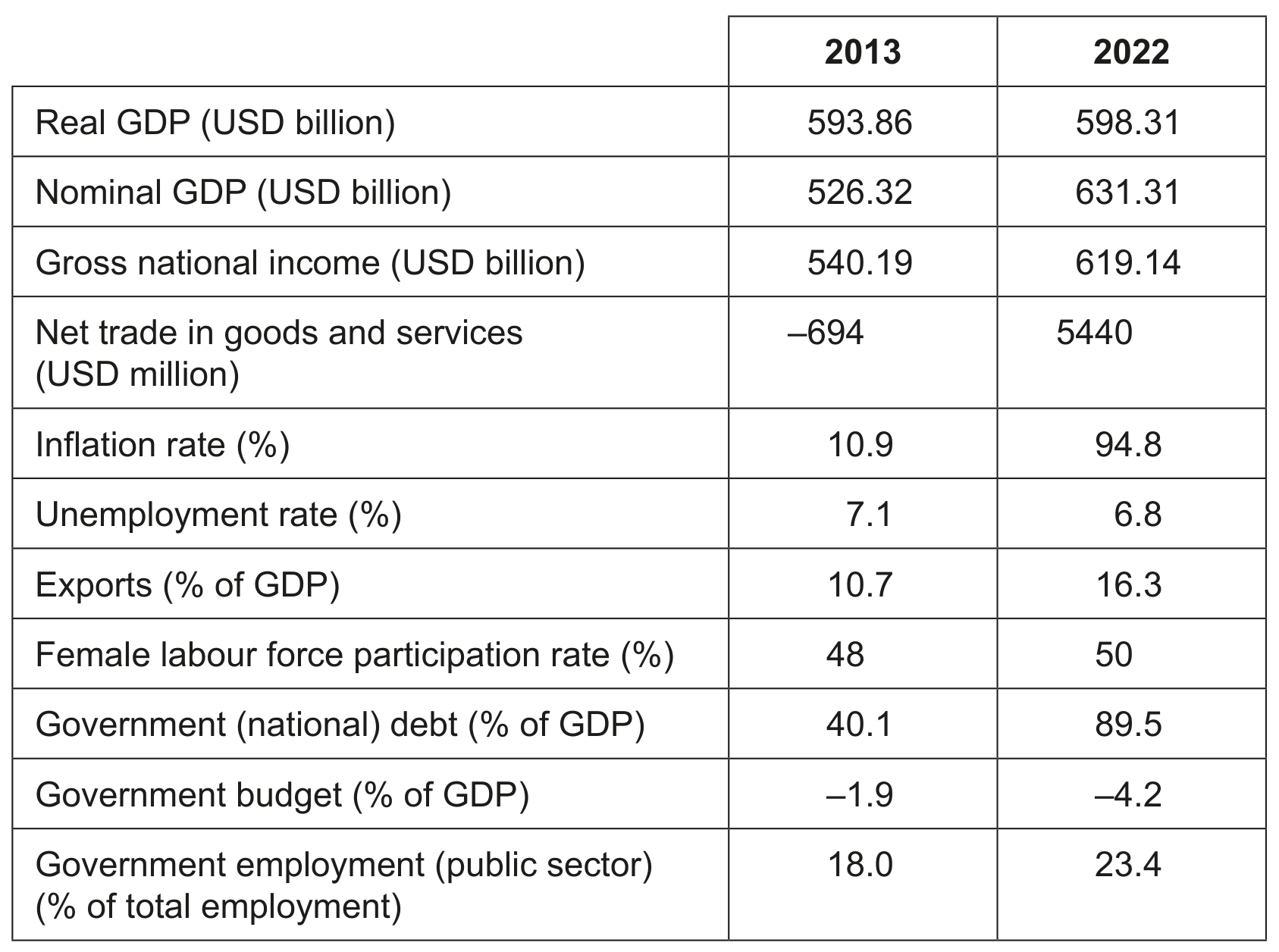
Table 2: Development data for Argentina

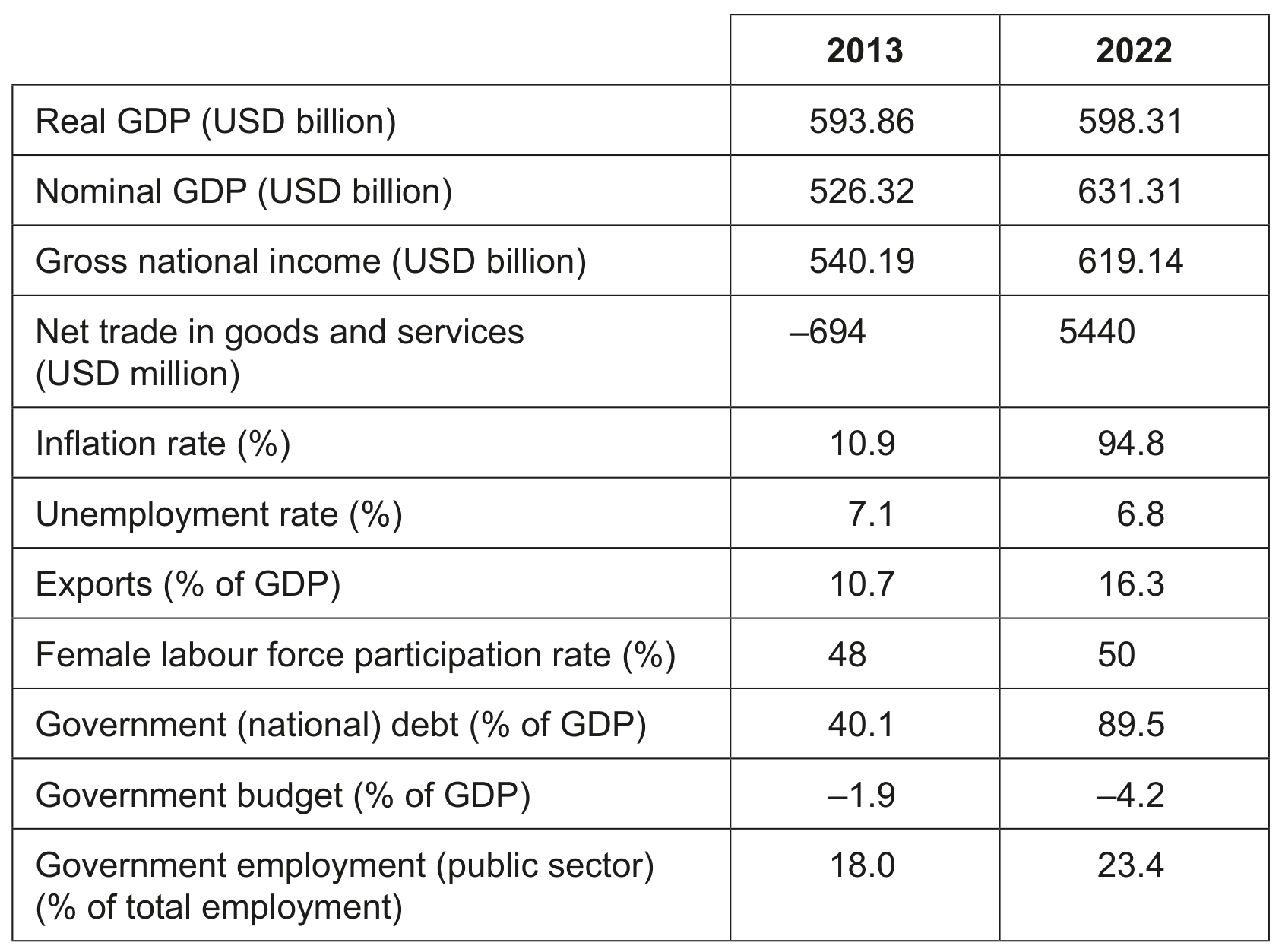
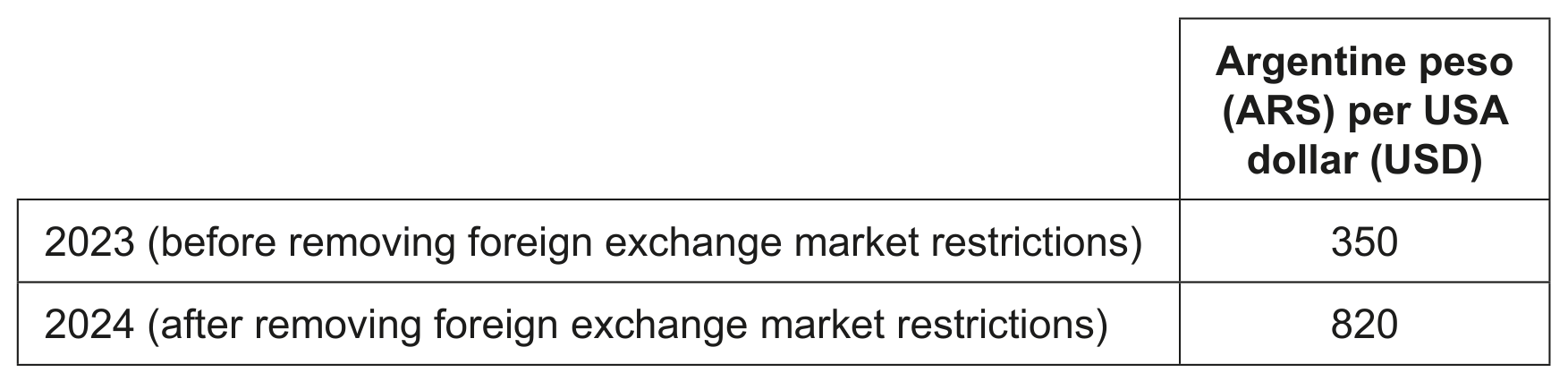
Table 3: Economic data for Argentina

Table 3: Economic data for Argentina

Question 1(b)(i)

(a)

Using the data provided in Table 3, calculate the GDP price deflator for 2022.

[ 2 ]

Question 1(b)(ii)

(b)

Using your answer to part (b) (i), determine the percentage change in prices from the base year.
[ 1 ]

Question 1(b)(ii)

[Maximum number: 3]

Read the extracts and answer the questions that follow.
Text A - The economy of Argentina

(1) Argentina, the third-largest economy in Latin America, has experienced several cycles of high economic growth and deep recessions over the last 70 years. It has vast natural resources in energy and agriculture and potential for renewable energy. Its leading exports include soybeans and beef products, which contribute significantly to gross domestic product (GDP) and employment and are major sources of foreign currency. However, Argentina faces unfavourable climate conditions that create problems for the agriculture sector. A drought in 2023 caused over 20 billion United States dollars (USD) in losses for soybean farmers.

(2) Argentina faces high relative poverty rates despite redistribution policies such as transfer payments. Argentina is known for extensive government intervention, including price ceilings on rent and strong protection for labour unions and workers.

(3) For many years, Argentina managed its exchange rate by limiting the amount of foreign currency that citizens could purchase as well as by restricting imports. The aim was to protect reserve assets and prevent currency depreciation. This led to the establishment of an informal (unofficial) foreign exchange market and discouraged foreign direct investment (FDI). However, the foreign currency limitations resulted in an overvalued currency and failed to stop the level of reserve assets from decreasing.

(4) In 2018, Argentina requested a loan from the International Monetary Fund (IMF) to help fund its budget deficit and large external debt repayments. However, Argentina defaulted on its debt repayments to the IMF, which led to low consumer and business confidence, causing large FDI and portfolio investment outflows. To receive future loans, the IMF requires Argentina to promote good governance, reduce government spending, increase reserve assets and control inflation.

(5) In 2022, Argentina's economic challenges continued with high inflation and a persistent budget deficit, leading to unsustainable debt. High inflation has led to declining real wages. Moreover, uncertainty about future prices has contributed to lower business investment.
Text B - Argentina's new economic reforms

(1) In December 2023, Argentina's new government initiated reforms to help solve its economic challenges. The new economic reforms included:
- deregulating markets, such as removing price controls and restrictions on buying foreign currency
- privatization of 41 state-owned enterprises to improve efficiency, including the national airline, rail networks, state media, and major oil, water and sewage companies, many of which were recording losses and burdening the government budget
- increasing labour market flexibility by reducing labour union power and lowering labour costs
- reducing government spending by cancelling infrastructure projects, reducing the size of the public sector and eliminating transport and energy subsidies.

(2) The immediate result of removing restrictions on foreign currency purchases was a large depreciation of the Argentine peso (ARS), Argentina's currency, as predicted by speculators. Moreover, inflation increased to over 250 %. The new government maintained that while the reforms may cause a short-term recession, the policies would ultimately lead to long-term price stability and economic growth, despite predictions that relative poverty rates could increase to 60 %. However, the government has stated it will continue spending on programmes to decrease poverty.

(3) To address the budget deficit and maintain a trade surplus, the government increased taxes on cigarettes and imposed tariffs on imports such as laptops. Income taxes were increased, but the level of income on which no income tax is paid was raised from ARS 1.35 million to ARS 1.55 million per month.

(4) The IMF supported the reforms and agreed to grant future loans to Argentina. The loans are important to establish international credibility and finance government spending.

Table 1: Argentina's exchange rates

Table 1: Argentina's exchange rates

Text C - Education and productivity in Argentina
Despite significant investments in education, achievement levels are not improving. Experts recommend that Argentina focus on improving the quality of education to decrease poverty rates and increase the economy's productive capacity. Additionally, Argentina's low female labour force participation rate indicates an underutilized resource. An improved education system could increase female participation in the economy and raise household incomes.

Table 2: Development data for Argentina

Table 2: Development data for Argentina

Table 3: Economic data for Argentina

Table 3: Economic data for Argentina

Sketch a business cycle diagram and indicate a period of economic growth and a period of recession on the diagram (Text A, paragraph 1).

Question 2(b)

[Maximum number: 15]

Using real-world examples, discuss the usefulness of real gross domestic product (GDP) per capita in comparing economic well-being between countries.

Question 2(b)(ii)

[Maximum number: 1]

Read the extracts and answer the questions that follow.
Text D - Overview of Papua New Guinea

(1) Papua New Guinea (PNG) consists of hundreds of small islands near Australia. Over 50 % of the labour force is employed in agriculture, forestry and fishing. The extraction sector, which mines non-renewable minerals (gold and copper) and extracts energy products (oil and gas), provides 30 % of the gross domestic product (GDP). The mining operations, usually carried out by foreign-owned firms, sometimes cause environmental damage and disputes over land rights.

(2) The lack of substitutes and the difficulty of extracting gold, copper and gas cause both global demand and supply to be price inelastic. Consequently, changes in global demand result in volatile prices, which lead to macroeconomic instability because the extraction sector in PNG is so large. Fiscal policies have been unable to reduce the business cycle fluctuations. Tax revenue has declined as a percentage of GDP partly due to lower commodity prices and thus business tax revenue. The government could get more revenue from the extraction sector through ownership or part-ownership of the firms. Alternatively, taxes on the use of natural resources or higher business taxes could be imposed. However, such revenues are unpredictable and probably unsustainable.

(3) After the rapid depreciation of the Papua New Guinea kina (PGK), PNG's currency, between 2012 and 2015, the central bank moved away from a floating exchange rate system to a managed exchange rate system. It used reserve assets in the foreign exchange market to prevent excessive currency depreciation, thereby lowering cost-push inflationary pressures. However, this intervention caused the PGK to become an overvalued currency. Therefore, the International Monetary Fund (IMF) recommended less intervention in the foreign exchange market so the PGK would gradually depreciate.

(4) Official development assistance (ODA) is providing funds and technical assistance to improve infrastructure and therefore assist economic growth, which is one of the objectives of aid. The other two objectives are promoting effective governance and improving health and education. The World Bank's aid programme provides advice and funds for investment in human capital, especially for women and children's education. The government provides subsidies for schools, but they are inadequate, and government spending per student has declined due to the growing population. Many women work in the informal sector where they earn lower wages, contributing to rising gender inequality in PNG.

(5) The IMF's aid is in the form of loans at low interest rates. Its programme aims to support growth that also benefits women and minorities, while improving the management of government (national) debt. It sets performance criteria, including reductions in the government's budget deficit.

(6) There is criticism that too much aid is for improving governance and more should be allocated to infrastructure, including transportation networks, water, sanitation and electricity, which is accessible to only 21 % of the population.
Text E - Papua New Guinea's balance of trade

(1) The surplus on PNG's balance of trade in goods is due to the extraction sector, which earns 90 % of its export revenues. Less than 10 % of export revenues come from agriculture, forestry and fishing, although these sectors employ more people. Studies show that PNG exports have a high income elasticity of demand (YED =+3.0 ), but price elasticities of demand are low, particularly for mineral exports such as copper (PED =-0.18 ).

(2) PNG has relatively low tariffs on most imports. However, tariffs on manufactured items, including machinery for palm oil production, were increased in 2019 to protect local manufacturing companies.
Text F - Foreign direct investment and Papua New Guinea

(1) The capital and financial accounts on the balance of payments have large deficits. The outflows are mainly due to the repayment of loans that were used to develop the extraction sector. Most inward foreign direct investment (FDI) has been for mining and energy extraction projects. The FDI inflows fall once the project is completed.

(2) FDI into other sectors is low due to regulations and inadequate infrastructure. The regulations limit certain economic activities and restrict land purchases to PNG citizens and state-owned enterprises. However, increased competition from foreign firms could raise efficiency in some industries.

(3) PNG is setting up special economic zones in certain regions, which provide tax exemptions and eased regulations. The aim is to encourage FDI into tourism and industries that process agricultural and fishing products. Aid agencies recommend using FDI for renewable energy and environmental projects.

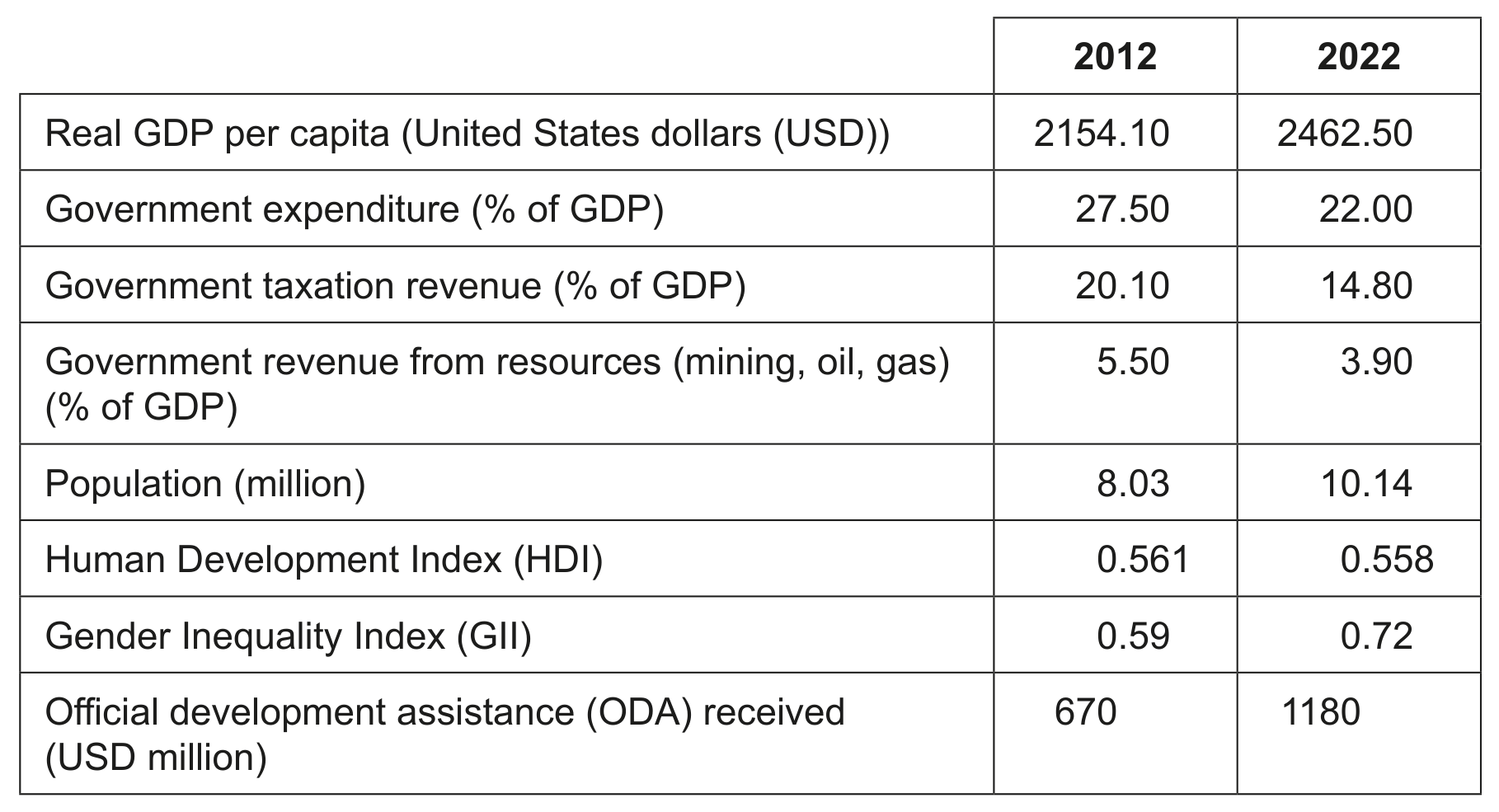
Table 4: Economic and development data for Papua New Guinea

Table 4: Economic and development data for Papua New Guinea

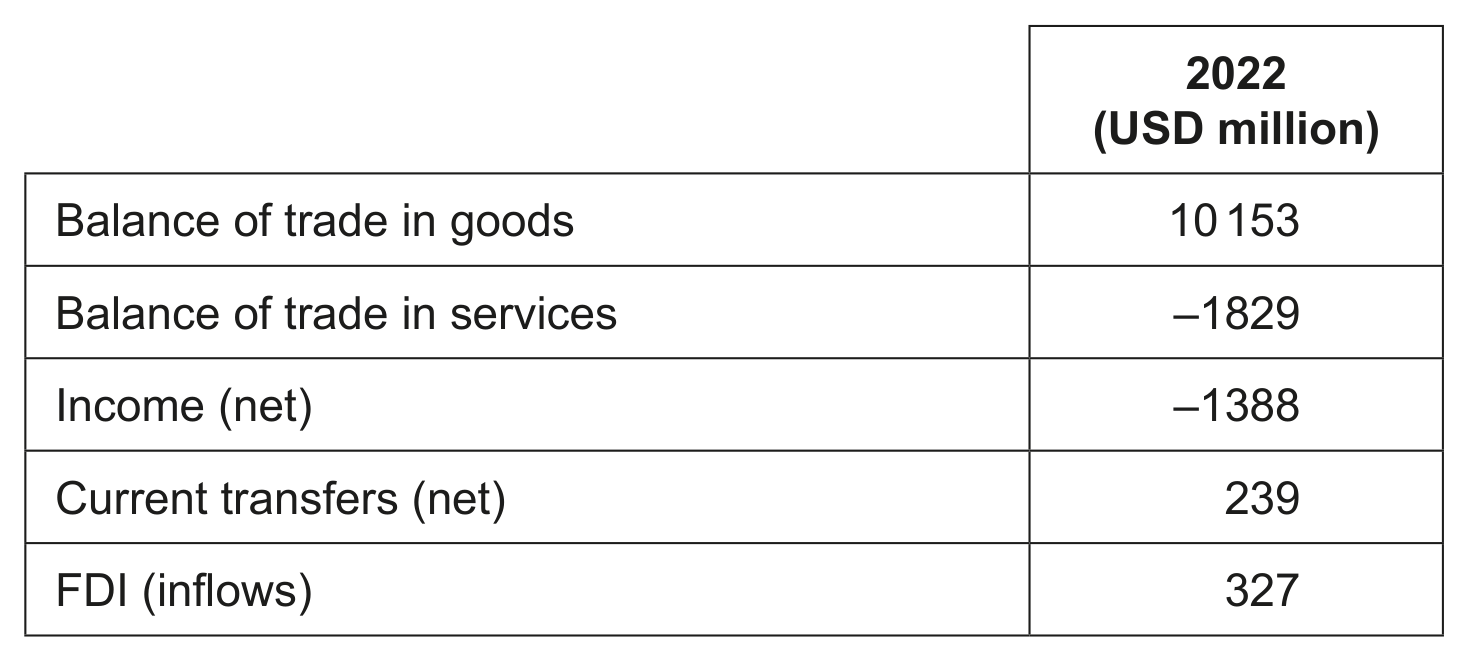
Table 5: Balance of payments data for Papua New Guinea

Table 5: Balance of payments data for Papua New Guinea

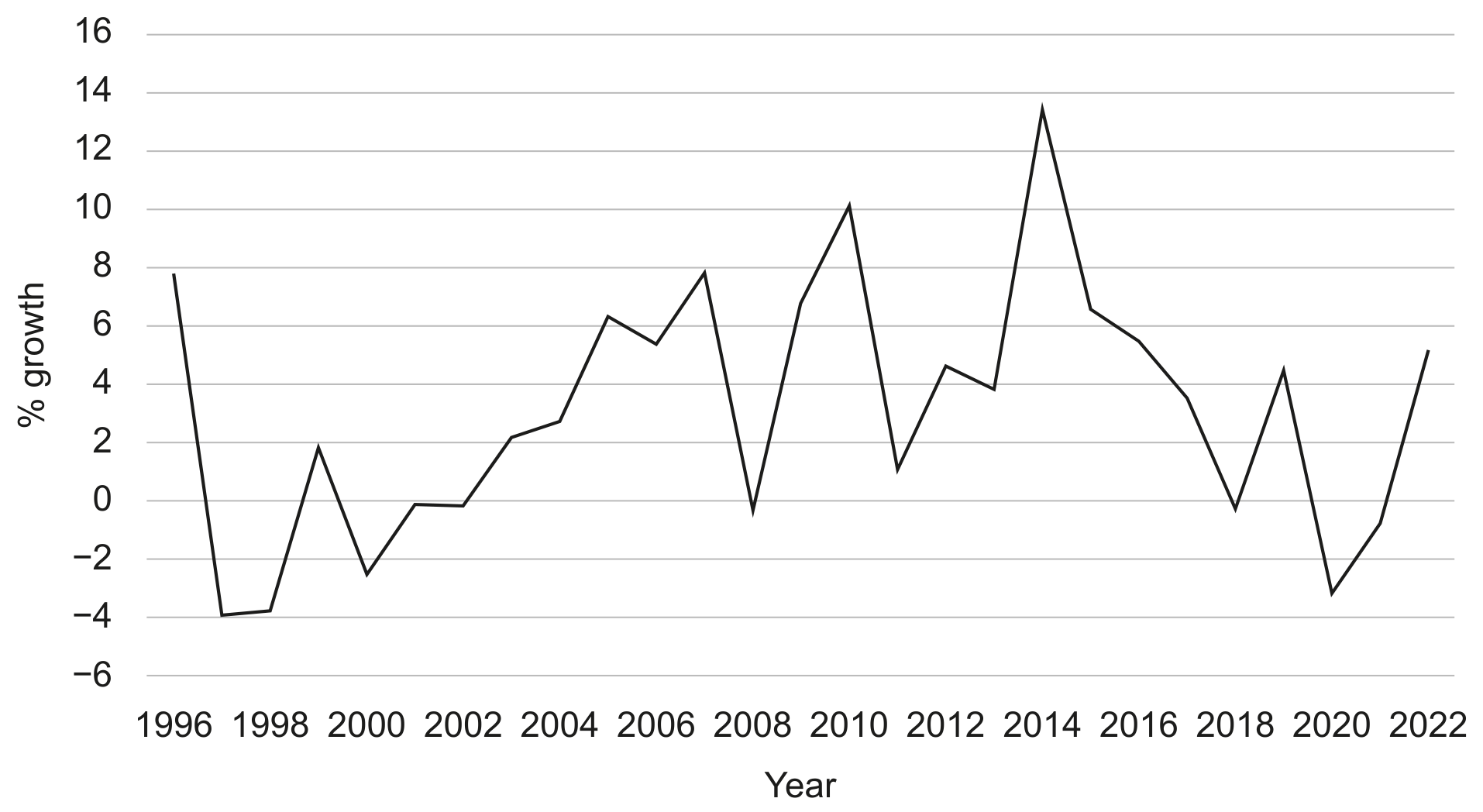
Figure 1: Real GDP annual growth rates in Papua New Guinea between 1996 and 2022

Figure 1: Real GDP annual growth rates in Papua New Guinea between 1996 and 2022

Using information from Table 4, calculate PNG's real GDP in millions of USD in 2022.

Question 2

[Maximum number: 5]

Read the extracts and answer the questions that follow.
Text D - Overview of Bhutan

(1) Bhutan is a lower-middle income country in southern Asia. It is mountainous, water is plentiful, and 60 % of the territory is protected forest. Since 2008, Bhutan has measured its economic development by changes in its "Gross National Happiness" (GNH) index. The index considers factors such as income inequality, environmental conservation, sustainable development, and gender equality, in addition to the components of the Human Development Index (HDI).

(2) The pursuit of GNH has involved using government programmes to spread the benefits of economic growth across all social groups. An example of this is the construction of large hydropower plants, not only for the export of electricity but also to ensure that remote communities can buy power at low prices. Hydropower is a renewable method of producing electricity using the natural flow of water. With these new plants, all rural and urban areas had access to electricity by 2019.

(3) Government intervention in the market for electricity has been necessary due to the high cost of resources. Both the production and distribution of electricity are therefore controlled by state
owned enterprises. Bhutan's government has relied on India for grants and loans to finance hydropower projects.

(4) Sales of surplus electricity to India, amounting to over 70 % of electricity generation in 2021, have increased the funds available to the government for investment in healthcare and education. These revenues have also helped to finance the expansion of essential infrastructure, particularly road networks. The government's aim has been to reduce poverty and to improve well-being, especially in rural areas.

(5) Hydropower has proved to be an important source of economic development. However, the private sector faces a lack of investment for multiple reasons, including high transport costs and a small domestic market. This has limited the creation of new private sector jobs. Furthermore, a sustainability tax of 100 USA dollars (USD) per night for tourists helps with Bhutan's conservation efforts. The tax reduces Bhutan's competitiveness as a tourist destination.

(6) Agriculture is vital to Bhutan's largely rural population. This sector employed 55 % of the workforce in 2021. However, most agricultural produce, such as rice, is consumed by farming households rather than sold in the market. By 2021, the country was importing about 50 % of its food. The growing food demands of urban areas could have negative consequences for the balance of payments.

(7) Agricultural output is constrained by many factors, including a lack of machinery, irrigation and affordable credit. Bhutan's partnership with the United Nations International Fund for Agricultural Development has provided funds for investment in the agricultural sector, such as irrigation systems, roads connecting farms to markets, and storage facilities. However, the GNH emphasis on sustainability could restrict growth in this sector. For example, to preserve biodiversity there are restrictions on the use of chemical fertilizers.
Text E - Youth unemployment in Bhutan*

(1) The youth unemployment rate for Bhutan in 2021 was 20.9 %. However, youth unemployment in towns was much higher than in rural areas. Approximately 60 % of the total unemployed youth were female.

(2) There is a mismatch between the needs of employers and the skills of young people. Apart from this problem, the private sector requires government assistance in creating job opportunities so that young people can find employment outside of the public sector. Moreover, a lack of finance discourages the youth from entrepreneurship, further reducing their work prospects and the growth of Bhutan's economy.
Text F - Bhutan's trade relations with India
Bhutan has a free trade agreement with India, removing all tariffs between the two countries. In 2021-2022, about 80 % of Bhutan's international trade was with India. India's top imports from Bhutan include electricity, metals, and cement. Bhutan relies on India for goods such as fuel, cars, and rice. Transactions between the two countries are straightforward, as the central bank of Bhutan ensures the ngultrum (Bhutan's currency, BTN) is fixed to the rupee (India's currency, INR) at the exchange rate of 1 BTN=1 INR.
* aged between 15 and 24

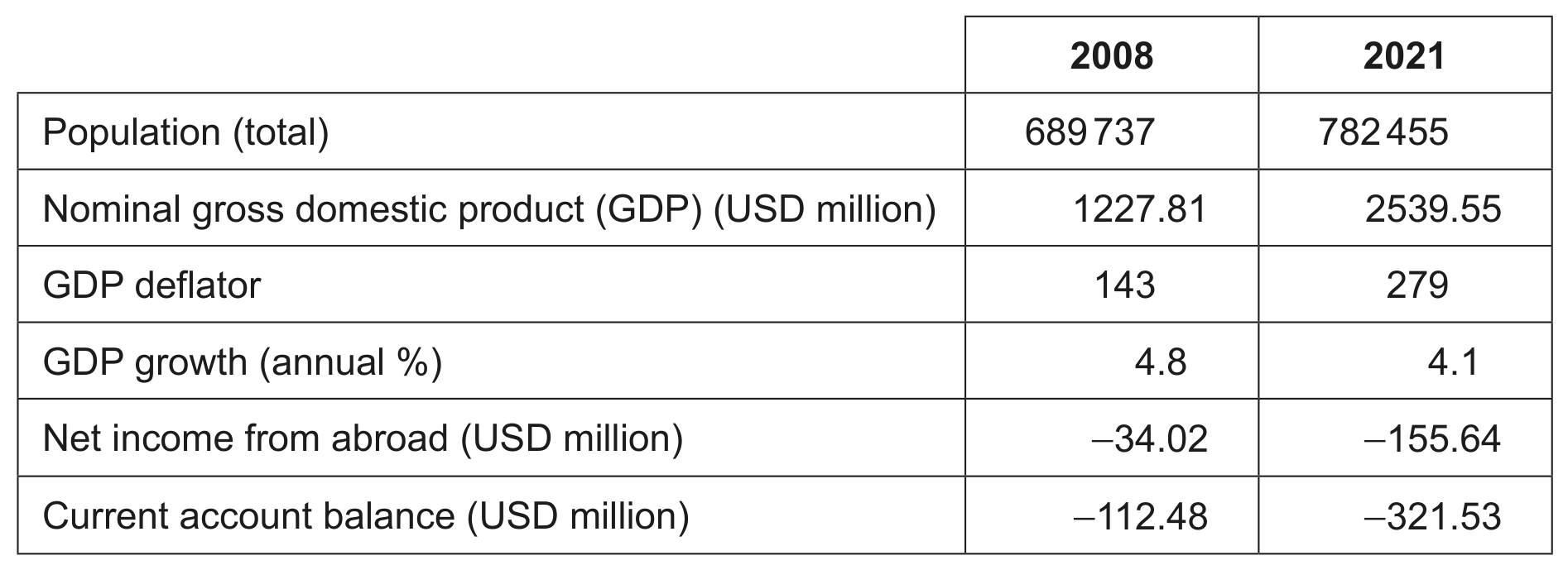
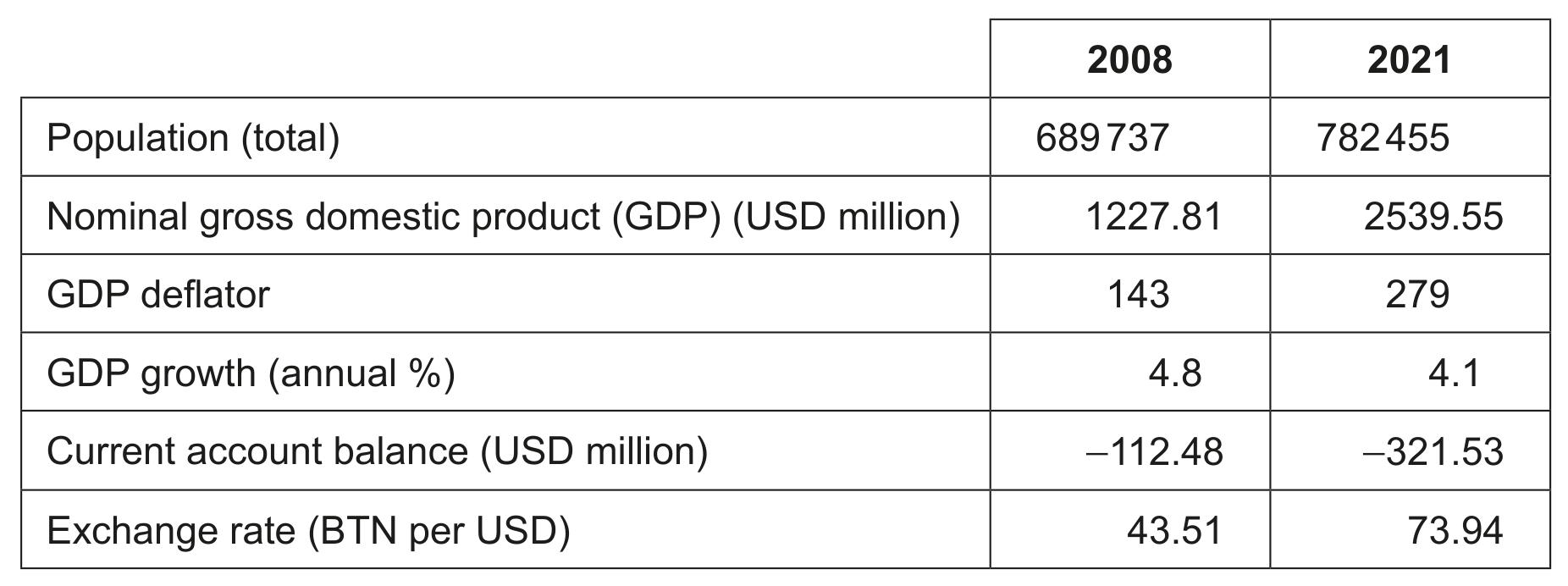
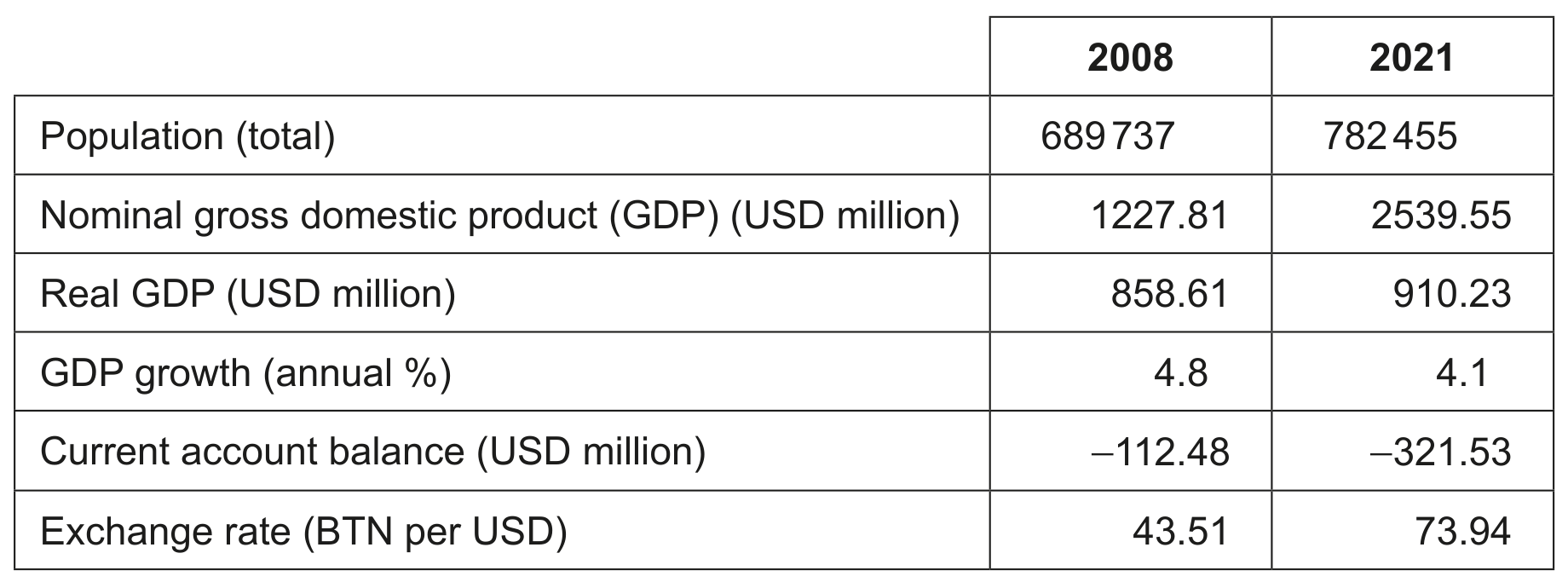
Table 4: Economic data for Bhutan

Table 4: Economic data for Bhutan

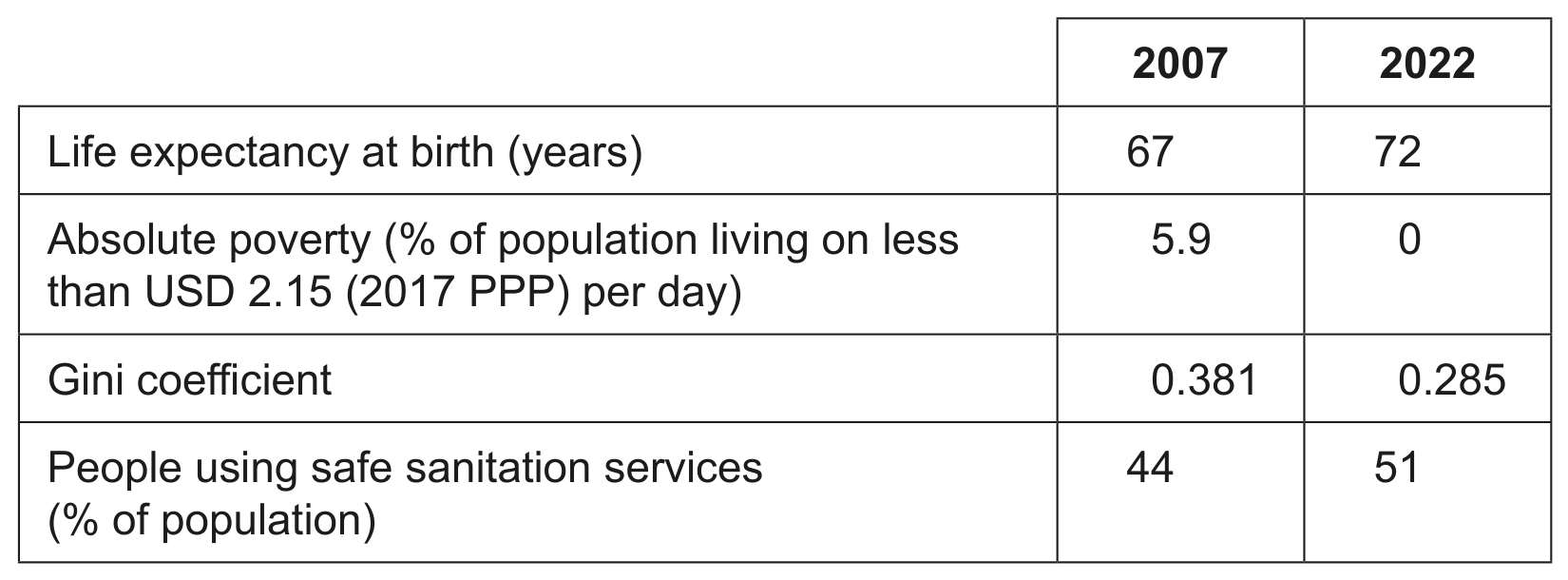
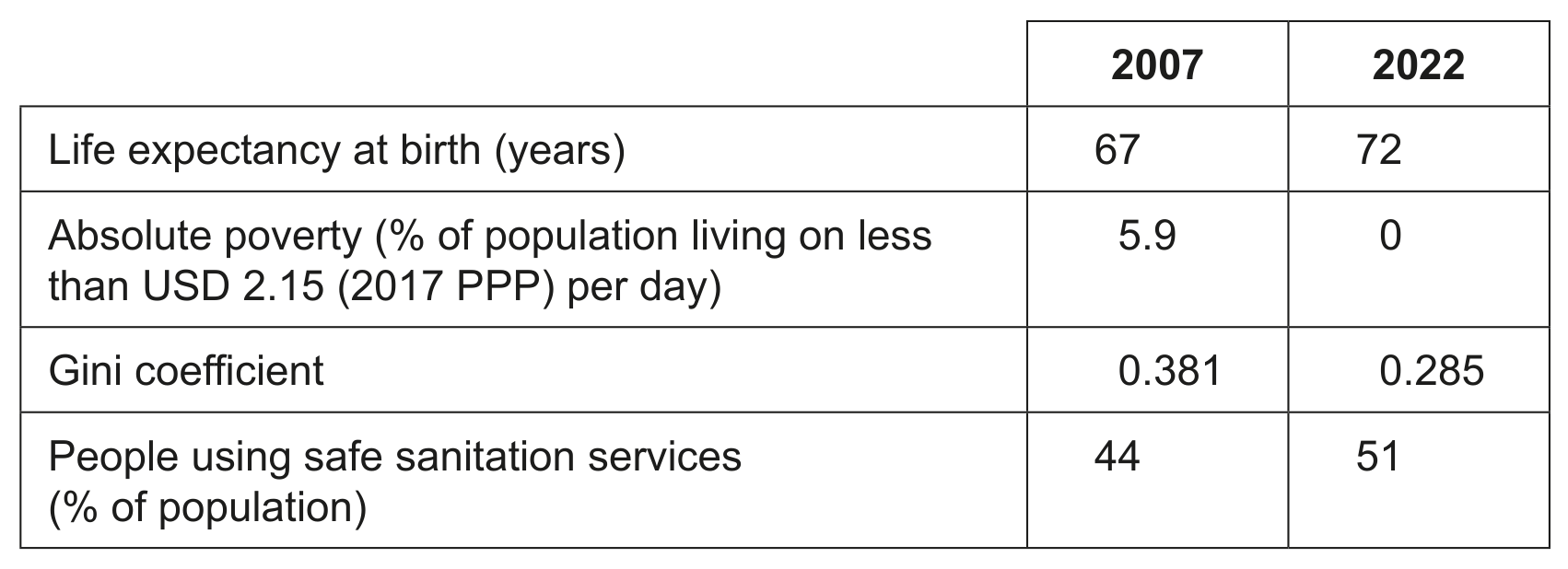
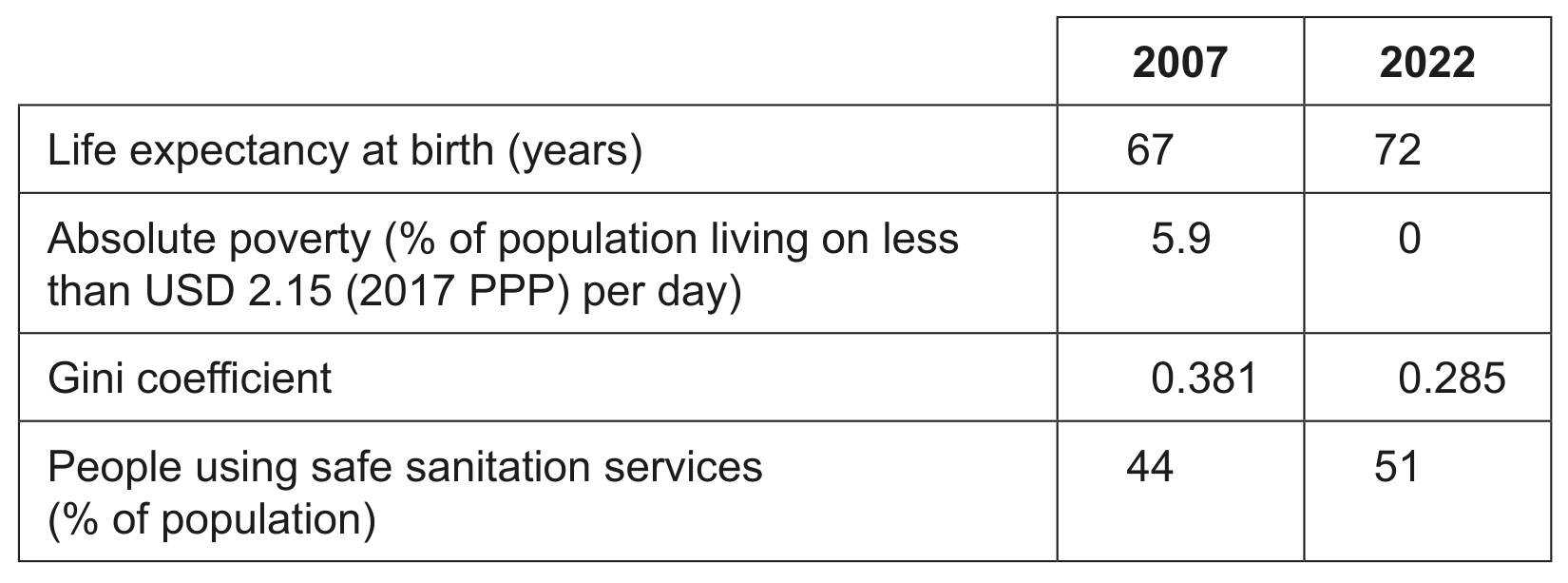
Table 5: Development data for Bhutan

Table 5: Development data for Bhutan

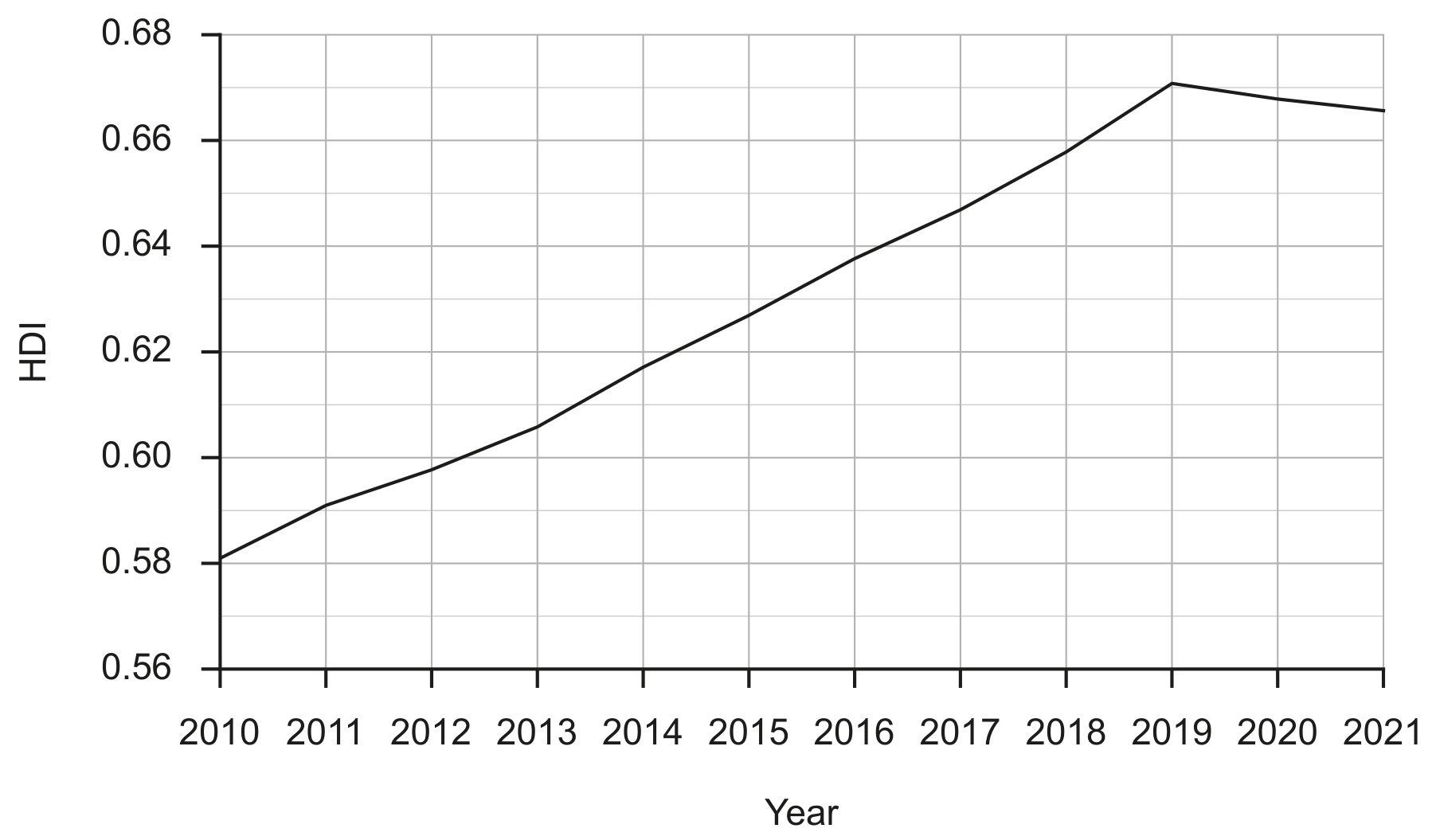
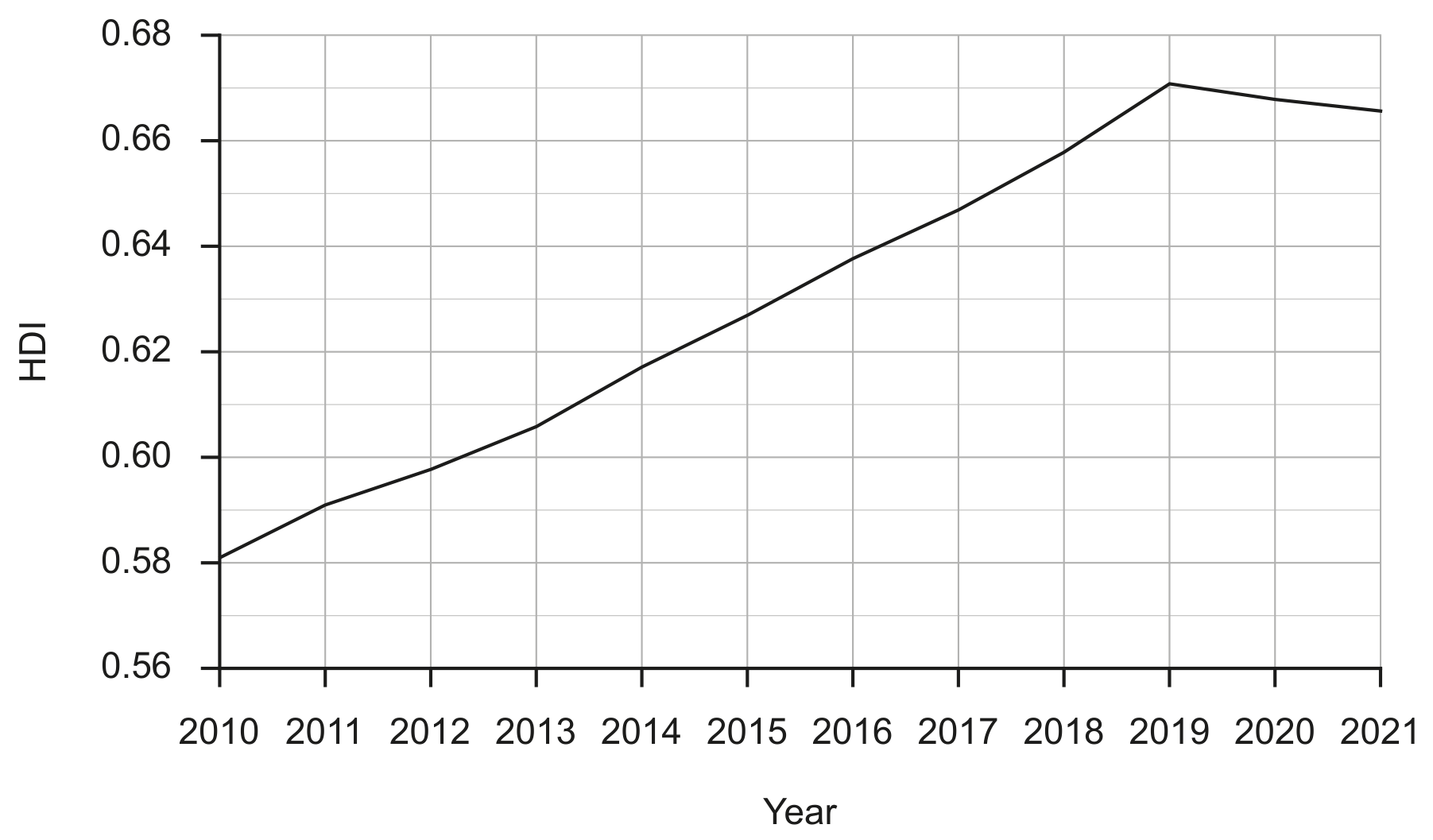
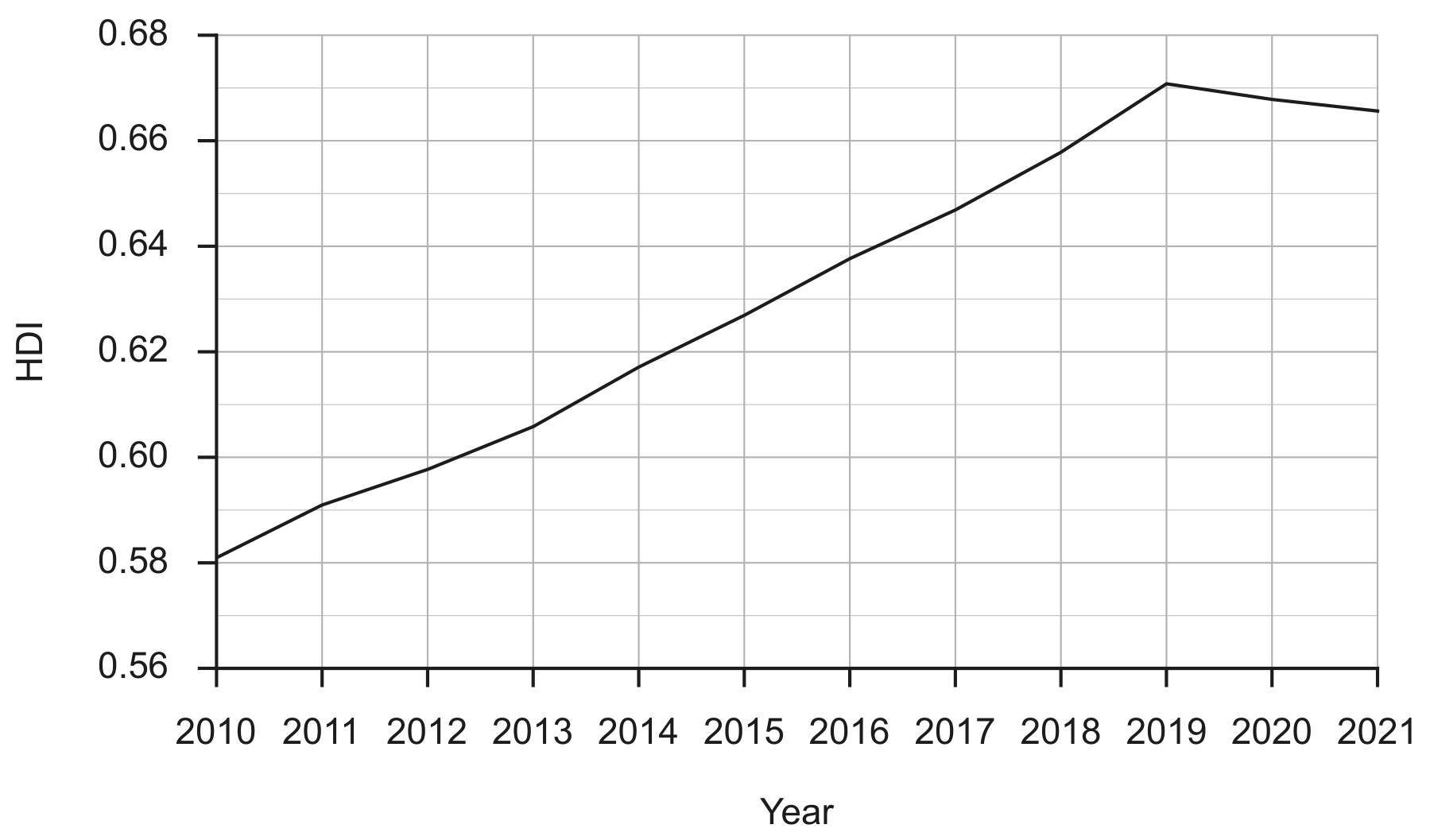
Figure 1: HDI for Bhutan from 2010 to 2021

Figure 1: HDI for Bhutan from 2010 to 2021

Question 2(b)(i)

(a)

Using information from Table 4, calculate Bhutan's real GDP in USD in 2021.

[ 2 ]

Question 2(b)(ii)

(b)

Using information from Table 4, calculate Bhutan's nominal GDP per capita in USD in 2021.

[ 1 ]

Question 2(b)(iii)

(c)

Using information from Table 4, calculate the change in Bhutan's nominal gross national income (GNI) in USD between 2008 and 2021.

[ 2 ]

Question 2

[Maximum number: 5]

Read the extracts and answer the questions that follow.
Text D - Overview of Bhutan

(1) Bhutan is a lower-middle income country in southern Asia. It is mountainous, water is plentiful, and 60 % of the territory is protected forest. Since 2008, Bhutan has measured its economic development by changes in its "Gross National Happiness" (GNH) index. The index considers factors such as income inequality, environmental conservation, sustainable development, and gender equality, in addition to the components of the Human Development Index (HDI).

(2) The pursuit of GNH has involved using government programmes to spread the benefits of economic growth across all social groups. An example of this is the construction of large hydropower plants, not only for the export of electricity but also to ensure that remote communities can buy power at low prices. Hydropower is a renewable method of producing electricity using the natural flow of water. With these new plants, all rural and urban areas had access to electricity by 2019.

(3) Government intervention in the market for electricity has been necessary due to the high cost of resources. Both the production and distribution of electricity are therefore controlled by state
owned enterprises. Bhutan's government has relied on India for grants and loans to finance hydropower projects.

(4) Sales of surplus electricity to India, amounting to over 70 % of electricity generation in 2021, have increased the funds available to the government for investment in healthcare and education. These revenues have also helped to finance the expansion of essential infrastructure, particularly road networks. The government's aim has been to reduce poverty and to improve well-being, especially in rural areas.

(5) Hydropower has proved to be an important source of economic development. However, the private sector faces a lack of investment for multiple reasons, including high transport costs and a small domestic market. This has limited the creation of new private-sector jobs. Furthermore, a sustainability tax of 100 USA dollars (USD) per night for tourists helps with Bhutan's conservation efforts. The tax reduces Bhutan's competitiveness as a tourist destination.

(6) Agriculture is vital to Bhutan's largely rural population. This sector employed 55 % of the workforce in 2021. However, most agricultural produce, such as rice, is consumed by farming households rather than sold in the market. By 2021, the country was importing about 50 % of its food. The growing food demands of urban areas could have negative consequences for the balance of payments.

(7) Agricultural output is constrained by many factors, including a lack of machinery, irrigation and affordable credit. Bhutan's partnership with the United Nations International Fund for Agricultural Development has provided funds for investment in the agricultural sector, such as irrigation systems, roads connecting farms to markets, and storage facilities. However, the GNH emphasis on sustainability could restrict growth in this sector. For example, to preserve biodiversity, there are restrictions on the use of chemical fertilizers.
Text E - Youth unemployment in Bhutan*

(1) The youth unemployment rate for Bhutan in 2021 was 20.9 %. However, youth unemployment in towns was much higher than in rural areas. Approximately 60 % of the total unemployed youth were female.

(2) There is a mismatch between the needs of employers and the skills of young people. Apart from this problem, the private sector requires government assistance in creating job opportunities so that young people can find employment outside of the public sector. Moreover, a lack of finance discourages the youth from entrepreneurship, further reducing their work prospects and the growth of Bhutan's economy.
Text F - Bhutan's trade relations with India
Bhutan has a free trade agreement with India, removing all tariffs between the two countries. In 2021-2022, about 80 % of Bhutan's international trade was with India. India's top imports from Bhutan include electricity, metals, and cement. Bhutan relies on India for goods such as fuel, cars, and rice. Transactions between the two countries are straightforward, as the central bank of Bhutan ensures the ngultrum (Bhutan's currency, BTN) is fixed to the rupee (India's currency, INR) at the exchange rate of 1 BTN=1 INR.
* aged between 15 and 24

Table 4: Economic data for Bhutan

Table 4: Economic data for Bhutan

Table 5: Development data for Bhutan

Table 5: Development data for Bhutan

Figure 1: HDI for Bhutan from 2010 to 2021

Figure 1: HDI for Bhutan from 2010 to 2021

Question 2(b)(i)

(a)

Using information from Table 4, calculate Bhutan's real GDP in USD in 2008.

[ 2 ]

Question 2(b)(ii)

(b)

Using your answer to part (b)(i) and Table 4, calculate Bhutan's real GDP per capita in USD in 2008.

[ 1 ]

Question 2(b)(iii)

(c)

A cement firm based in Bhutan contributed BTN 400000 to the nominal GDP of Bhutan in 2008. Using information from Table 4, calculate the firm's contribution in USD to Bhutan's nominal GDP in 2008.

[ 2 ]

Question 2

[Maximum number: 3]

Read the extracts and answer the questions that follow.
Text D - Overview of Bhutan

(1) Bhutan is a lower-middle income country in southern Asia. It is mountainous, water is plentiful, and 60 % of the territory is protected forest. Since 2008, Bhutan has measured its economic development by changes in its "Gross National Happiness" (GNH) index. The index considers factors such as income inequality, environmental conservation, sustainable development and gender equality, in addition to the components of the Human Development Index (HDI).

(2) The pursuit of GNH has involved using government programmes to spread the benefits of economic growth across all social groups. An example of this is the construction of large hydropower plants, not only for the export of electricity but also to ensure that remote communities can buy power at low prices. Hydropower is a renewable method of producing electricity using the natural flow of water. With these new plants, all rural and urban areas had access to electricity by 2019.

(3) Government intervention in the market for electricity has been necessary due to the high cost of resources. Both the production and distribution of electricity are therefore controlled by state-owned enterprises. Bhutan's government has relied on India for grants and loans to finance hydropower projects.

(4) Sales of surplus electricity to India, amounting to over 70 % of electricity generation in 2021, have increased the funds available to the government for investment in healthcare and education. These revenues have also helped to finance the expansion of essential infrastructure, particularly road networks. The government's aim has been to reduce poverty and to improve well-being, especially in rural areas.

(5) Hydropower has proved to be an important source of economic development. However, the private sector faces a lack of investment for multiple reasons, including high transport costs and a small domestic market. This has limited the creation of new private sector jobs. Furthermore, a sustainability tax of 100 USA dollars (USD) per night for tourists helps with Bhutan's conservation efforts. The tax reduces Bhutan's competitiveness as a tourist destination.

(6) Agriculture is vital to Bhutan's largely rural population. This sector employed 55 % of the workforce in 2021. However, most agricultural produce, such as rice, is consumed by farming households rather than sold in the market. By 2021, the country was importing about 50 % of its food. The growing food demands of urban areas could have negative consequences for the balance of payments.

(7) Agricultural output is constrained by many factors, including a lack of machinery, irrigation and affordable credit. Bhutan's partnership with the United Nations International Fund for Agricultural Development has provided funds for investment in the agricultural sector, such as irrigation systems, roads connecting farms to markets, and storage facilities. However, the GNH emphasis on sustainability could restrict growth in this sector. For example, to preserve biodiversity there are restrictions on the use of chemical fertilizers.
Text E - Youth unemployment in Bhutan*

(1) The youth unemployment rate for Bhutan in 2021 was 20.9 %. However, youth unemployment in towns was much higher than in rural areas. Approximately 60 % of the total unemployed youth were female.

(2) There is a mismatch between the needs of employers and the skills of young people. Apart from this problem, the private sector requires government assistance in creating job opportunities so that young people can find employment outside of the public sector. Moreover, a lack of finance discourages the youth from entrepreneurship, further reducing their work prospects and the growth of Bhutan's economy.
Text F - Bhutan's trade relations with India
Bhutan has a free trade agreement with India, removing all tariffs between the two countries. In 2021-2022, about 80 % of Bhutan's international trade was with India. India's top imports from Bhutan include electricity, metals, and cement. Bhutan relies on India for goods such as fuel, cars, and rice. Transactions between the two countries are straightforward, as the central bank of Bhutan ensures the ngultrum (Bhutan's currency, BTN) is fixed to the rupee (India's currency, INR) at the exchange rate of 1 BTN=1 INR.
* aged between 15 and 24

Table 4: Economic data for Bhutan

Table 4: Economic data for Bhutan

Table 5: Development data for Bhutan

Table 5: Development data for Bhutan

Figure 1: HDI for Bhutan from 2010 to 2021

Figure 1: HDI for Bhutan from 2010 to 2021

Question 2(b)(i)

(a)

Using information from Table 4, calculate Bhutan's GDP deflator in 2021.

[ 2 ]

Question 2(b)(ii)

(b)

Using information from Table 4, calculate Bhutan's real GDP per capita in USD in 2008.

[ 1 ]
0 selected