Question 1
Question 1(b)
(a)
Using real-world examples, evaluate the policies a government might adopt to respond to a market situation in which significant asymmetric information exists.
[ 15 ]
 EduNinja
Using real-world examples, evaluate the policies a government might adopt to respond to a market situation in which significant asymmetric information exists.
Read the extracts and answer the questions that follow.
Text D — Overview of Cambodia
(1) Between 2010 and 2019 Cambodia had one of the fastest growing economies in Southeast Asia. Most of the growth was driven by tourism, exports of garments and improved consumer confidence.
(2) However, despite high economic growth, rural poverty has persisted, and inequality has grown within rural populations. Approximately 90 % of workers are employed in the informal sector and access to quality healthcare and education remain a challenge for Cambodia. Youth (under 25 years old) make up a large proportion of the labour force, but many do not complete secondary school. As a result, those entering work are under-skilled and human capital is low. Access to clean water and sanitation facilities is still lacking. Export-driven growth is being threatened as the European Union (EU), which accounts for 30 % of Cambodia's export market, recently ended a preferential trade agreement and will now impose tariffs on Cambodian products, such as garments.
(3) Experts state that the focus on growth through garment manufacturing is unsustainable. The garment industry, which is the largest informal employment sector, has been criticised for poor working conditions and pay. Even workers who are formally employed can barely meet basic needs, despite the recent minimum wage increase and introduction of a price ceiling on rents for housing in cities. Additionally, there are reports of pollution and water waste generated by garment factories, damaging the health of those who live nearby.
(4) To help solve the market failure in the garment industry, economists recommend that the government should support projects that encourage garment factories to adopt a circular economy approach, either in partnership with worldwide clothing brands or by forming social enterprises (SEs) locally. The circular economy approach can help reduce environmental waste that occurs during production by encouraging the recycling and reusing of materials. Developing ecotourism has also been recommended to support sustainability and provide new job opportunities for the youth and the rural population. Furthermore, ecotourism could help Cambodia benefit from growing world income levels.
(5) Reforms in the garment and tourism industries are needed, along with improvements in infrastructure, to maintain sustainable growth and competitiveness. Promoting entrepreneurship, developing new skills and increasing the use of technology would help solve current labour market needs.
Text E - Social Enterprise (SE) in Cambodia
(1) When Cambodia's status changed from low income to lower middle-income in 2015, the inflow of foreign aid decreased dramatically. As a result, SEs became increasingly more important in promoting Cambodia's economic development. Furthermore, SEs were seen as a key factor in breaking the poverty cycle and providing opportunities for its young labour force. SEs may also encourage local investment, which has experienced very slow growth compared to foreign direct investment (FDI).
(2) Many SEs focus on addressing issues of poverty, child rights, education, disability, health and environmental concerns. The main beneficiaries are children, youth, women and people with disabilities. Successful Cambodian examples include Phare Performing Social Enterprise (PPSE), which is a performing arts school targeting underprivileged children. Most graduates become full time workers at PPSE. Another example is Hydrologic, which provides affordable safe water options to rural households. New SEs are currently being established to ensure sustainability within the growing ecotourism industry.
(3) However, challenges exist within the SE sector. Less than 8 % of SEs are formally registered due to bureaucracy and high taxes. This limits access to potential investors and markets and encourages businesses to stay in the informal sector. New SE start-ups often fail due to lack of sufficient funding and the inability to attract skilled labour.
Text F - Microfinance in Cambodia
Since 1991, Cambodia has had one of the fastest growing microfinance sectors in the world. Microfinance has helped decrease poverty in rural areas and solve asymmetric information in the market for loans. However, key issues have persisted, including low success rates of some businesses due to inadequate financial literacy and expertise. Additionally, microfinance has become increasingly dependent on funding from international banks and investors, resulting in higher interest rates. Some borrowers have been forced to sell their land as they could not meet their debt repayment obligations. Recently the government implemented a price ceiling on the interest rate for loans in rural areas to help prevent increasing household indebtedness.
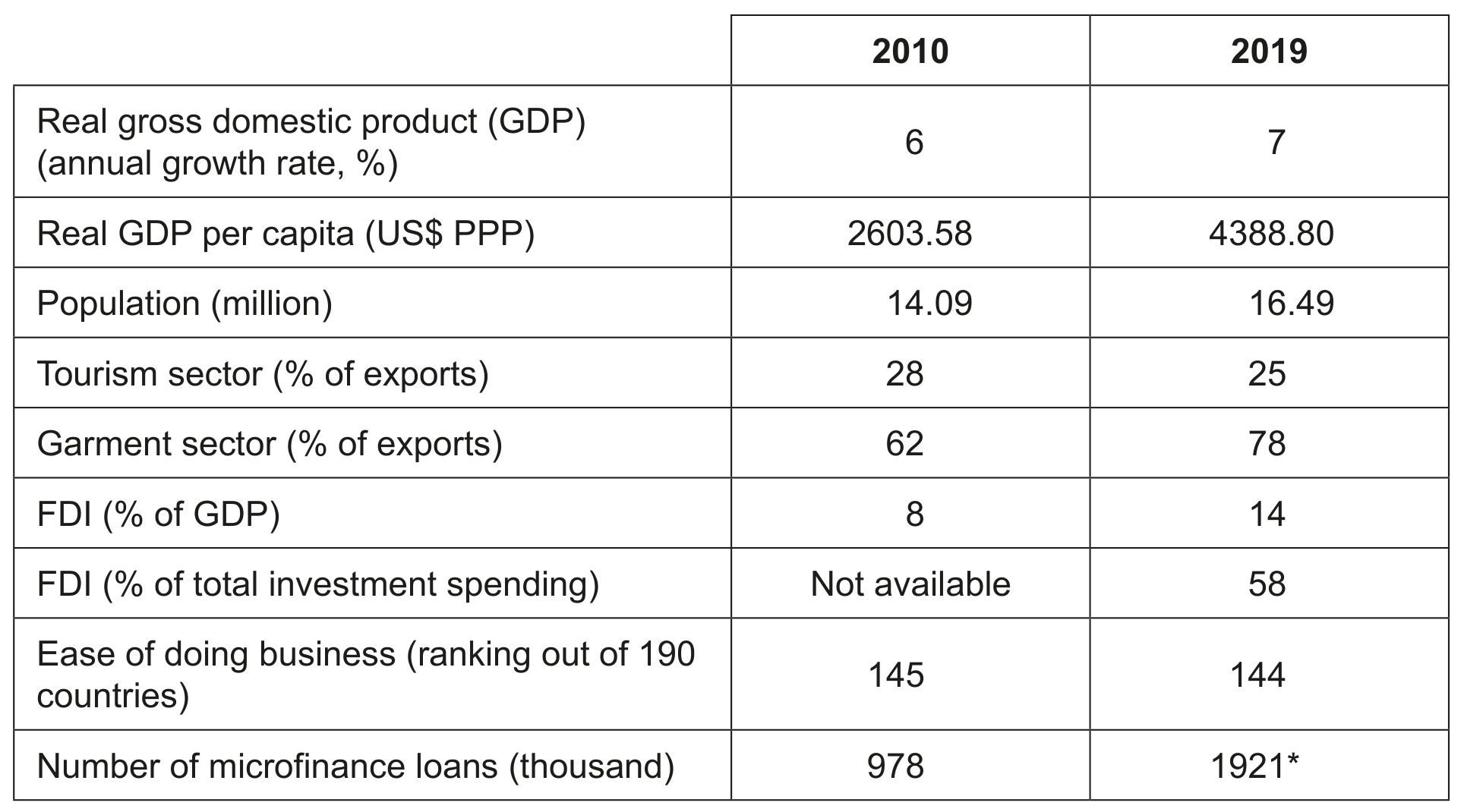
Table 3: Economic data for Cambodia
*2016 figure
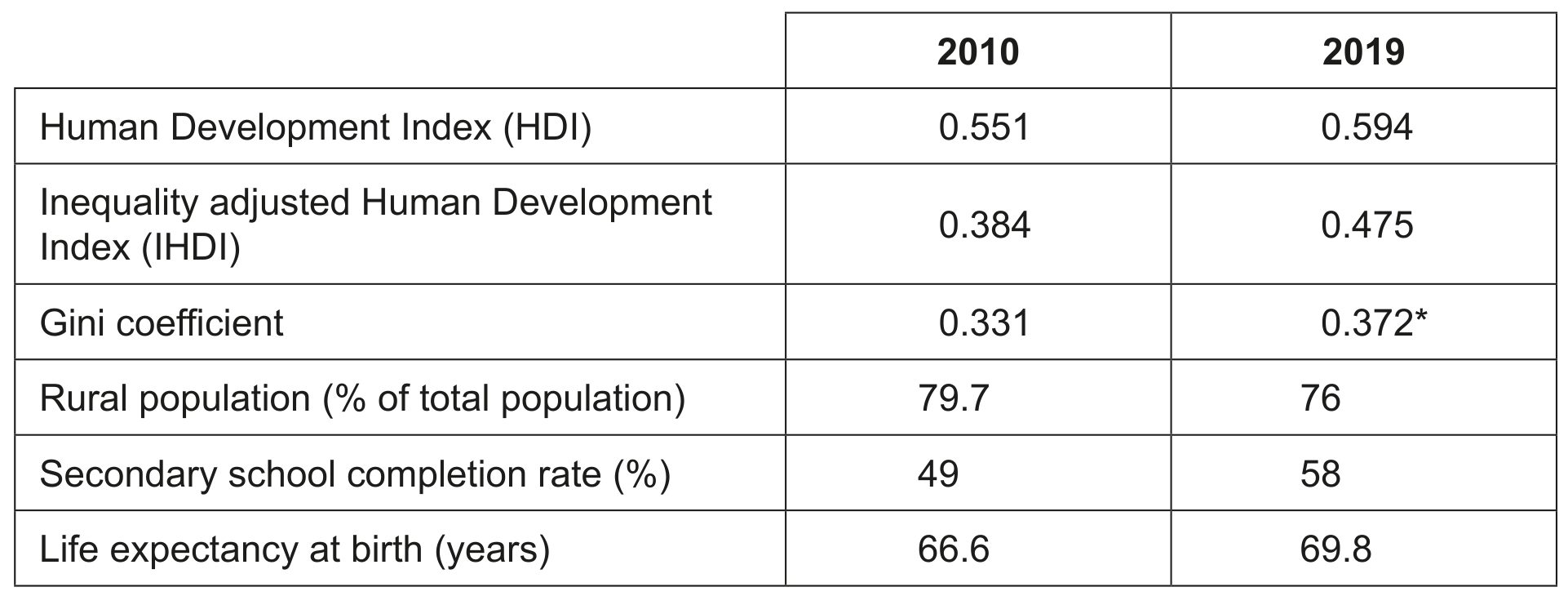
Table 4: Development data for Cambodia
*estimate
Define the term asymmetric information indicated in bold (Text F).
Study the following extract and answer the questions that follow.
Fiji's challenges and opportunities
(1) In 2016, the island nation of Fiji suffered from cyclone Winston (a tropical storm), costing more than 40 lives and damaging its infrastructure. One of the country's four sugar mills was severely damaged, harming raw sugar processing. Processed sugar is, in addition to bottled water and tourism, a major export in Fiji. A recent study found that the damage from the cyclone continues to have a lasting effect on communities as fisherwomen report fewer and smaller crabs and fishes. The social safety net is limited and there are calls for the government to help the citizens who have been affected by the cyclone. However, the government had to use its budget to rebuild infrastructure.
(2) The government has prepared several strategies to strengthen the economy. These include financial support for sugar cane producers, diversification of its agricultural produce, better access to finance and encouragement of investment. The government has committed to provide equal opportunities for all: promoting the participation of women in education and political leadership, because Fiji has one of the lowest female participation rates in politics in the world.
(3) To support its sugar cane farmers, the government provides a 55 % subsidy on pesticides (products that kill weeds) used in farming. However, small farmers are complaining about the excessive paperwork that needs to be completed to receive the subsidy and there is potential for corruption. Fiji competes with Brazil, which has an absolute advantage, in the world market for sugar.
(4) To diversify, the government plans to expand the ginger and coconut industries. Both industries are economically and environmentally sustainable. The industries provide an increased number of Fijians with a worthwhile income. Coconut production plays a very important role in Fiji's economy, particularly in the more isolated rural communities, where formal employment is scarce and where alternative cash crops (crops grown to be sold for profit) do not exist. Coconut is a staple food and is vital for food security (ensuring that people have access to enough food), but is also important for health, economic and cultural reasons. New market opportunities have emerged in high-value products - green coconut products, such as coconut water, are becoming increasingly popular throughout the world.
(5) The Asian Development Bank encourages Fijian farmers to access "green finance". These financial investments support economic development through sustainable development initiatives and policies. Under the government's new reforms, farmers are able to use assets such as crops and contracts as collateral for loans, creating improved access to finance. However, to increase incomes, farmers will also need to improve their financial knowledge.
(6) To create an investment-friendly environment, the government must develop more infrastructure, create market access through greater economic integration and reduce asymmetric information between farmers and wholesale buyers. Australia has decided to help Fiji by financing infrastructure through grants and concessional loans.
Define the term asymmetric information indicated in bold in the text (paragraph 6).