EduNinja

IB Economics HL2.11 Market failure - market powerQuestion Bank

Question 1

[Maximum number: 4]

Study the following extract and data and answer the questions that follow.
Filipino rice farmers prepare for trade liberalization

(1) To meet its obligations under World Trade Organization (WTO) rules, the president of the Philippines has asked the government to eliminate the current quota system for rice imports. As an important part of food security measures, the government wants to achieve self-sufficiency in the production of rice. To support this goal, the WTO allowed the Philippines to extend its rice quota until June 2017 to allow more time for local farmers to prepare for free trade.

(2) The current quota system for rice imports makes domestic prices rise dramatically during periods of low domestic supply.

(3) Eliminating the quota on rice aims to make the rice market more competitive, which could reduce the price of rice by as much as 7 Philippine pesos (PHP)\left(\mathrm{PH}^{\mathrm{P}}\right) per kilogram (kg). The National Economic and Development Authority has estimated that lower rice prices could save Filipino households as much as PH 2362 per year. However, if the rice quota is eliminated, economists have warned that the government must prepare local rice producers so that they can either compete with rice imports or move to producing other crops. "Currently Filipino farmers cannot compete with Vietnamese farmers who may enjoy economies of scale" declared one economist. "The solution is to bring down the cost of production of rice."

(4) To help Filipino farmers to adjust to competition from lower-priced rice imports, the government has allocated funds to the Rice Competitiveness Enhancement Fund. This fund will provide support to farmers in order to increase productivity by supplying high-yield seeds and fertilizer. It will also provide subsidies to encourage the use of agricultural machinery and will offer support services and training to farmers.

(5) Apart from being an essential food for many Filipinos, rice is also an important input for the food industry. The plan to remove the import quota will reduce the inflation rate in the Philippines by up to 0.4 %. In July 2018, the central bank governor reported that inflation had reached 5.7 %, well above the government's target range of 2 % to 4 %. He stated that "supply-side factors are the main drivers of the present inflation. These factors include rising international oil prices, higher indirect taxes and poor weather conditions that have affected food supply". The president stated that the removal of the rice quota was one solution to ease the rising inflation.

Table 1: Average economic costs and prices of rice in the Philippines and Vietnam

Table 1: Average economic costs and prices of rice in the Philippines and Vietnam

Question 1(c)

(a)

Using a perfect competition diagram, explain whether farmers in the Philippines are making an economic profit or loss (Table 1).
[ 4 ]

Question 1

Question 1(a)

(a)

Explain how welfare loss may result from monopoly power.

[ 10 ]

Question 1(b)

(b)

Discuss the effectiveness of government policies (legislation and regulation) to reduce monopoly power.

[ 15 ]

Question 1

Question 1(b)

(a)

Using diagrams, compare and contrast the market structure of monopoly with that of perfect competition.

[ 15 ]

Question 1

Question 1(b)

(a)

Evaluate the view that monopoly is an undesirable market structure as it fails to achieve productive and allocative efficiency.

[ 15 ]

Question 1

Question 1(a)

(a)

Explain why in perfect competition abnormal profits are only made in the short run.

[ 10 ]

Question 1

[Maximum number: 5]

Note that widgets and pidgets are imaginary products.

In the country of Burbia, the demand and supply of widgets are given by the functions

Qd=249−4PQs=150+14P\begin{aligned} & Q d=249-4 P \\ & Q s=150+14 P \end{aligned}

where Qd is the quantity demanded per month, Qs is the quantity supplied per month and P is the price per widget in dollars ($).

Question 1(k)

(a)

Draw and label the marginal revenue (MR) curve for the 2018 Football World Cup final.

[ 1 ]

Question 1(l)

(b)

(I) Using the diagram on page 6 and your answers to parts (j) and (k), explain how the organizers could achieve their goal of profit maximisation.

[ 4 ]

Question 1

[Maximum number: 6]

Study the extract and data below and answer the questions that follow.
American shrimp farmers taste victory

(1) American shrimp farmers have received good news from a United States (US) ruling that could lead to tariffs being imposed on imports from competing countries.

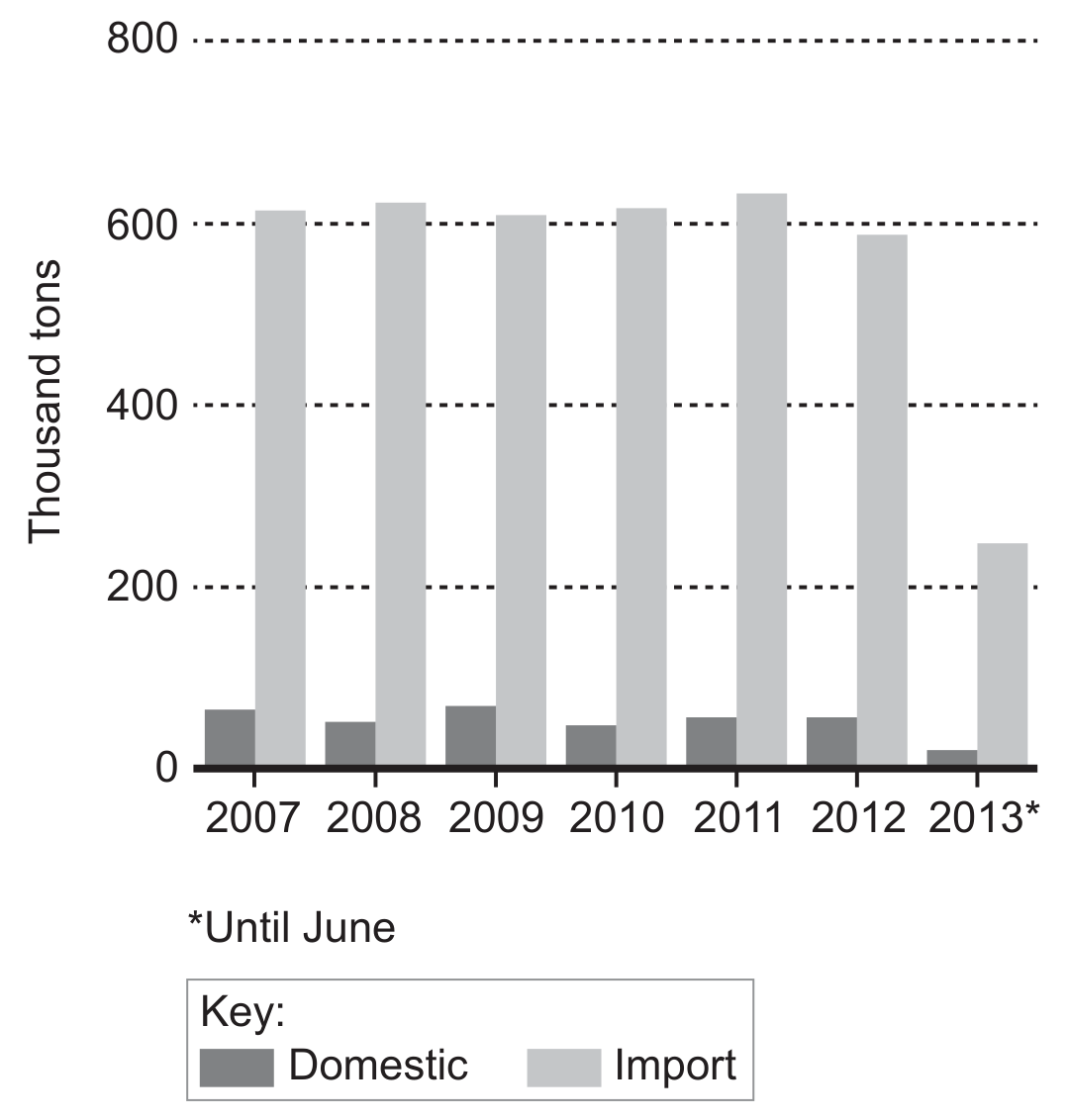
(2) US producers in the Gulf Coast were suffering from a significant oil spill in 2010. The higher fuel costs as a result of the spill have made it hard to compete with foreign shrimp farms, which they say receive government subsidies. The US producers claim such subsidies threaten to destroy the domestic shrimp business. The US imported 1200 million pounds (lb) of shrimp last year and produced 100 million pounds (lb) of shrimp domestically.

(3) The US Department of Commerce ruled that five countries - China, Ecuador, India, Malaysia and Vietnam - improperly subsidized shrimp that were exported to the American market. The department rejected accusations of improper subsidies by Thailand and Indonesia, two of the biggest US shrimp suppliers.

(4) The US International Trade Commission will now have to decide whether the subsidies harmed the American industry. If so, the US would impose tariffs on shrimp imports from the five countries. The proposed US tariffs could be as much as 54.5 %.

(5) The US shrimp farmers claim that the Indian government pays extra to cover shipping costs on shrimp going to the US and that China provides subsidized loans to its shrimp farmers. They argue that these violate World Trade Organization (WTO) rules.

(6) The five countries disputed the US Department of Commerce's decision. The Vietnamese producers state that, "This is an unfair decision affecting the lives of more than 600000 shrimp farmers and processors in Vietnam". Chinese officials have said that there was no evidence of improper Chinese subsidies and that US tariffs on Chinese shrimp would violate WTO rules.

(7) The US shrimp farmers say they need tariffs to allow them to compete fairly with Asian farmers, noting that high fuel prices are keeping some shrimp boats at the dock. "The price received by our farmers is not enough to cover their variable costs," said a lawyer, who represents the US shrimp farmers.

(8) Large US retailers and food distributors oppose the tariffs saying that the US shrimp industry had support from the oil company, BP, which has paid billions of US dollars to those affected by its 2010 oil spill.

(9) US politicians and shrimp farmers commented on problems they are facing, saying that, "not only is shrimping an industry, but it is a way of life".

Figure 1: Amount of shrimp imported to the US compared with domestic catch (thousands of tons)

Figure 1: Amount of shrimp imported to the US compared with domestic catch (thousands of tons)

Question 1(a)

Question 1(a)(ii)

(a)
(i)

Define the term variable costs indicated in bold in the text (paragraph (7).

[ 2 ]

Question 1(c)

(b)

Using an average costs diagram, explain the short-run consequence for shrimp farmers if the price received "is not enough to cover their variable costs" (paragraph (7).

[ 4 ]

Question 1

[Maximum number: 17]

In Ruritania, the demand for butter is given by the function

Qd=420-19P

where Qd is the quantity of butter demanded per year, in millions of kilogrammes (kg), and P is the price of butter in dollars ($) per kg.

Question 1(c)

Question 1(c)(i)

(a)
(i)

If fixed costs are $ 800000 per month, calculate the total variable costs at a monthly output of 140000 units.

[ 2 ]

Question 1(c)(ii)

(ii)

Outline the difference between the explicit and implicit costs of production.

[ 2 ]

Question 1(c)(iii)

(iii)

Define the term normal profit.

[ 2 ]

Question 1(d)

Question 1(d)(i)

(b)
(i)

Calculate the economic profit made by the cartel if the members jointly supply 50000 units per month.

[ 2 ]

Question 1(d)(ii)

(ii)

Identify the level of output which would maximize revenue for the cartel.

[ 1 ]

Question 1(d)(iii)

(iii)

Calculate the value of total revenue per month for members of the cartel if they produce at the revenue maximizing level of output.

[ 2 ]

Question 1(e)

(c)

Outline the reason why, even if a cartel achieves its objective of jointly maximizing profit, there will be an incentive for members of the cartel to cheat.

[ 2 ]

Question 1(f)

(d)

Explain two conditions, apart from the incentive for members to cheat, which make cartel structures difficult to maintain.

[ 4 ]

Question 1

Question 1(a)

(a)

Explain why a monopoly can earn supernormal (abnormal) profits in the long run.

[ 10 ]

Question 1(b)

(b)

Evaluate the reasons why a government might allow a competitor into an industry that was previously a monopoly.

[ 15 ]

Question 1

[Maximum number: 8]

A report into fitness levels in the United States of America (USA) says that only about 23 % of all USA adults get the recommended amount of exercise. Walking, cycling, swimming, playing sports or doing domestic jobs such as gardening can all contribute to personal fitness. The following information is a cause for concern:
- Only one in three children are physically active every day.
- Less than 5 % of adults participate in 30 minutes of physical activity each day.
- Children now spend more than seven hours per day in front of a screen (for example, televisions, video game devices, computers).

At the same time, there has been a significant increase in demand for memberships at gyms (fitness centres), causing the fitness industry to grow by 8.7 % in the past few years.

Despite the increase in gym memberships, there is still concern about the lack of exercise in the USA. This is particularly important, as physical inactivity is estimated to result in USD 130 billion in annual healthcare spending and causes a significant reduction in the productivity of labour.

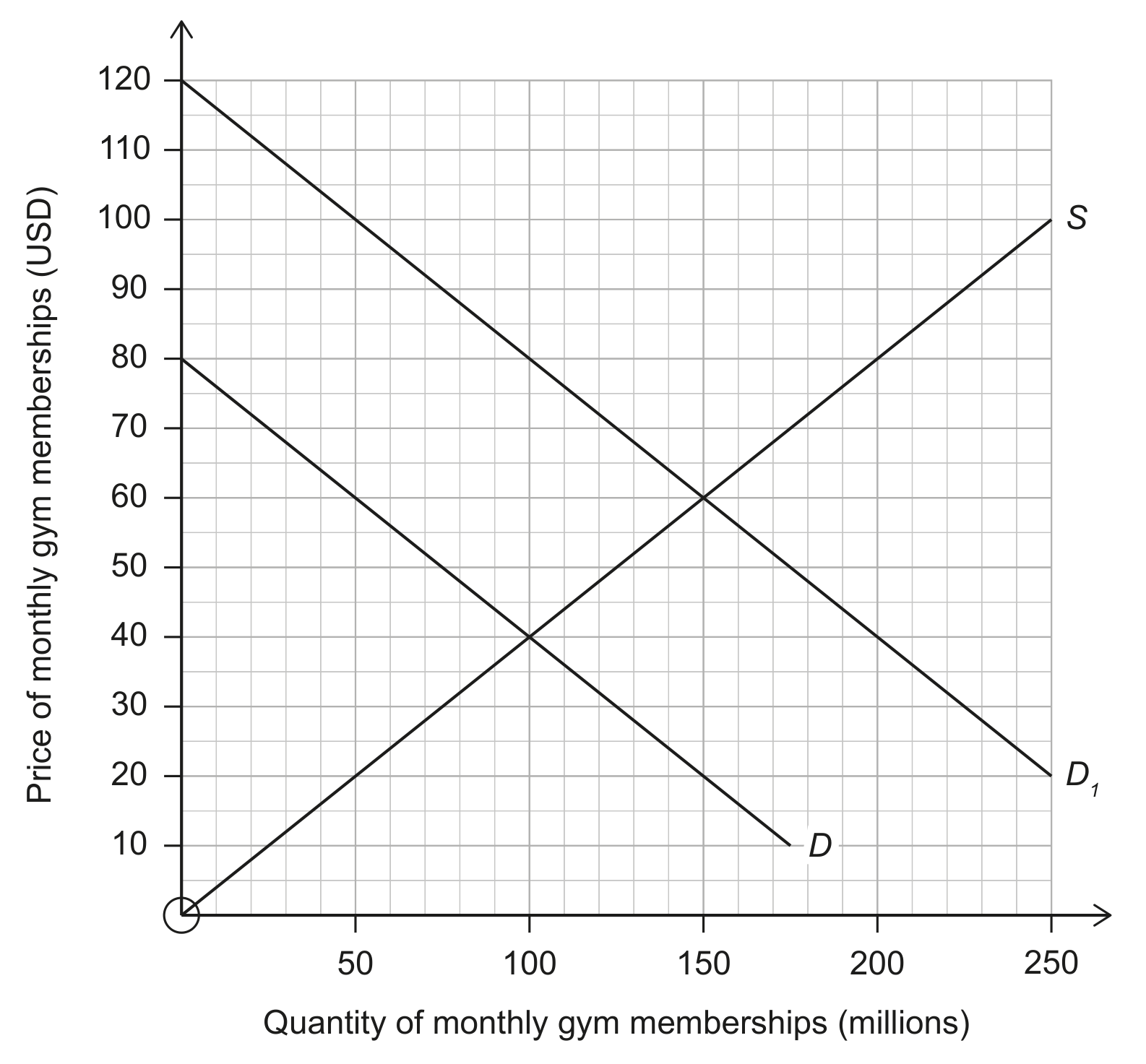
Figure 1 illustrates the market for gym memberships in the USA. D represents the demand for and S represents the supply of gym memberships. D1D_{1} represents the increased demand for gym memberships in recent years.

Figure 1

Figure 1

Question 1(a)

Question 1(a)(iv)

(a)
(i)

Sketch a diagram showing the average cost curve for a natural monopoly.

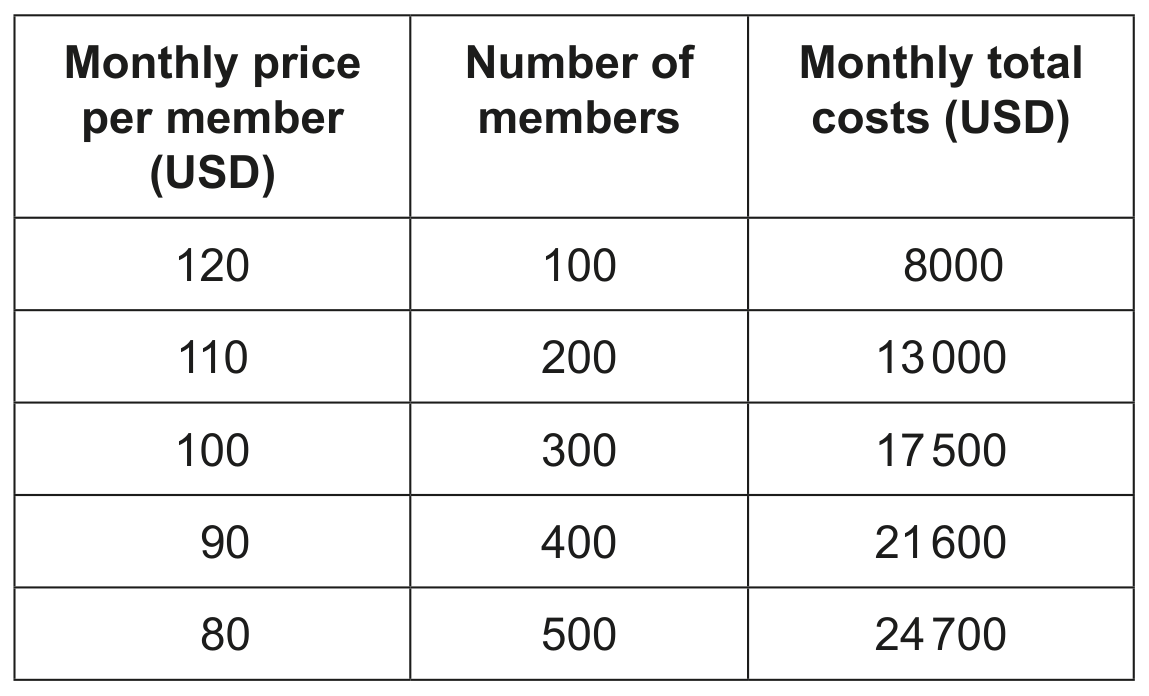
Table 1 provides financial information for the town's only gym. The price per member is the price of a monthly subscription to the gym (a membership fee).

Table 1

Table 1

[ 2 ]

Question 1(a)(v)

(ii)

Using Table 1, calculate the marginal revenue if the number of members increases from 300 to 400 per month.

[ 2 ]

Question 1(a)(vi)

(iii)

Using Table 1, calculate the increase in profit if the number of members increases from 400 to 500 per month.

[ 2 ]

Question 1(a)(vii)

(iv)

If the number of members increases from 500 to 600 per month, total costs per month will increase by USD 2800. Using Table 1, calculate the average cost per member for 600 members.

Some residents of the town have complained that the gym membership fee is too high and that the owner only cares about profit. The owner has stated that this is false and that profit is not the main objective of the business.

[ 2 ]
0 selected