Question 1
Question 1(b)
(a)
Using real-world examples, discuss the assumption that consumers always seek to maximize their utility.
[ 15 ]
 EduNinja
Using real-world examples, discuss the assumption that consumers always seek to maximize their utility.
A report into fitness levels in the United States of America (USA) says that only about 23 % of all USA adults get the recommended amount of exercise. Walking, cycling, swimming, playing sports or doing domestic jobs such as gardening can all contribute to personal fitness. The following information is a cause for concern:
- Only one in three children are physically active every day.
- Less than 5 % of adults participate in 30 minutes of physical activity each day.
- Children now spend more than seven hours per day in front of a screen (for example, televisions, video game devices, computers).
At the same time, there has been a significant increase in demand for memberships at gyms (fitness centres), causing the fitness industry to grow by 8.7 % in the past few years.
Despite the increase in gym memberships, there is still concern about the lack of exercise in the USA. This is particularly important, as physical inactivity is estimated to result in USD 130 billion in annual healthcare spending and causes a significant reduction in the productivity of labour.
Figure 1 illustrates the market for gym memberships in the USA. D represents the demand for and S represents the supply of gym memberships. represents the increased demand for gym memberships in recent years.
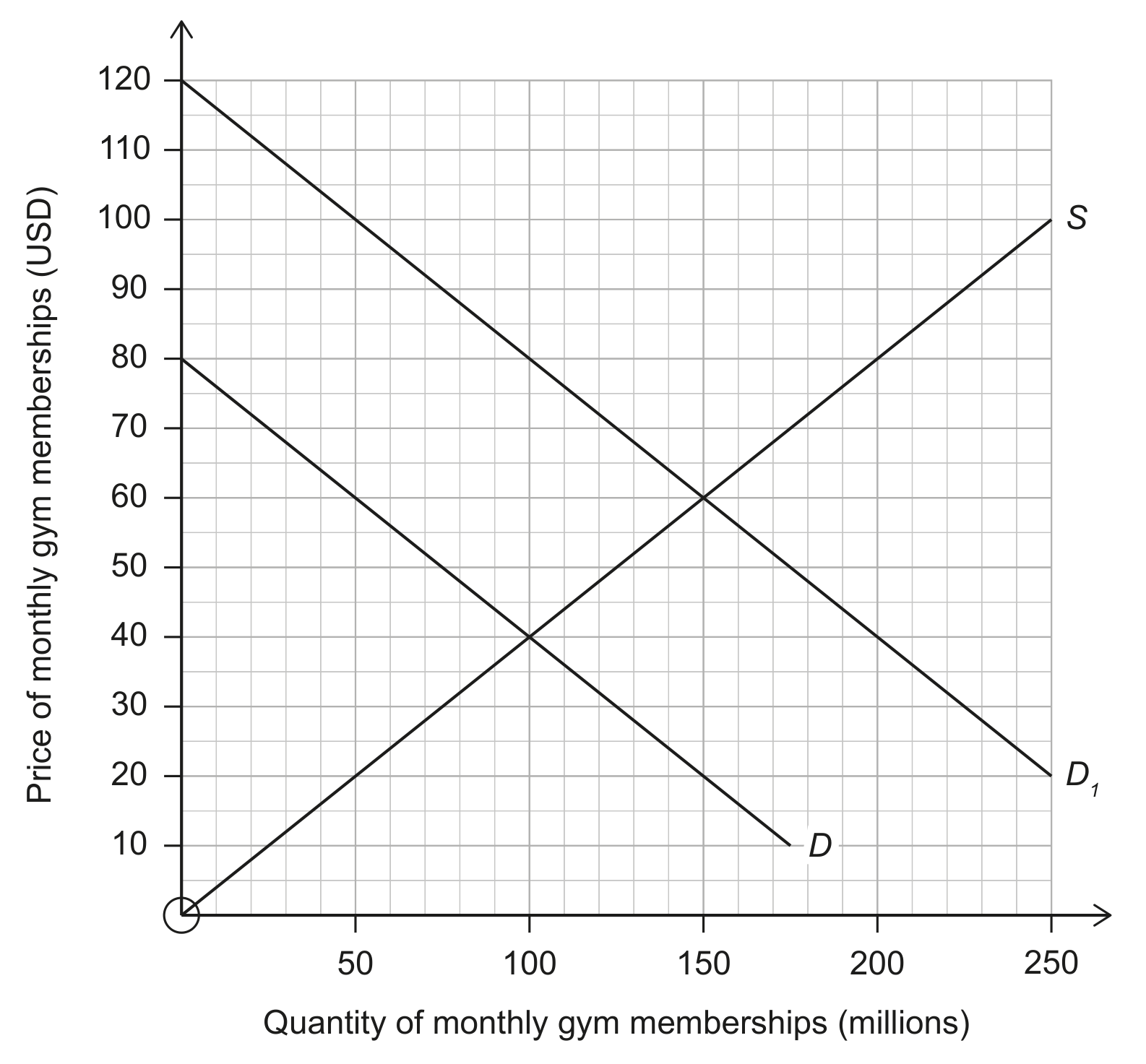
Figure 1
Define the term bounded self-control.
A small town in the USA has a population of 2700 . Given the high cost of exercise equipment and the small population, the gym in the town is considered to be a natural monopoly.
Explain two alternative business objectives (other than profit maximization) which the owner might adopt.
Using real-world examples, evaluate the view that firms will always seek to maximize their profits.
Explain why some firms might choose the goal of profit maximization while others might choose to adopt satisficing behaviour.
Explain why firms may not always pursue the goal of profit maximization.
Traffic congestion is a major problem in India. It is estimated that congestion in four major cities costs the Indian economy approximately US $ 22 billion annually. According to a 2019 survey, India has four of the eight most congested cities in the world. People in these cities pay higher fuel costs, inhale toxic gases, and waste up to 11 days a year stuck in traffic.
In New Delhi, India's capital city, 45 % of workers use cars to travel to work, while 89 % of workers indicate plans to purchase a car in the next five years. However, 80 % of car users say they would change their plans if ridesharing businesses such as Uber could meet their requirements on price, timeliness and availability.
Define the term rational consumer choice.
With reference to the use of cars in India, explain how one limitation of the assumptions of rational consumer choice might result in the overuse of cars in New Delhi.
Economists agree that travel by train, instead of by plane or car, should be promoted in Europe because of environmental issues. However, the growth of passenger rail travel in Spain has slowed down. During 2013, millions of passenger-kilometres* travelled on railways in Spain increased by 6.72 %, while in 2019 the annual increase only amounted to 1.36 %.
* passenger-kilometres measure the distance travelled by all passengers over one year
Figure 4 illustrates the monopoly-market structure for tickets on a train between Madrid and Barcelona in Spain. MC is marginal cost, AC is average cost, D is the demand for tickets and M R is marginal revenue.
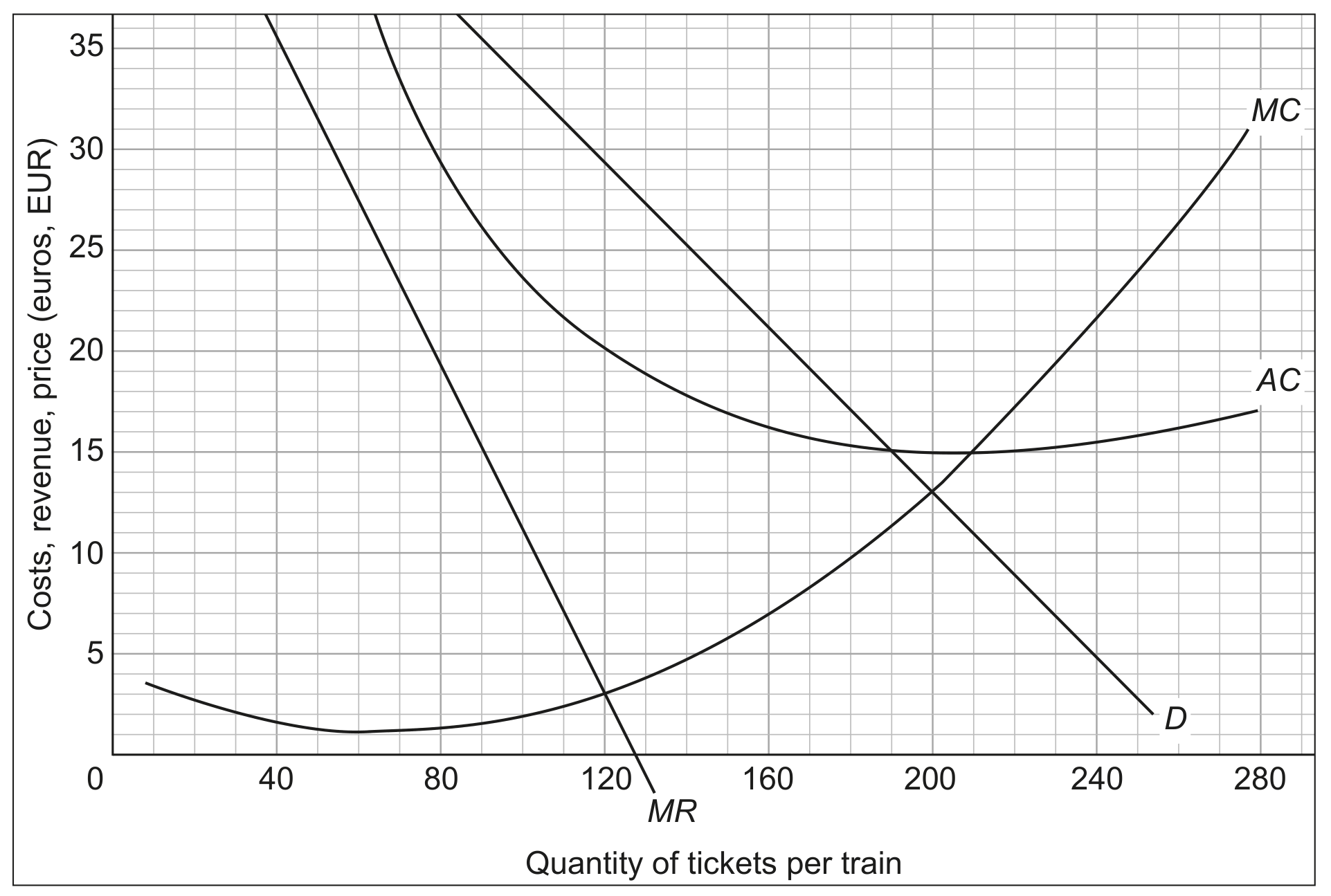
Figure 4
Define the term consumer nudge.