Edexcel IAL Chemistry AS Decimal and Standard Form

Edexcel IAL Chemistry AS Decimal and Standard Form
Pearson Edexcel International Advanced Subsidiary/Advanced Level in Chemistry, Issue 1, September 2017Chemistry XCH11/YCH11

Practise Edexcel IAL Chemistry decimal and standard form skills by calculating reciprocal table values such as 1/t and recording small decimals to sensible precision.

How this is tested

  • Calculate reciprocal values such as 1/t in data tables and round small decimals to two significant figures.

Question 3(c)(i)

[Maximum number: 1]

A student investigated the kinetics of the reaction between bromide ions, Br\mathrm{Br}^{-}, and bromate(V) ions, BrO3\mathrm{BrO}_{3}^{-}, in aqueous acid.

5Br(aq)+BrO3(aq)+6H+(aq)3Br2(aq)+3H2O(l)5 \mathrm{Br}^{-}(\mathrm{aq})+\mathrm{BrO}_{3}^{-}(\mathrm{aq})+6 \mathrm{H}^{+}(\mathrm{aq}) \rightarrow 3 \mathrm{Br}_{2}(\mathrm{aq})+3 \mathrm{H}_{2} \mathrm{O}(\mathrm{l})

To determine the rate equation for the reaction, the student varied the concentration of bromide ions, bromate(V) ions and acid in turn.

The effect of the concentration of bromide ions was investigated first.

Procedure

Step 1 Add 10.0 cm310.0 \mathrm{~cm}^{3} of 0.0050 moldm30.0050 \mathrm{~mol} \mathrm{dm}^{-3} potassium bromate(V), 15.0 cm315.0 \mathrm{~cm}^{3} of acidified methyl orange indicator solution and 5.0 cm35.0 \mathrm{~cm}^{3} of 0.00010 moldm30.00010 \mathrm{~mol} \mathrm{dm}^{-3} aqueous phenol to a beaker labelled P.

Step 2 Prepare the contents of beaker Q for Run 1 as specified in the table.
Step 3 Pour the contents of beaker Q into beaker P and start a timer. Pour the contents of beaker P back into beaker Q and place beaker Q on a white tile.

Step 4 Stop the timer as soon as the mixture turns colourless. Record the time, along with the temperature of the solution.

Step 5 Repeat Steps 1 to 4 for the remaining runs.
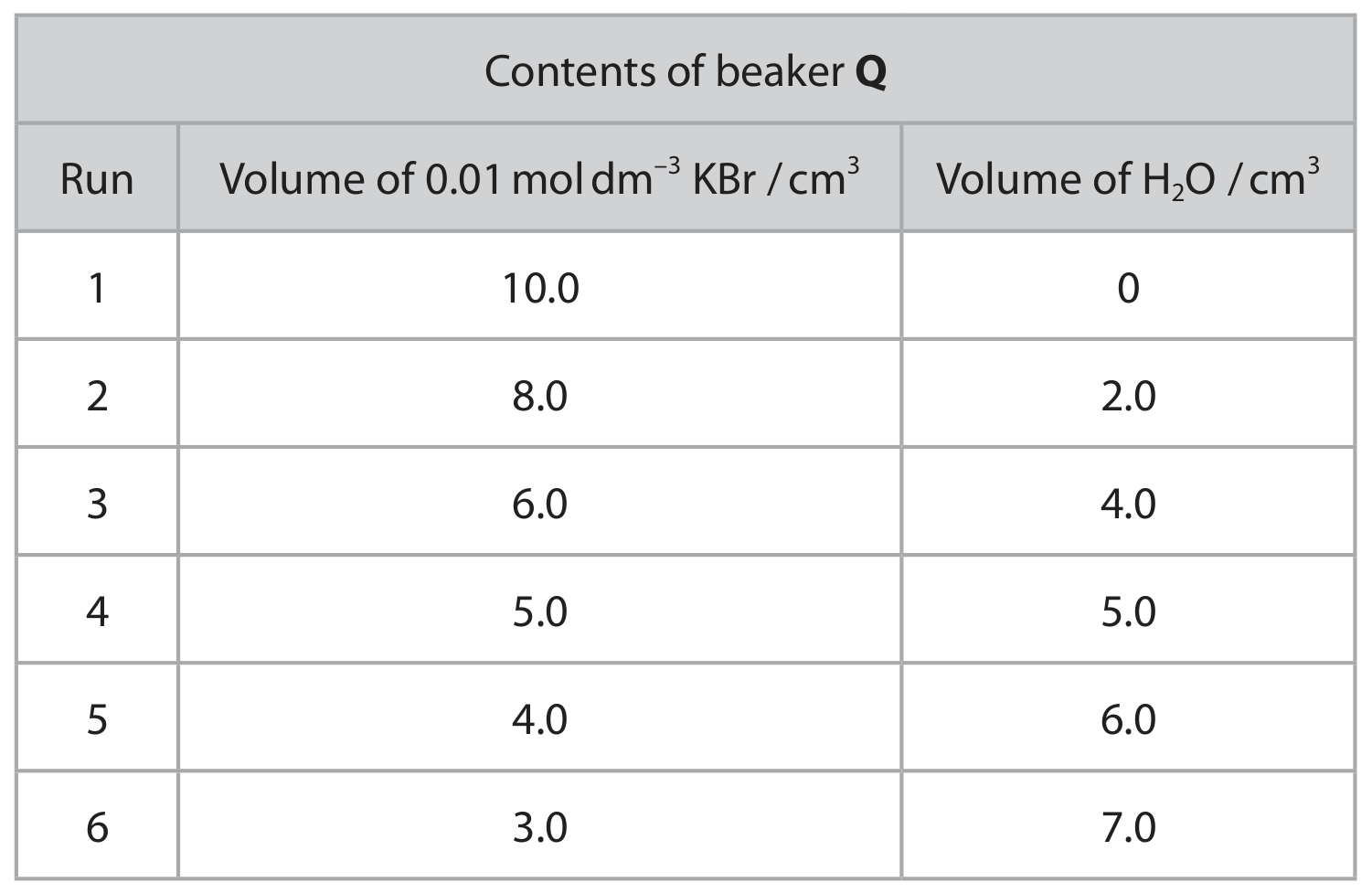
Table for Question 3(c)(i) — Edexcel A-Level Chemistry AS

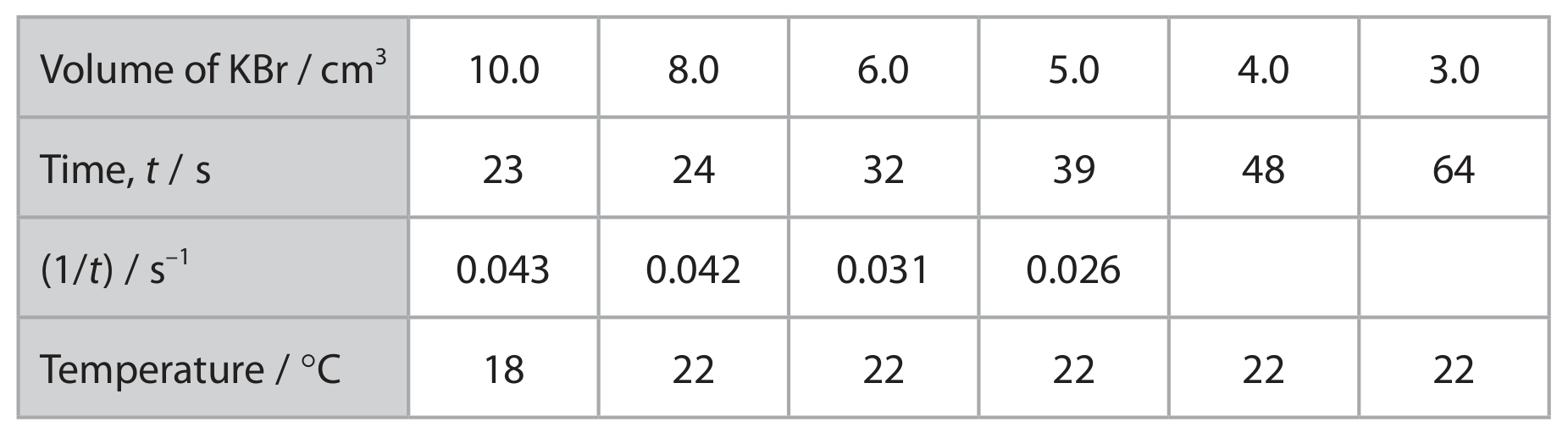
The student's results are shown.

Table for Question 3(c)(i) — Edexcel A-Level Chemistry AS

Complete the table by calculating the remaining values of 1 / t.