
EduNinja

Edexcel IAL Chemistry AS Topic 10 Halogenoalkanes, alcohols and spectra

Edexcel IAL Chemistry AS Topic 10 Halogenoalkanes, alcohols and spectra
Pearson Edexcel IAL Chemistry syllabusChemistry YCH11First assessment 2019

Identify structures and reaction class first, then supply precise reagents, conditions, curly arrows or diagnostic spectral peaks required by the pathway or evidence.

Exam points

  • Draw nucleophilic substitution and elimination mechanisms with correct curly arrows.
  • Plan halogenoalkane or alcohol conversions using named reagents, conditions and products.
  • Interpret hydrolysis experiments, infrared absorptions and mass-spectral fragments.

Question 2

[Maximum number: 10]

This question is about two organic compounds, X and Y. Both are liquids which contain carbon, hydrogen and oxygen only.

Question 2(b)

(a)

When phosphorus(V) chloride is added to X, steamy white fumes are seen.

State what can be deduced about compound X from this observation only.

[ 1 ]

Question 2(c)

(b)

Compound X is converted into compound Y when refluxed with excess sodium dichromate(VI) in sulfuric acid.

Compound Y is a liquid that is soluble in the reaction mixture.
Draw a labelled diagram of the apparatus that could be used to separate Y from the reaction mixture.

[ 3 ]

Question 2(d)

(c)

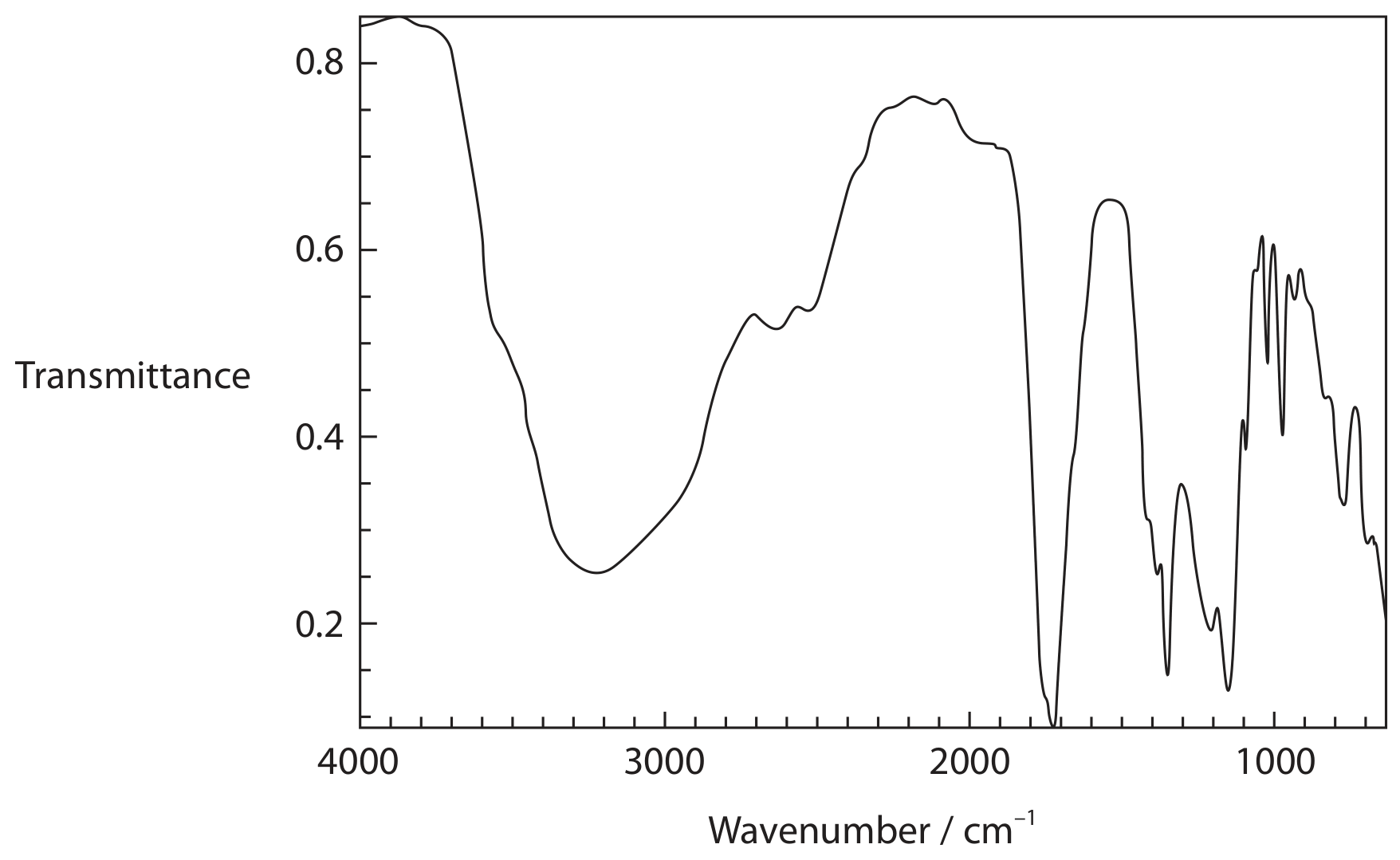
The infrared spectrum of Y is shown.

Question image

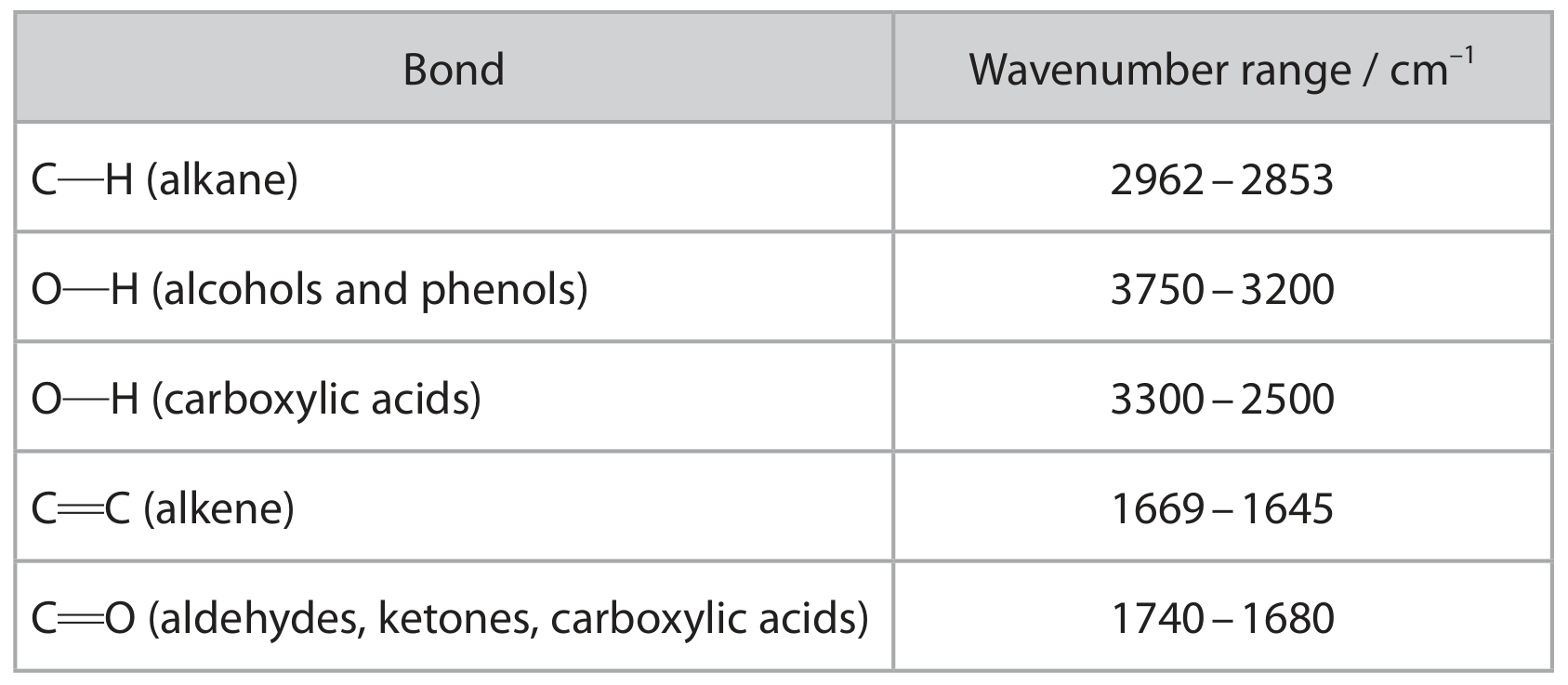
The table shows some infrared absorption data.
Table

Explain how this spectrum shows that Y contains a carboxylic acid functional group, quoting data from the table.

[ 2 ]

Question 2(e)

(d)

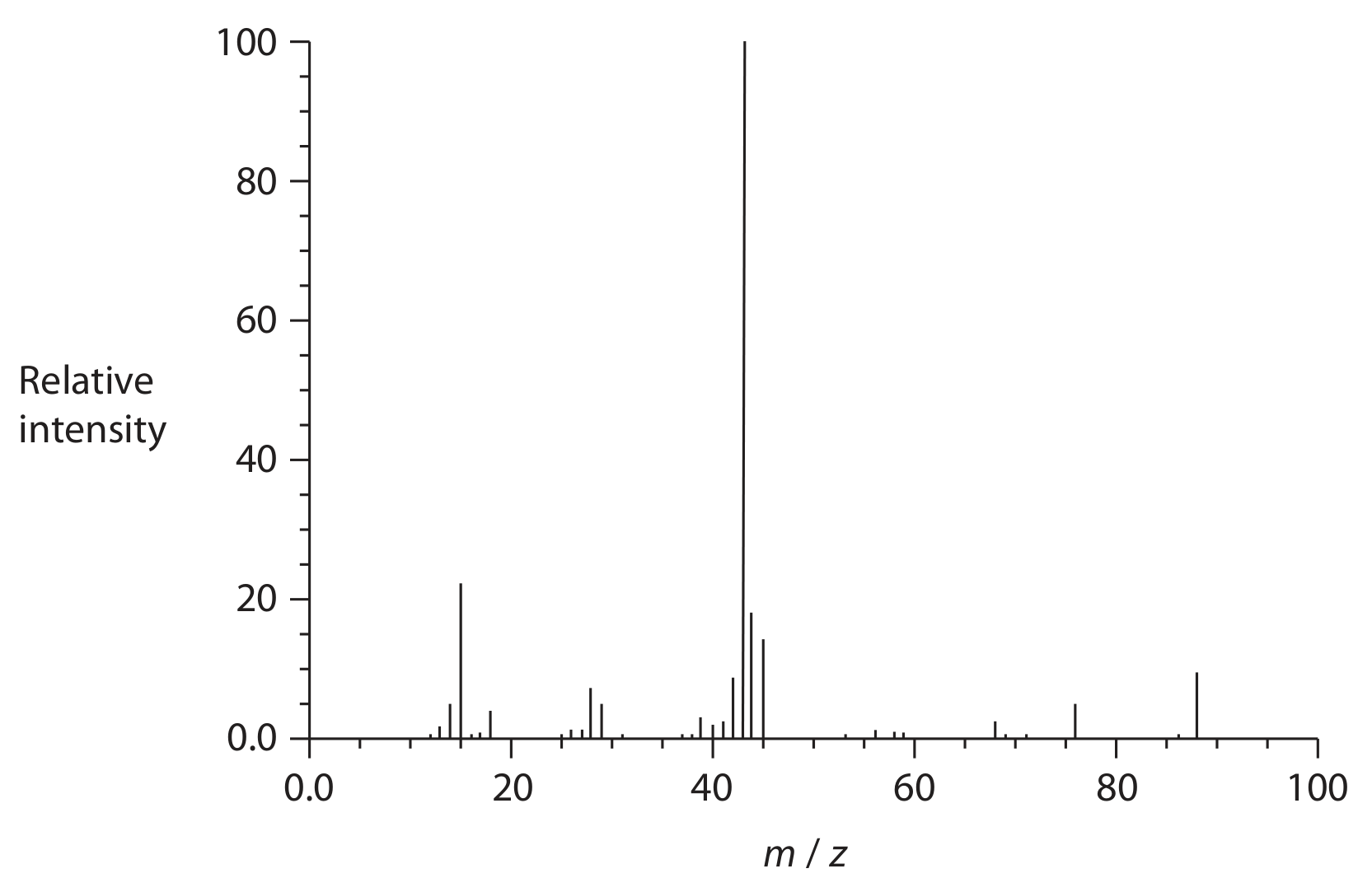
The mass spectrum of Y is shown.

Question image
[ 2 ]

Question 2(e)(i)

(i)

Show that the mass spectrum is consistent with Y having the molecular formula C3H4O3\mathrm{C}_{3} \mathrm{H}_{4} \mathrm{O}_{3}.

[ 1 ]

Question 2(e)(ii)

(ii)

Suggest the structure of the ion causing the peak at m / z=43 in the mass spectrum of Y.

[ 1 ]

Question 2(f)

(e)

Compound X contains one type of functional group.

Compound Y contains two different functional groups.
Use the information in the question to deduce the structures of X and Y.

Compound X

Compound Y
[ 2 ]

Question 13

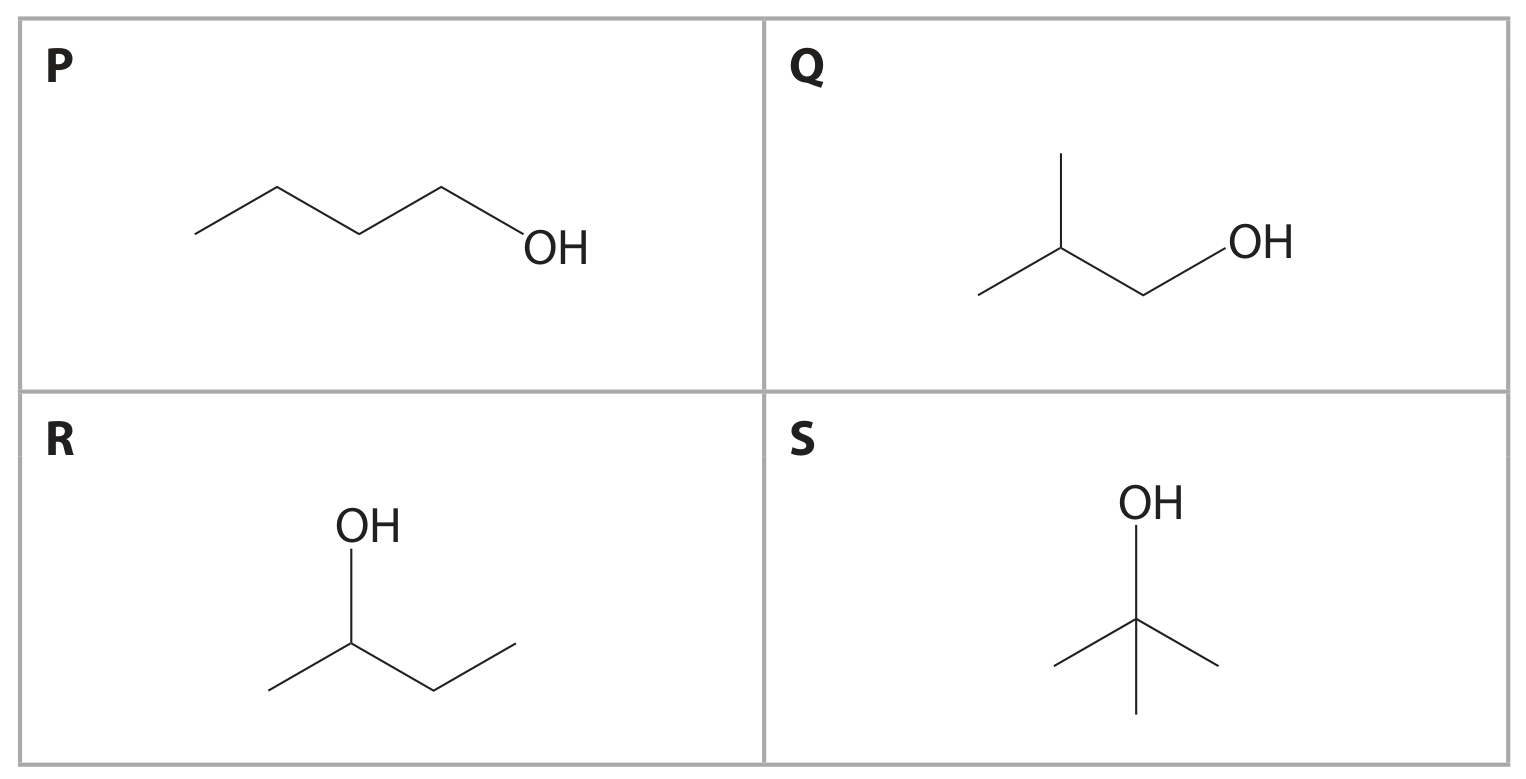
Which of these alcohols will produce a carboxylic acid when heated under reflux with acidified potassium dichromate(VI)?

Table

□ A P only
□ B P and Q only
□ C P, Q and R only
□ D P, Q, R and S

Question 14

[Maximum number: 3]

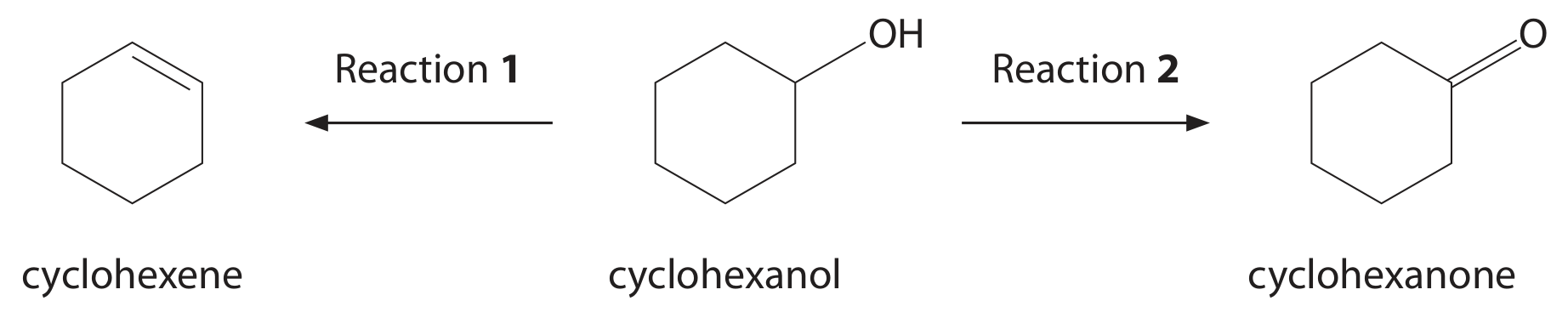
Two reactions of cyclohexanol are shown.

Question image

Question 14(a)

(a)

What is the reagent for Reaction 1?

A

acidified potassium manganate(VII)

B

aqueous bromine

C

concentrated phosphoric(V) acid

D

phosphorus(V) chloride

[ 1 ]

Question 14(b)

(b)

The reagent for Reaction 2 is acidified potassium dichromate(VI).

Which equation best represents this reaction?

A C6H11OHC6H10O+H2\mathrm{C}_{6} \mathrm{H}_{11} \mathrm{OH} \rightarrow \mathrm{C}_{6} \mathrm{H}_{10} \mathrm{O}+\mathrm{H}_{2}

B C6H11OHC6H10O+2[H]\mathrm{C}_{6} \mathrm{H}_{11} \mathrm{OH} \rightarrow \mathrm{C}_{6} \mathrm{H}_{10} \mathrm{O}+2[\mathrm{H}]

C C6H11OH+[O]C6H10O+H2O\mathrm{C}_{6} \mathrm{H}_{11} \mathrm{OH}+[\mathrm{O}] \rightarrow \mathrm{C}_{6} \mathrm{H}_{10} \mathrm{O}+\mathrm{H}_{2} \mathrm{O}

D C6H11OH+12O2C6H10O+H2O\mathrm{C}_{6} \mathrm{H}_{11} \mathrm{OH}+\frac{1}{2} \mathrm{O}_{2} \rightarrow \mathrm{C}_{6} \mathrm{H}_{10} \mathrm{O}+\mathrm{H}_{2} \mathrm{O}

[ 1 ]

Question 14(c)

(c)

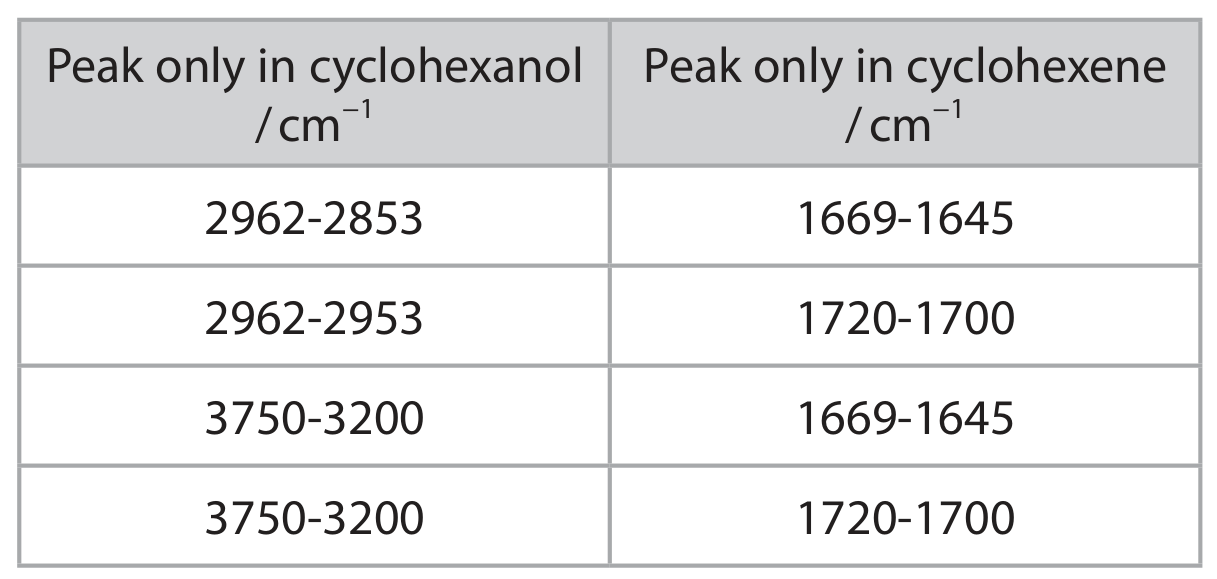
Cyclohexanol and cyclohexene each has a peak in their infrared spectrum which is not present for the other compound.

Which are these peaks?
□ A
□ B
□ C
□ D

Table

(Total for Question 14 = 3 marks)

TOTAL FOR SECTION A = 20 MARKS

Answer ALL the questions. Write your answers in the spaces provided.

[ 1 ]

Question 20

[Maximum number: 10]

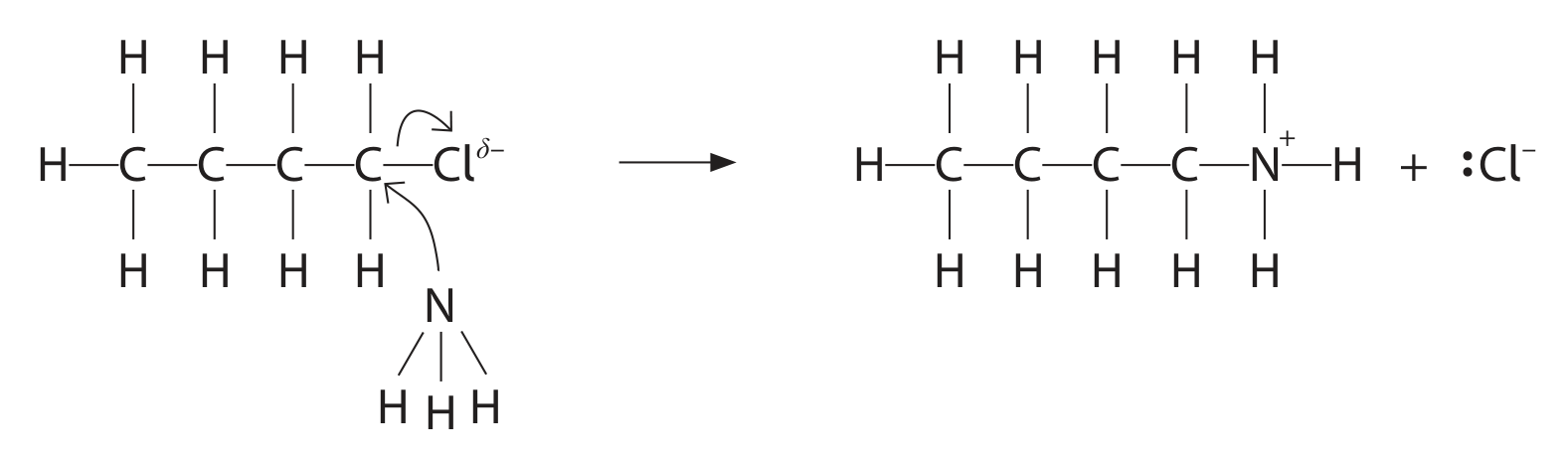
Ammonia reacts with 1-chlorobutane.

Question 20(a)

(a)

State the type and mechanism of this reaction.

[ 2 ]

Question 20(b)

(b)

A student drew the first step of the mechanism for the reaction.

Question image
[ 5 ]

Question 20(b)(i)

(i)

Identify two omissions in the student's mechanism.

[ 2 ]

Question 20(b)(ii)

(ii)

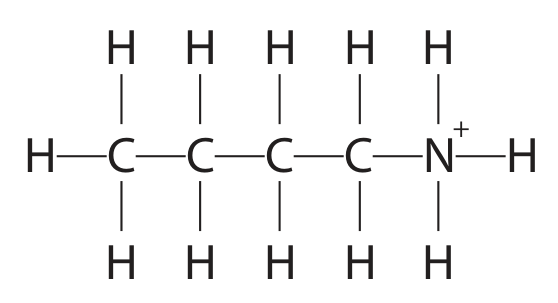
To obtain butylamine, sodium hydroxide solution is added.

Complete the next step of the mechanism to form butylamine, showing curly arrows, relevant lone pairs and the reaction products.
(3)

Question image
[ 3 ]

Question 20(c)

(c)

The reactions of ammonia and of hydroxide ions with halogenoalkanes are similar. Compare the rate of reaction of ammonia with 1-chlorobutane and with 2-bromo-2-methylpropane. Justify your answer.

[ 3 ]

Question 3

[Maximum number: 14]

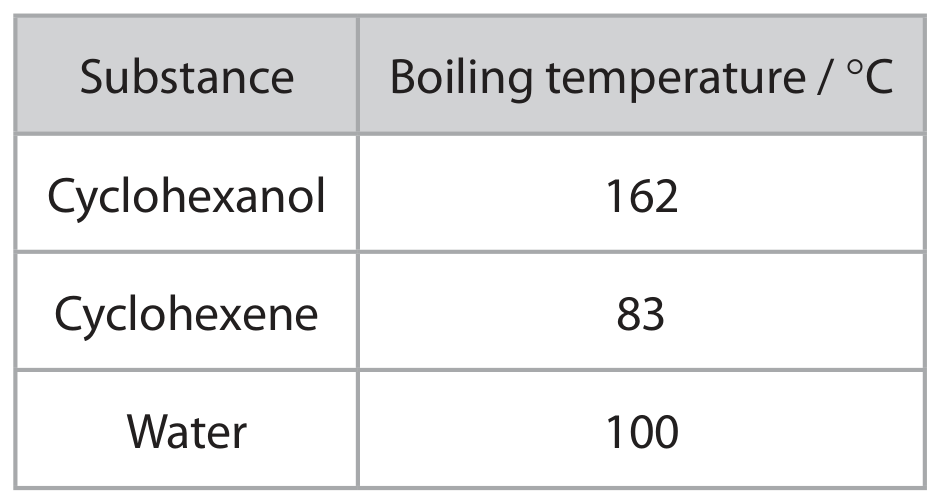
Cyclohexene, C6H10\mathrm{C}_{6} \mathrm{H}_{10}, was prepared by dehydrating cyclohexanol, C6H11OH\mathrm{C}_{6} \mathrm{H}_{11} \mathrm{OH}, using concentrated phosphoric (V) acid, H3PO4\mathrm{H}_{3} \mathrm{PO}_{4}.

C6H11OH(l)C6H10(l)+H2O(l)\mathrm{C}_{6} \mathrm{H}_{11} \mathrm{OH}(\mathrm{l}) \rightarrow \mathrm{C}_{6} \mathrm{H}_{10}(\mathrm{l})+\mathrm{H}_{2} \mathrm{O}(\mathrm{l})

Procedure

Step 1 Approximately 12 cm312 \mathrm{~cm}^{3} of cyclohexanol was measured into a small flask.
Step 25 cm325 \mathrm{~cm}^{3} of concentrated phosphoric(V) acid was added slowly to the flask with cooling and swirling.

Step 3 Some anti-bumping granules were added to the mixture.
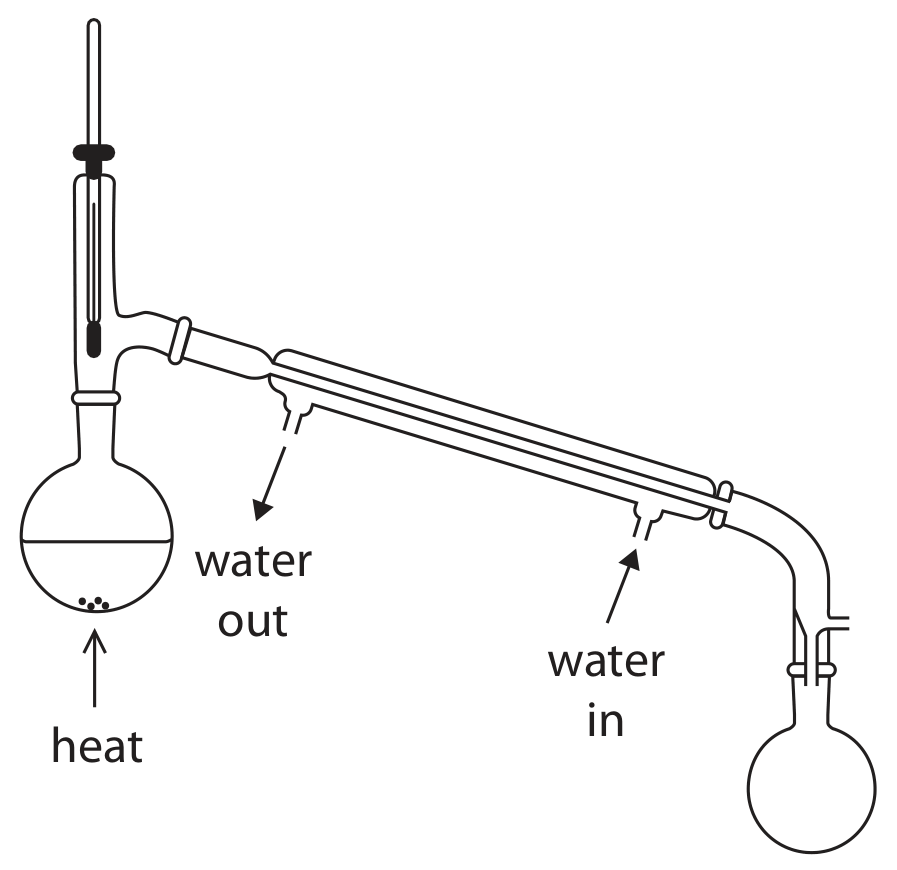
Step 4 The flask was set up for distillation, using the apparatus shown, and the distillate was collected between 80C80^{\circ} \mathrm{C} and 90C90^{\circ} \mathrm{C}.

Question image

Step 5 The distillate was transferred to a separating funnel and washed with an aqueous solution of sodium carbonate.

Step 6 The crude organic product was separated from the mixture, placed in a clean separating funnel and washed with deionised water.

Step 7 The organic layer was separated and dried using a suitable drying agent.
Step 8 The dried organic layer was distilled, over a narrow range of temperature, to give pure cyclohexene.

Table
VIIIV SIHI NI JIIYM IONOOVJYV SIAL NI IIIYM ION OCVIIV SIHI NI JIIIM ION OC

Question 3(b)

(a)

Explain why adding phosphoric(V) acid slowly, with cooling and swirling,

[ 2 ]

Question 3(d)

(b)

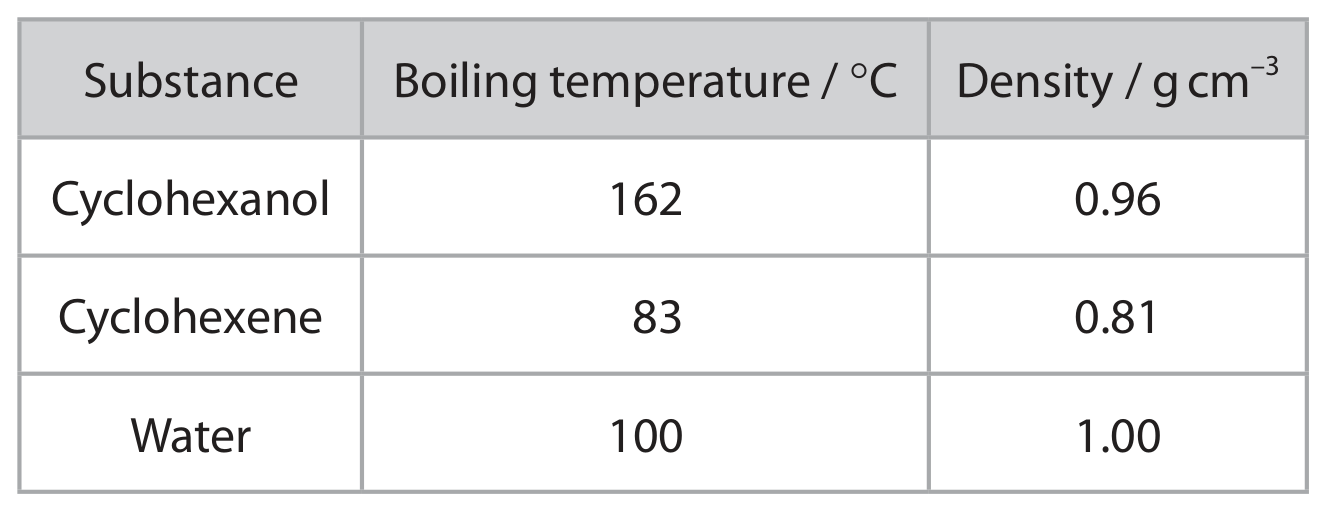
Explain why, in Step 4, the distillate is collected in a temperature range of 80C80^{\circ} \mathrm{C} to 90C90^{\circ} \mathrm{C}.
(2)

Table
[ 2 ]

Question 3(e)(i)

(c)

State what is removed by washing the mixture with
sodium carbonate solution in Step 5.
Include an ionic equation for the reaction.
State symbols are not required.

[ 2 ]

Question 3(e)(ii)

(d)

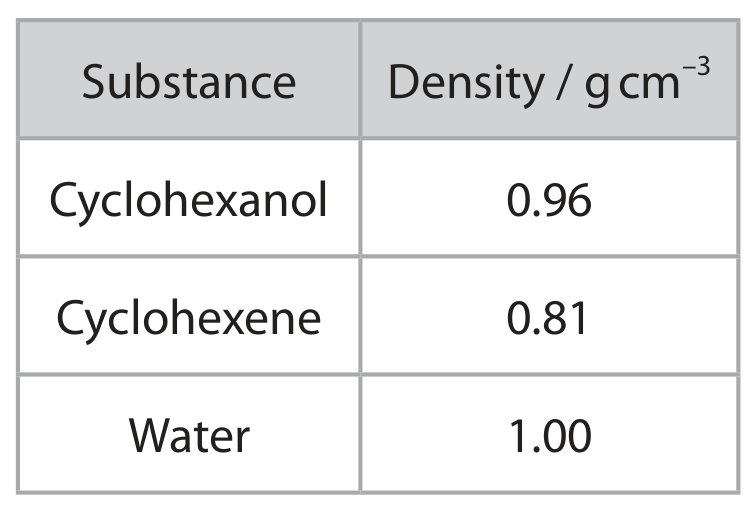
After the washing in Step 5, the separating funnel contains two layers.

Draw a diagram of the separating funnel, labelling its contents.
(2)

Table
[ 2 ]

Question 3(e)(iii)

(e)

Suggest what might be removed by washing the product with deionised water in Step 6.

[ 1 ]

Question 3(f)

(f)

Identify from the list shown one substance that could be used as a drying agent in Step 7 of this procedure. Justify your choice.

Table
[ 2 ]

Question 3(g)

(g)

Chemical tests may be used to show whether or not reactants and products are present during the course of the procedure.

[ 3 ]

Question 3(g)(ii)

(i)

State a chemical test and the expected observation for an -OH group.

[ 2 ]

Question 3(g)(iii)

(ii)

State whether or not the test in (g)(ii) could be used on the organic product to show if cyclohexanol remains when Step 5 is complete.
Justify your answer.
(1)

[ 1 ]

Question 17

[Maximum number: 9]

This question is about some halogenoalkanes.

Question 17(a)

(a)

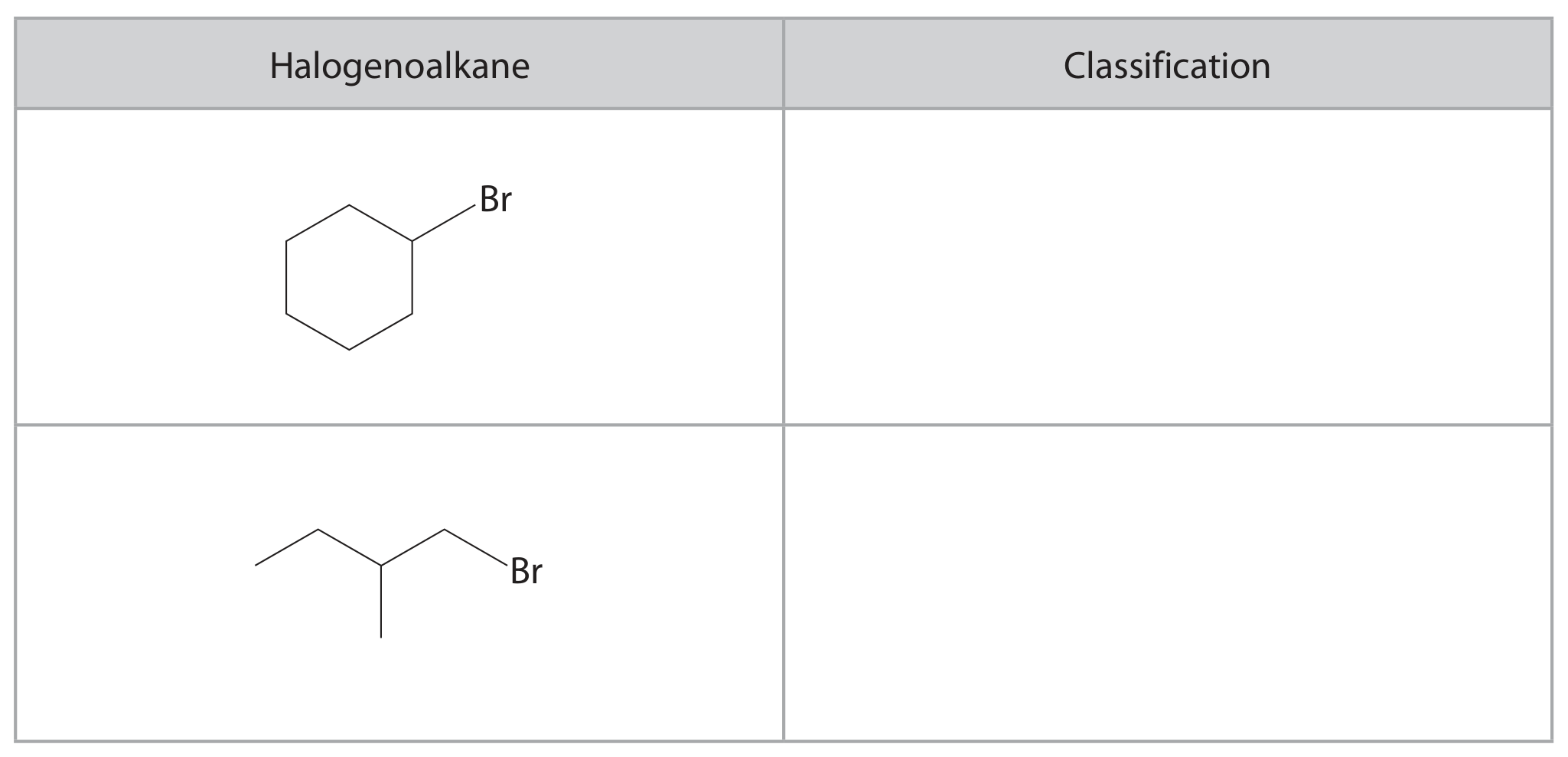
Give the classification of each halogenoalkane shown in the table as primary, secondary or tertiary.

Table
[ 1 ]

Question 17(b)

(b)

Samples of 1-iodobutane and 2-chloro-2-methylpropane were hydrolysed using aqueous silver nitrate in ethanol.

Explain whether or not it is possible to predict the relative rate of hydrolysis of these two compounds.

[ 3 ]

Question 17(c)

(c)

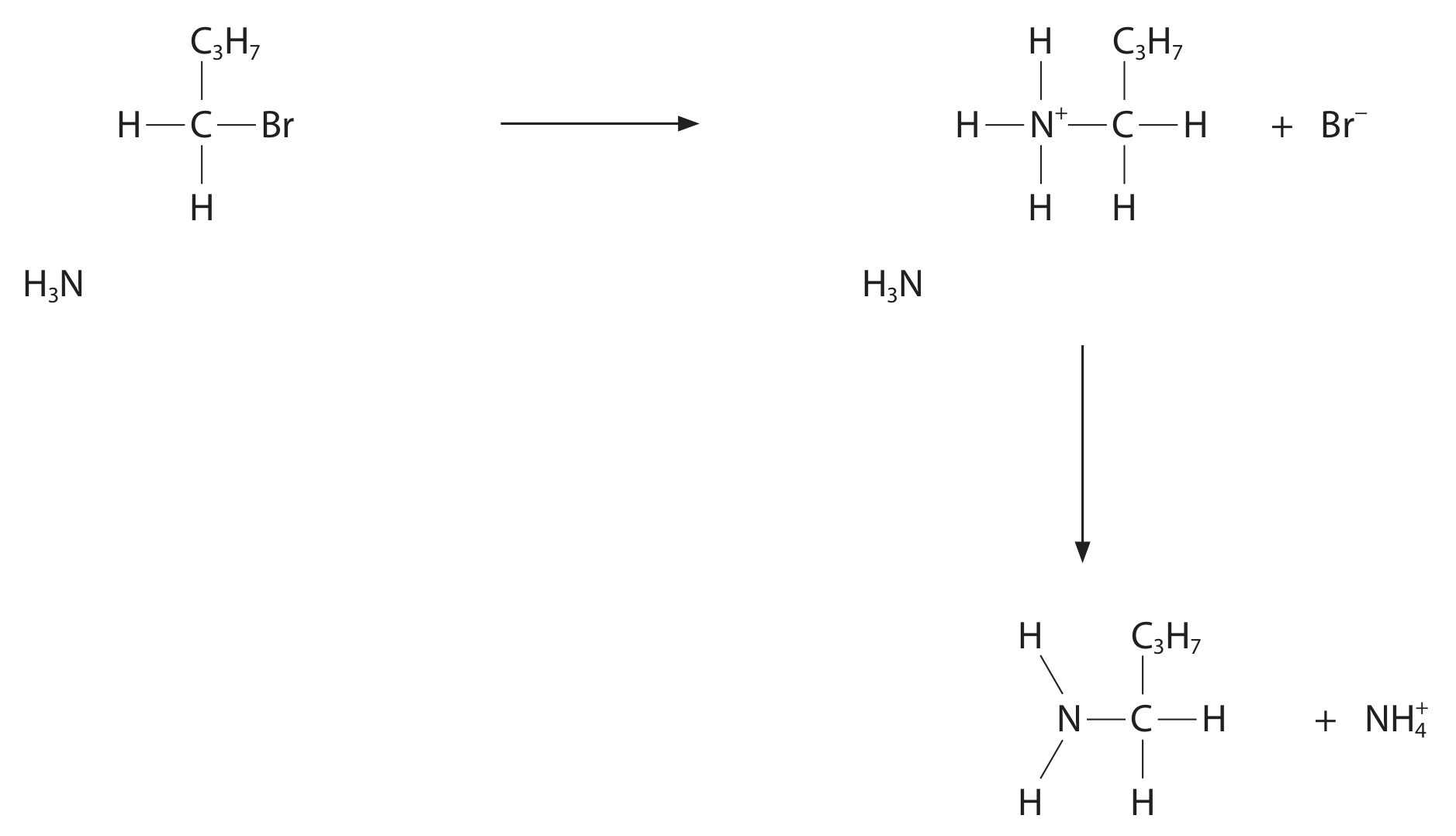
Butylamine is formed when 1-bromobutane reacts with excess concentrated alcoholic ammonia.

CH3CH2CH2CH2Br+2NH3CH3CH2CH2CH2NH2+NH4Br\mathrm{CH}_{3} \mathrm{CH}_{2} \mathrm{CH}_{2} \mathrm{CH}_{2} \mathrm{Br}+2 \mathrm{NH}_{3} \rightarrow \mathrm{CH}_{3} \mathrm{CH}_{2} \mathrm{CH}_{2} \mathrm{CH}_{2} \mathrm{NH}_{2}+\mathrm{NH}_{4} \mathrm{Br}
[ 5 ]

Question 17(c)(i)

(i)

Give a reason why this reaction should be carried out by heating the reactants in a sealed tube rather than heating under reflux.

[ 1 ]

Question 17(c)(ii)

(ii)

Complete the mechanism for this reaction by adding curly arrows, and any relevant lone pairs and dipoles.

Question image
[ 4 ]

Question 24

[Maximum number: 2]

Some diesel cars contain an extra catalytic converter for the reduction of nitrogen oxides (NOx)\left(\mathrm{NO}_{\mathrm{x}}\right) in exhaust gases.
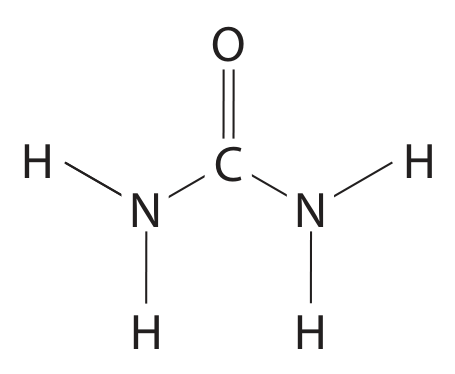
A solution of urea is used for this process.

Question image

urea

Question 24(d)

(a)

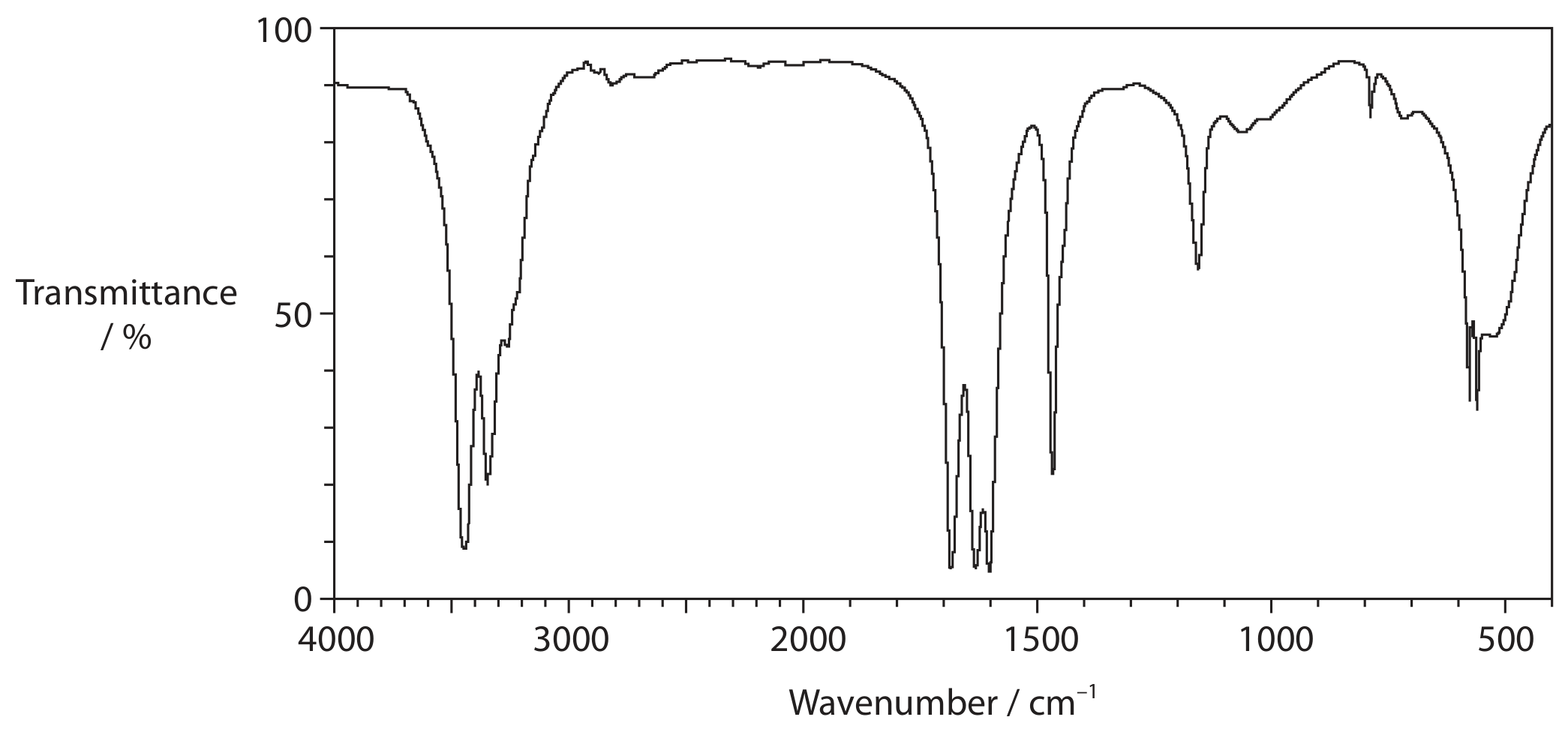
An infrared spectrum of urea is shown.

Refer to your Data Booklet.

stretching of the \(\mathrm{N

stretching of the \(\mathrm{N

[ 2 ]

Question 24(d)(i)

(i)

Draw a circle around an absorption in the spectrum that could be due to the

[ 1 ]

Question 24(d)(ii)

(ii)

Identify the bond responsible for the absorption at 1683 cm11683 \mathrm{~cm}^{-1}.

Question image

ption in

[ 1 ]