Question 1
[Maximum number: 1]
Which equation represents the standard enthalpy change of formation, , for aluminium oxide?
□
A
□
B
□
C
□
D
(Total for Question 1 = 1 mark)
 EduNinja
Practise energetics by interpreting enthalpy definitions, diagrams, calorimetry data, Hess cycles and bond enthalpy tables.
Which equation represents the standard enthalpy change of formation, , for aluminium oxide?
□
A
□
B
□
C
□
D
(Total for Question 1 = 1 mark)
The equation for the complete combustion of methanal is shown.

Some bond enthalpy data are shown.
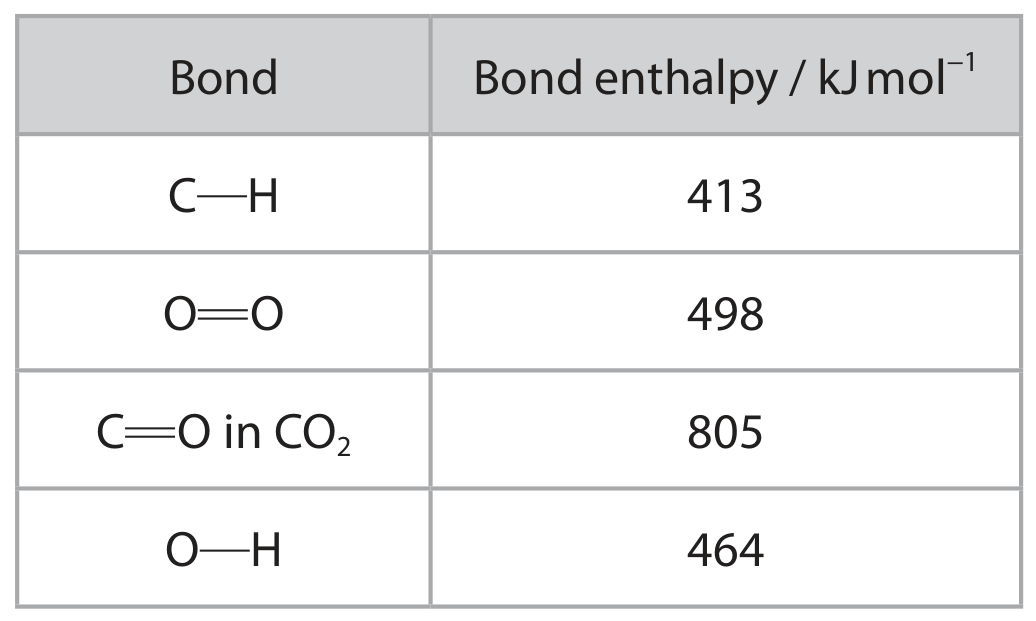
What is the C=O bond enthalpy in methanal?
□ A
□ B
□ C
□ D
A student carried out experiments to determine the enthalpy change for the hydration of anhydrous copper(II) sulfate, , to form hydrated copper(II) sulfate crystals, .
To find the enthalpy change of solution of anhydrous copper(II) sulfate, of distilled water was placed in a polystyrene cup and the temperature measured at one minute intervals.
After 2.5 minutes, 7.50 g of anhydrous copper(II) sulfate was added and the mixture stirred continuously.
The results are shown.

Determine the maximum temperature change, , using your graph.
You must show your working on the graph.
The value of the enthalpy change from this experiment was .
Give one possible reason why this value is different from a data book value of .
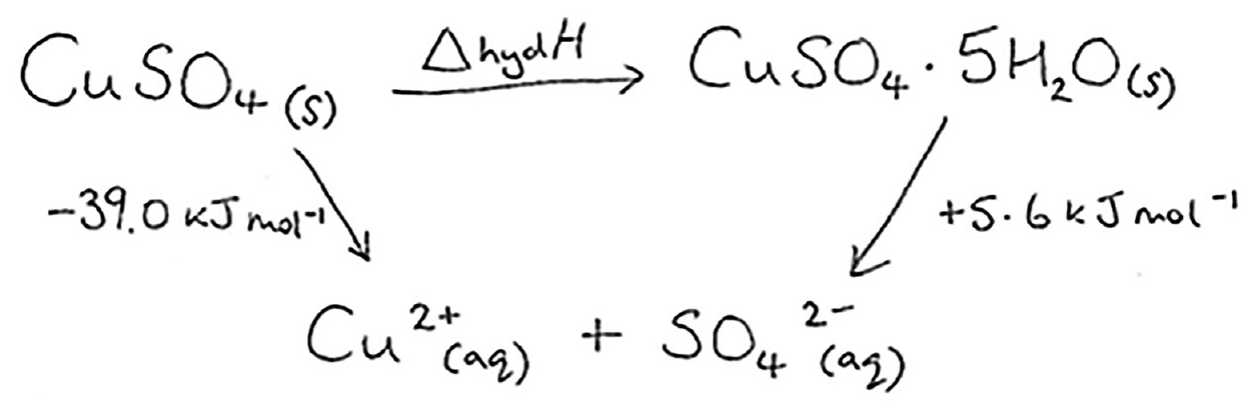
After another experiment to find the enthalpy change of solution of hydrated copper(II) sulfate crystals, the student constructed the Hess cycle shown.
Calculate the enthalpy change of hydration for the conversion of anhydrous copper(II) sulfate to hydrated copper(II) sulfate crystals.
Give one possible reason why the enthalpy change of hydration in (d)(i) could not be found directly by experiment.
| DO NOT WRITE IN THIS AREA | DO NOT WRITE IN THIS AREA | DO NOT WRITE IN THIS AREA |
|---|
This question is about enthalpy changes.
An experiment was carried out to determine the entalpy change of combustion for ethanol.
1.19 g of ethanol was burned in a spirit burner. The heat energy from this combustion raised the temperature of 100 g of water from to .
Calculate the heat energy required to raise the temperature of 100 g of water from to .
[Specific heat capacity of water ]
Use your answers to (a) (i) and (ii) to calculate a value for the enthalpy change of combustion of ethanol.
Give your answer to an appropriate number of significant figures and include a sign and units.
The value of the enthalpy change of combustion from this experiment was very inaccurate.
Give two reasons why this value was so inaccurate, apart from heat loss.
Mean bond enthalpies can be used to calculate a value for the enthalpy change of combustion of a compound.
Give the meaning of the term 'mean bond enthalpy'.
Calculate a value for the enthalpy change of combustion of methanol, using the information in the table and the equation shown.

Enthalpy changes of combustion can be used to calculate the enthalpy change of formation of a compound.
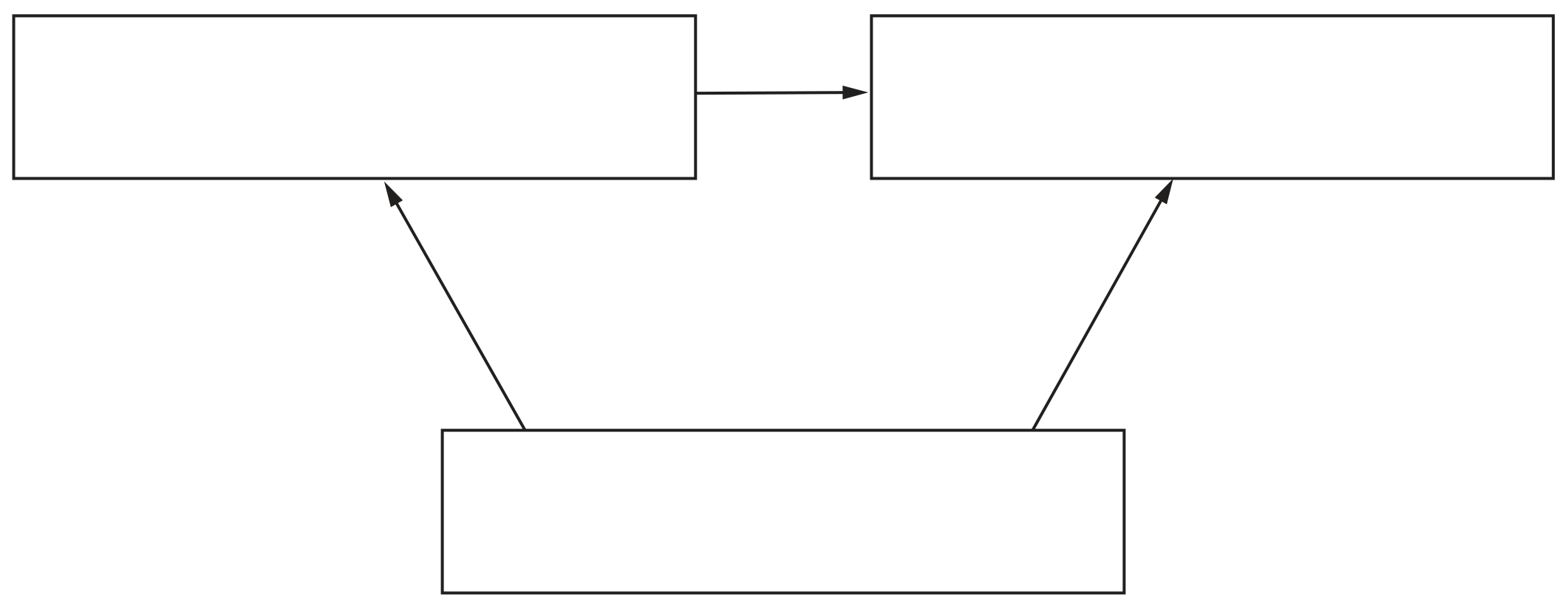
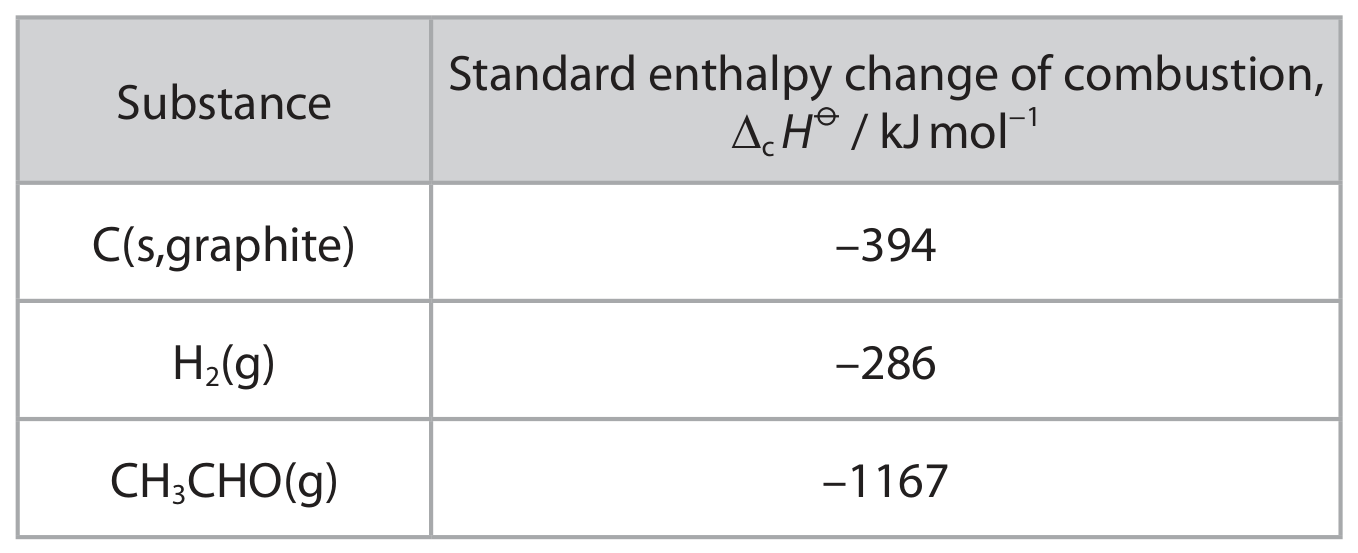
Complete the Hess cycle and use it to calculate the standard enthalpy change of formation for ethanal, .
A student carried out an experiment to determine the enthalpy change when solid lithium chloride, LiCl, dissolved in water to form a solution.
Procedure
Step 1 Use a pipette to place of distilled water into a polystyrene cup.
Step 2 Measure and record the initial temperature of the water.
Step 3 Add 2.12 g of lithium chloride to the water.
Step 4 Stir the mixture and record the highest temperature reached.
Give a reason why a polystyrene cup was used instead of a glass beaker in Step 1.
The temperature rise was .
Calculate the enthalpy change for the formation of this solution of lithium chloride.
Include a sign and units in your answer.
[Assume: specific heat capacity of the solution density of the solution ]
The temperature rise in this experiment was lower than expected, due to heat loss to the surroundings.
Describe changes to the procedure that would give a more accurate temperature rise.
Include the use of a stopwatch and details of a graph you would plot.
Enthalpy changes of combustion can be determined using calorimetry or calculated using Hess cycles. Apparatus for a calorimetry experiment is shown.
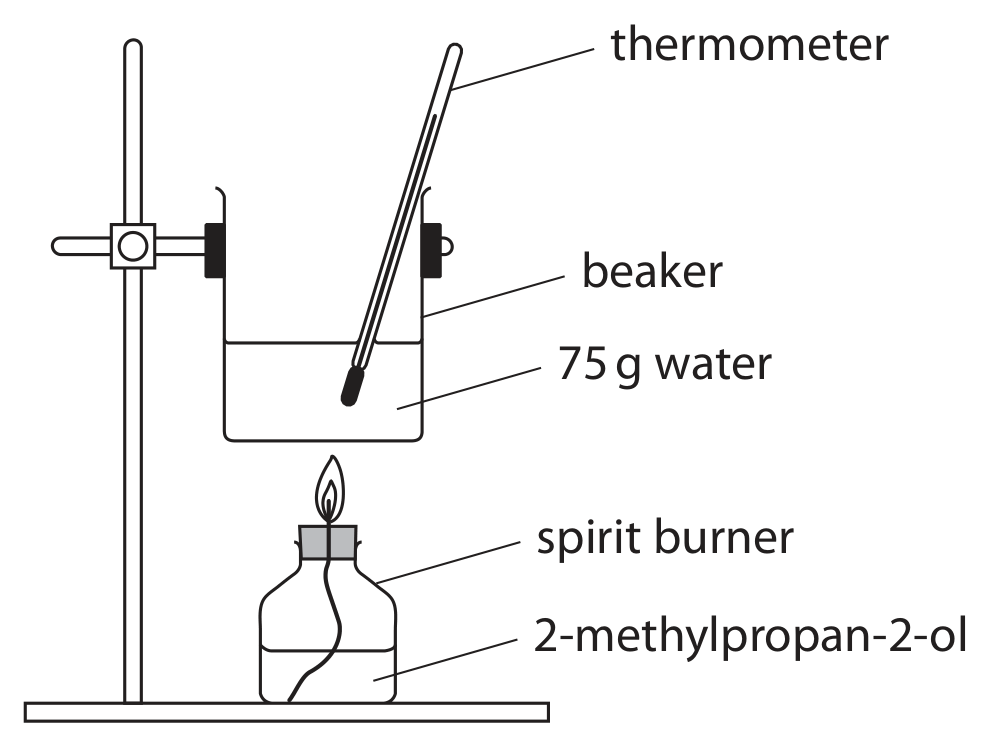
A sample of 2-methylpropan-2-ol was burned in a spirit burner and used to heat 75 g of water. The results are shown.
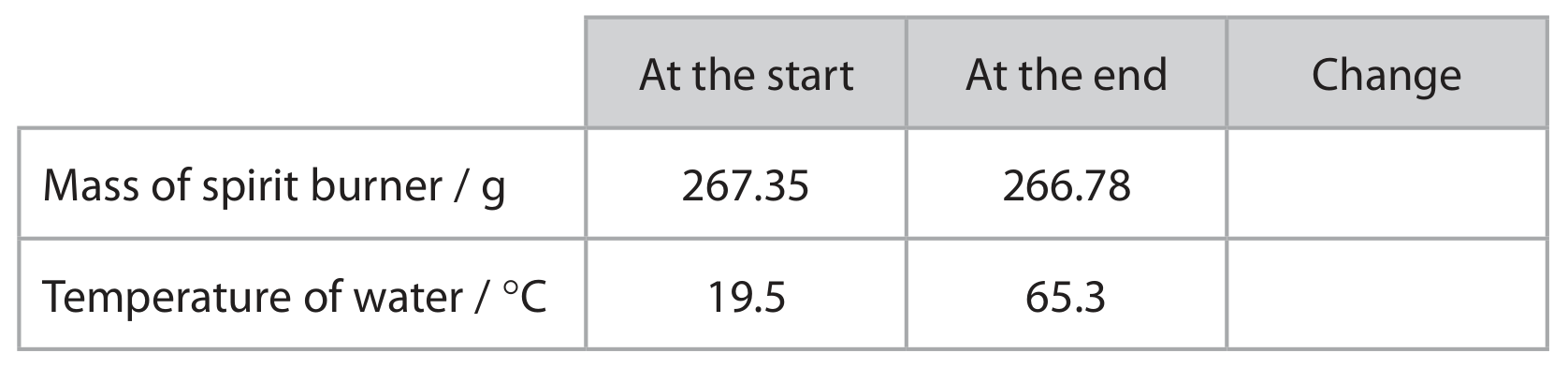
Complete the table.
Calculate the enthalpy change of combustion, , of 2-methylpropan-2-ol. Give a sign and units in your answer. [Specific heat capacity of water ]
The standard enthalpy change of combustion, , can be calculated using standard enthalpy changes of formation.
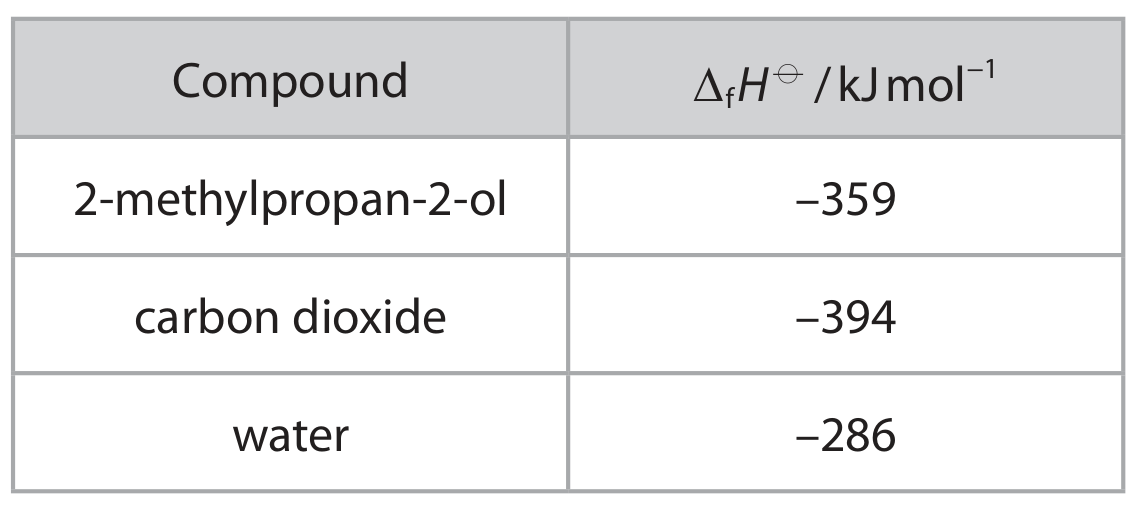
State why no value has been given for oxygen.
Complete the Hess cycle.
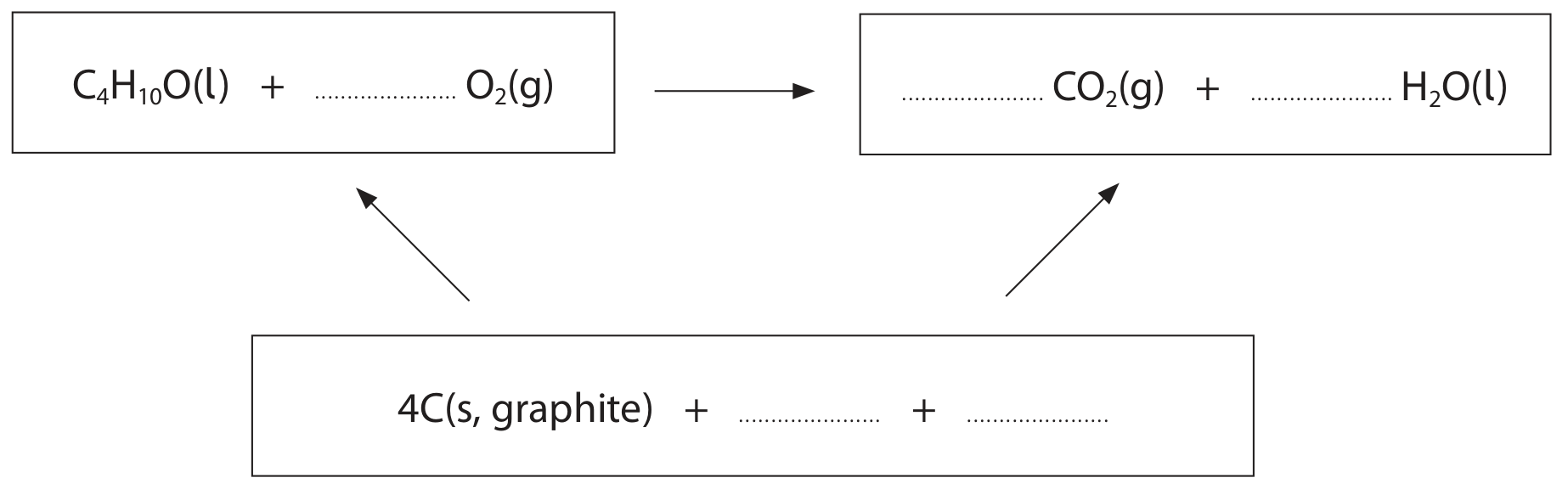
Calculate the standard enthalpy change of combustion of 2-methylpropan-2-ol using the data in the table and the completed Hess cycle.
The value for obtained in part (a)(ii) is much less exothermic than calculated in (b)(iii).
Suggest two reasons for this other than non-standard conditions.
(2)
| DO NOT WRITE IN THIS AREA | DO NOTI WRITE IN THIIS AREA | DO NOT WRITE IN THIS AREA |
|---|
This question is about ethanoic acid and some related salts.
Sodium ethanoate is a component of reusable hand warmers.
In use, a supersaturated solution of sodium ethanoate recrystallises to form solid hydrated sodium ethanoate, releasing energy.
A hand warmer has a mass of 63.2 g and forms 20.1 g of hydrated sodium ethanoate on recrystallisation.
Calculate the maximum temperature reached by the hand warmer if its initial temperature is .
[Specific heat capacity of the hand warmer ]
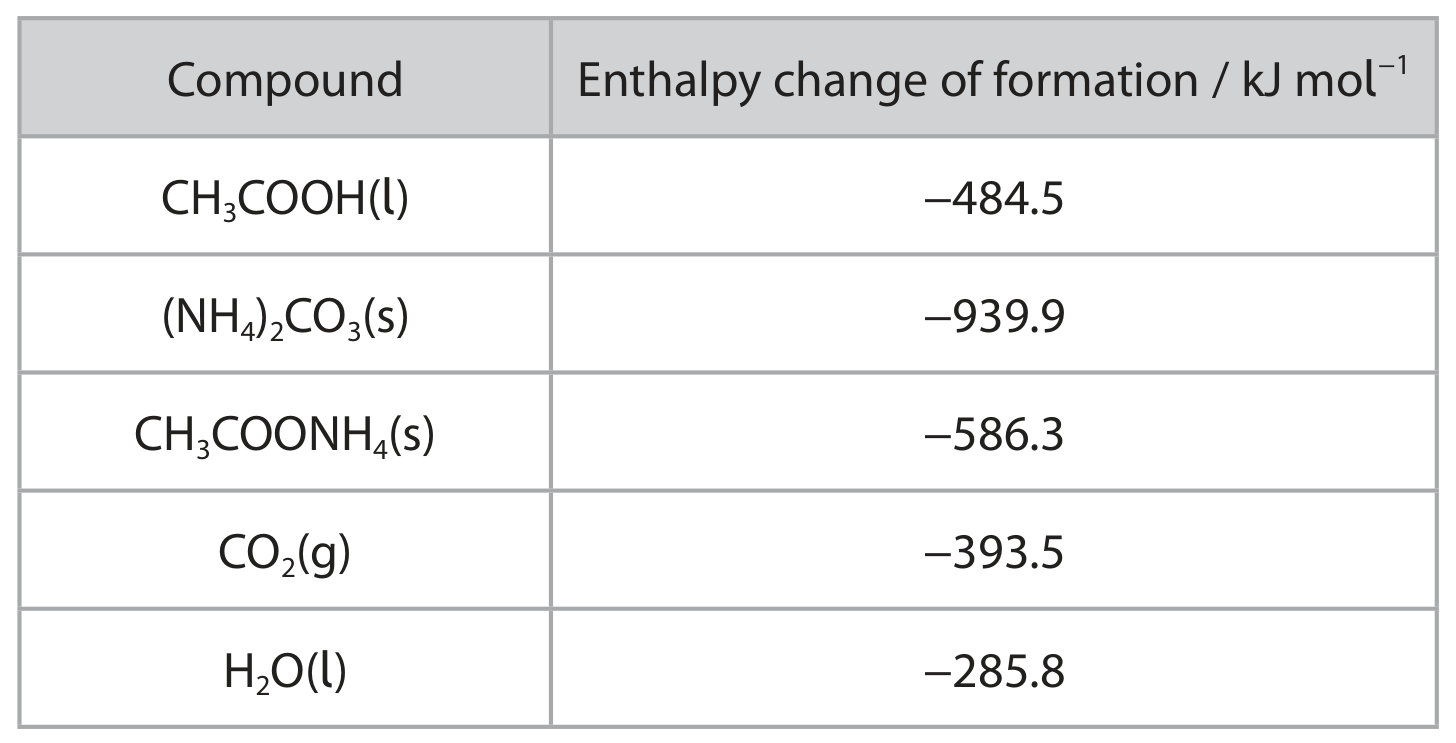
Ammonium ethanoate, , is used to control the pH of foods. It can be formed by the reaction of pure ethanoic acid, , with ammonium carbonate, .
Calculate the standard enthalpy change for this reaction by completing the Hess cycle and using the data shown.