
Question 9
[Maximum number: 1]
Which of these ions has the greatest ionic radius?
A
B
C
D
 EduNinja
Identify the bonding and particles present, draw or interpret the requested representation and connect charge, geometry or intermolecular attraction to the observed property.
Which of these ions has the greatest ionic radius?
Which of these ions has the greatest polarising power?
Which of these does not have a structure formed by a giant lattice of carbon atoms?
fullerene
diamond
graphene
graphite
Which of these molecules is the most polar?
HF
This question is about the bonding, structure and properties of the elements in Period 3 of the Periodic Table and their compounds.
Aluminium has the greatest electrical conductivity of the Period 3 elements.
Describe how metals conduct electricity.
(2)
Give a possible reason why aluminium has a higher electrical conductivity than sodium.
(1)
Aluminium is extracted by the electrolysis of aluminium oxide in the liquid state.
Draw a dot-and-cross diagram to show the bonding in aluminium oxide. Show outer shell electrons only.
Give a reason why aluminium oxide must be in the liquid state before electrolysis can occur.
This question is about the structure and bonding of Group 5 chlorides.
Nitrogen trichloride, , has a molecular structure.
The displayed formula of a molecule of is shown.
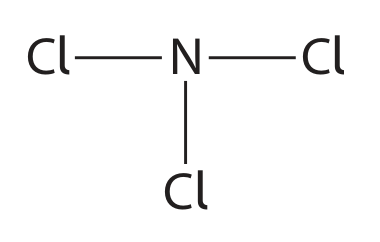
Complete the table for this molecule.
(3)
Under standard conditions, phosphorus(V) chloride ( ) is a solid made up of cations and anions.
Antimony (V) chloride is a liquid made up of molecules.
Explain why has a higher melting temperature than .
Draw a dot-and-cross diagram to show the bonding in a molecule of .
Use dots (•) to represent the Sb electrons, and crosses (x) to represent the Cl electrons. Show outer electrons only.
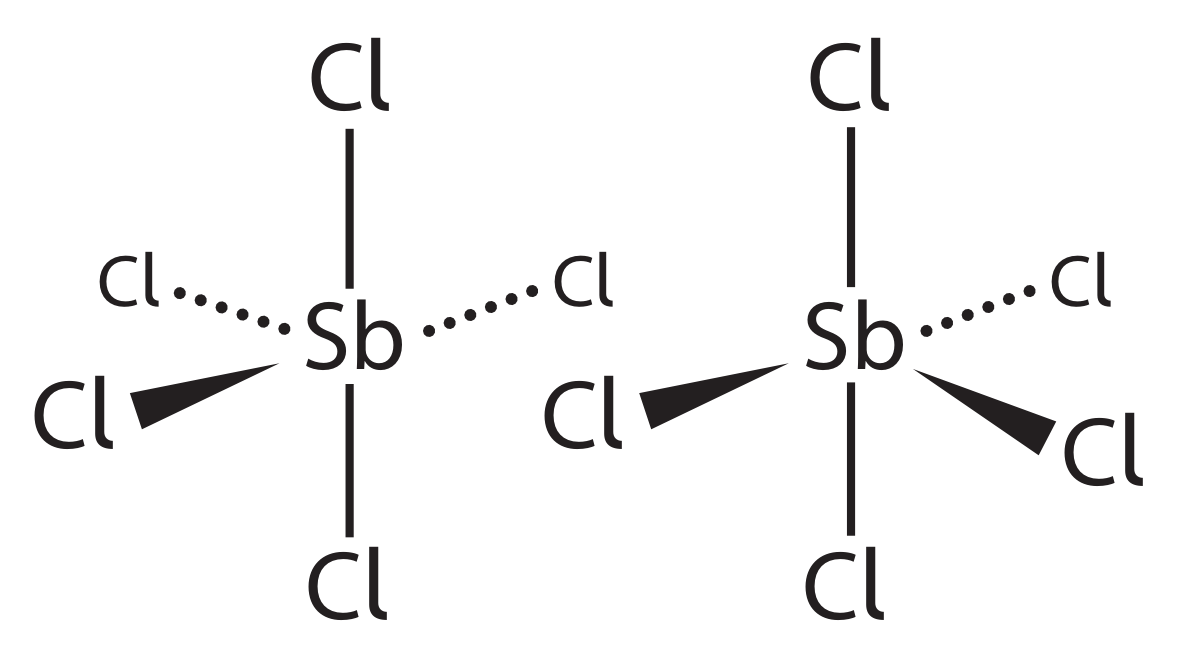
At low temperatures, converts to which contains dative covalent bonds.
State what is meant by the term dative covalent bond.
Complete the diagram to show the dative covalent bonds in .
Arsenic also forms a pentachloride with the formula .
Give one possible reason why nitrogen is the only Group 5 element that does not form a pentachloride.
(1)
(Total for Question 19 = 10 marks)
This question is about the compound ammonium dichromate(VI), .
Draw a dot-and-cross diagram of the ammonium ion.
Use dots for the nitrogen electrons and crosses (x) for the hydrogen electrons.
Explain the shape of the ammonium ion using electron-pair repulsion theory.
(2)