CAIE A-Level Economics 8.2 Equity and Redistribution Question Bank

CAIE A-Level Economics 8.2 Equity and Redistribution Question Bank
Cambridge International AS & A Level Economics 9708 syllabus for exams in 2026, 2027 and 20282026–2028

Practise distinguishing equity from equality, explaining poverty traps and evaluating taxes, transfers, benefits and supply-side measures for distribution and work incentives.

Exam points

  • distinguish equal outcomes from equitable treatment using income, wealth and opportunity evidence
  • trace tax and means-tested benefit withdrawal to disposable income and a poverty trap
  • evaluate progressive tax, negative income tax, UBI and supply policies through equity and incentives

Question 1(b)(i)

[Maximum number: 2]

Inequality and globalisation

A government commission published a report saying that global poverty and inequality were worsening and there was a risk that the gap between the rich and the poor would increase.

But, according to a newspaper, a lot of what is said about inequality is wrong. It overlooks the fact that the past 50 years saw a period of dramatic reduction in global inequality. The normal measurement of relative inequality is the Gini coefficient. The figure for global inequality in 1975 was 0.75 , in 2020 it was 0.72 and in 2022 it was 0.67 .

It is important to understand this trend rather than make the mistake of the commission.
The fall in global inequality should not come as a surprise. For about two hundred years the benefits of industrialisation went mainly to countries in Europe and North America. Income inequality between these countries and poorer countries worsened. The spread of globalisation in recent decades has meant this difference has lessened. Countries such as China and India have benefited from large increases in per capita (average) income, as shown in Table 1.1.
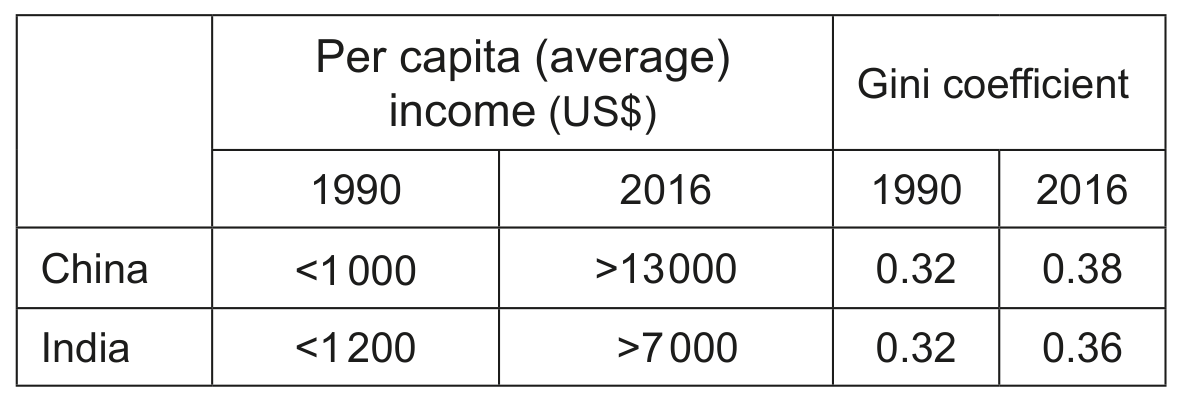
Table 1.1 Per capita (average) income and Gini coefficient for China and India 1990 and 2016

Table 1.1 Per capita (average) income and Gini coefficient for China and India 1990 and 2016

With such an increase in per capita incomes maybe some level of inequality does not matter. Indeed, it might be a necessary condition for economic growth. Instead of concentrating on eliminating inequality perhaps the focus should be on the absolute position of the poorest.

If the attention is on the relief of poverty rather than the wealth of the richest, improvements can be seen. Life expectancy has increased, most noticeably by ten years in the past two decades in the poorest region of sub-Saharan Africa. Literacy rates have also increased. Those in absolute poverty across the world have fallen from more than a third to under a tenth of the world's population. And all this while the world's population has increased.

Critics of globalisation and foreign direct investment (FDI) by multinational companies point to the possible negative environmental effects, the weakening of individual cultures and the reliance on international financial institutions that can fail. They also claim there can be exploitation of workers leading to greater wage inequality and possible increases in domestic unemployment as cheaper goods are imported.

Distinguish between equity and equality.

Question 1(a)

[Maximum number: 2]

Working overseas

Many low-income countries have large proportions of the population below the World Bank's absolute poverty level of $2.15\$ 2.15 per day (United States dollars, 2022). One way in which these countries try to reduce their poverty is by the migration of workers to richer countries. The migrants send a portion of their incomes, known as remittances, back home to support their families.

These overseas workers are a link between migration and development. The flow of remittance money is greater than the foreign direct investment and official development aid received by middle-income and low-income countries. Total remittances received by those countries in 2022 was $650\$ 650 billion, of which 45%45 \% ( $293\$ 293 billion) was received by only five countries.

About 50\% of migrants from low-income countries went to high-income countries.
Migrants can find their incomes increase significantly. A nurse may make seven times more in Australia than in the Philippines, adjusted for purchasing power parity (PPP).

Unlike official aid, remittances flow directly to their receivers and are a stable source of income. They can buy extra food and they may provide savings for the receiver. They may reduce child labour in disadvantaged families and allow for higher spending on education through higher enrolments and more years of completed schooling.

Migration can reduce unemployment and raise wages in home countries. Migration may lead to larger benefits for the home country by increasing the rates of return on human capital caused by the creation of better, more productive, and higher paying jobs.

When the flow of migrants goes to a host country whose population is ageing, it may reduce the average age of the population. This can lead to an increase in the size of the labour force, reduce the age dependency ratio and make a positive tax contribution. The migrants increase the demand for host country output and may utilise housing in less popular areas. Those with a high level of education make an even more significant contribution to economic output.

Sources: The Guardian, 23 August 2023
asia.nikkei.com, 3 March 2023
imf.org, March 2020

Explain what is meant by absolute poverty.

Question 10

[Maximum number: 1]

Which policy is most likely to contribute to people ending up in a poverty trap?

A

legal minimum wage

B

means-tested benefits

C

prevention of cheaper imports

D

proportional taxation

Question 10

[Maximum number: 1]

A government has a policy where income tax is paid only after the first $ 20000 of income has been earned.

What would make the government's policy more equitable?

A

Decreasing the threshold for paying income tax to $ 10000 for all taxpayers.

B

Integrating the tax and welfare systems by introducing a negative income tax.

C

Introducing universal benefits that are available to all citizens irrespective of wealth.

D

Means testing all benefits so that they remain the same even if real incomes fall.

Question 15

[Maximum number: 1]

When is a policy of income redistribution from rich people to poor people most appropriate?

A

when control of demand-pull inflation is the priority

B

when equality is valued more highly than efficiency

C

when monetary reward is the best incentive to risk-taking

D

when the rich have higher marginal utility curves than the poor