
Question 1(a)
In 2023, Mexico's energy policies looked increasingly out of step with those in the rest of the world. The Mexican President reversed recent reforms of Mexico's energy market. These reforms increased the role of private sector firms. He changed the balance of the mixed economy by prioritising state-owned companies and stressed that Mexico should produce its own energy rather than importing it.
The government invested in a new oil refinery and decided to keep coal-fired power stations running. It also gave state-owned electricity and oil companies priority over private sector rivals, so it was harder for private firms to obtain permits to generate electricity or to explore for oil.
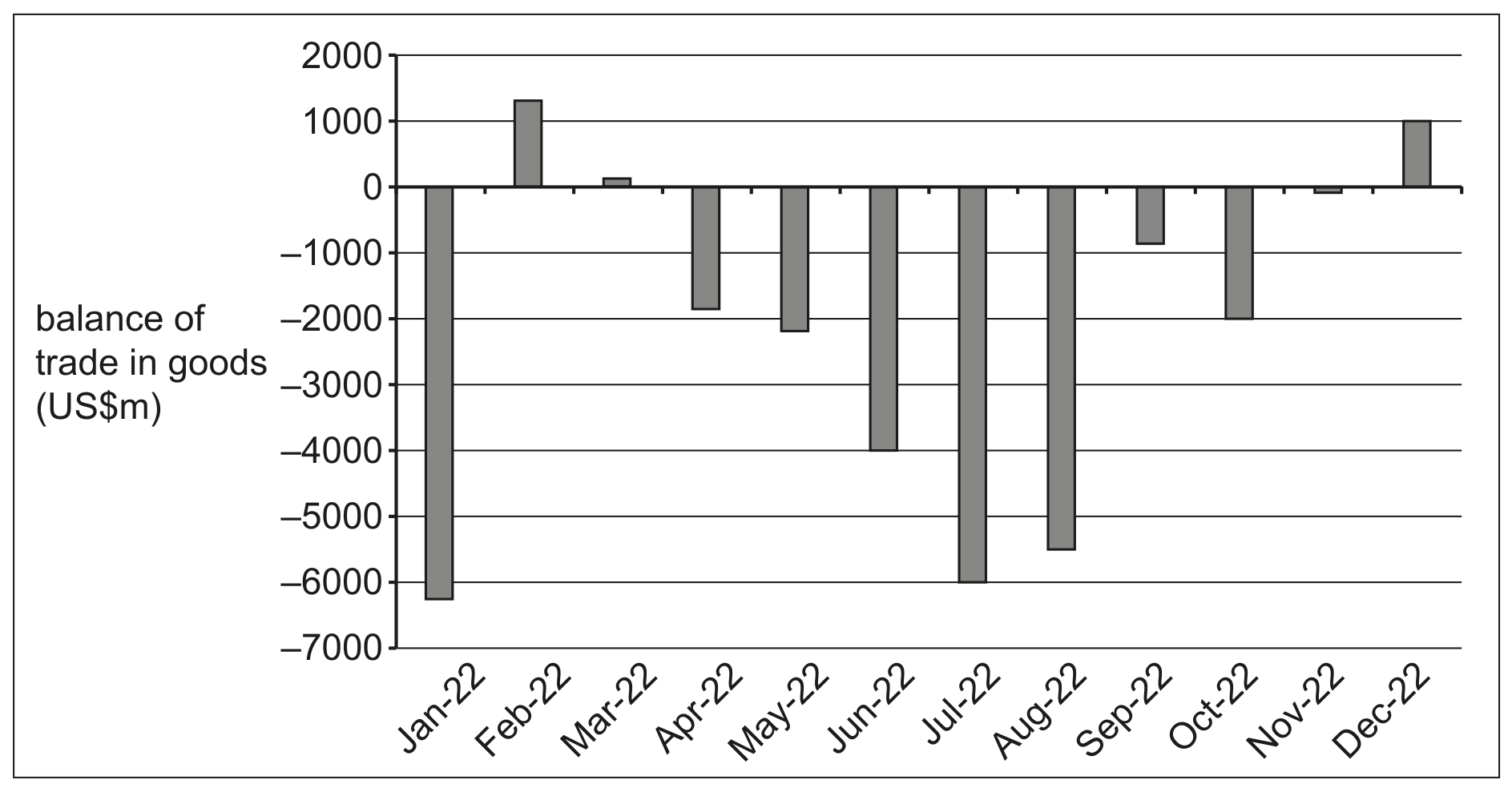
Mexico has traditionally exported crude oil and imported natural gas. However, the new plan is that the oil will be used to generate the country's electricity. There has been a global shift towards energy self-sufficiency but it is unclear whether Mexico has the capacity to produce enough electricity for its 130 million people. There may also be an impact on the country's balance of trade in goods which was in deficit for nine months of 2022, as shown in Figure 1.1.
Energy is likely to become more expensive. Operating costs of the state-owned electricity producers are significantly higher than their private sector rivals. Its old and inefficient plants are expensive to maintain. These costs will be passed on to the consumer, either directly or by the government having to spend more on subsidies to keep down the price.
The environment will also suffer. Mexico will see less investment in renewable energy because of its change in energy policy. In the past, domestic and foreign firms in the private sector did much of the investing. The policy change means that Mexico is unlikely to meet its pledge to produce of its electricity from renewable sources by 2024.
The impact of the energy policy may be felt in the economy more broadly. The earlier energy reforms had helped to bring manufacturers to Mexico by making power cheaper and more reliable. Now the uncertainty is deterring investors.
The opportunity cost of Mexico's new energy policy is huge. Economists reckon that Mexico could have produced almost half its electricity from renewable sources long before its target of 2050. Multinational companies were looking at Mexico as an alternative location to other countries, but because of Mexico's change in energy policy, those companies are likely to go elsewhere.
Using the information provided, explain whether Mexico is a mixed economy.