3.4.2—Nucleophilic substitution

Syllabus
First assessment 2025
Objective
3.4.2
Level
SL

Nucleophilic Substitution

The nucleophile donates a pair to carbon while the leaving group departs with its bonding pair. Deduce the product by replacing the leaving group with the nucleophile.
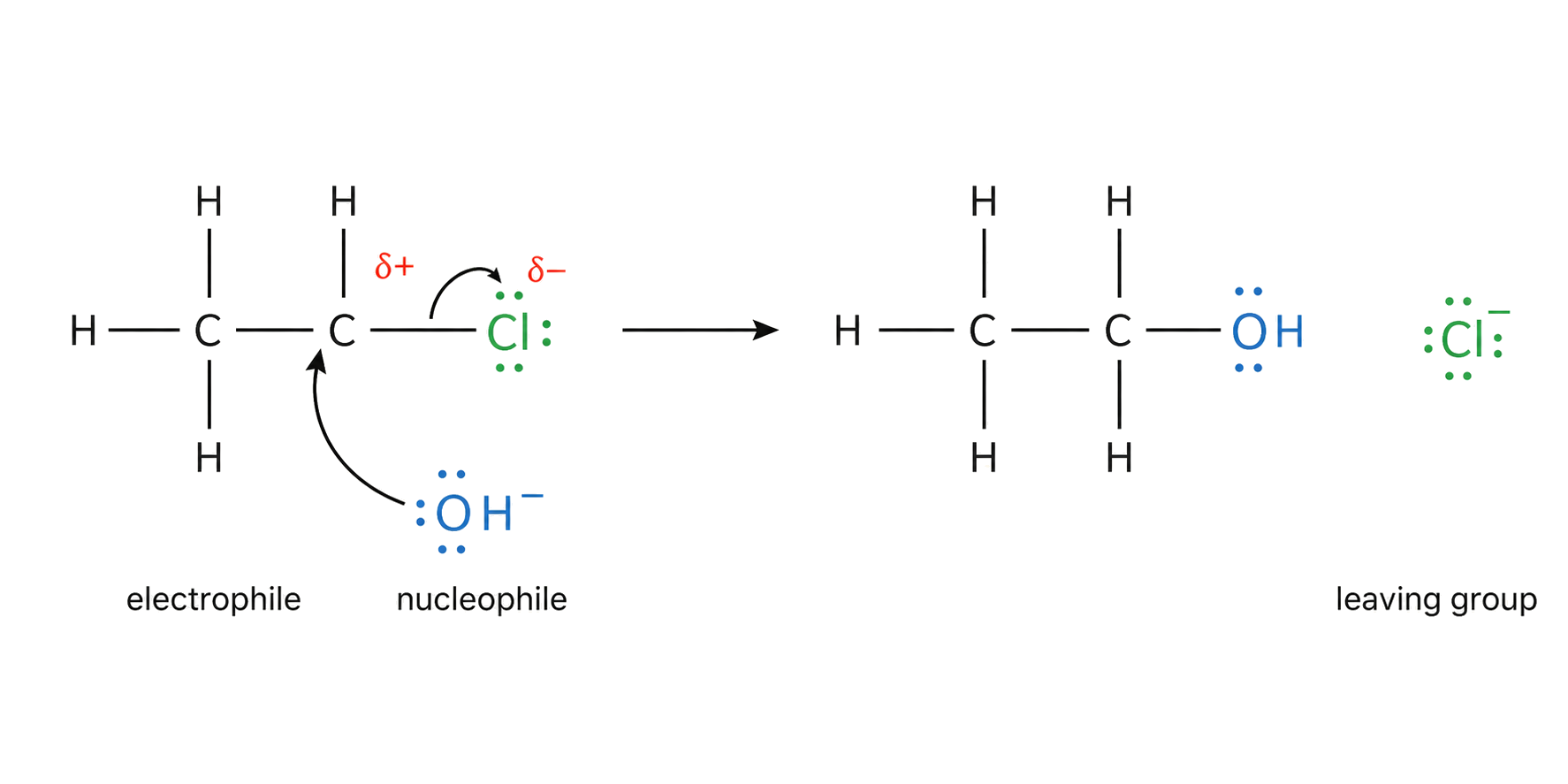
the hydroxide arrow starts at oxygen and ends at the carbon bearing chlorine; the leaving-group arrow starts at the C-Cl bond and ends at chlorine; carbon is delta positive and chlorine delta negative; CH3CH2OH and Cl- conserve every atom and charge.

For CH₃CH₂Br + OH⁻, the C–O bond forms as the C–Br bond breaks, giving CH₃CH₂OH + Br⁻. Account for charge and every atom in the product; the leaving group takes the bonding pair rather than departing as a neutral bromine atom.

Deducing Substitution Products

[ 4 ]

Explain the mechanism of the reaction, using curly arrows to represent the movement of electron pairs.

Electron-Pair Sharing Summary

Retrieve the route: classify nucleophiles and electrophiles, show heterolysis, write substitution and addition mechanisms, map Lewis coordination, compare SN1/SN2, and restore aromaticity in benzene substitution.

Check electron-pair arrow origin and destination, leaving-group departure, intermediate identity, carbocation stability and the assessed mechanism boundary.