3.4.5—Electrophilic addition to alkenes
- Syllabus
- First assessment 2025
- Objective
- 3.4.5
- Level
- SL
The electron-rich C=C attacks an electrophile. Deduce addition products with water, halogens or hydrogen halides within the SL mechanism boundary.
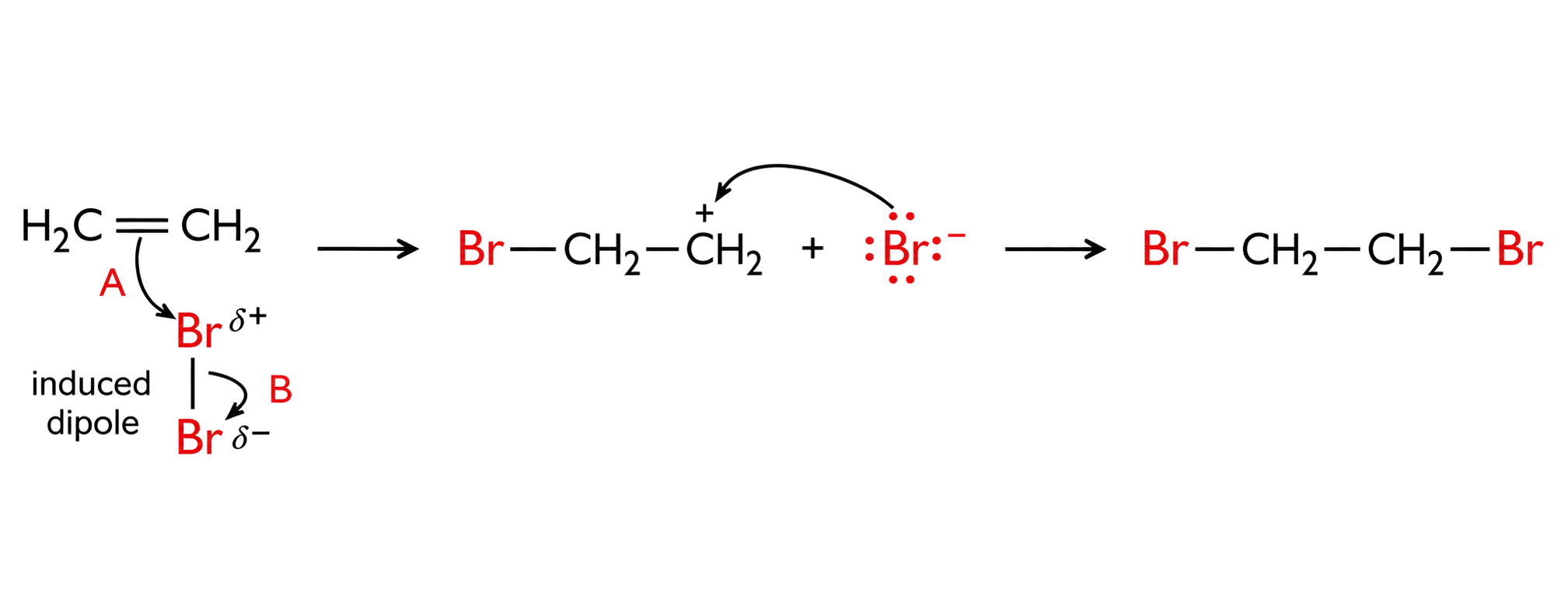
Treat the C=C as the reactive site and place the two added groups on its two carbon atoms. Bromine addition removes the double bond and forms a dibromoalkane; hydration forms an alcohol. At SL, deducing these products does not require a mechanism.
| Reagent | Groups added across C=C | Product check |
|---|---|---|
| X₂ (for example Br₂) | X and X | vicinal dihalogenoalkane; C=C becomes C–C |
| HX | H and X | halogenoalkane; conserve the H and halogen from HX |
| H₂O/steam under acid-catalysed hydration conditions | H and OH | alcohol; conserve the carbon skeleton |
At SL, use reagent and atom conservation to deduce products; curly-arrow mechanisms are not assessed in this card.