3.1 Proton transfer reactions

Syllabus
First assessment 2025
Topic
3.1
Level
SL

Brønsted–Lowry Acids and Bases

A Brønsted–Lowry acid donates H+ and a Brønsted–Lowry base accepts H+. An alkali is a base that is soluble in water.
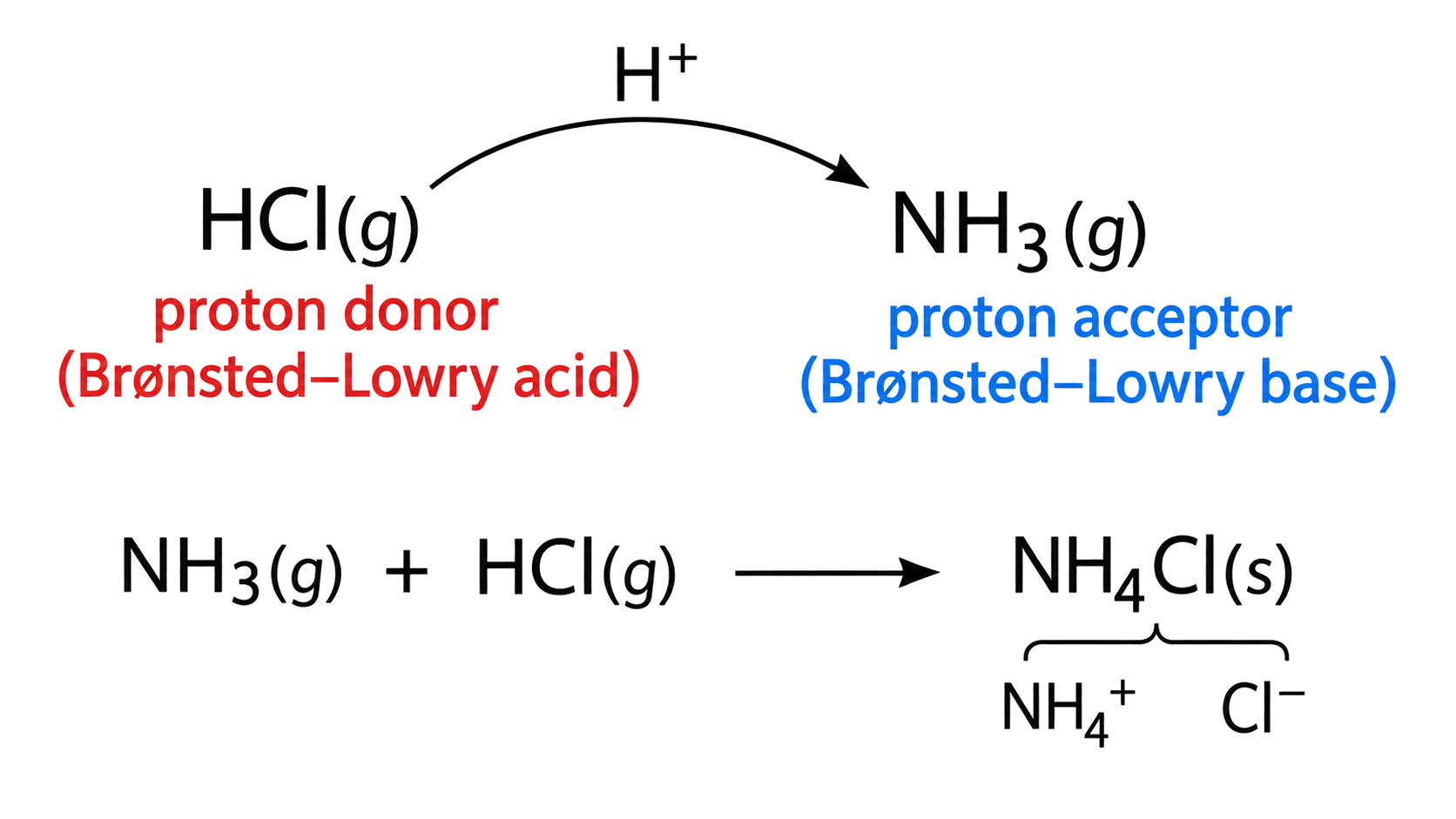
Follow the proton: the species losing it is the acid and the species gaining it is the base.

Pair species that differ by exactly one H⁺ to identify conjugate acid–base pairs. Charge alone does not decide the role: in NH₄⁺ + H₂O ⇌ NH₃ + H₃O⁺, NH₄⁺ is the proton donor and water is the acceptor.

Assigning Acid and Base Roles

Assessment in practice

Representative question

Question 1

[Maximum number: 2]

Describe whether ammonia acts as a Brønsted-Lowry acid or base in its reaction with water. Include an equation in your answer.

Conjugate Acid–Base Pairs

A conjugate base is what remains after an acid donates one proton. A conjugate acid is formed when a base accepts one proton; the pair differs by exactly one H+.

Remove H+ to find the conjugate base or add H+ to find the conjugate acid, then check the charge changes by one unit.

NH₄⁺/NH₃ and H₂CO₃/HCO₃⁻ are conjugate pairs because each pair differs by one H⁺. Removing H⁺ lowers charge by one; adding H⁺ raises it by one. Do not pair species merely because they occur on opposite sides of an equation—trace the specific proton transfer.

Deducing Conjugate Formulae

Assessment in practice

Representative question

Question 1

[Maximum number: 2]

A solution of nitrous acid contains two conjugate acid-base pairs.

State the formulas of the conjugate acid and conjugate base in each pair.

Conjugate acid:
Conjugate base:
Conjugate acid:
Conjugate base:

Amphiprotic Species

An amphiprotic species can donate H+ in one reaction and accept H+ in another.
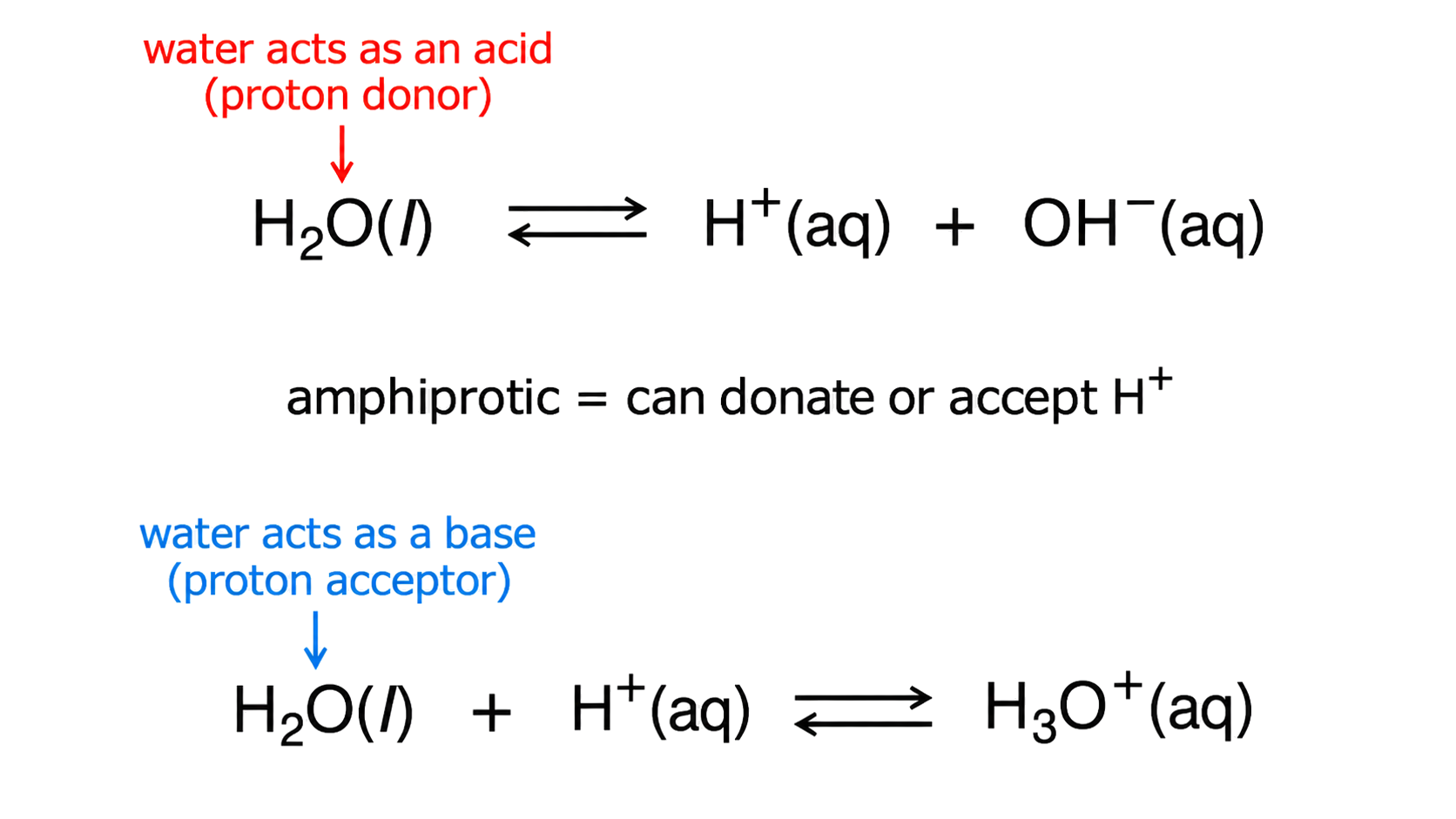
Write one equation in which the species becomes its conjugate base and another in which it becomes its conjugate acid.

For HCO₃⁻, donation gives CO₃²⁻ whereas acceptance gives H₂CO₃. Showing both reactions is the evidence for amphiprotic behaviour; one acid–base equation alone is insufficient.

Showing Amphiprotic Behaviour

Assessment in practice

Representative question

Question 1

[Maximum number: 2]

Formulate two equations to show the amphiprotic nature of H2PO4\mathrm{H}_{2} \mathrm{PO}_{4}^{-}.

pH and Hydrogen-Ion Concentration

pH=log10[H+];[H+]=10(pH)pH = −log10[H+]; [H+] = 10^(−pH)

pH is logarithmic: a one-unit change represents a tenfold concentration change. Universal indicator gives a colour range; a pH probe gives an instrumental pH measurement.

For [H⁺] = 2.0 × 10⁻³ mol dm⁻³, pH = 2.70; the leading 2 makes the answer non-integer. A colour indicator estimates a range, whereas a calibrated probe supports a numerical measurement.

Calculating pH and [H+]

Assessment in practice

Representative question

Question 1

[Maximum number: 1]

A solution has a pH of 3.0 . What is the hydrogen ion concentration in the solution in moldm3\mathrm{mol} \mathrm{dm}^{-3} ?

A

3.0×1033.0 \times 10^{-3}

B

1.0×1031.0 \times 10^{-3}

C

1.0×1031.0 \times 10^{3}

D

3.0×1033.0 \times 10^{3}

The Ion Product of Water

Kw=[H+][OH]Kw = [H+][OH−]

Solution Ion comparison
acidic [H+] > [OH−]
neutral [H+] = [OH−]
basic [H+] < [OH−]

At 25 °C, Kw = 1.0 × 10⁻¹⁴, so a neutral solution has [H⁺] = [OH⁻] = 1.0 × 10⁻⁷ mol dm⁻³. Neutrality always means equal ion concentrations; neutral pH is not necessarily 7 when temperature changes.

At a fixed temperature, Kw is constant, so [OH-] = Kw/[H+]: a higher [H+] means a lower [OH-]. For example, at pH 9.3 and 25 C, [OH-] = 2.0 x 10^-5 mol dm^-3. Classify a solution from the ion comparison; do not assume neutral pH is 7 at every temperature.

Classifying Solutions with Kw

Assessment in practice

Representative question

Question 1

[Maximum number: 1]

Calculate the concentration of hydroxide ions in an ammonia solution with pH=9.3. Use sections 1 and 2 of the data booklet.

Strong and Weak Acids and Bases

A strong acid or base ionizes completely in aqueous solution; a weak acid or base ionizes only partially. The equilibrium favours the weaker conjugate species.
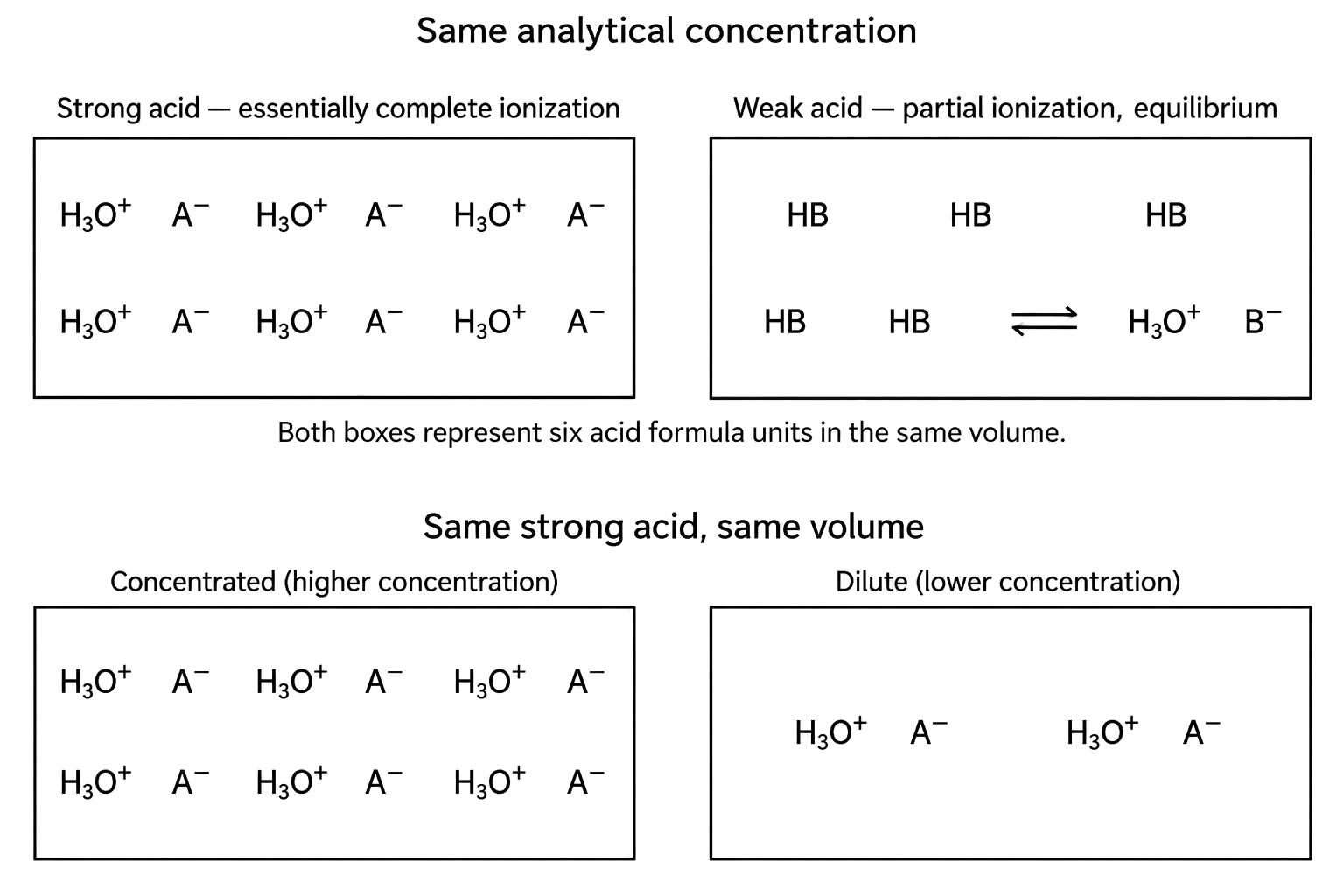
Strength is the extent of ionization, whereas concentration is the amount of solute per volume. A concentrated weak acid can be more acidic than a dilute strong acid.

Represent a strong acid with essentially complete ionization and a weak acid with an equilibrium containing substantial undissociated acid. Strength is an equilibrium property, while concentration is an initial amount per volume; pH depends on both, so strength alone cannot rank arbitrary solutions.

Distinguishing Strength from Concentration

Assessment in practice

Representative question

Question 1

[Maximum number: 2]

Explain the difference in pH .

Neutralization Reactions

Acids neutralize metal oxides and hydroxides to form salt and water. Carbonates and hydrogencarbonates also produce carbon dioxide when the reaction requires it; balance all formulae and coefficients.

Identify the parent acid and parent base of a salt by tracing its anion and cation back to the neutralization reactants.

Balance proton capacity as well as atoms: H₂SO₄ + 2NaOH → Na₂SO₄ + 2H₂O, while an acid–carbonate reaction also releases CO₂. To identify parents of Na₂SO₄, trace SO₄²⁻ to the acid and Na⁺ to the base rather than treating the salt name as a reaction equation.

Writing Neutralization Equations

Assessment in practice

Representative question

Question 1

[Maximum number: 1]

Write two equations showing how these antacids neutralize excess hydrochloric acid.

Magnesium carbonate:

Aluminium hydroxide:

Strong-Acid–Strong-Base Titration Curves

The equivalence point is where stoichiometric amounts of analyte and titrant have reacted. A monoprotic strong-acid–strong-base curve has a steep neutral region centred at the equivalence point.
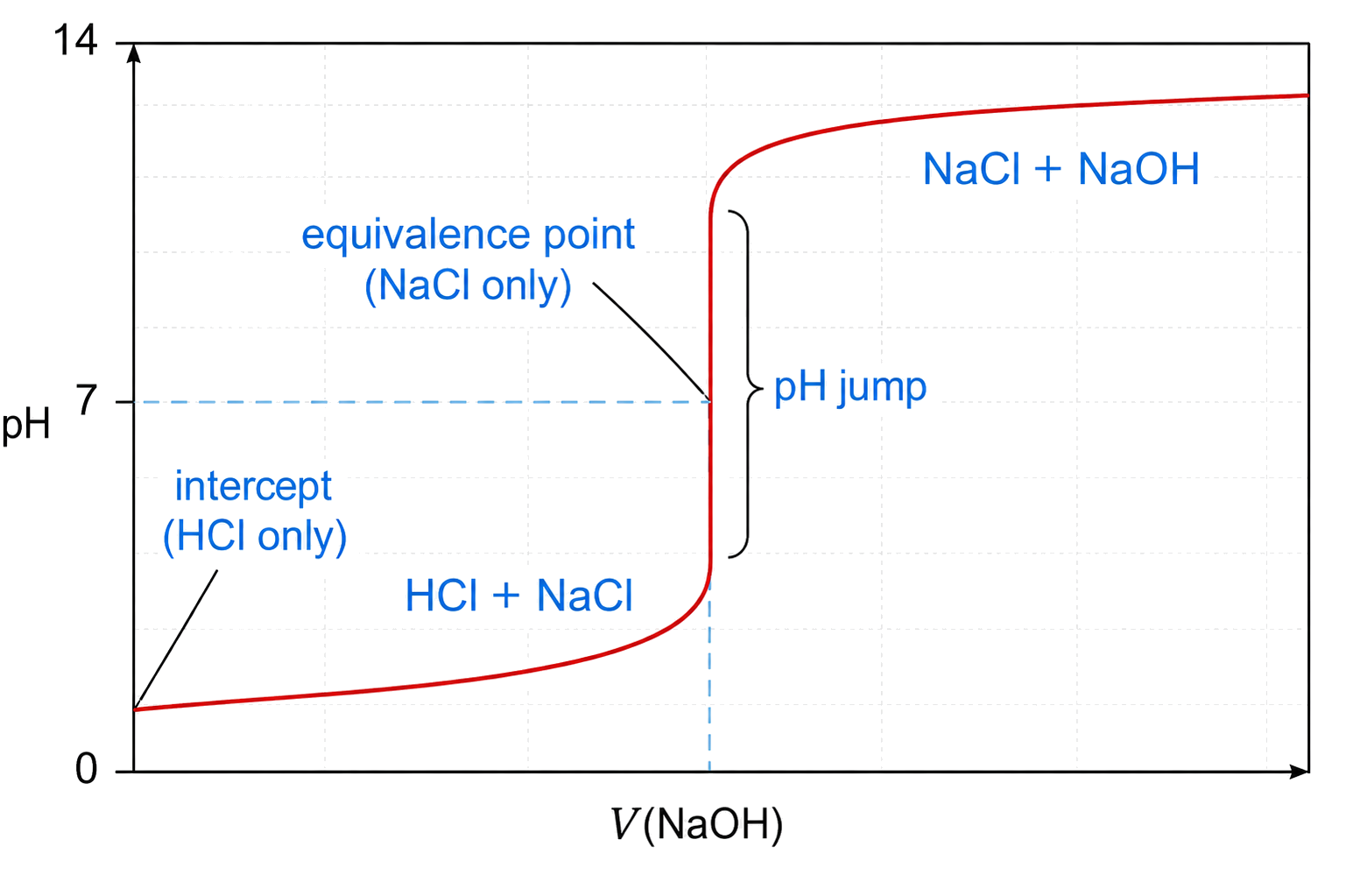
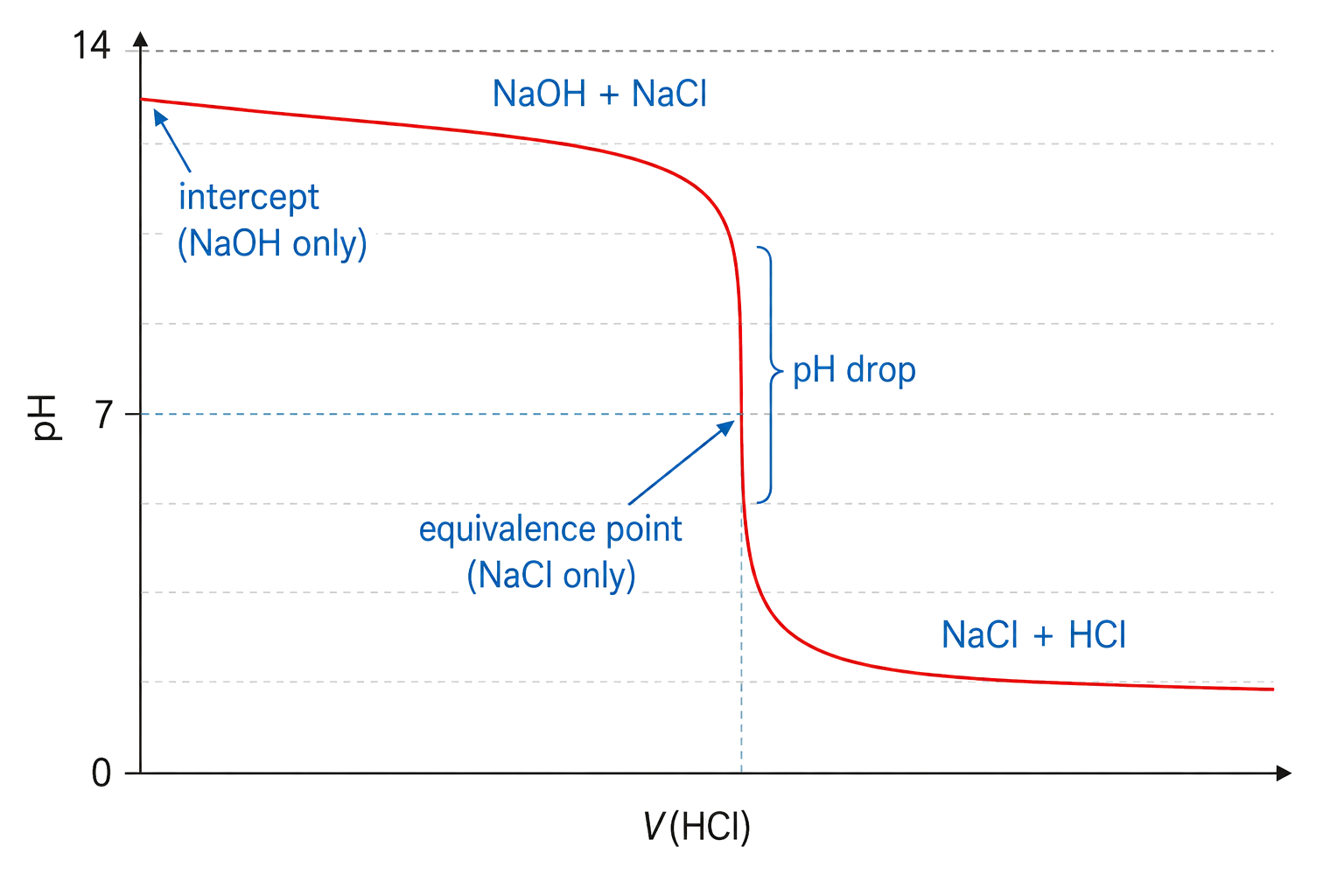
Read the initial pH, steep intercept region and final plateau; curve direction depends on whether acid or base is added.

For a strong acid titrated with strong base at 25 °C, calculate the initial pH from excess acid, locate equivalence from stoichiometric moles, and place the steep section around pH 7. Equivalence is a mole condition; it is not the same as equal solution volumes unless concentrations and stoichiometry make it so.

Interpreting a Strong Titration Curve

Assessment in practice

Representative question

Question 1

[Maximum number: 1]

Which graph would be obtained by adding 0.10moldm3HCl(aq)0.10 \mathrm{moldm}^{-3} \mathrm{HCl}(\mathrm{aq}) to 25 cm325 \mathrm{~cm}^{3} of 0.10moldm3NaOH(aq)0.10 \mathrm{moldm}^{-3} \mathrm{NaOH}(\mathrm{aq}) ?

A
B
C
D

Proton Transfer Reactions Summary

Retrieve the route: track proton transfer and conjugates, calculate pH and Kw, distinguish strength, balance neutralization, read titration curves, use Ka/Kb and hydrolysis, select indicators, and explain and calculate buffer behaviour.

Check donor versus acceptor, one-proton differences, logarithm direction, ion comparison, strength versus concentration, equivalence versus endpoint, pKa landmarks, conjugate equations and dilution ratios.

Objective notes

8 learning objectives