3.4 Electron-pair sharing reactions

Syllabus
First assessment 2025
Topic
3.4
Level
SL

Learning objectives

Recognizing Nucleophiles

A nucleophile is an electron-rich species that donates an electron pair to an electron-deficient centre.
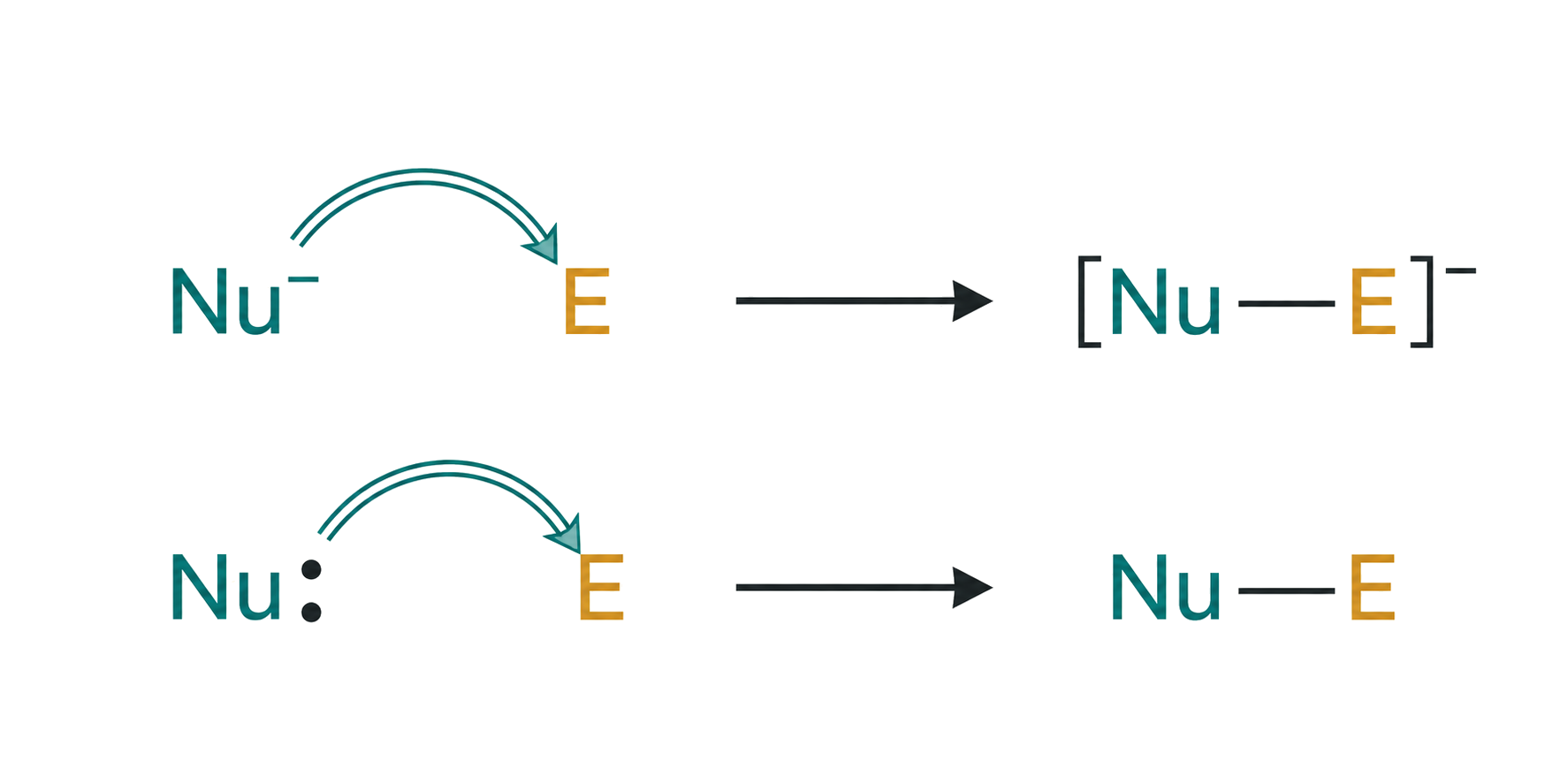
both curved arrows begin at the nucleophile electron pair and end at E; Nu- gives a negatively charged adduct while neutral Nu gives a neutral adduct; the coordinate bond is shown as electron-pair donation from Nu to E.

Look for an available electron pair: OH⁻ and CN⁻ use a negative charge and lone pair, while NH₃ uses a lone pair without being an anion. A curly arrow must start at that pair and point toward the atom where the new bond forms.

Identifying Nucleophiles

1 mark

Identify a nucleophile which could be used for this reaction.

Nucleophilic Substitution

The nucleophile donates a pair to carbon while the leaving group departs with its bonding pair. Deduce the product by replacing the leaving group with the nucleophile.

the hydroxide arrow starts at oxygen and ends at the carbon bearing chlorine; the leaving-group arrow starts at the C-Cl bond and ends at chlorine; carbon is delta positive and chlorine delta negative; CH3CH2OH and Cl- conserve every atom and charge.

For CH₃CH₂Br + OH⁻, the C–O bond forms as the C–Br bond breaks, giving CH₃CH₂OH + Br⁻. Account for charge and every atom in the product; the leaving group takes the bonding pair rather than departing as a neutral bromine atom.

Deducing Substitution Products

4 marks

Explain the mechanism of the reaction, using curly arrows to represent the movement of electron pairs.

Heterolytic Fission

In heterolytic fission both bonding electrons remain with one fragment, producing ions. Curly arrows show movement of an electron pair.

a full two-electron curly arrow begins at the A-B bond and ends at B; both bonding electrons are transferred to B; the products are exactly A plus and B minus.

Place the curly-arrow tail on the bond being broken and its head on the fragment receiving both electrons. Then assign charges from electron ownership: heterolysis creates ions, unlike homolysis, which gives one electron to each radical.

Showing Electron-Pair Movement

2 marks

Contrast homolytic and heterolytic fission.

Homolytic fission:

Heterolytic fission:

Recognizing Electrophiles

An electrophile is an electron-deficient species that accepts an electron pair from a nucleophile.

BF3 is trigonal planar with exactly three B-F single bonds; boron is labelled delta positive and each fluorine delta negative; no lone pair, formal charge, or fourth ligand is added to boron.
the skeletal structure is butanoic acid with four carbons; the C=O double bond and O-H bond are distinct; the carbonyl carbon is delta positive and carbonyl oxygen delta negative.

Identify the electron-poor atom, not merely a positive-looking formula. H⁺ and carbocations are electrophiles, and the δ⁺ carbon in a polar C–X bond can also accept a pair. The incoming curly arrow ends at this acceptor.

Recognizing Electrophiles

1 mark

Which species is the electrophile?

CH3Br+OH−→CH3OH+Br−\mathrm{CH}_{3} \mathrm{Br}+\mathrm{OH}^{-} \rightarrow \mathrm{CH}_{3} \mathrm{OH}+\mathrm{Br}^{-}

Electrophilic Addition to Alkenes

The electron-rich C=C attacks an electrophile. Deduce addition products with water, halogens or hydrogen halides within the SL mechanism boundary.

the C=C pi pair attacks Br delta positive and the Br-Br pair moves to Br delta negative; the textbook bromoethyl carbocation plus Br- intermediate is preserved; Br- attacks C+ and forms neutral 1,2-dibromoethane; two carbons, four hydrogens, and two bromines are conserved.

Treat the C=C as the reactive site and place the two added groups on its two carbon atoms. Bromine addition removes the double bond and forms a dibromoalkane; hydration forms an alcohol. At SL, deducing these products does not require a mechanism.

Reagent Groups added across C=C Product check
X₂ (for example Br₂) X and X vicinal dihalogenoalkane; C=C becomes C–C
HX H and X halogenoalkane; conserve the H and halogen from HX
H₂O/steam under acid-catalysed hydration conditions H and OH alcohol; conserve the carbon skeleton

At SL, use reagent and atom conservation to deduce products; curly-arrow mechanisms are not assessed in this card.

Deducing Alkene-Addition Products

1 mark

Predict the product of the reaction between ethene and bromine.

Lewis Acids and Bases

A Lewis acid accepts an electron pair; a Lewis base donates an electron pair. Nucleophiles correspond to Lewis bases and electrophiles to Lewis acids.

both curved arrows begin at the nucleophile electron pair and end at E; Nu- gives a negatively charged adduct while neutral Nu gives a neutral adduct; the coordinate bond is shown as electron-pair donation from Nu to E.

In BF₃ + NH₃ → F₃B←NH₃, NH₃ donates the pair and is the Lewis base; BF₃ accepts it and is the Lewis acid. Classify the roles from electron-pair movement rather than from whether H⁺ appears.

Classifying Lewis Acids and Bases

1 mark

What is the role of the CN−\mathrm{CN}^{-}ion in the reaction of 1-chloropropane with excess KCN in ethanol?

C3H7Cl+KCN→C3H7CN+KCl\mathrm{C}_{3} \mathrm{H}_{7} \mathrm{Cl}+\mathrm{KCN} \rightarrow \mathrm{C}_{3} \mathrm{H}_{7} \mathrm{CN}+\mathrm{KCl}

Coordination Bonds

A ligand acts as a Lewis base and donates an electron pair to a Lewis-acid transition-metal cation, forming a coordinate bond.

the full curly arrow starts at the nitrogen lone pair and ends at boron; reactants contain exactly BF3 and NH3; the product contains one B-N coordination bond with three F and three H; no proton transfer or extra ligand is implied.
Lewis base donates an electron pair to Lewis acid; nucleophile donates an electron pair to electrophile; ligand donates an electron pair to transition element cation; all three arrows run from donor on the left to acceptor on the right.

Show a coordination bond with an arrow from a ligand lone pair to the metal ion. The arrow records the origin of the shared pair; after formation the bond is not a different electrostatic species from other covalent bonds.

Explaining Coordinate-Bond Formation

1 mark

Outline how ammonia acts as a Lewis base when it forms the complex ion

[Cu(NH3)4(H2O)2]2+(aq).\left[\mathrm{Cu}\left(\mathrm{NH}_{3}\right)_{4}\left(\mathrm{H}_{2} \mathrm{O}\right)_{2}\right]^{2+}(\mathrm{aq}) .

Ligands and Complex Ions

Identify the central transition-metal cation and the surrounding ligands. Each ligand donates an electron pair to the metal centre.

the bracketed ion contains one Cu and exactly six neutral H2O ligands; oxygen is the donor atom directed toward Cu; the six-coordinate geometry is octahedral; the overall charge is exactly 2 plus.

Read [Cu(NH₃)₄]²⁺ as one Cu centre with four NH₃ ligands and coordination number 4. Use ligand charges and the overall bracket charge to deduce the metal oxidation state; do not confuse coordination number with oxidation state.

Identifying Complex-Ion Components

1 mark

Which statements are correct for the complex ion [FeCl4]2−\left[\mathrm{FeCl}_{4}\right]^{2-} ?

I. Chloride ions are behaving as ligands.
II. The oxidation state of iron is +3 .
III. Iron ion forms coordination bonds with chloride ions.

Electron-Pair Sharing Summary

Retrieve the route: classify nucleophiles and electrophiles, show heterolysis, write substitution and addition mechanisms, map Lewis coordination, compare SN1/SN2, and restore aromaticity in benzene substitution.

Check electron-pair arrow origin and destination, leaving-group departure, intermediate identity, carbocation stability and the assessed mechanism boundary.