3.2.5—Electrodes in electrochemical cells

Syllabus
First assessment 2025
Objective
3.2.5
Level
SL

Anodes, Cathodes and Polarity

Oxidation always occurs at the anode and reduction always occurs at the cathode. In a voltaic cell the anode is negative and cathode positive; in an electrolytic cell the anode is positive and cathode negative.
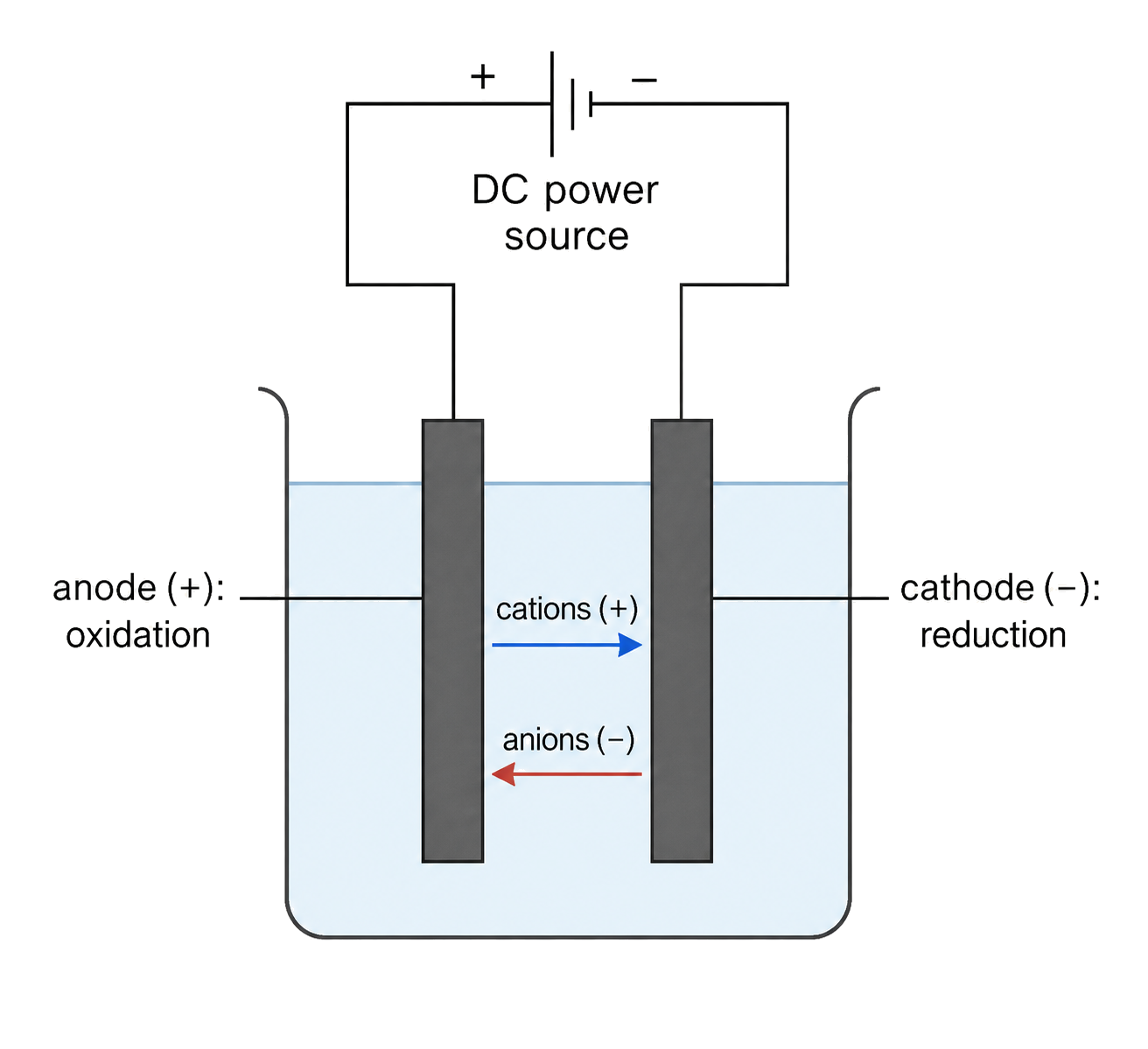
Name electrodes from the half-reactions before assigning signs. Electrons leave the anode and reach the cathode through the external circuit; a power supply reverses the polarities in an electrolytic cell but never changes where oxidation and reduction occur.

Labelling Electrochemical Cells

Assessment in practice

Representative question

Question 1

[Maximum number: 2]

Annotate the electrolytic cell with the terms anode and cathode, and show the direction of ion movement.

Electron Transfer Reactions Summary

Retrieve the route: assign oxidation states, balance half-equations, predict displacement, label cells, trace electrons and ions, follow organic redox pathways, calculate potentials and choose electrolysis products.

Check electron loss/gain, anode/cathode versus polarity, spontaneous sign, salt-bridge direction, ions present, organic functional-group direction and object-cathode placement.