3.2.10—Reduction of organic functional groups

Syllabus
First assessment 2025
Objective
3.2.10
Level
SL

Reduction of Carbonyl Compounds

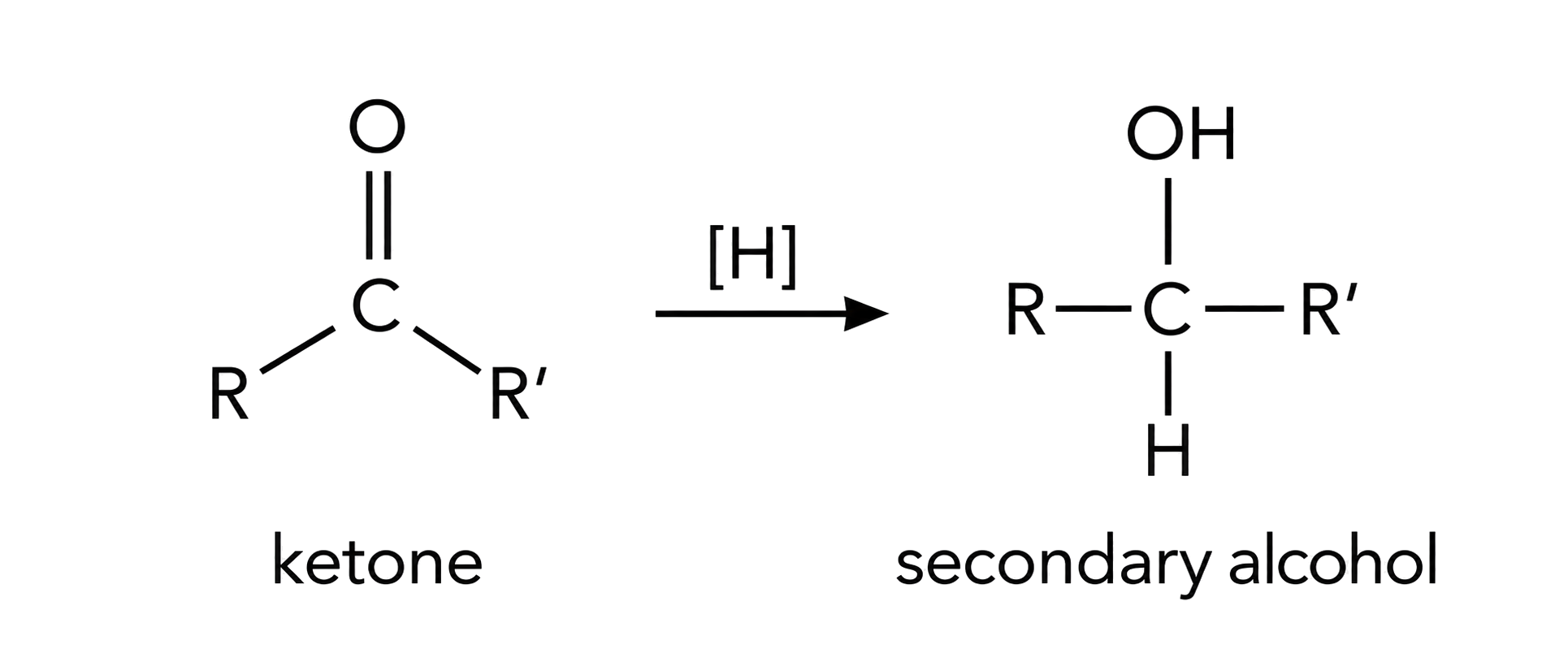
A carboxylic acid can be reduced through an aldehyde to a primary alcohol; a ketone is reduced to a secondary alcohol. Hydride ions supply the reduction equivalent in these transformations.
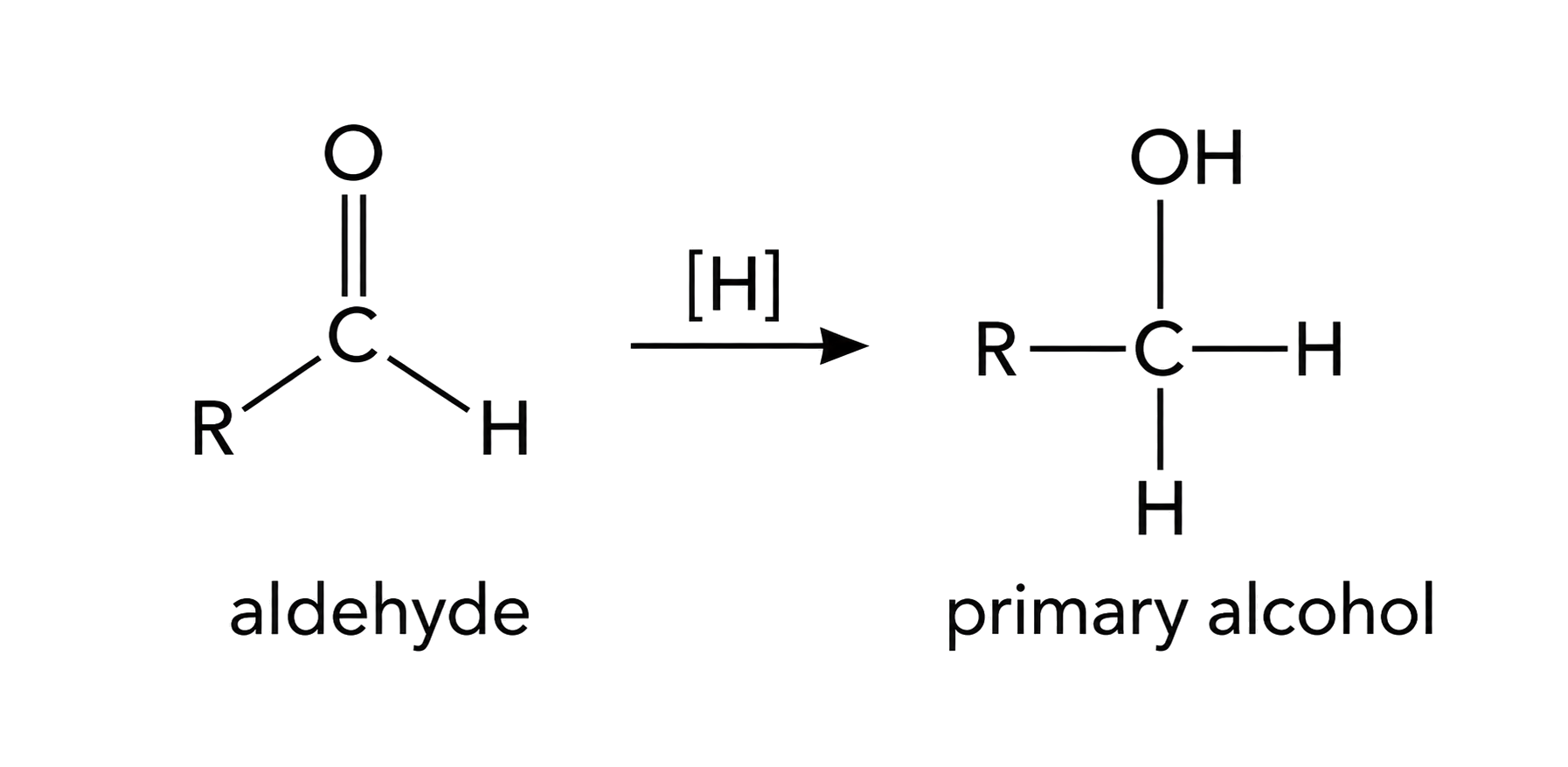
R–CHO becomes R–CH2OH; the product carbon has R, OH and two H substituents; the product is correctly labelled primary alcohol.
R–C(=O)–R′ becomes R–CH(OH)–R′; the product is correctly labelled secondary alcohol; the carbon skeleton is unchanged.

Track the carbon functional group rather than only the reagent: an aldehyde gives a primary alcohol and a ketone gives a secondary alcohol. Hydride supplies an electron-rich H unit to the carbonyl carbon; named reducing agents and detailed mechanisms are outside this objective.

Deducing Reduction Products

[ 1 ]

Which product may be obtained by the reduction of CH3CH2COOH\mathrm{CH}_{3} \mathrm{CH}_{2} \mathrm{COOH} ?

Electron Transfer Reactions Summary

Retrieve the route: assign oxidation states, balance half-equations, predict displacement, label cells, trace electrons and ions, follow organic redox pathways, calculate potentials and choose electrolysis products.

Check electron loss/gain, anode/cathode versus polarity, spontaneous sign, salt-bridge direction, ions present, organic functional-group direction and object-cathode placement.