2.4.4—Polymers
- Syllabus
- First assessment 2025
- Objective
- 2.4.4
- Level
- SL
A polymer is a macromolecule built from repeating monomer-derived units. Chain structure and cross-links influence plastic properties.
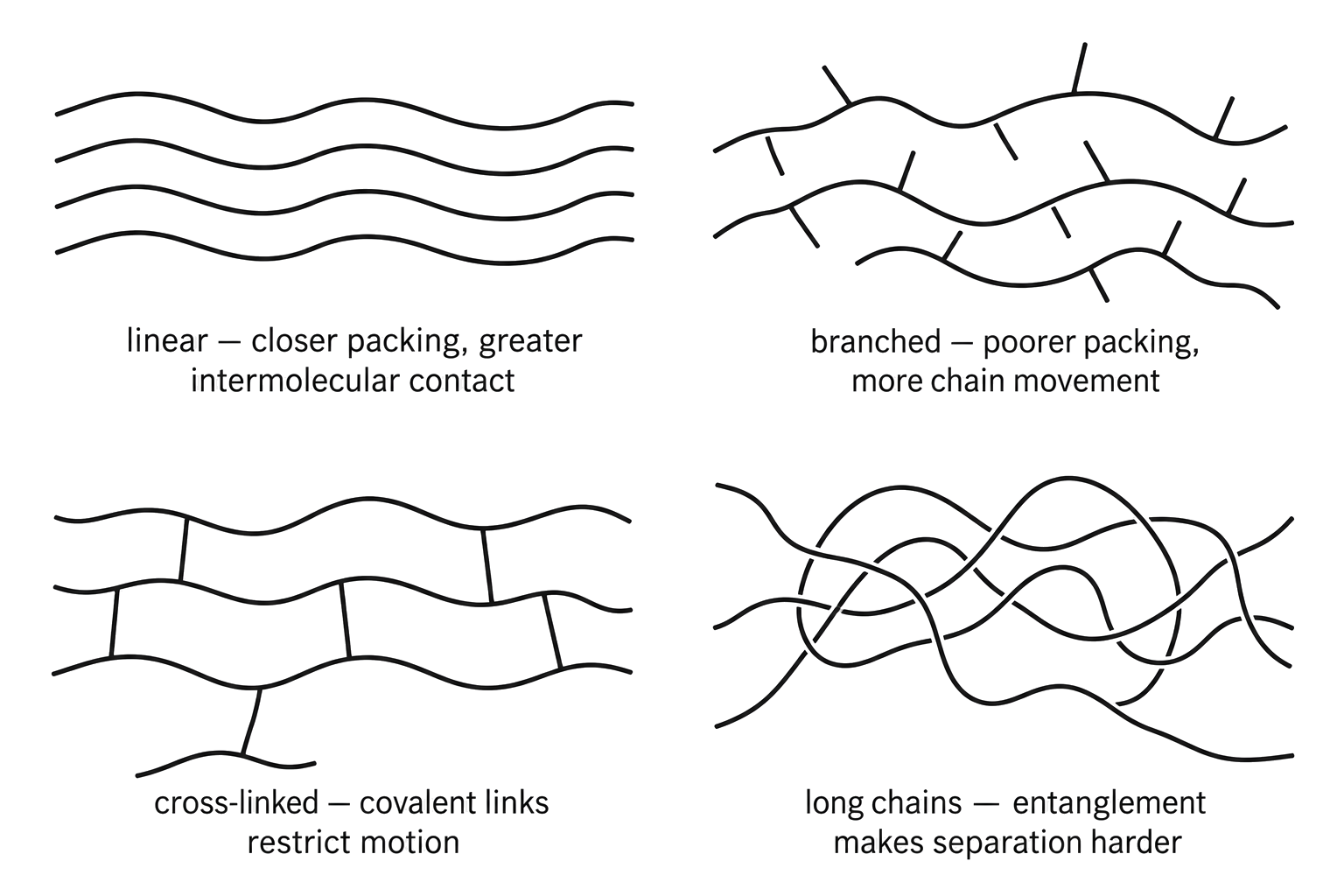
| Chain feature | Molecular-motion or packing effect | Typical qualitative consequence |
|---|---|---|
| Long, relatively linear chains | can pack more closely when chain chemistry permits | stronger intermolecular contact and often greater strength/density |
| More branching | can hinder close, regular packing | often lowers packing efficiency and can increase flexibility |
| Few/no cross-links | chains can move past one another more readily on heating | thermoplastic softening and reshaping |
| Dense cross-linking | strongly restricts chain movement | rigid thermoset behaviour; does not simply melt and reshape |
These are conditional structure–property trends: functional groups, chain length and processing history also matter.
Compare chain mobility: weakly interacting, unlinked chains can soften and be reshaped, whereas extensive cross-linking restricts movement and gives thermoset behaviour. A useful structure–property explanation names the repeat-chain feature, the permitted molecular motion and the resulting macroscopic response.
Cellulose is a natural polymer, whereas polyethene is synthetic. Both are macromolecules with repeating units, but origin alone does not determine a plastic's properties or biodegradability: chain structure, functional groups, intermolecular attractions, branching and cross-linking control packing and molecular motion.