2.4.1—Bonding continuum
- Syllabus
- First assessment 2025
- Objective
- 2.4.1
- Level
- SL
Ionic, covalent, and metallic bonding are models whose contributions can vary across materials. The bonding continuum represents mixed character rather than completely separate categories.
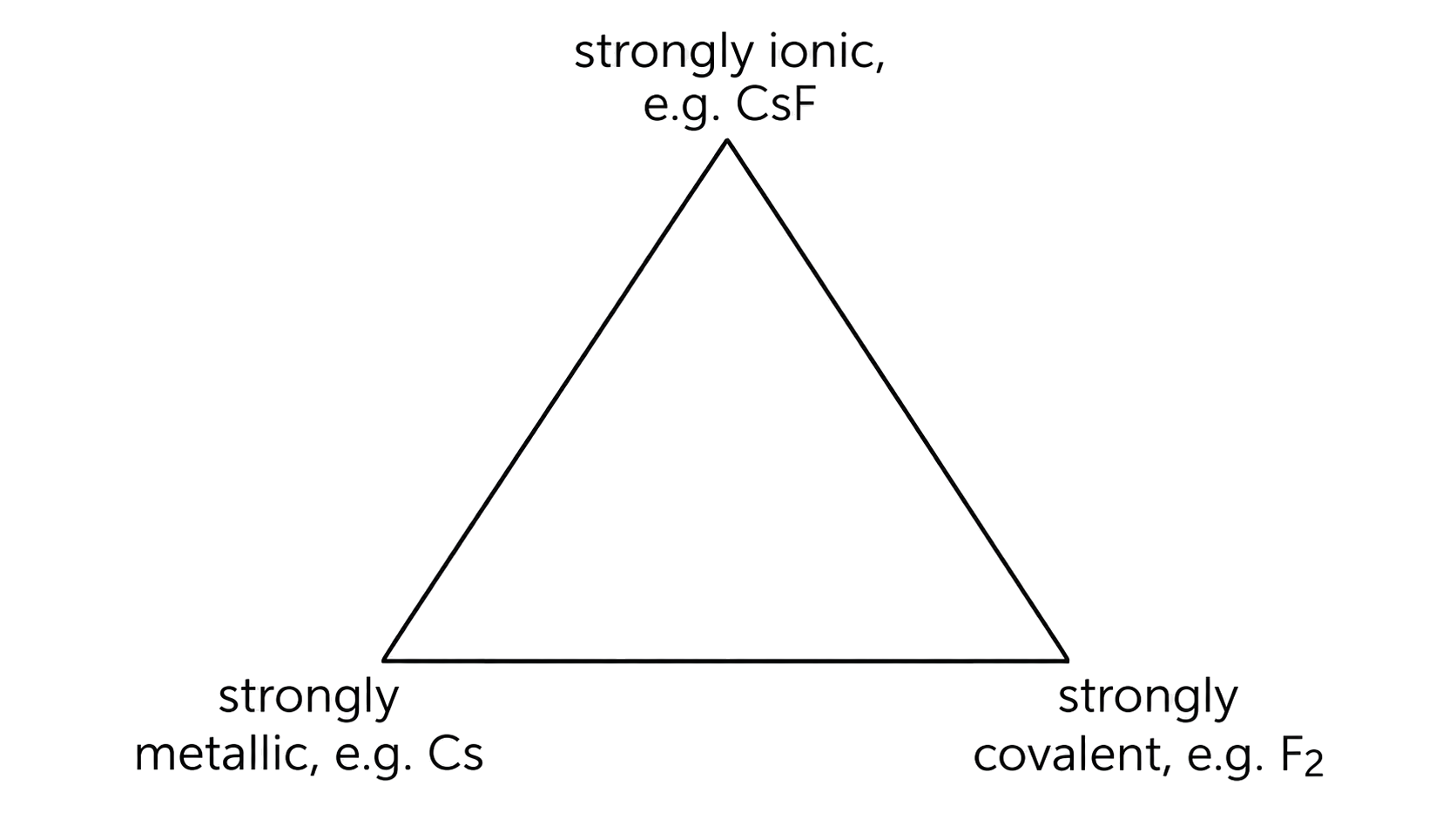
Use the relative contributions of the three bonding types to explain a material's position and its likely properties.
Treat the three bonding models as coordinates rather than sealed boxes. A material may combine electron sharing with partial charge separation, so its properties can fall between idealized categories. Explain which model contribution accounts for each observed property instead of assigning one label and stopping.
Representative question
State the types of bonding in magnesium, oxygen and magnesium oxide, and how the valence electrons produce these types of bonding.
| Substance | Bond type | How the valence electrons produce these bonds |
|---|---|---|
| Magnesium | .......... | □ ________ |
| Oxygen | .......... | ____ □ |
| Magnesium oxide | .......... | ____ |
Substance
Bond type
How the valence electrons produce these bonds
Marking guidance:
Award [1] for all bonding types correct.
Award [1] for each correct description.
Apply ECF for M2 only once.
delocalized «throughout
lattice attracted to
cations»
Accept reference to "sea"/flux of electrons
«attracted to cations»
Oxygen
covalent
shared «between
Magnesium oxide
ionic
transferred «from magnesium to oxygen» OR
lost by magnesium AND gained by oxygen
Retrieve the pathway: locate bonding contributions, connect them to material properties, distinguish alloy lattice disruption, and construct addition or condensation polymer repeating units from monomer evidence.
Check that the bonding description matches the material, the property explanation names the structural cause, and every polymer substituent, continuation bond, and released small molecule is represented.