3.1 The periodic table
- Syllabus
- First assessment 2025
- Topic
- 3.1
- Level
- HL
| Feature | Meaning |
|---|---|
| Period | Row; highest occupied main energy level |
| Group | Column with related valence pattern |
| Block | Region associated with the outermost s, p, d, or f subshell |
| Region | Metals, metalloids, and non-metals occupy characteristic areas |
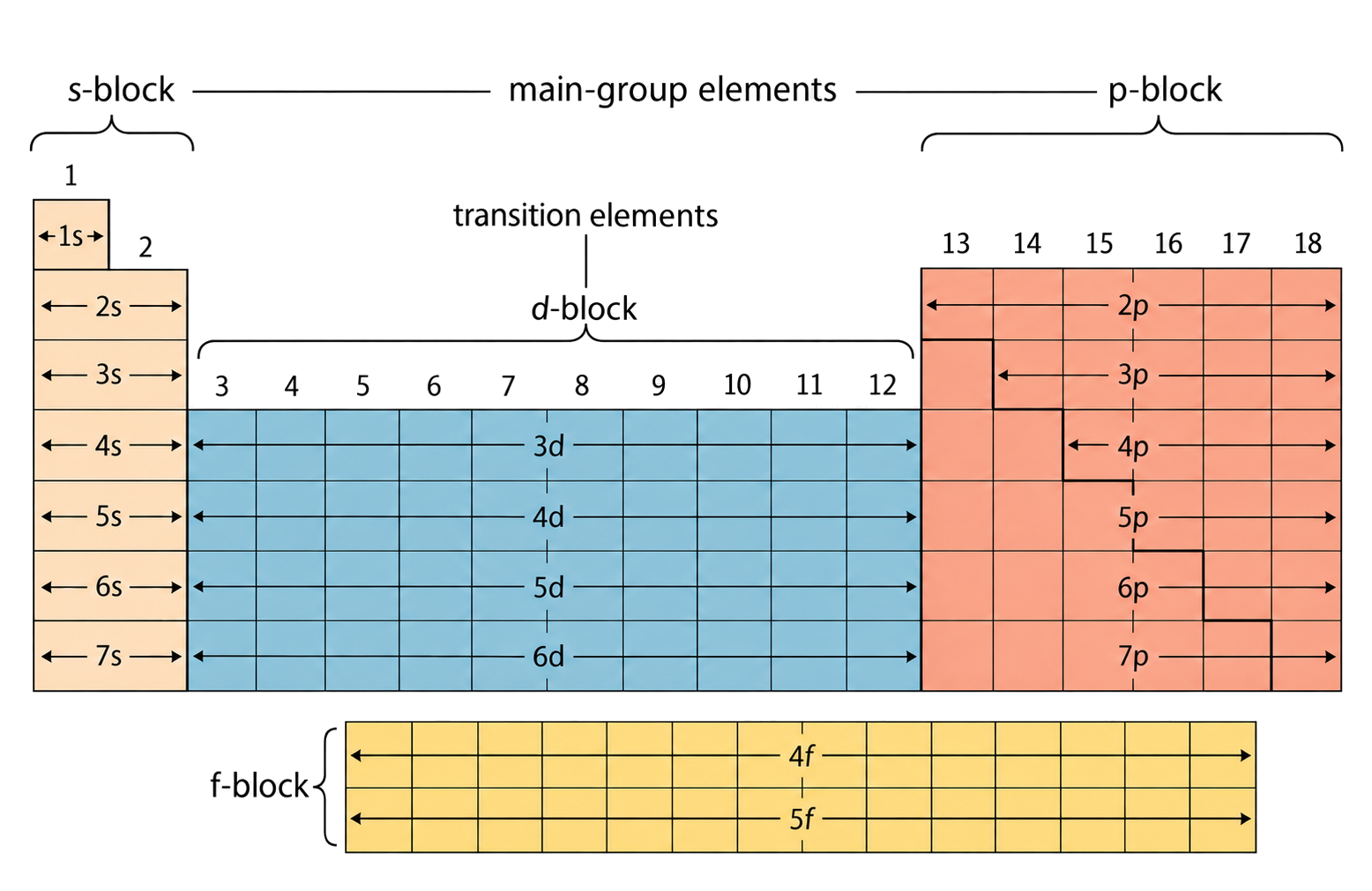
Use the table's row, column, and block together; do not substitute period number for group or block identity.
Use bromine as a three-coordinate check: it lies in period 4, group 17 and the p block, so its outer shell is n = 4 with a p-subshell being filled. Block describes the subshell pattern, period the highest occupied main level, and group the repeating valence pattern—three related but different labels.
| Configuration evidence | Position evidence |
|---|---|
| Highest occupied energy level | Period |
| Valence-electron pattern | Group pattern |
| Outermost subshell type | s, p, d, or f block |
Read the configuration in both directions: position predicts the outer pattern, and the outer pattern identifies the position.
The configuration 1s²2s²2p⁶3s²3p⁵ ends at n = 3 and p⁵, placing the element in period 3, group 17 and the p block. Reverse the reasoning by using a table position to predict the outer configuration, then check that the total electron count matches the atomic number.
| Quantity | Across a period | Down a group |
|---|---|---|
| Atomic/ionic radius | Generally decreases | Generally increases |
| First IE | Generally increases | Generally decreases |
| Electronegativity | Generally increases | Generally decreases |
| Electron affinity | Interpret with the stated convention and attraction evidence | Interpret with shell and shielding evidence |
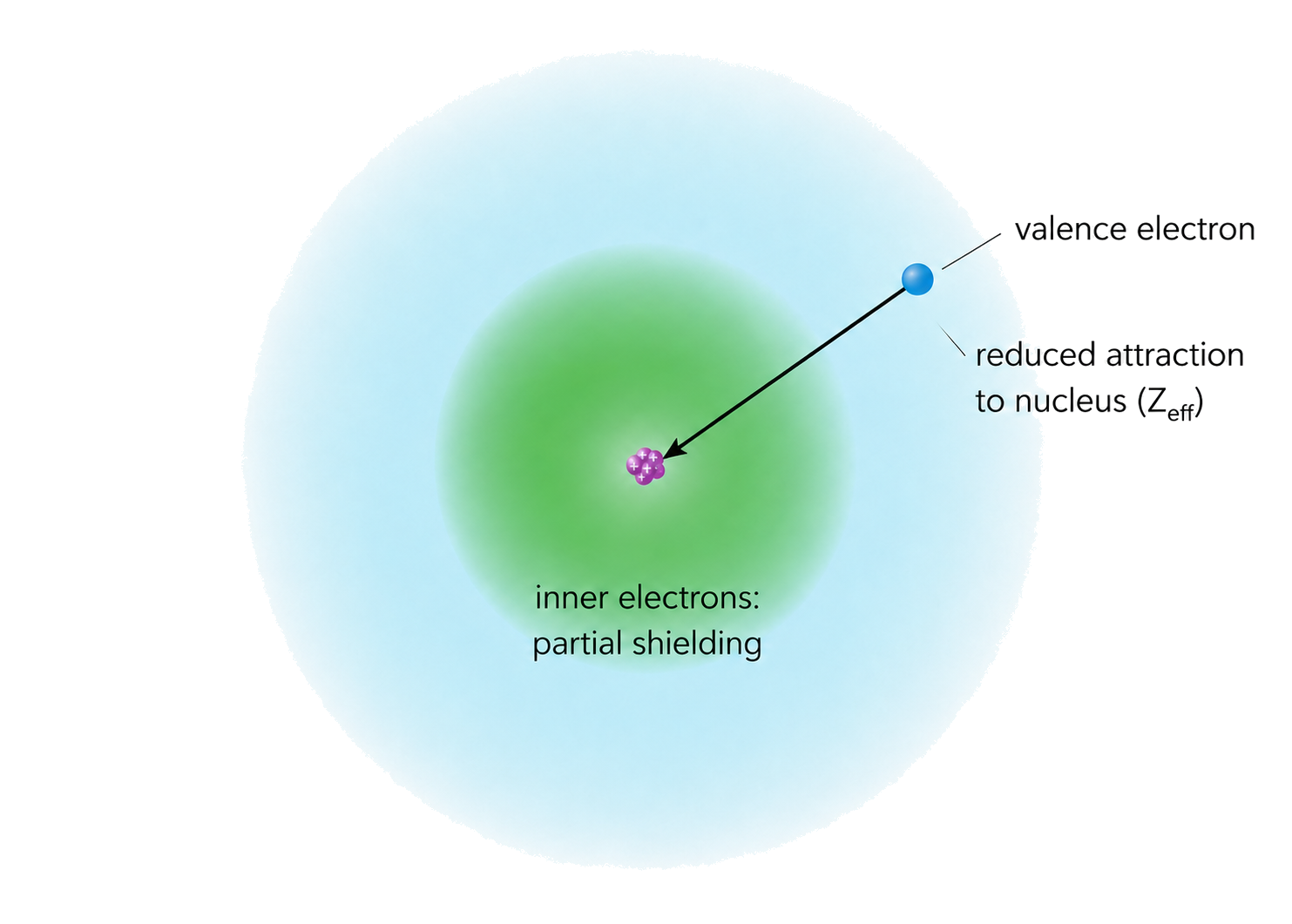
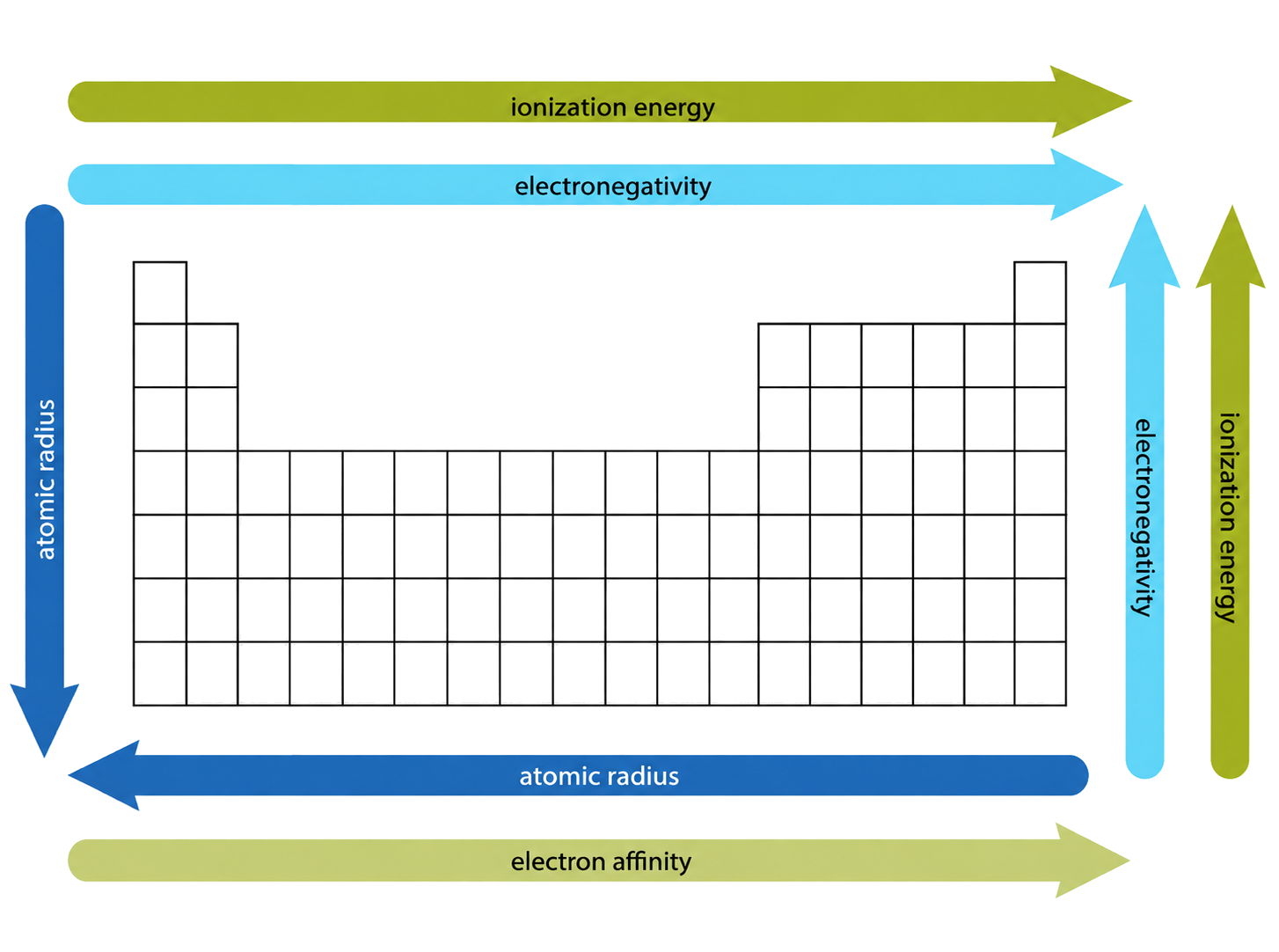
Explain a trend with effective nuclear charge, shielding, shell, distance, and attraction; a direction alone is not a complete explanation.
Across period 3, nuclear charge rises while added electrons enter the same main shell, so effective attraction generally increases, radius falls and first ionization energy rises. For ions, compare electron count and charge as well as position; an isoelectronic species with more protons is smaller.
Electron affinity needs a sign check. Under the enthalpy-change convention, a more favourable first electron gain is more negative: it generally becomes more negative across a period as nuclear attraction increases, and less negative down a group as distance and shielding increase. Sublevel energy and electron repulsion cause exceptions, so compare the stated data rather than forcing every element into a smooth trend.
| Region | Typical oxide character | Water/reaction reasoning |
|---|---|---|
| Metal side | Basic | Can form alkaline solution with water |
| Boundary | Amphoteric | Can react as acid or base in the appropriate context |
| Non-metal side | Acidic | Can form an acid with water |
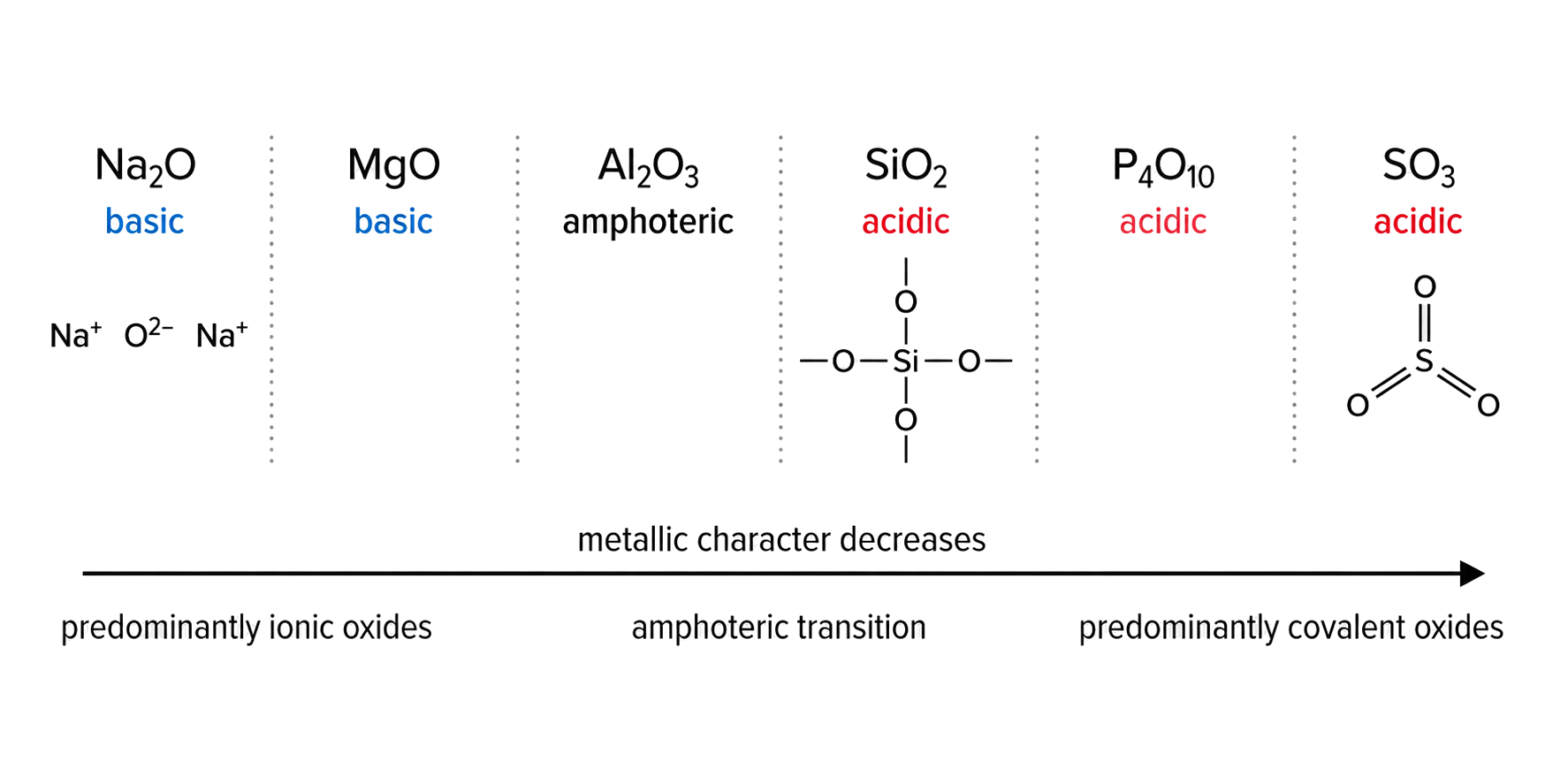
Use balanced equations as evidence for the classification: Na₂O + H₂O → 2NaOH and SO₃ + H₂O → H₂SO₄ are representative basic and acidic cases. The bonding/electronegativity trend explains why the character changes across the period, but it does not guarantee that every oxide reacts readily with water.
Al₂O₃ is the useful boundary case: it is amphoteric, so it can react with an acid such as HCl and with a strong base such as NaOH. Do not label an oxide from the element's position alone—check the stated reaction and distinguish a water reaction from acid–base behaviour in another medium.
Environmental link: sulfur oxides dissolve and can be oxidized to acids that increase in rainwater, causing acid rain. Atmospheric dissolves in seawater and participates in , increasing and lowering ocean pH. These are acidification mechanisms; do not treat every non-metal oxide as reacting with water in exactly the same way.
Discontinuities in the general first-ionization-energy trend provide evidence for sublevel energies and electron pairing. A higher-energy p electron can be easier to remove than an s electron, and paired-electron repulsion can lower IE.
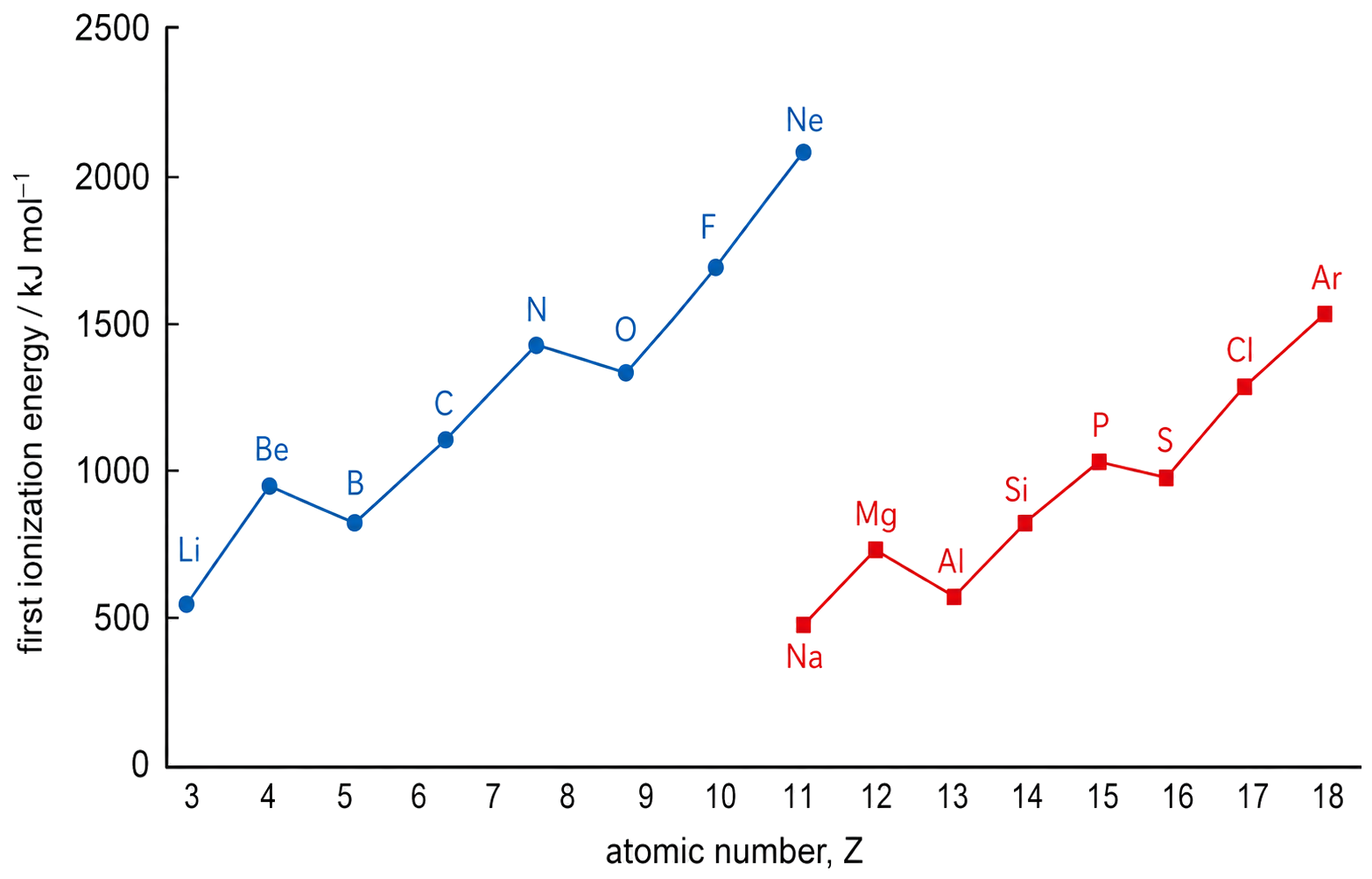
Name the sublevel and pairing evidence, not just the direction of the graph change.
The drop from Mg to Al occurs because Al loses a higher-energy 3p electron after Mg loses 3s; the drop from N to O reflects pairing repulsion in one 2p orbital. These local electronic effects explain exceptions without overturning the overall across-period rise.
Light can be absorbed to promote an electron between split d-orbitals. The observed colour is complementary to the colour absorbed.
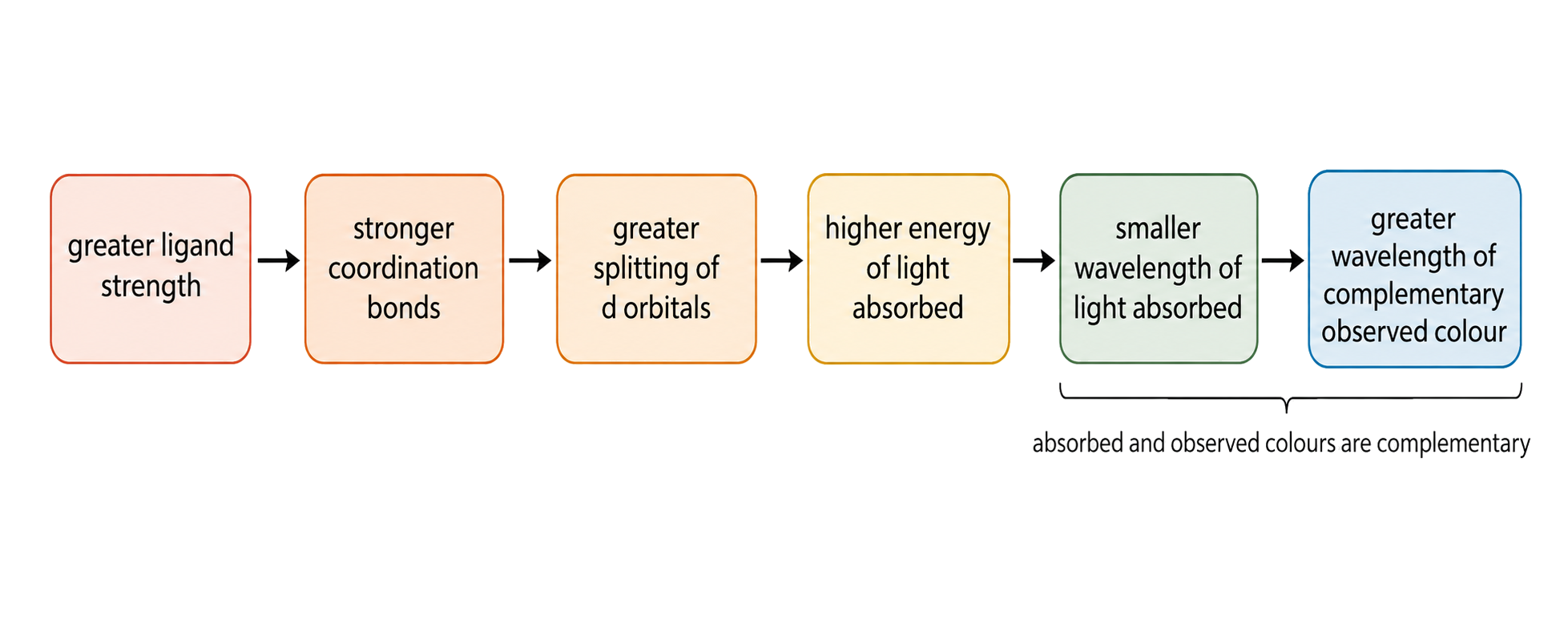
Use the colour wheel to map absorbed colour to observed complementary colour, and explain the absorption through d-orbital splitting and promotion.
$c = \lambda f$
Worked calculation: for absorbed light of wavelength , . Use the colour wheel separately: absorption in the orange region means the observed colour is the complementary blue region. Frequency and wavelength describe the absorbed radiation, not the colour label by themselves.
If a complex absorbs orange light, use the colour wheel to predict the observed complementary blue. The absorbed photon promotes a d electron between ligand-split levels; the observed colour is transmitted or reflected light, not the colour of the absorbed radiation.
The simple d–d model requires an electron in a lower split d level and an available higher d level. A d⁰ or d¹⁰ ion therefore has no d–d transition in this model. The energy gap—and hence absorbed wavelength—also depends on the metal ion, oxidation state, ligand and geometry, so an exact shade cannot be predicted without the coordination environment.