B3.1.7—Leaf gas exchange adaptations

Leaf gas exchange occurs through stomata and internal air spaces, with guard cells balancing carbon dioxide uptake against water loss.

Syllabus
First assessment 2025
Objective
B3.1.7
Level
SL

Exam analysis

Chance of appearing1%of analysed past papers
Latest appearanceNovember 2025
Most common paperPaper1B
Typical marks1–2

Common command terms

  • Identify
  • Explain

Scoring notes

Common mistake
Calling any pore a stoma without identifying the guard-cell opening through the epidermis.

Recent exam appearances

November 2025Paper1B ["SL"] · TZ32(d)[ 2 ]B3.1.7—Leaf gas exchange adaptations
May 2025Paper1B ["SL"] · TZ11(a)[ 1 ]B3.1.7—Leaf gas exchange adaptations

Coverage 2025–2025 · Updated 15 Jul 2026

A Stoma Trades Carbon Entry for Water Loss

CO₂ enters and water vapour exits mainly through stomata. Guard cells change pore width, balancing photosynthetic demand against dehydration risk.
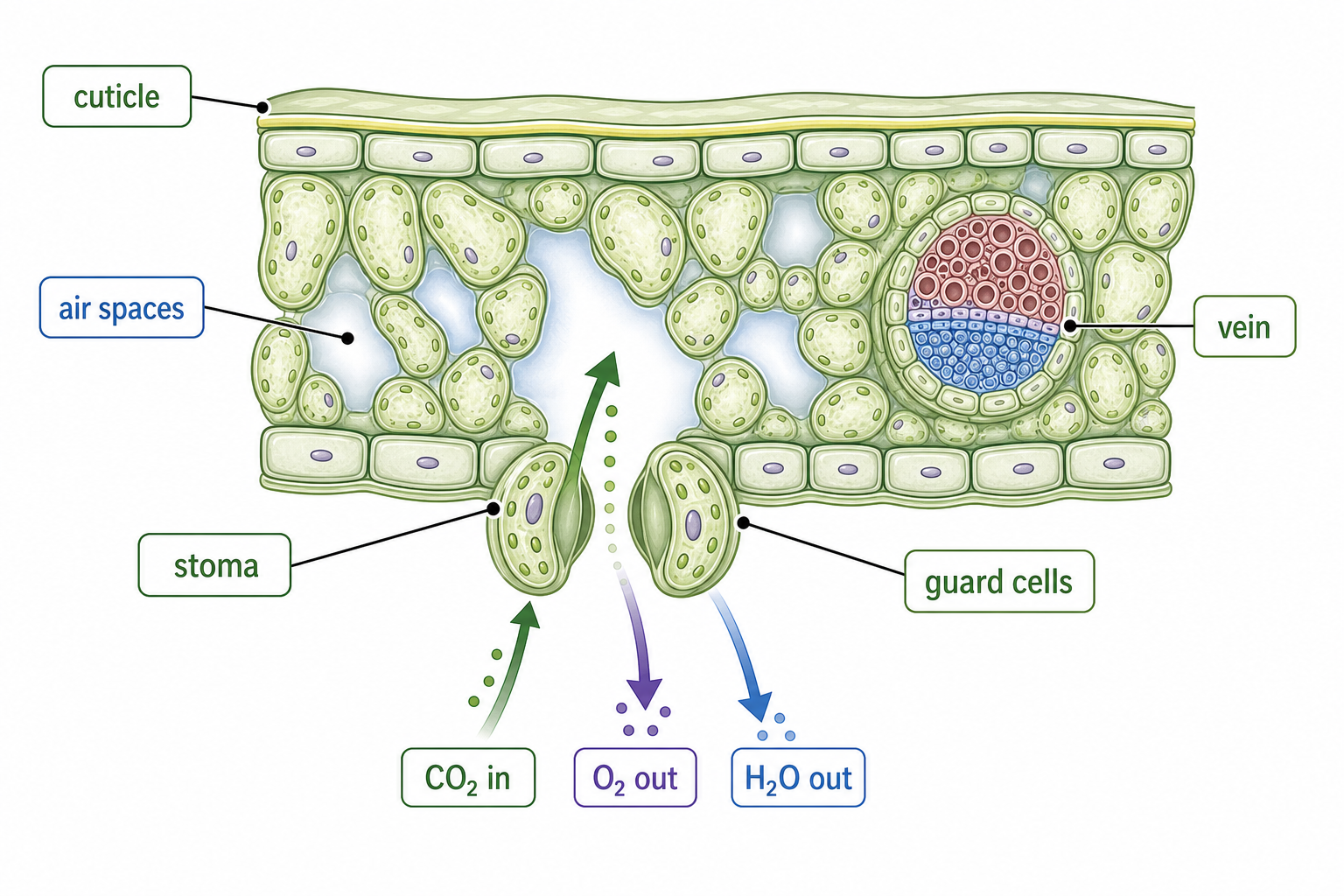
Leaf gas-exchange tradeoff diagram showing waxy cuticle limiting water loss, lower epidermal stomata with guard cells controlling pores, spongy mesophyll air spaces for diffusion, and veins supplying water and removing assimilates.

CO₂: atmosphere → stoma → substomatal air space → moist mesophyll wall → photosynthetic cell
H₂O: xylem → mesophyll wall → evaporation → air spaces → diffusion through stoma

SL Summary: One Diffusion Model

Feature Lung Leaf
area many alveoli broad blade + mesophyll walls
path thin barrier thin leaf + air spaces
gradient air + blood flow CO₂ use + stomata

Spirometry measures ventilation; a potometer estimates water uptake; a leaf cast measures stomatal density. Match each method to its direct measurement.

Leaf gas exchange adaptations

[ 2 ]

Explain the roles of two leaf structures that help with the process of gas exchange in the leaf.

Concept essentials

  • Stomata allow carbon dioxide, oxygen and water vapour to diffuse through the epidermis.
  • Guard cells regulate stomatal opening by changing turgor.
  • Spongy mesophyll air spaces provide internal diffusion routes.
  • The upper epidermis and cuticle protect the leaf while allowing light entry.