B2.2.3—Advantages of compartmentalization

Compartmentalization uses internal membranes to create organelles with controlled conditions, concentrated enzymes, separated reactions, and efficient gradients inside eukaryotic cells.

Syllabus
First assessment 2025
Objective
B2.2.3
Level
SL

Compartments Turn One Cell into Many Workspaces

An organelle is a distinct cellular subunit adapted for a particular function. Membranes create local conditions, concentrate enzymes and substrates, and isolate incompatible reactions.

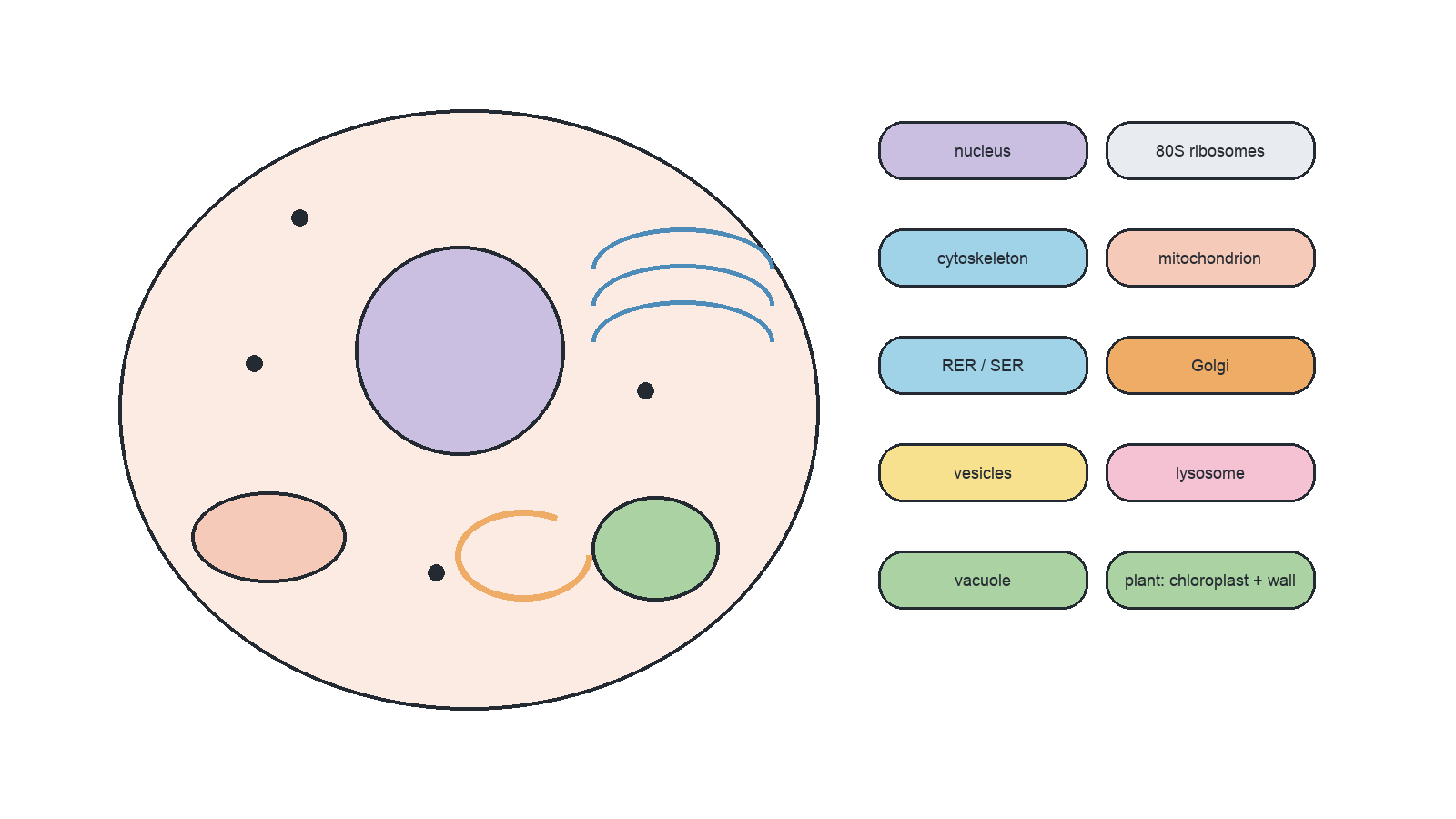
Cutaway diagram of a eukaryotic cell showing the nucleus, mitochondrion, rough endoplasmic reticulum, Golgi apparatus and lysosome as distinct compartments.

boundary → controlled composition → efficient reaction conditions; vesicles and transport proteins then connect the separate spaces into one coordinated cell

SL Summary: Explain the Advantage, Not Just the Organelle

  • organelle membrane → selected molecules and conditions → faster, regulated pathways
  • nucleus separated from cytoplasm → RNA processing before translation → controlled gene expression
  • distinct cytoplasmic spaces → incompatible reactions remain apart → simultaneous specialized work

For any compartment: name its boundary → state what differs across it → connect that difference to a function.

Advantages of compartmentalization

[ 4 ]

Discuss the use of membranes for compartmentalization in eukaryotic cells.

Concept essentials

  • Internal membranes divide eukaryotic cells into functional compartments.
  • Compartmentalization can concentrate enzymes and substrates in small volumes.
  • Different organelles can maintain different pH or chemical conditions.
  • Lysosomes keep hydrolytic enzymes separated from the cytoplasm.