B3.3.1 (HL)—Movement adaptations
Movement in organisms ranges from cellular locomotion by cilia or flagella to whole-body movement for feeding, escape, migration and reproduction.
- Syllabus
- First assessment 2025
- Objective
- B3.3.1
- Level
- HL
Movement in organisms ranges from cellular locomotion by cilia or flagella to whole-body movement for feeding, escape, migration and reproduction.

Coverage 2013–2013 · Updated 15 Jul 2026

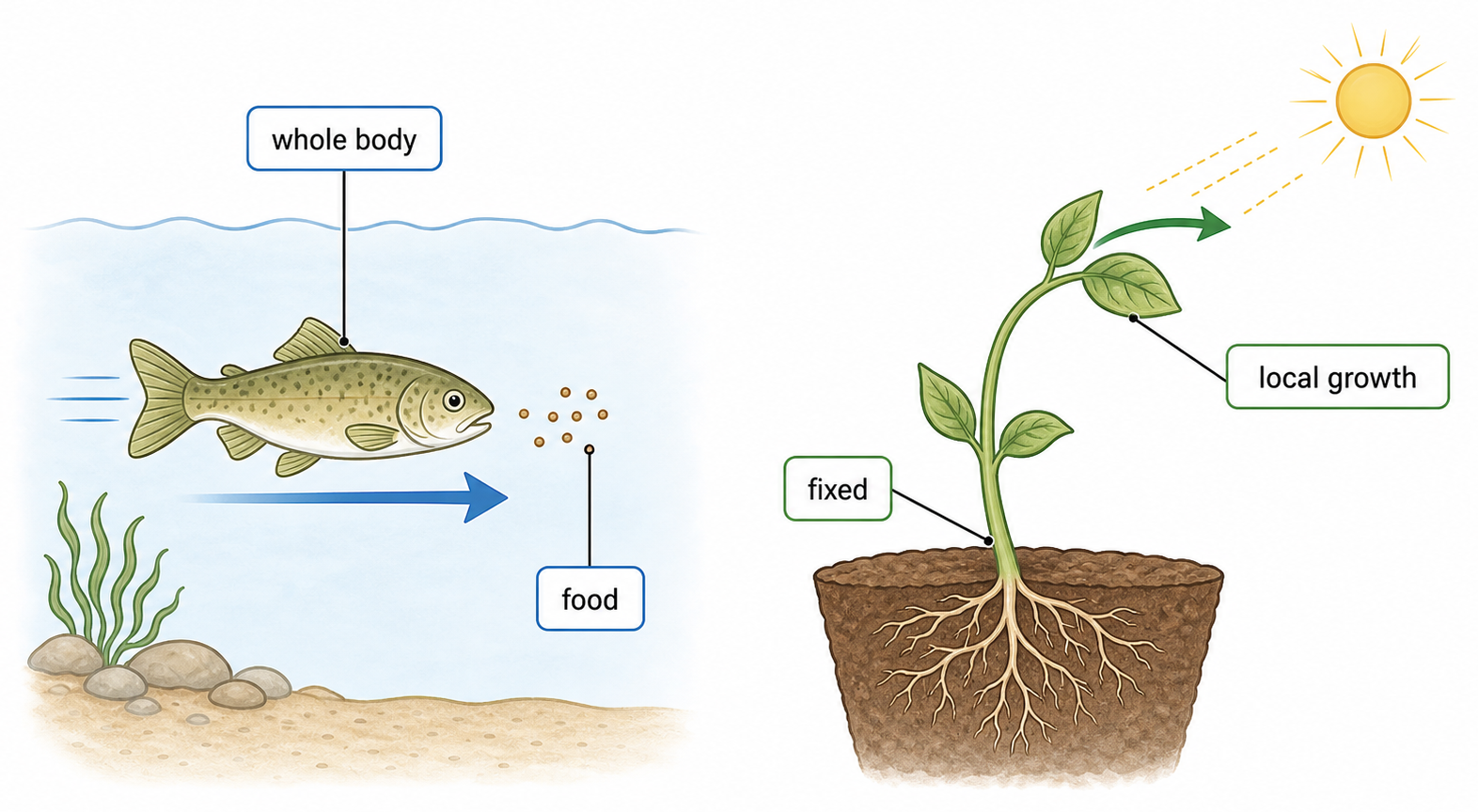
Movement is universal in living organisms, but locomotion is movement of the whole organism from one place to another. Motile organisms locomote; sessile organisms remain attached yet can still move parts or grow directionally.
A motile animal can change location using metabolic energy and structures such as legs, wings or fins. A sessile coral can move tentacles, and a rooted plant can grow or bend toward a stimulus without locomoting.
Locomotion can improve survival and reproduction: a blackbird forages for food, a hare escapes a predator, an orangutan searches for a mate, and a whale migrates between feeding and breeding areas.
A plant shoot curving toward light demonstrates movement through differential growth, whereas a bird flying to a feeding site demonstrates locomotion because its whole body changes location.
Sessile does not mean incapable of movement, and locomotion is not cost-free: it requires energy and often increases nutritional demand and exposure to risk.
This objective is assessed through structured response.
Build the answer around this relationship: Euglena use a flagellum for locomotion.
Confusing movement of cells or body parts with whole-organism locomotion.
Representative question
Microscopic eukaryotes include Euglena and Paramecium. Outline the range of cellular structures used for locomotion in these organisms.
Euglena have a flagellum;
Paramecium have cilia; ..... [2]
A strong answer links movement benefit, muscle contraction mechanism, force transfer, joint range, and locomotion adaptations. For contraction, use calcium-troponin-tropomyosin and ATP-driven myosin cross-bridge cycling. For movement, use antagonistic muscles, tendons, ligaments, skeletons as levers, and joint type. For locomotion, link body form to survival or swimming advantage. Locomotion can improve survival and reproductive success.